
The worst way to get a strong LOR from your USCE attending is to ask, “Can you write me a letter?” and hope for the best. That’s how you get a vague, lukewarm, program-director-ignoring letter.
Here’s the answer you’re really looking for: you don’t just ask for a letter. You ask for a strong letter, at the right time, from the right person, and you make it stupidly easy for them to say yes and write well about you.
Let’s break that down.
Step 1: Decide Who You Should Ask (Not Every Attending is Equal)
The biggest mistake IMGs make is thinking any U.S. letter is good enough. It’s not. A generic “hardworking and pleasant” letter does nothing for you.
You want an attending who can honestly say:
- They directly supervised you (not just “saw you around”).
- They’ve seen you with multiple patients over time (not 2 days on service).
- They can comment on more than, “shows up on time.”
Here’s who’s usually worth asking:
- Your primary supervising attending on a 4-week rotation where you:
- Pre-rounded consistently
- Presented patients
- Wrote notes (if allowed)
- Followed up on tasks
- An attending who:
- Knows your name without looking at your badge
- Has given you feedback (good or constructive)
- Has said things like “Nice job today,” or “You’re doing well”
Red flags (don’t force letters from these):
- They barely talked to you and always stayed in the workroom.
- You only worked with them 2–3 days.
- They routinely ignored students and just spoke to residents.
- They seemed irritated you were an IMG or on a visa.
If you’re unsure, test the waters: ask for feedback first:
“Dr. Smith, I’m applying to internal medicine residency this year. Do you have any feedback for me on how I’ve been doing on this rotation and anything I can improve?”
If they say things like:
- “You’re doing great, keep this up.”
- “Residents have said good things about you.”
- “You’re one of the stronger students on the team.”
That’s a green light for a letter request.
Step 2: Timing — When To Ask So It Doesn’t Feel Awkward
Don’t wait 3 months after the rotation. Their memory of you will be gone.
Best timing windows:
- Ideal: Last 3–5 days of the rotation, after you’ve had enough time to prove yourself
- Acceptable: Within 2–4 weeks after the rotation (by email, if needed)
- Bad: Months later, especially if they had dozens of other students in between
On in-person rotations, do this:
- Pick a day when things are relatively calmer. Not during a code. Not mid-rounds.
- Catch them after rounds or at the end of the day when they’re not running out the door.
- Ask in person first. Follow up with email.
If you only had virtual/contact-limited interaction and in-person isn’t realistic, a well-written email is fine. But in-person usually leads to a stronger, more invested yes.
Step 3: The Exact Words: How to Ask for a Strong LOR
You need one specific sentence in your ask:
“Would you feel comfortable writing me a strong letter of recommendation for residency?”
The word “strong” is not optional. It gives them a polite out if they can’t write you a good one.
Here’s a full in-person script you can literally use:
“Dr. Patel, I’ve really appreciated working with you this month and I’m applying to internal medicine residency this upcoming cycle. I was wondering if you’d feel comfortable writing me a strong letter of recommendation based on my performance on this rotation?”
Then you shut up and wait.
If they say:
- “Yes, absolutely. I’d be happy to.”
- “Sure, you’ve done a great job, I can do that.”
- “Of course, send me your materials.”
Great. That’s a real yes.
If they say:
- “I can write you a letter,” but don’t say strong
- “I don’t know you that well, but I guess I can.”
- “Maybe, let’s see if I have time.”
That’s a polite no. Thank them and don’t use that letter. A lukewarm letter is worse than no letter.
Step 4: What To Give Them So They Can Actually Write Something Good
Most attendings are busy. They’re not going to go hunting for your ERAS ID or trying to remember whether you were the IMG from India or Egypt.
Your job is to hand them a “letter-writing kit.” Here’s what that usually includes:
- Updated CV
- Your personal statement (even a good draft is fine)
- A short summary of your work on their service, e.g.:
- Dates of rotation
- Specialty (IM, FM, psych, etc.)
- A few bullet points of what you did / what they saw
- Your ERAS AAMC ID (and NRMP if they ask later)
- A deadline (early, not last-minute)
- How to submit:
- “You’ll receive an email from ERAS with a link” (once you enter them in ERAS)
You can say:
“I’ll email you my CV, draft personal statement, and a brief summary of my work on this rotation, plus my ERAS ID. Is there anything else that would help?”
And then actually send it that day. Not three weeks later.
Step 5: The Email Template to Use After They Say Yes
Here’s the kind of email that makes attendings’ lives easier and gets you better letters.
Subject: Letter of Recommendation Request – [Your Name], [Rotation Name/Month]
Body:
Dear Dr. Patel,
Thank you again for agreeing to write a strong letter of recommendation for my internal medicine residency application. I really appreciated the opportunity to work with you on the inpatient service in May 2026.
As promised, I’ve attached:
- My current CV
- My personal statement draft
- A brief summary of my work on your rotation
Rotation: Internal Medicine Inpatient, XYZ Hospital
Dates: May 1–28, 2026
Role: Visiting international medical graduate from [Your School/Country]ERAS AAMC ID: [Your ID]
ERAS will send you a direct link to upload the letter. My goal is to have all letters uploaded by [date ~3–4 weeks away], but if you need a different timeframe, I’m happy to adjust.
Thank you again for your support and for everything I learned on your service.
Best regards,
[Your Full Name]
[Your Email]
[Your Phone]
That’s it. Clean, respectful, and gives them what they need.
Step 6: How To Make It Easy for Them to Say Powerful Things About You
You want them to remember specific things you did. Don’t assume they will.
In the “brief summary of my work” you attach, include 5–8 bullet points like:
- Pre-rounded daily on 4–6 patients and presented clearly and concisely on rounds
- Consistently followed up on labs and imaging and updated plans proactively
- Took ownership of complex patients (e.g., new CHF exacerbation, DKA) and read about management
- Communicated with patients and families, including difficult conversations with empathy
- Worked closely with residents and nursing staff; frequently offered to help with extra tasks
- Showed improvement in [X] based on your feedback about [Y]
Don’t lie. Don’t exaggerate. But remind them what you actually did.
This does two things:
- Helps them write specific examples instead of vague fluff.
- Triggers their real memory of you, which makes the letter more authentic.
Step 7: How Many USCE Letters You Actually Need (and Which Ones Matter)
Not all LORs are equal in the eyes of program directors, especially for IMGs.
Here’s a rough priority order:
| Rank | Letter Type |
|---|---|
| 1 | US attending in your chosen field |
| 2 | US program director/department head |
| 3 | US subspecialist in that field |
| 4 | US attending in another core field |
| 5 | Non-US clinical letter |
| 6 | Research-only letter (no clinical) |
If you’re applying to internal medicine, for example:
- Best: IM attending or IM program leadership from USCE
- Decent: FM/geri/ED letters that describe inpatient-type work
- Lower value: Research letter that never saw you with patients
Aim for:
- 2–3 strong US clinical letters
- 1 additional letter (clinical or research) if it’s genuinely strong
Step 8: Following Up Without Being Annoying
Yes, you’re allowed to follow up. You just need to be polite and not frantic.
Typical pattern:
- Ask in person → send email same day with documents.
- Once ERAS shows letter “not received” and 2–3 weeks have passed, send a gentle reminder.
Sample reminder:
Dear Dr. Patel,
I hope you’re doing well. This is just a quick, friendly reminder about the letter of recommendation you kindly agreed to write for my internal medicine residency application.
ERAS is now open for applications, and I’m planning to certify and submit my application on [date]. If you’re still able to submit the letter, I’d be very grateful.
Thank you again for your time and support.
Best regards,
[Your Name]
If they still don’t submit after 2 reminders, assume it’s not coming and look for another letter writer. Don’t chase endlessly.
Step 9: What If They Say No (or Hesitate)?
If an attending says:
- “I don’t know you well enough.”
- “I can write a letter, but it will be more factual than strong.”
- “I’m not comfortable writing it.”
You say:
“Thank you for your honesty. I really appreciate it.”
And move on. Don’t push them. A negative or bland letter will absolutely hurt you, especially as an IMG.
Your lesson: during your next rotation, be intentional:
- Show up early
- Own patients
- Ask for feedback
- Be present on rounds
- Be visibly useful to residents
Strong letters are earned two weeks before you ask, not two minutes before.
Step 10: How To Behave on Rotation to Set Up a “Strong” LOR
If you’re reading this before you start USCE, good. This is where the letter really comes from.
Attendings write strong letters for students who:
- Make their lives easier
- Are safe
- Care about patients
- Have a visible work ethic
On rotation, focus on:
Reliability
You say you’ll follow up on labs? You actually do. Every time.Initiative
You read about your patients’ conditions the night before. You show up with a plan.Communication
You present clearly. You don’t mumble, and you don’t disappear.Adaptability as an IMG
You learn the EMR. You ask smart questions. You don’t hide when something’s unfamiliar.
I’ve seen IMGs with average Step scores get interviews at solid university programs purely because their letters painted them as “one of the best rotators we’ve had.”
That’s your goal.
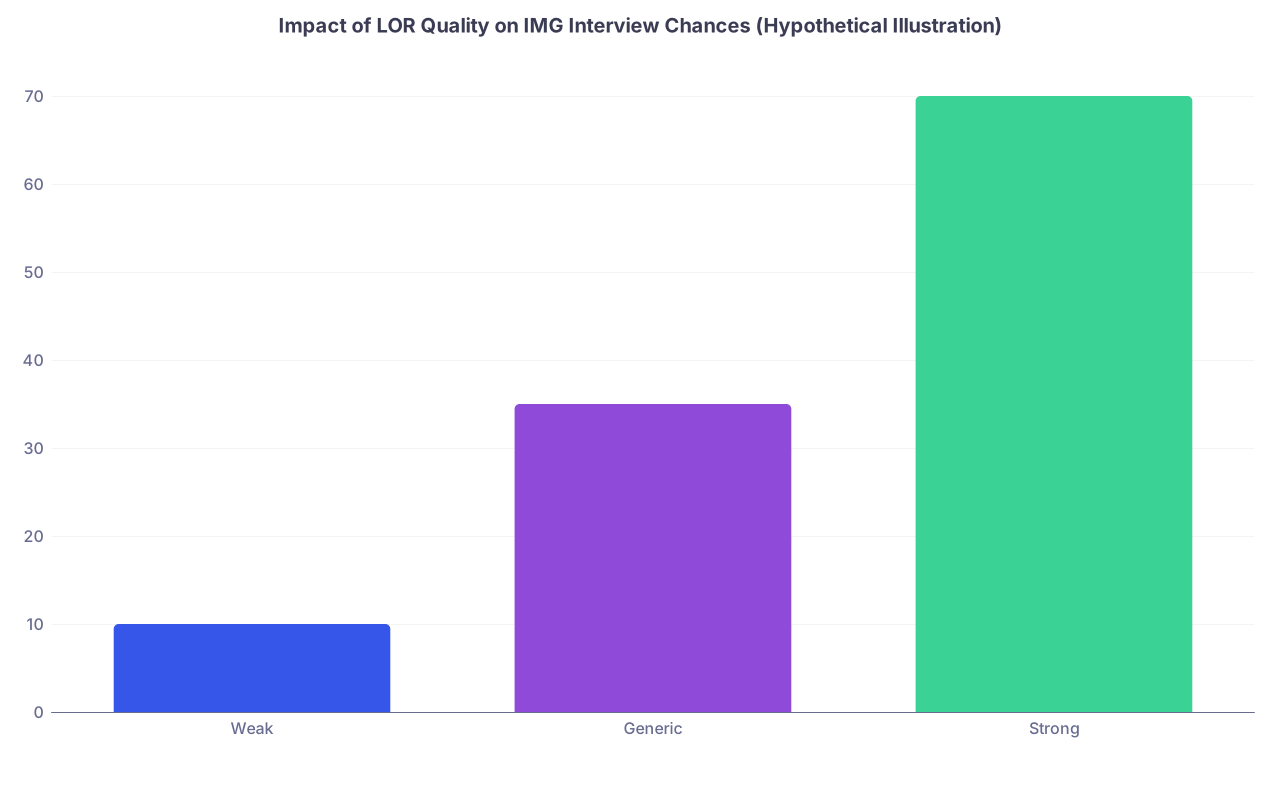
| Category | Value |
|---|---|
| Weak | 10 |
| Generic | 35 |
| Strong | 70 |

| Step | Description |
|---|---|
| Step 1 | Start USCE Rotation |
| Step 2 | Work Hard & Seek Feedback |
| Step 3 | Identify Supportive Attending |
| Step 4 | Ask In Person for Strong LOR |
| Step 5 | Send Email + Materials |
| Step 6 | Identify Another Attending |
| Step 7 | Send Gentle Reminder if Needed |
| Step 8 | ERAS Letter Submitted |
| Step 9 | Attending Response |


FAQ: Strong LORs from USCE Attendings for IMGs
1. Should I ever write my own LOR draft if an attending asks me to?
This happens more than people admit. If an attending explicitly says, “Draft something and I’ll edit it,” you can write a factual, conservative draft. Focus on concrete behaviors (reliability, patient care, communication), not over-the-top praise. They’re responsible for the final version. Don’t refuse bluntly; you can say, “I’m happy to send a summary of my work and accomplishments on your service,” and write that in a letter-like format.
2. How long should my attending have worked with me before I ask for a letter?
At least 2 solid weeks of meaningful contact. Four weeks is ideal. If it’s only a week-long elective and you barely saw them, that’s not enough. Program directors can smell “short contact” letters – they’re usually vague and fluffy.
3. Is an LOR from a community hospital attending worse than one from a big academic center?
Not automatically. A detailed, specific letter from a community IM attending who really knows you is often more valuable than a generic letter from “Famous Professor at Brand-Name University” who barely remembers you. That said, if you can get a strong letter from an academic attending who knows you well, that’s gold.
4. Can I use the same LOR for multiple specialties?
You can, but you probably shouldn’t. If the letter repeatedly says “She will make an excellent internal medicine resident,” and you apply to neurology, it looks lazy. If you’re truly applying to more than one specialty, tell the attending up front and see if they’re comfortable writing a more general letter or two different versions.
5. Do program directors care that I’m an IMG if my LORs are strong?
Yes, they still see that you’re an IMG, but strong US letters absolutely change how they look at your file. A powerful LOR saying “This IMG functioned at the level of or above our U.S. grads” can push you from the “maybe” pile into the “interview” pile, especially in IM, FM, psych, peds, and some specialties open to IMGs.
6. How late is “too late” to request a letter before ERAS opens?
If you’re asking in August for a September application, you’re late but not doomed. You should still ask. Just be upfront: “I know this is close to application season, but if you’re able to submit a letter by [specific date], I’d be very grateful.” Going into September with no US letters as an IMG is worse than asking a bit late.
Key takeaways:
Ask for a strong letter in person near the end of your rotation, from someone who’s actually seen you work. Hand them a clean package (CV, PS, summary, ERAS ID, deadline) so writing the letter is easy and specific. And remember: the real work for a great LOR starts weeks before you ever bring it up—on the ward, with your patients, every single day.