Most IMGs are aiming for the wrong number of US clinical experience weeks.
The question isn’t “what’s the minimum to apply?” It’s “what’s enough that a program director stops worrying you won’t function on day one?” Those are very different targets.
Let me give you the straight answer first, then we’ll break it down by specialty, profile, and timing.
The Short Answer: How Many Weeks You Should Aim For
If you’re an IMG targeting the US Match, here’s the practical rule of thumb:
Absolute bare minimum to be taken seriously:
4 weeks (1 month) of USCECompetitive baseline for most IMGs:
8–12 weeks (2–3 months) of recent, in-person US clinical experienceIdeal target if you can realistically afford it and schedule it:
12–16 weeks (3–4 months), with at least half in your target specialty
This is what I see over and over when talking to successful IMGs and reading program director comments: once you’re above about 3 months, the conversation shifts from “Do they even know how US hospitals work?” to “Is their overall application strong?”
Not all weeks are equal though. Four months of mediocre observerships is weaker than 8 weeks of strong, hands-on electives with excellent letters.
What Programs Actually Want From USCE (Not Just a Number)
Program directors aren’t sitting with a spreadsheet counting your weeks like a loyalty card. They care about:
- Recency – within the last 1–2 years of applying
- Relevance – in or close to your intended specialty
- Depth of involvement – hands-on > observership
- Letters of recommendation – from US attending physicians who actually know your work
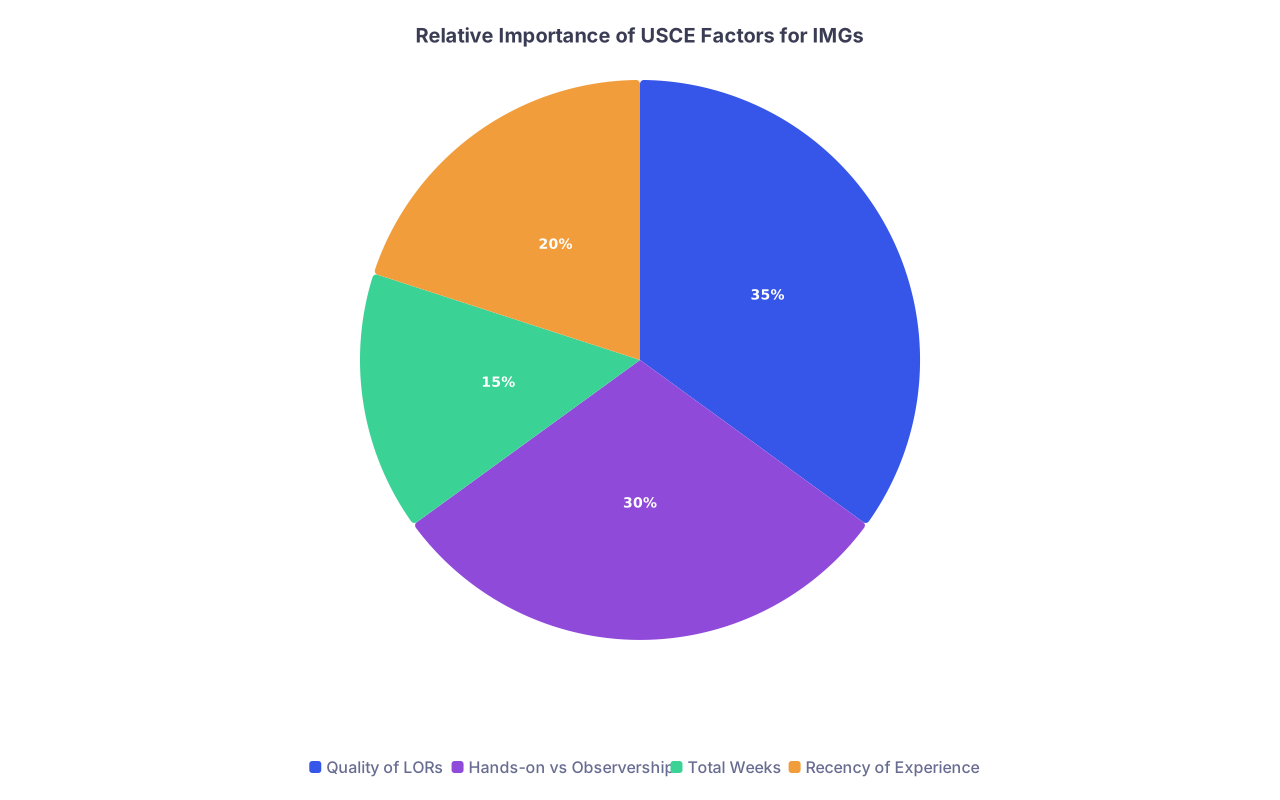
| Category | Value |
|---|---|
| Quality of LORs | 35 |
| Hands-on vs Observership | 30 |
| Total Weeks | 15 |
| Recency of Experience | 20 |
So when you think “How many weeks?”, you should immediately follow it with “Of what type?” and “With what outcome?”
If you told me:
“I have 12 weeks: 8 weeks Internal Medicine sub-internships + 4 weeks Cardiology elective, all in the past year, 3 strong LORs from US faculty.”
I’d tell you you’re in the sweet spot.
If you told me:
“I have 20 weeks of random observerships over 5 years, no hands-on, 1 generic LOR.”
Technically more weeks. Functionally weaker.
Recommended Weeks by Profile and Specialty
Here’s where people get this wrong: more competitive you are on paper, fewer USCE weeks you need to “prove” yourself. If you’re weaker on scores or YOG, USCE is one of the main ways to compensate.
| Applicant Type | Recommended USCE | Notes |
|---|---|---|
| Strong IMG (high scores, recent grad) | 8–12 weeks | At least 4–8 weeks in target specialty |
| Average IMG | 12–16 weeks | Mix of core + target specialty |
| Older YOG / Lower scores | 16–20 weeks | Emphasize recency + strong LORs |
Internal Medicine / Family Medicine / Pediatrics
For primary care–type specialties:
- Target: 8–16 weeks total
- Minimum to stay competitive: 8 weeks
- Try for:
- 4–8 weeks in Internal Medicine or FM inpatient/outpatient
- Remaining time in related fields (cards, endo, geriatrics, hospitalist services)
If you’re a strong candidate (Step 1 pass, 240+ Step 2, recent grad), 8–12 weeks is usually enough. If you’re fighting a 230 Step 2 or older YOG, aim toward 12–16 weeks with excellent performance.
Psychiatry
Psych likes to see:
- 8–12 weeks total, with:
- 4–8 weeks psychiatry (inpatient or outpatient)
- Additional time in IM/FM or Neurology isn’t wasted
Psych programs are wary of applicants who’ve never done real psych in a US setting. More than 3 months won’t magically fix a weak application, but zero or 4 weeks total will hurt you.
Surgery and Surgical Subspecialties
For General Surgery, Ortho, Neuro, etc.:
- Target: 12–16 weeks if you’re serious about matching in surgery as an IMG
- 8+ weeks in surgical electives/sub-internships
- The rest in ICU, trauma, or relevant rotations
Surgical programs care heavily about whether you’ve:
- Functioned on a team
- Managed post-op patients
- Shown work ethic in a US OR
Less than 8 weeks in actual surgery? You’re basically asking them to guess.
Highly Competitive Specialties (Derm, Plastics, Radiology, etc.)
If you’re going after these as an IMG, you’re already playing on hard mode. USCE alone won’t carry you, but:
- 12–20 weeks is common among the very few successful IMGs
- Often combined with research years in the same department
You’re not just showing “I can function clinically”; you’re trying to become “part of the department” for a while.
How to Distribute Your Weeks Across Rotations
Do not stack 16 random weeks just to hit a number. Plan them with intent.
Think in three buckets:
- Core USCE – shows you can function in a US hospital
- Internal Medicine, Family Medicine, Pediatrics
- Target Specialty USCE – shows alignment with your chosen field
- Psych, Surgery, Cards, etc.
- Letter-Generating Rotations – where attendings actually see you work
A solid plan for a typical IMG targeting Internal Medicine might look like:
- 4 weeks – Inpatient Internal Medicine (Sub-I style if possible)
- 4 weeks – Outpatient Internal Medicine or Family Medicine
- 4 weeks – Cardiology or another IM subspecialty
- Optional extra 4 weeks – Hospitalist service / ICU / another IM team
That’s 12–16 weeks, spread across different attendings, with at least 3 real opportunities for letters.

| Step | Description |
|---|---|
| Step 1 | Decide Target Specialty |
| Step 2 | Check Your Current Strengths |
| Step 3 | Plan 8-12 Weeks USCE |
| Step 4 | Plan 12-16+ Weeks USCE |
| Step 5 | Split: Core + Target Specialty Rotations |
| Step 6 | Prioritize Hands-on & LOR Opportunities |
| Step 7 | Schedule Within 1-2 Years of Match |
| Step 8 | Strong Scores & Recent Grad? |
If your rotations are all over the place and don’t tell a coherent story, programs notice.
Observerships vs Hands-On: How This Changes the Week Count
Here’s the uncomfortable truth:
If your “12 weeks of USCE” are all observerships (no orders, no notes, no real patient responsibility), many programs mentally discount a chunk of that.
For week-count purposes:
4 weeks hands-on (elective, sub-I, externship)
≈ 4 weeks on paper, 4 weeks in PD’s mind4 weeks observership
≈ 4 weeks on paper, maybe 1–2 weeks worth of actual weight
No, there isn’t a formal conversion rate, but I’ve heard versions of:
“Four solid weeks as a sub-I tells me more than three months of shadowing.”
If you’re stuck with observerships only:
- Aim closer to the higher end (12–16+ weeks)
- Make sure your letters clearly describe your clinical reasoning, not just “they observed and were on time”
And if you can get even one or two hands-on experiences, grab them and build your letters there.
Timing: When During Your Path You Need Those Weeks
USCE is not lifetime achievement; it’s “Can they function like this now?”
Best timing:
- Final year of med school for electives / sub-Is, then
- 0–2 years before Match for additional rotations if needed
USCE older than 3 years before application starts looking stale, especially if you’ve had a gap or no ongoing clinical work.
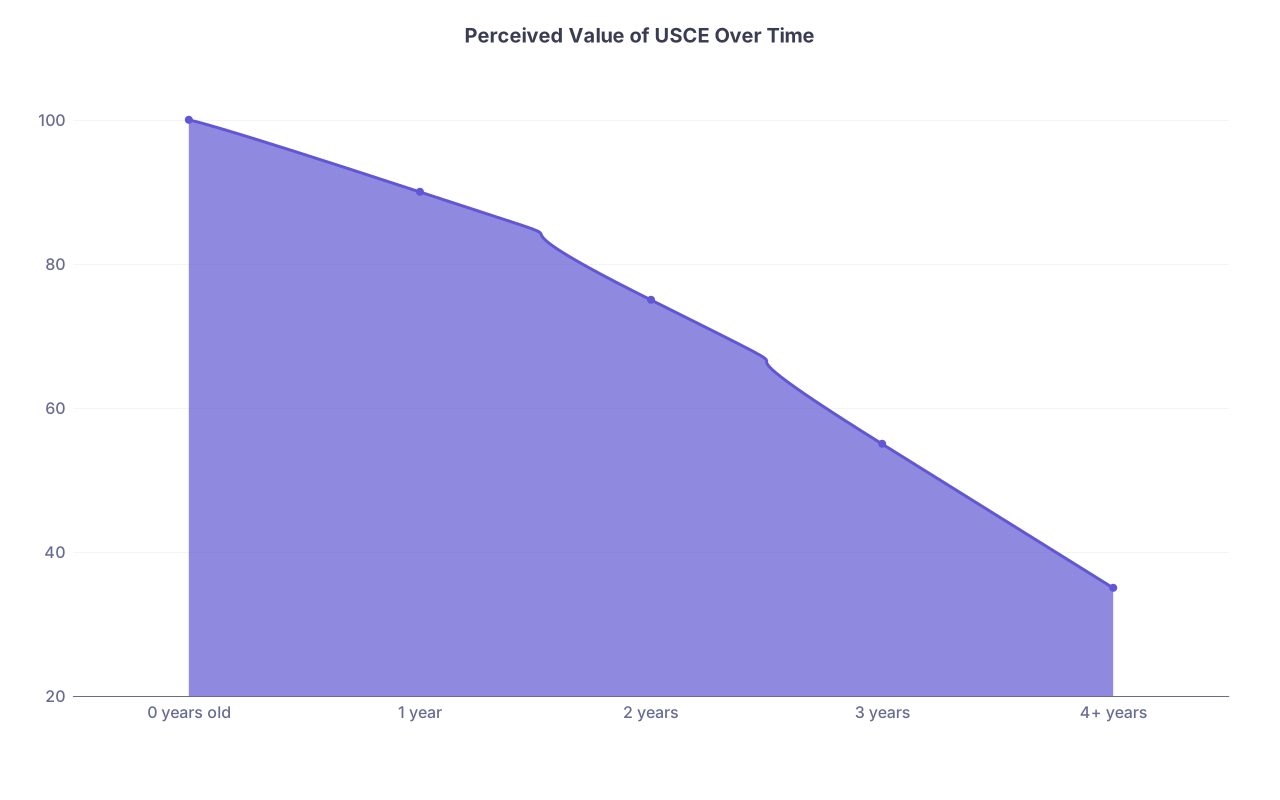
| Category | Value |
|---|---|
| 0 years old | 100 |
| 1 year | 90 |
| 2 years | 75 |
| 3 years | 55 |
| 4+ years | 35 |
Key takeaway:
If you can only afford 8–12 weeks, schedule them strategically close to the Match rather than spread randomly across 5 years.
How Many Weeks Is “Too Many”?
There is a point where extra weeks don’t improve your chances and may even raise questions like “Why so much USCE but no Match?”
You’re entering “hmm” territory if you have:
- 24+ weeks over multiple years
- Several cycles of applications with no Match
- USCE that looks like “permanent student” rather than “future resident”
There’s no official upper cap, but once you’re past 4–5 months, each extra month should be doing something very specific:
- Strengthening a weak area (e.g., fresh psych for a psych applicant)
- Generating a crucial letter from a known program
- Repairing a long non-clinical gap
If you’re thinking “I’ll just keep adding months until someone takes me,” you’re missing the bigger problem in your application.
Example Scenarios: What Good vs Weak Week Plans Look Like
Here’s how this plays out in real life.
Stronger Plan – Internal Medicine IMG
- Graduate 2023, Step 2: 244
- USCE:
- 4 weeks IM inpatient sub-I at community program → strong LOR
- 4 weeks outpatient FM → LOR
- 4 weeks Cardiology elective at academic center → LOR
Total: 12 weeks, within one year of application, 3 US LORs.
This applicant looks integrated and ready.
Weaker Plan – Same Applicant, Same Weeks
- 4 weeks Cardiology observership, no real duties
- 4 weeks Gastro observership at private office
- 4 weeks Nephrology observership in a small clinic
- All shadowing, no notes, no call, generic one-line letters
Same total weeks. Much weaker impact. If they ask me “Do I need more weeks?” my answer is: you don’t need more weeks, you need better weeks.
Cost, Logistics, and Reality
I know. Rotations are expensive. Travel, housing, agency fees, lost income. You’re not made of money.
So if you’re constrained, here’s the priority stack:
- Hit at least 8 weeks total, recent, in-person
- Make at least 4–8 of those weeks in your target specialty or close
- Focus on settings where attendings clearly see and assess you
- Come out with 2–3 genuinely detailed US letters
If you manage that on 8–10 weeks, you’re fine. You do not need to sell an organ to reach 20 weeks.

Common Mistakes IMGs Make With USCE Weeks
I see the same avoidable errors over and over:
- Chasing a random high number like “I heard 6 months is required” without asking where or for what specialty
- Doing all rotations in one tiny private clinic where nobody knows how to write a residency-style LOR
- Spreading 12 weeks across 5+ years, so none of it looks fresh
- Ignoring target specialty—e.g., applying to Psych with 12 weeks of Cardiology
- Thinking “another month” will fix a fundamentally weak application (low scores, no Step 2, long non-clinical gaps, poor personal statement)
Do not just ask, “How many weeks?” Ask, “Will these specific weeks convince a PD to take a chance on me?”

Practical Framework: Decide Your Target Number in 3 Steps
If you want a simple decision tool, here it is.
Assess your baseline
- Recent grad (≤ 3 years)?
- Step 2 ≥ ~240 or equivalent?
- No major gaps?
If mostly yes → you’re a “stronger” IMG.
If mostly no → you need more USCE to compensate.Pick a range
- Stronger IMG, primary care/psych → 8–12 weeks
- Average IMG or older YOG → 12–16 weeks
- Surgery/competitive specialty → 12–16+ weeks, heavily specialty-focused
Map it to rotations
- At least 50% in or near your target specialty
- All within 1–2 years of application
- Aim for 3 solid US LORs
| Step | Description |
|---|---|
| Step 1 | Decide Target Specialty |
| Step 2 | Check Your Current Strengths |
| Step 3 | Plan 8-12 Weeks USCE |
| Step 4 | Plan 12-16+ Weeks USCE |
| Step 5 | Split: Core + Target Specialty Rotations |
| Step 6 | Prioritize Hands-on & LOR Opportunities |
| Step 7 | Schedule Within 1-2 Years of Match |
| Step 8 | Strong Scores & Recent Grad? |
If you do this and you end up at, say, 10 weeks instead of 12, you’re still fine. The structure and quality matter more than mathematically landing on a magic number.

FAQ: US Clinical Experience Weeks for IMGs
Is there a universal minimum number of USCE weeks required for all programs?
No. There isn’t a universal rule like “you must have 12 weeks.” Different programs say different things: some list “US clinical experience required,” some say “preferred,” some specify “3 months” or “1 year,” and some don’t mention it at all. In reality, for most IMGs, you want at least 8 weeks to be taken seriously, and 12+ to be solid, but individual program websites and FREIDA should guide you for specific cutoffs.Do virtual or online observerships count toward my USCE weeks?
For most residency programs, no. Virtual experiences might help you understand the system and maybe get a letter, but when a PD hears “US clinical experience,” they’re imagining in-person work in a US hospital or clinic. List virtual work under “Other Experience” if you must, but do not fool yourself into thinking 8 weeks of Zoom shadowing equals 8 weeks of genuine USCE.If I already have 12–16 weeks, should I keep adding more, or focus elsewhere?
If you already have 12–16 weeks of recent, relevant, mostly hands-on USCE with 2–3 strong US LORs, piling on more weeks usually has diminishing returns. At that point, you’re better off improving test scores (Step 2), research, your personal statement, interview skills, and targeting the right programs. If your existing USCE is all weak observerships, fix the quality, not the total count.How many weeks do I need for a second or third application cycle if I didn’t match?
If you didn’t match and already had, say, 12 strong weeks, doing another 8–12 weeks might help, but only if it addresses a clear gap: new specialty focus, fresher LORs, or closing a clinical gap. If your previous USCE was low quality or very old, then 8–12 new high-quality weeks can be valuable. But if your main problem was extremely low scores or weak interview performance, more USCE alone won’t fix that.Can I spread my 12 weeks across different specialties or should I focus on one?
You can split, but not randomly. If you’re applying to Internal Medicine, having 4 weeks IM, 4 weeks Cardiology, 4 weeks Endocrine makes sense. If you’re applying Psych with 8 weeks Cardiology and 4 weeks Nephrology, that’s a mismatch. As a rule, make sure at least half of your total USCE is in or very closely related to your target specialty, and the rest still looks clinically coherent.Do electives done as a final-year medical student count the same as post-graduate USCE?
For most programs, yes—if they were in-person, clinical, and gave you actual responsibilities appropriate for a student. Fourth-year US electives and sub-internships are often the strongest USCE you can get, especially if they produced detailed letters. They may actually look better than post-grad observerships where you only shadowed. The key is recency and quality, not just whether you were technically still a student or a graduate.
Bottom line:
Aim for 8–12 weeks of recent, relevant, mostly hands-on US clinical experience; push toward 12–16 weeks if you’re an average or older IMG or going for tougher fields.
Make at least half of it in your target specialty and focus on rotations that produce real US letters and clear responsibility, not just a big week count.