
What do you think the program director sees first when they open your application: your hard work, or your USCE red flags?
Let me be blunt. For many IMGs, US clinical experience is not a strength. It is a liability. Not because you did not work hard, but because of how it looks on paper to a tired program director reviewing their 300th file at 11:30 p.m.
You are not competing only on scores anymore. You are competing on “Are you safe to put in front of American patients on July 1?” That answer, for IMGs, lives or dies in the USCE section.
These are the seven USCE patterns that quietly get you filtered into “too risky” even when your scores are decent. And almost all of them are preventable.
1. “Shadow-Only” Experience Disguised as Real USCE
Program directors have seen this trick a thousand times: the application that tries to inflate shadowing or observerships into something they are not.
You know the kind of description I mean:
“Actively participated in patient care, involved in management decisions, performed focused physical exams…”
Then in the LOR:
“Student had the opportunity to observe patient care in our busy clinic.”
There is a word for that mismatch: red flag.
Why this worries program directors
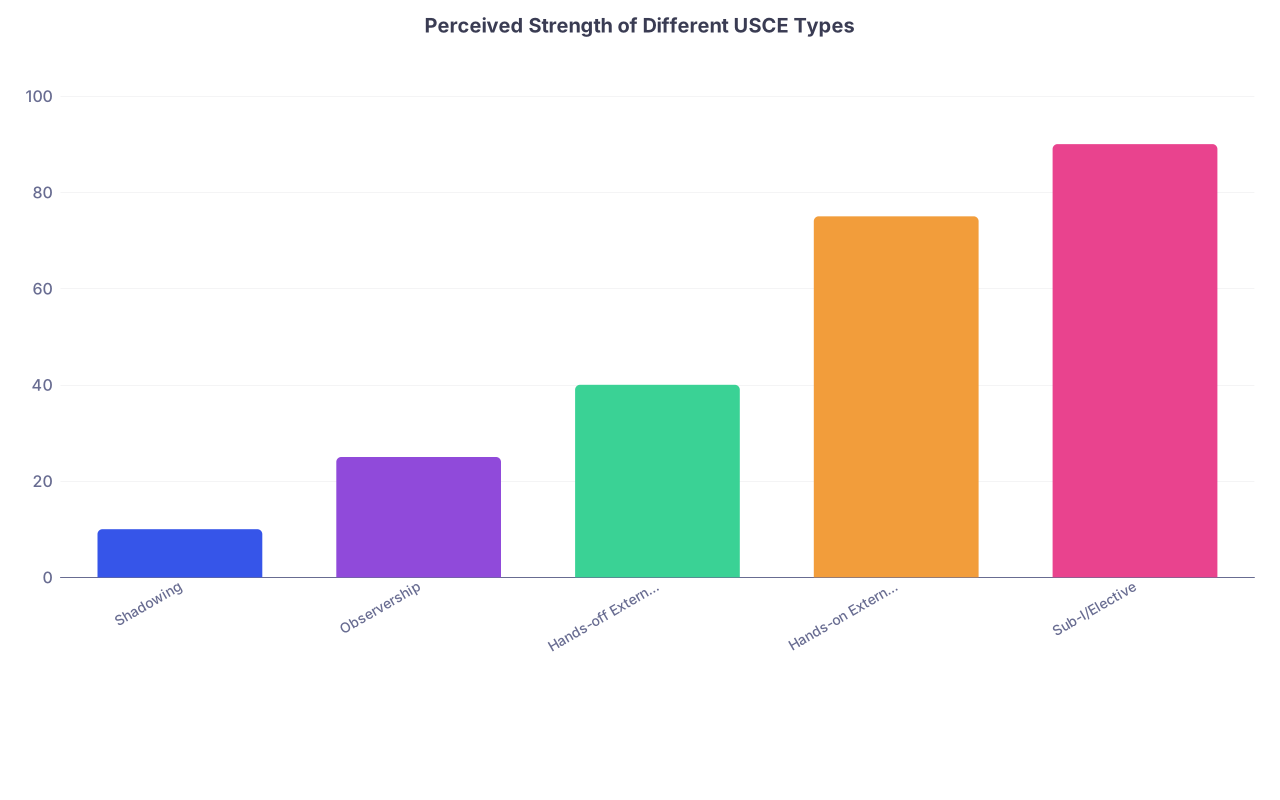
Shadowing and pure observerships are not USCE in the way programs care about. They do not show:
- Responsibility
- Documentation skills in English
- EMR use
- Ability to function in a US-style team
If your entire “US experience” boils down to following attendings around and occasionally presenting on rounds, you have not proved you can work here. You have proved you can stand here.
| Category | Value |
|---|---|
| Shadowing | 10 |
| Observership | 25 |
| Hands-off Externship | 40 |
| Hands-on Externship | 75 |
| Sub-I/Elective | 90 |
Program directors do not like feeling misled. When your description screams “I was part of the team” but the letter screams “This was observership-level,” they start wondering what else in your application is overstated.
How to avoid this mistake
Call things what they actually are.
- Observership = Observership.
- Shadowing = Shadowing.
- Externship = Externship.
If you were not allowed to touch patients, do not pretend otherwise.
Use accurate verbs:
- Shadowing/observership: “observed,” “attended,” “presented cases,” “participated in discussions.”
- Hands-on: “performed,” “documented,” “placed orders (supervised),” “wrote notes,” “called consults.”
Prefer fewer, stronger experiences over a long list of weak shadow-only entries.
If your only USCE is shadowing, do not waste energy trying to re-label it. Spend that energy finding at least one legitimate hands-on or at least structured, intensive observership with clear teaching and evaluation.
2. Super Short, Fragmented USCE: One Week Here, Two Weeks There
Another pattern that screams “checkbox, not commitment” is the IMG portfolio of micro-rotations:
- 1 week cardiology “observership”
- 1 week neurology “externship”
- 2 weeks family medicine “experience”
- 1 week research “externship”
Total “USCE”: 5 weeks spread across 4 sites and 3 states.
That looks scattered. And frankly, unserious.
Why this worries program directors
It tells them:
- You may not have seen enough continuity of care to understand US outpatient follow-up or inpatient handoffs.
- You did not spend long enough anywhere to get meaningful feedback, so your letters will probably be generic.
- You might struggle with stamina and consistency in a real residency where you are on the same service for 4+ weeks at a time.
I remember a PD at a community internal medicine program say during ranking:
“Anyone with all 1–2 week USCE blocks goes straight to the maybe pile. Nobody learns our system in 7 days.”
The sane minimum
If you want to stay out of the red-flag zone, aim for:
- At least 4 continuous weeks at a single core site in your target specialty.
- Better: 8–12 weeks total, with at least one 4-week block in the same environment (community hospital, academic center, etc.) that resembles the programs you are applying to.

Every time you are tempted by a 5-day “USCE experience” advertised online, ask yourself:
Will this actually convince a program I can function here? Or will it make me look like I am collecting certificates?
3. Unclear or Dubious Clinical Settings
There is a specific type of line that raises blood pressure in program directors:
“Outpatient clinical observership at a private clinic in [City], supervised by Dr. X (non-ACGME).”
Or worse: no hospital name. Just a physician’s name and a vague “clinic.”
Here is the translation inside the PD’s head:
“Paid experience at a visa-mill type clinic that may or may not follow standard practices.”
Why this reads as a red flag
Programs care about:
- Standard of care aligned with US norms.
- Real patient volume and diversity.
- Supervision by physicians who understand ACGME expectations.
- Legitimate documentation and evaluation.
Ambiguous sites suggest:
- Potentially unethical or low-quality practice environments.
- Experiences designed more to extract money from IMGs than to teach them.
- Letters inflated or transactional.
| USCE Setting Description | Initial PD Reaction |
|---|---|
| ACGME-affiliated teaching hospital | Strongly positive |
| Large community hospital with residency programs | Positive |
| FQHC/academic-affiliated clinic | Generally positive |
| Solo private clinic, no training programs | Neutral to negative |
| Unnamed “private clinic” with vague details | Clear red flag |
How to avoid this mess
Always name the institution clearly.
Prefer sites with:
- Residency programs
- University affiliation
- Clear educational structure
If you must use a private clinic:
- Make sure the supervisor has clear academic connections (faculty appointment, teaching role).
- Describe specific educational activities (case conferences, didactics, evaluations).
If the website screams more about “visa support” and “get US letters fast” than about teaching or patient care, walk away. Those letters smell fake from a mile away.
4. USCE That Does Not Match Your Chosen Specialty
Here is the classic IMG trap:
You apply to internal medicine. Your USCE: 3 months of psychiatry, 2 months of neurology, 1 month of pediatrics observership. Zero IM.
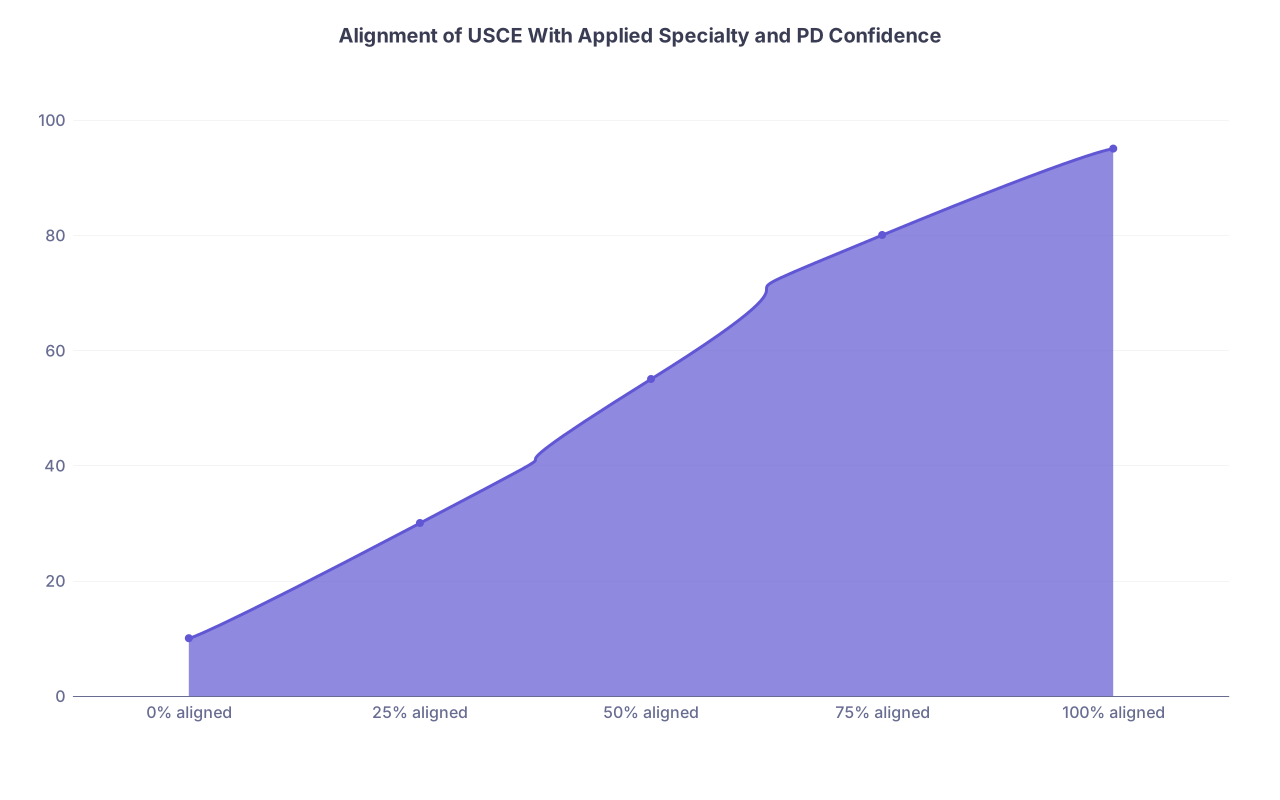
When PDs talk about “specialty commitment,” they are not joking. They look at:
- What you did
- Where you did it
- Who wrote about you
If all three point away from their field, you have a problem.
Why this freaks them out
Program directors want to avoid:
- Residents who will be miserable and switch specialties (bad for their numbers).
- People fishing across multiple specialties just to get “any spot.”
- Applicants who only realized they “love internal medicine” a few weeks before ERAS opened.
| Category | Value |
|---|---|
| 0% aligned | 10 |
| 25% aligned | 30 |
| 50% aligned | 55 |
| 75% aligned | 80 |
| 100% aligned | 95 |
So when you apply to family medicine with only outpatient cardiology and neurology observerships, they question:
- Do you understand what FM actually is?
- Did you just spray applications everywhere?
How to correct this
You do not need 100% perfect alignment, but you must show a clear core.
For example, for internal medicine:
- 1–2 rotations in inpatient IM or hospitalist medicine.
- 1–2 in subspecialties (cardiology, GI, ID) is fine.
- Psychiatry, neuro, etc. can be extras, not the whole story.
If your USCE is misaligned now:
- Add at least one solid 4-week experience in the specialty you are applying to, before the next cycle.
- Make sure at least one LOR is clearly from that specialty.
- Have your personal statement explicitly connect your prior experiences to your chosen field in a believable way.
“Fell in love with internal medicine a month before applications” is not believable.
5. Glaring Time Gaps Between Graduation and First USCE
Here is the scenario I see often:
- Graduated: 2017
- USCE: first observership in 2023
- Application cycle: 2024
And then the personal statement says:
“I have always been committed to pursuing residency in the United States.”
No, you have not. Not on paper.
Why this scares programs
Time gaps are not an automatic rejection, but they demand a clean story. When there is:
- A 3–6 year gap after graduation
- No active clinical work
- Then suddenly a few months of USCE right before applying
Program directors worry about:
- Skill decay – are your physical exam and clinical reasoning rusty?
- Motivation – did you only decide to come to the US when doors elsewhere closed?
- Risk of struggling with intern-year workload after years out of practice.

What they actually look for
If you have a gap, they look for:
- Continuous clinical involvement (even in your home country).
- Clearly explained reasons (family illness, mandatory service, research, etc.).
- Progressive steps toward the US, not a sudden pivot.
If your first USCE is 5–7 years after graduation, and you did almost nothing clinical in between, many programs will simply not risk ranking you.
How to fix or at least soften this
- If you are still early in your gap, get into any legitimate clinical work now: home country hospital, primary care clinic, even lower-resource settings where you can document real patient care.
- Document it clearly on ERAS as ongoing clinical experience.
- Use your personal statement to take ownership of the gap. Not excuses—context and growth.
- Get USCE and strong letters as soon as feasible; do not push it to the last second.
The mistake is not having a gap. The mistake is letting the gap be unexplained and clinically empty.
6. Weak, Generic, or Template-Looking USCE Letters
Most PDs will tell you privately: they do not believe overinflated USCE letters. The obviously paid ones are almost comical.
You know the type:
“To Whom It May Concern,
It is with great pleasure and no reservation that I recommend Dr. X for any residency program in the United States. They are among the top 1% of students I have ever worked with…
[Five paragraphs of adjectives. Zero specific cases.]”
No numbers. No concrete stories. No sense the writer actually knows you.
That is not just “not helpful.” That is suspicious.
The red-flag patterns
Program directors get wary when they see letters that:
- Could be copy-pasted for any IMG.
- Mention nothing about actual patient interactions or medical decision-making.
- Exaggerate rankings (“top 1%”) from people who clearly run IMG mills.
- Are all from non-ACGME private clinics that advertise USCE online.
| Letter Feature | PD Reaction |
|---|---|
| Specific patient cases mentioned | Trust increases |
| Concrete comparison to US grads | Helpful |
| Only vague praise, no examples | Low credibility |
| All letters from same paid externship | High suspicion |
| No mention of documentation or EMR | Question readiness |
How to avoid trash letters
Work where attendings actually see you work:
- Presenting on rounds
- Writing notes
- Calling consults (under supervision)
- Following patients over days
Ask directly for honest letters:
- “If you feel comfortable writing a strong letter based on my performance, I would be very grateful.”
- If they hesitate, do not push. A lukewarm letter is harmful.
Provide them:
- Your CV
- Personal statement draft
- Brief bullet list of cases or contributions they saw you make
If all your USCE options are at paid sites, at least choose ones where real evaluation happens and faculty have true academic roles, not just “Supervisor, Private Clinic X.”
7. USCE That Looks Transactional or “For Sale”
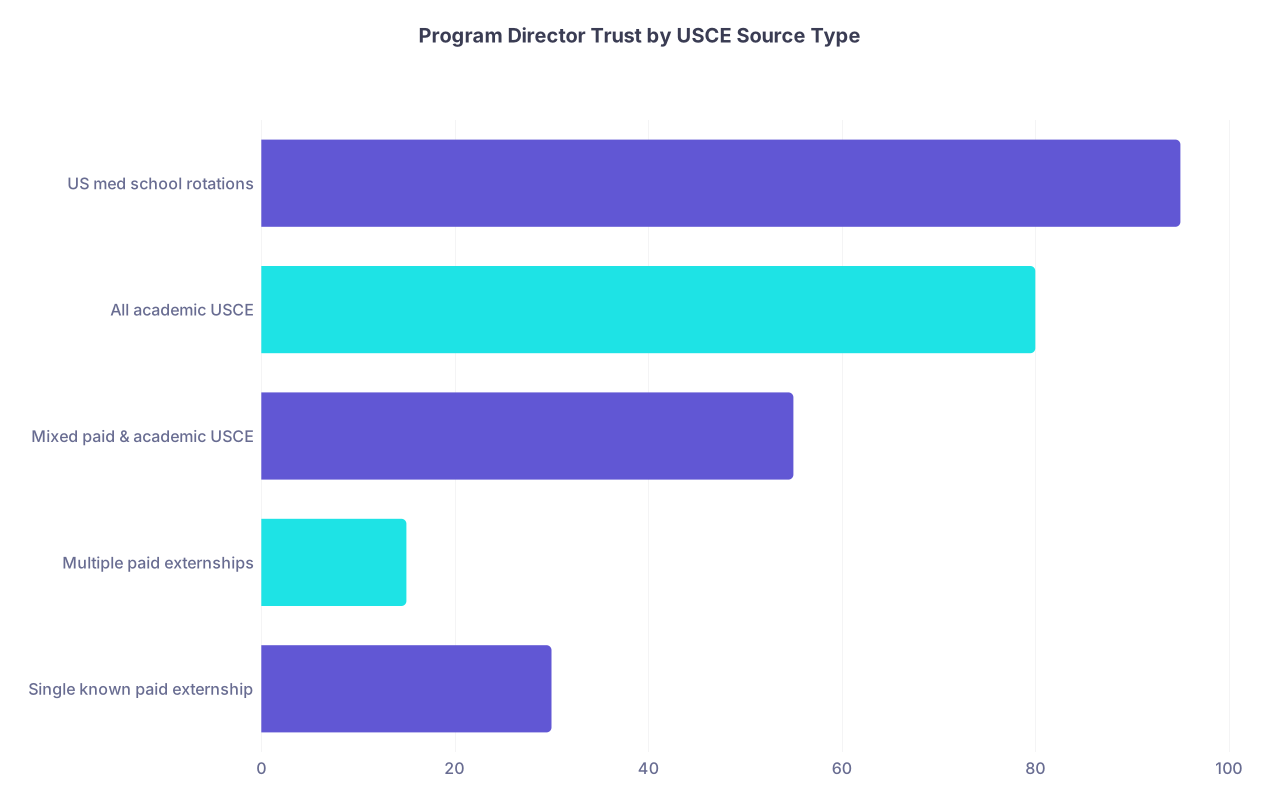
This is the dirtiest secret everyone knows but few say out loud: there is an entire industry built on selling IMGs “USCE” and “LORs.” Program directors know exactly which companies run it.
If your CV shows:
- Multiple “externships” all run by the same well-known for-profit company
- Very short durations, clustered during your “US visit”
- Letters only from that network, with nearly identical language
They assume you bought your exposure rather than earned long-term trust.
Why this triggers them
Residency is not a transaction. It is a 3–7 year legal, financial, and educational commitment. Programs fear:
- People who treat every step as something to purchase rather than earn.
- Trainees who may not respect rules, documentation, or ethical boundaries.
- A culture of shortcuts.
| Category | Value |
|---|---|
| Single known paid externship | 30 |
| Multiple paid externships | 15 |
| Mixed paid & academic USCE | 55 |
| All academic USCE | 80 |
| US med school rotations | 95 |
Do they auto-reject all paid rotations? No. But obvious patterns of “USCE shopping” get you closer to the bottom of the rank list.
How to lower suspicion
If you must use a paid rotation:
- Limit how many. One or two can be acceptable; five from the same company looks awful.
- Pair them with:
- Home country clinical work
- Any academic or hospital-based observerships you can get
- In interviews, talk about what you actually learned and did, not the “branding” of the program.
Most importantly: do not chase the fanciest logo or the most aggressive marketing. Choose places where real teaching and supervision are obvious, even if they are not flashy.
Pulling It Together: What a “Non-Scary” USCE Profile Looks Like
Let me show you what calms program directors down versus what raises their guard.
You want your application to look more like Column A, less like Column B:
| Aspect | Lower-Risk Pattern (Good) | Higher-Risk Pattern (Bad) |
|---|---|---|
| Duration | 8–12 weeks, with ≥1 continuous 4-week block | Multiple 1–2 week “experiences” |
| Setting | ACGME or academic-affiliated hospital/clinic | Unnamed or solo private clinics |
| Specialty alignment | Majority in applied specialty | Random mix unrelated to applied field |
| Timing | USCE within 1–3 years of graduation | First USCE 5–7 years post-graduation |
| Letter quality | Specific, case-based, honest | Generic, exaggerated, clearly templated |
| Payment signal | Mixed academic and (maybe) one paid experience | Many experiences from same well-known paid outfit |
If you are in the right-hand column right now, the answer is not to write more flowery ERAS descriptions. The answer is to change your clinical reality before the next application cycle.
Your Concrete Next Step
Do this today: open your CV or ERAS draft and look only at the USCE section. For each entry, ask yourself three questions:
- Would a US program director immediately know where this is and what level of care it represents?
- Does the duration and timing show real clinical engagement, or does it look like a last-minute checkbox?
- If you removed this line entirely, would your application become more believable or less?
If any entry fails those questions, mark it. Your next move is not to rephrase it—it is to replace it, with stronger, clearer, and less suspicious US clinical experience.
Because the real mistake is not having imperfect USCE. The real mistake is letting your USCE whisper to program directors: “This applicant is a risk.”