
You are not getting rejected because “USCE is too competitive.” You are getting rejected because your application is weak in very specific, fixable ways.
I have seen IMGs with average scores and year of graduation older than most programs claim to accept still land strong US clinical experience. And I have seen 260+ scorers get ignored by observership coordinators. The difference was never luck. It was how they built and presented their USCE application.
Let me walk you through exactly how to repair yours.
Step 1: Diagnose Why You Are Getting Rejected (Not Guessing. Diagnosing.)
Most IMGs respond to rejection by doing the worst possible thing: sending more of the same bad application to more programs.
Stop that.
Before you send a single additional email, you need a clear working diagnosis of why you are getting ignored or rejected. There are only a handful of common failure points.

1.1 Look at your rejection pattern
Go back through your emails and messages. Categorize them:
- No response at all
- Automated “we are full” or “we do not offer observerships”
- Personal rejection (after CV review or after some back-and-forth)
Now ask:
- Are you targeting mostly big-name academic centers?
- Are you writing generic emails?
- Are you applying too close to your desired start date?
- Are there red flags in your CV (big gaps, very old graduate, multiple attempts) that you are hiding instead of controlling?
1.2 Compare yourself to who actually gets accepted
You need a reference point. Programs rarely publish exact criteria, but you can approximate from your peers and public info.
| Profile Type | USMLE | YOG | Research | Outcome Trend |
|---|---|---|---|---|
| Strong IMG Academic | 245+ | ≤ 3 yrs | 1–2 pubs | Often accepted at academic USCE |
| Average Fresh IMG | 225–240 | ≤ 5 yrs | Minimal | Accepted at community USCE/observerships |
| Older Graduate | 215–230 | 6–10 yrs | Some activity | Must be very strategic with outreach |
| Repeat Attempts / Gaps | Mixed | Any | Variable | Needs tailored, honest explanation |
If you are an older graduate with average scores targeting Harvard electives with a generic email, this is not a “system is unfair” problem. It is a targeting and strategy problem.
1.3 Identify your main bottlenecks
In blunt terms, for USCE rejections, the usual killers are:
- Poor targeting
- Weak or generic outreach emails
- Badly structured CV that hides your strengths
- No clear value to the host physician or hospital
- Timing mistakes (applying too late, wrong season)
- Lack of any US connection or reference
You probably see yourself in at least two of those. Good. That is where we attack.
Step 2: Fix Your Targeting – Stop Applying Blindly
Most IMGs aim for “USCE” as if it is one uniform thing. It is not. The type of USCE you aim for dramatically changes your chance of success.
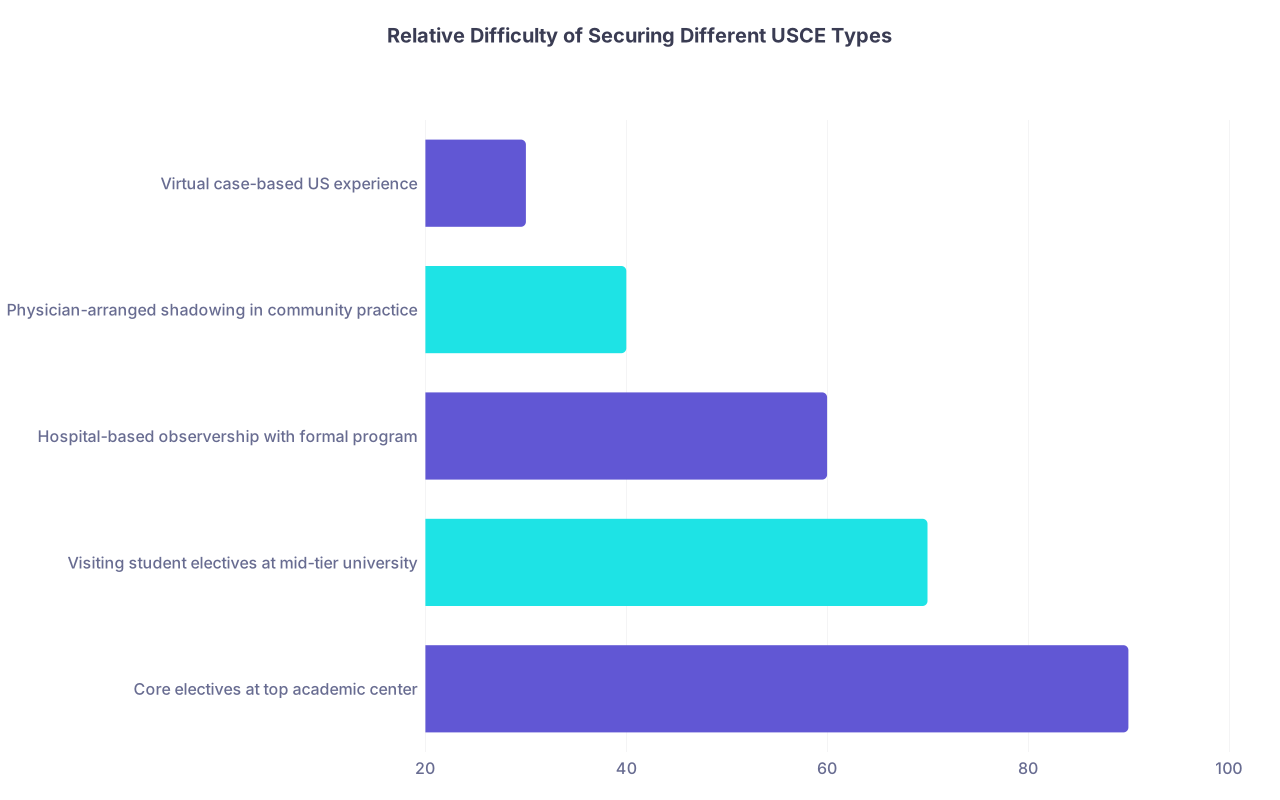
| Category | Value |
|---|---|
| Core electives at top academic center | 90 |
| Visiting student electives at mid-tier university | 70 |
| Hospital-based observership with formal program | 60 |
| Physician-arranged shadowing in community practice | 40 |
| Virtual case-based US experience | 30 |
2.1 Match your profile to realistic USCE types
Be brutally honest about where you stand and pick the level that matches:
- If you are a current student from a recognized school with decent scores:
- Formal visiting electives at university hospitals are realistic.
- If you are a recent graduate (≤ 5 years) with Step 1/2 done, but average scores:
- Community hospital observerships, private practice observerships, some structured experiences.
- If you are an older graduate (> 5–7 years) or with multiple attempts:
- You will do better with physician-arranged shadowing, community sites, smaller hospitals, or mixed tele/onsite experiences initially.
If your current rejections are all from big-name programs with online portals, shift your focus toward:
- Community hospitals
- Safety-net hospitals
- Federally Qualified Health Centers (FQHCs)
- Private groups with 5–20 physicians
- Alumni connections from your school
2.2 Identify the right targets systematically
Do not just “Google observership” and click the first 10 programs. Build a spreadsheet and research deliberately:
Columns to include:
- Institution / Practice name
- Setting (academic center, community, private practice)
- Specialty
- USCE type (elective, observership, externship, shadowing)
- Has official IMG/observership page? (Y/N)
- Contact name & email
- Application requirements
- Lead time needed (months before start)
- Cost (if any)
- Your personal connection (alumni, friend, previous email thread)
Aim for at least 40–60 realistic targets, not 10 impossible ones.
Step 3: Rewrite Your Outreach Email – The Thing Almost Everyone Gets Wrong
Your email is often your only shot. Many IMGs send a long, needy, generic wall of text that screams “forwarded to 100 programs.”
That gets deleted.

3.1 The anatomy of an email that actually gets opened
Use this simple structure:
- Clear subject line
- Short, respectful introduction
- One-sentence value proposition
- Specific ask with flexible dates
- Attached CV + brief closer
Subject line examples (use, do not copy exactly word-for-word)
- “International medical graduate seeking observership in Internal Medicine – March–April 2025”
- “Request for short-term IMG observership – Family Medicine – flexible dates”
- “USMLE-completed IMG interested in Cardiology observership (research-active)”
Email body template you can adapt
Do not copy this verbatim. Adapt to your situation.
Dear Dr. [Last Name],
My name is [Name], an international medical graduate from [Country] who completed medical school at [School] in [Year]. I have passed USMLE Step 1 and Step 2 CK with scores of [X] and [Y], and I am pursuing Internal Medicine residency in the United States.
I am writing to ask if you would consider hosting me for a short observership in your practice/service between [Month–Month, Year]. I am particularly interested in [specific interest that relates to their work: e.g., inpatient cardiology, diabetes management in underserved populations, etc.], and I have prior clinical experience in [brief relevant experience].
I can arrange my own visa, housing, and malpractice coverage if needed, and I will fully comply with your institution’s requirements. My CV is attached for your review.
If you are not able to host observers, I would be very grateful if you could suggest a colleague or department that occasionally supervises IMGs.
Thank you for your time and consideration.
Respectfully,
[Full Name]
[Degree]
[Phone number with country code]
[Email]
[LinkedIn or professional website, if you have one]
Short. Specific. Professional. Not begging.
3.2 Fix the top 5 email mistakes you are probably making
- Too long – Nobody is reading an 800-word life story. Keep it under ~200 words.
- Generic flattery – “Your institution is prestigious…” – useless and transparent. Mention something specific if you can.
- No clear timing – “Whenever is fine” signals you have not thought this through. Offer a window (e.g., “Sept–Nov 2025, 4 weeks”).
- Attachments with weird names – “cv final real use 3.docx”. Rename to “CV_[LastName]_[FirstName].pdf”.
- Gmail-style subject lines – “Hi” or “Observership” alone is amateur.
Set up a professional email signature. You are presenting yourself as a future colleague, not a desperate student.
Step 4: Rebuild Your CV So It Sells You in 10 Seconds
Coordinators skim, not read. If your CV does not tell them “This person is organized, active, and safe to have around” in seconds, you lose.
| Section | Strong Signal | Weak Signal |
|---|---|---|
| Education | Clear MD/MBBS, dates, location | Missing dates, unclear degree |
| Exams | USMLE scores/dates listed cleanly | “USMLE attempted” with no detail |
| Clinical Experience | Recent, relevant, organized | Only internship from 7 years ago |
| Research/Projects | Concrete roles & outcomes | Vague “helped with research” |
| Formatting | 1–2 pages, consistent fonts | 4–5 pages, cluttered, typos |