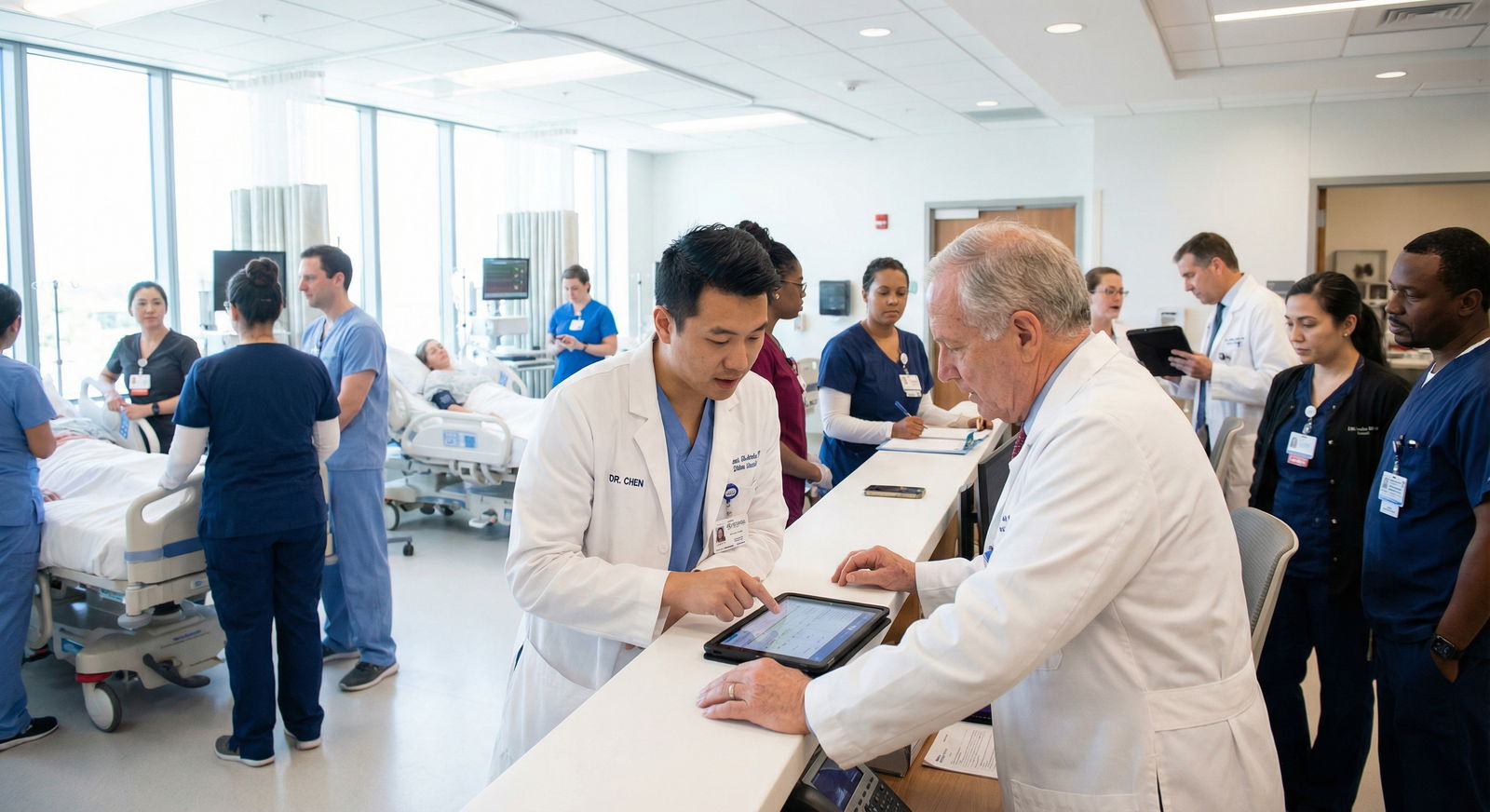
You are three years out of medical school, sitting in a small apartment in your home country, staring at your bank account and a spreadsheet of US clinical observerships.
Fees: $1,500–$3,000 per month.
Housing: another $1,200–$2,000 in any city with decent hospitals.
You do the math and realize: if you follow the “standard IMG route,” you are broke before you even submit ERAS.
And yet every program website screams the same thing: “US clinical experience preferred / required.”
Here is the reality:
You will not win a spending contest. You have to win a strategy contest.
This is fixable. But only if you stop thinking, “I must buy as many months of USCE as possible,” and start asking, “How do I turn limited money into maximum credibility and real relationships?”
That is what we are going to build: a low-budget, high-yield US clinical exposure plan that actually moves your application.
Step 1: Get Ruthlessly Clear on What “Counts” as USCE
Before you spend a single dollar, you need to understand what you are buying.
Programs do not care about “experience” in the abstract. They care about three things:
- Can this person function safely in a US hospital?
- Will they be a headache or an asset on the team?
- Can someone I trust vouch for them in a letter?
Most of the time, that translates into how they view different types of exposure:
| Type | How Programs Usually See It |
|---|---|
| US hands-on electives | Strong, especially in core fields |
| Sub-internships | Gold standard, “mini-residency” |
| Observerships (formal) | Useful but weaker than hands-on |
| Shadowing (informal) | Minimal value on its own |
| Tele-rotations | Weak alone, decent as add-on |
For IMGs who already graduated, “hands-on” is often limited, but not impossible:
- Some community hospitals and private groups allow direct patient contact (history, notes, presentations) under supervision, labeled as “externship.”
- Big-name universities usually offer observerships only: no orders, no notes, no direct patient care.
Here is how you think about it strategically:
1 month of high-quality, hands-on experience under an attending who writes you a strong letter is worth more than
3–4 months of anonymous, passive observerships at mid-tier places.Letters of recommendation from US attendings who actually know you are the real currency. Not logos.
So your core question becomes:
“Where can I get the strongest letter and story for the least money?”
Step 2: Set Your Budget and Non-Negotiables
You cannot plan meaningfully without hard numbers.
Do this on paper:
Total money available for US exposure over 12–18 months.
- Include plane tickets, visas, housing, local transport, rotation fees, food.
- Be honest and a bit conservative.
Non-negotiables:
- You must reserve:
- Money for ERAS fees,
- At least some money for interviews or virtual setup,
- Exam fees if any are pending (Step 2, OET, etc.).
- You must reserve:
Decide a realistic range of US time.
For example:- Absolute max: 3 months in the US across one year.
- More realistic: 1–2 targeted months plus remote/tele exposure.
I have seen too many IMGs blow everything on 4–6 months of low-yield observerships, then scramble to afford ERAS, let alone interviews.
Rule: If your total pot is small, aim for 1–2 months of extremely strategic, high-quality exposure. Then build everything else remotely.
Step 3: Choose Your Target Specialty and Align Your Exposure
Scattershot exposure is the enemy of the low-budget IMG.
If your ERAS application shows:
- 1 month cardiology observership
- 1 month neurosurgery shadowing
- 1 month dermatology tele-rotation
…and you apply to Internal Medicine, program directors will shrug. There is no coherent story.
Decide on one primary specialty (two at most, if they are related and you are disciplined about it):
- Internal Medicine
- Family Medicine
- Pediatrics
- Psychiatry
- Neurology
- etc.
Then ask:
“What exposure, in this specific specialty, at this level of budget, gives me the most believable narrative plus real letters?”
Step 4: Build a Tiered Exposure Plan (Core + Add-ons)
You need a core block of in-person US exposure and then layered, low-cost add-ons that show ongoing engagement.
4.1. Your Core Block: 4–8 Weeks That Actually Matter
Your core block should be:
- 4–8 weeks long in one specialty (preferably the one you are applying for).
- In a setting where:
- you can interact with attendings daily
- they see your work ethic
- there is at least a realistic chance at a letter of recommendation.
Where do you get these?
Low-cost community hospital / private group externships
Look for:- Small IM/FM/psych programs in mid-size cities
- Physician groups that take IMGs directly
Typical signs:
- Less polished websites
- Direct contact emails like “[email protected]”
- Rotations labeled “externship” or “hands-on training”
What you want:
- Daily patient interaction
- Presentations on rounds or in clinic
- Ability to write notes (even if they are not the final legal note)
- Discussion of management plans
Smart university observerships
These are not “hands-on,” but can still be effective if:- They are in your target specialty
- You are on a smaller team (fewer observers, more contact time)
- You are proactive, show up, read, and present informally
Key: do not pay $3,000 for a month in a huge, anonymous service with 10 observers who never talk to the attending.
Your 4–8 weeks should be booked with the following priorities:
- Strong letter potential > Brand name
- Actual interaction > Number of months
- Specialty alignment > “Cool factor”
If you can only afford 4 weeks in the US, accept that. Then squeeze every drop out of that month.
4.2. Layer 1: Tele-Rotations and Remote Clinics (Cheap, But Use Properly)
Tele-rotations alone will not impress most PDs. But as an adjunct to a solid month in person? They can show continuity and effort.
Good uses of tele-rotations:
- Arrange weekly virtual clinic with a US physician where you:
- Review patient charts before visits
- Help with education materials
- Join video visits (as observer)
- Discuss cases afterward
- Join tele-case conferences in your specialty (IM morning report, psych case discussions, tumor boards, etc.).
- Use them to maintain contact with an attending after your in-person month.
You put this on ERAS as structured “Tele-clinical observership” or “Telemedicine clinical experience” with clear dates and descriptions.
Cost: often hundreds, not thousands, or even free when arranged informally after in-person work.
4.3. Layer 2: Research-Adjacent Exposure Without a Fancy Lab
You are low-budget, so big, paid, US research positions are probably out.
You still have options:
- Offer to help your rotation attendings with:
- Chart reviews
- Case reports
- Retrospective audits
- Volunteer for registry data collection, QI projects, or clinic workflow audits.
If you are proactive and reliable, a lot of community attendings are happy to have someone help tidy up their research “to-do” list.
This does three things:
- Strengthens your relationship with the attending.
- Gives you something academic to list.
- Adds weight to their letter: “She not only did well clinically, but also helped us with a QI project on uncontrolled diabetes patients.”
Step 5: How to Pick Rotations Without Getting Scammed or Overpaying
You do not have money to burn. You cannot afford “I hope this is good” decisions.
5.1. Use a Simple 4-Question Filter
For every potential rotation, demand clear answers to:
- Who will be my primary supervising physician?
- Name, specialty, role (attending, program faculty, private doc).
- How many students/observers are typically there at once?
- If they say 10+, be careful.
- What exactly will my daily responsibilities be?
- Ask for specifics: H&Ps, presentations, note-drafting, pre-rounding.
- How often will I interact with you directly?
- Daily? Weekly? Once at the end? You want daily or near-daily.
If they are vague, evasive, or only talk about the hospital “brand,” move on.
5.2. Check for Real Outcomes, Not Marketing
You care about outcomes:
- Did past IMGs from this rotation get:
- Interviews?
- Letters used in successful matches?
- Any into your target specialty?
Try to:
- Find ex-rotators on LinkedIn (search the attending’s name + “observership”).
- Message them directly: “Did you get a letter? How many hours per week did you actually interact with the attending?”
I have seen people pay $2,000 a month to stand at the back of a crowded cardiology ward team that does not even know their name by week 4. Do not do that.
5.3. City Choice: Stop Chasing New York and California
Big, famous cities are usually:
- Expensive for housing
- Saturated with observers
- Less personal attention
Better targets for low-budget IMGs:
- Mid-size cities with regional hospitals:
- Cleveland, Columbus, Indianapolis, Milwaukee, Charlotte, Tampa, San Antonio, Kansas City, etc.
- States with more community-based programs:
- Ohio, Michigan, Indiana, Texas, Florida (outside Miami), Pennsylvania (outside Philly/Pittsburgh), etc.
Your housing cost drops. Your chance of standing out rises.
Step 6: Convert a Single Month into a Strong Letter
One month is enough for a strong letter if you behave like a sub-intern, not a tourist.
Here is your playbook for that month.
6.1. Day 1–3: Signal Intent and Reliability
- Meet your supervising attending early and say something like:
- “I know I am only here for four weeks, but I want to work as hard as your residents do, within my scope. I am hoping to demonstrate that I can function at the level of an intern here.”
- Learn the workflow fast:
- EMR basics
- Where to find vitals, labs, imaging
- How rounds actually move in that hospital
And then do the basics flawlessly:
- Show up before residents.
- Never disappear without telling someone.
- Never be late. At all.
6.2. Week 1: Prove You Are Useful, Not Just Polite
Ways you can help that residents actually appreciate:
- Pre-charting patients (within allowed rules).
- Pulling up old notes, consults, imaging before rounds.
- Offering to write draft H&Ps or progress notes (saved as “student note” if EMR allows).
- Carrying the list, keeping track of to-do items, reminding about pending labs.
You do not need to be brilliant. You need to be dependable and make the team’s life easier.
6.3. Week 2–3: Ask for Feedback and Adjust
By end of week 1 or early week 2, have a brief, direct check-in with the attending:
“I want to make the most of these weeks, and I value honest feedback. Are there 1–2 specific things I can improve to be closer to an intern level?”
Do not argue. Do not explain too much. Fix what they say.
Most attendings are so used to students ignoring feedback that when someone actually follows it, they remember that person.
6.4. Week 3–4: Secure the Letter Properly
Around week 3, if you have had consistent interaction and decent feedback, say:
“Dr. X, I am applying to Internal Medicine this September. I have learned a great deal here and tried to function as close to an intern as allowed. Would you feel comfortable writing me a strong letter of recommendation based on my performance during this rotation?”
Key points:
- You explicitly say “strong letter.”
- You give them a graceful out if they cannot.
If they hesitate, you thank them and do not push. A lukewarm letter can sink you.
If they agree:
- Follow up with:
- Your CV
- USMLE scores
- Personal statement draft
- Bullet list of specific things you did during the rotation (cases, presentations, projects) to jog their memory.
You want that letter uploaded to ERAS before September if you are applying the upcoming cycle.
Step 7: Housing, Transport, and Survival on a Shoestring
The financial side kills a lot of good plans. You must be tactical here.
7.1. Housing Hacks
- Avoid central, trendy areas. Look 30–60 minutes from the hospital by bus or train.
- Use:
- Hospital-affiliated housing (often cheaper, ask GME office or HR).
- Extended-stay motels weekly rates (not glamorous, but predictable and often cheaper than Airbnb).
- Student Facebook groups / WhatsApp groups for sublets near med schools or residency programs.
Do not:
- Commit to a long lease for a 4–8 week stay.
- Assume you can “figure it out when you get there.” That is how you end up in a $120/night hotel.
7.2. Transport
- Pick rotations where:
- Hospital is accessible by public transit from cheaper neighborhoods, or
- You can safely walk from your housing (20–30 minutes walking is often manageable).
Car rentals will destroy your budget. So will daily Uber.
7.3. Food
You will not match because you ate in the hospital cafeteria every day.
- Buy groceries once a week.
- Prep simple meals.
- Carry snacks (nuts, granola bars) to avoid $12 sandwiches when you are on call.
Small discipline here means you might be able to afford a second short rotation instead of blowing everything on living costs.
Step 8: Use Remote Work Before and After to Look “Continuous”
Programs do not like “I showed up for 4 weeks and disappeared.” You fix that on paper and in reality.
8.1. Before the Rotation
3–6 months before your US visit:
- Email potential attendings with a concise intro:
- Who you are
- Your specialty interest
- Your exam status
- Your plan to visit the US for an in-person rotation
Offer something specific:
“In the months before I arrive, I am happy to assist with any chart review, database building, or literature review for ongoing projects in your clinic.”
If one of them bites, you now have pre-existing relationship before you even land in the US.
8.2. After the Rotation
Do not vanish once you leave.
- Continue remote project work:
- Case report drafts
- Data cleaning
- Literature summaries
- Send updates:
- “Dr. X, I submitted my ERAS application last week and listed your rotation and letter. Thank you again for your support.”
- “I matched interviews in A, B, and C programs; your letter was a huge part of that.”
When that attending later answers a PD’s call, they can say, “Yes, I know this person well, we have been working together for months.”
Step 9: Crafting Your Story in ERAS Using Limited USCE
Now you have:
- 4–8 weeks of in-person US experience
- Maybe some tele-rotation
- Some remote project work
Your job is to present this as a coherent, intentional story, not scattered hustling.
Your ERAS entries should reflect:
- Commitment to one specialty.
- Progression: first remote / observational, then more involved, then project work.
- Continuity of relationships: same mentors appearing in multiple entries (rotation + project).
Example sequence for an IMG applying to Internal Medicine:
- “US Clinical Externship, Community Internal Medicine Clinic, Ohio – July 2025”
- “Tele-Internal Medicine Observership with Dr. X – Sept–Dec 2025”
- “Quality Improvement Project: Reducing No-Show Rates in IM Clinic – Aug 2025–Feb 2026”
That looks like a path. Not a random tour.
Step 10: If You Can Only Afford a Single Month – The Minimal Viable Plan
Let us be brutally honest. Many people reading this can afford just one month in the US. Maybe two weeks if they push.
Here is your minimal viable plan that still gives you a shot:
- Choose one core specialty (IM or FM gives the widest net for many IMGs).
- Book one 4-week rotation that satisfies:
- Direct, daily contact with one attending
- Reasonable chance for a letter
- Costs you no more than you can recover from in 6–12 months
- Start remote contact 3–6 months before:
- Ask about cases, reading lists, possible remote tasks.
- During that month:
- Act like a sub-intern
- Seek feedback
- Ask for a strong letter as above
- After:
- Keep working with that attending remotely on at least one project.
- Get their letter into ERAS.
- Highlight that experience explicitly in your personal statement:
- “During my externship with Dr. X in Ohio, I managed [X, Y, Z responsibilities] and confirmed my decision to pursue Internal Medicine in the US.”
Will this guarantee a match? No. But I have seen people match with exactly this foundation, plus decent scores and a clear story, while others with 6 months of unfocused observerships failed.
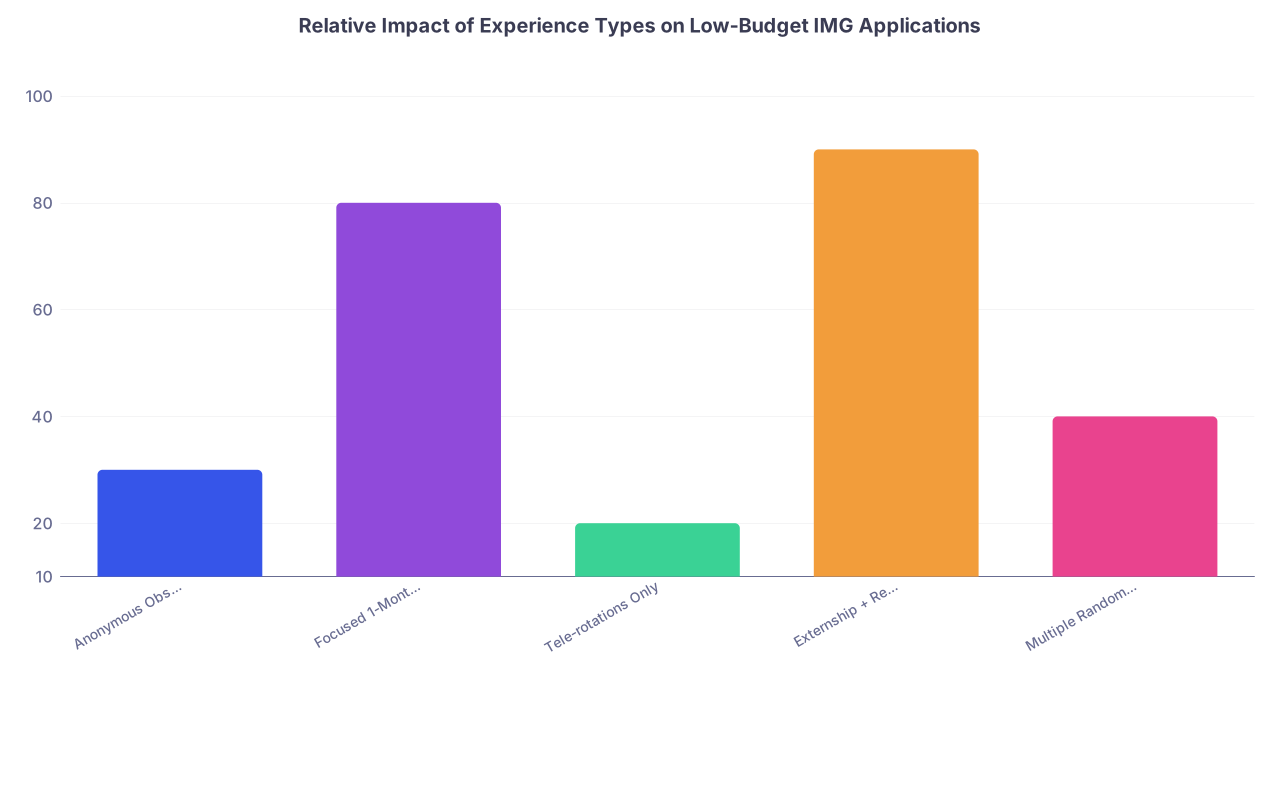
| Category | Value |
|---|---|
| Anonymous Observerships | 30 |
| Focused 1-Month Externship | 80 |
| Tele-rotations Only | 20 |
| Externship + Remote Project | 90 |
| Multiple Random Rotations | 40 |

| Step | Description |
|---|---|
| Step 1 | Decide Specialty & Budget |
| Step 2 | Identify 1-2 High-Yield Rotations |
| Step 3 | Pre-Rotation Remote Contact |
| Step 4 | 4-8 Week In-Person Rotation |
| Step 5 | Secure Strong Letter |
| Step 6 | Offer Help with Projects |
| Step 7 | Ongoing Remote Work |
| Step 8 | ERAS Application with Coherent Story |


Final Snapshot: What Actually Matters for You
If you remember nothing else:
One strategic, high-contact month is more powerful than many anonymous months.
Your goal is not “experience.” Your goal is a believable story + strong letters.Use remote work before and after to stretch every dollar.
Build relationships months in advance and keep them alive once you leave.Pick rotations based on people and interaction, not logos and cities.
You are not buying prestige. You are buying access to someone who will genuinely vouch for you.
You are low-budget. Fine. You can still be high-impact if you stop trying to copy the “rich IMG” playbook and start playing a smarter game.