
The biggest reason IMGs waste good US clinical experience is simple: they never engineer the conversations that create strong letters of recommendation.
They wait. They “hope” attendings noticed them. They send a polite email two months later and get a generic, useless letter that might as well say: “This person showed up and was fine.”
You are not doing that anymore.
This is a step‑by‑step, conversation‑by‑conversation plan to convert your USCE into powerful LORs that actually move your application.
The Goal: Turn Daily Work into Letter Content
Strong US LORs are not written in 20 minutes at the end of your rotation. They are written in tiny pieces, every day, through:
- How you introduce yourself
- How you present patients
- What you ask for
- How you close the rotation
You are feeding your letter writer specific proof, one interaction at a time.
Let me be blunt:
If your attending can’t recall at least 3 specific things you did well, your letter will be generic.
Generic = weak.
Weak = wasted USCE.
So your objective is clear: design your behavior and your conversations so that, by the end, your attending has:
- Clear examples of your work ethic
- A story about your clinical reasoning
- Evidence you are safe with patients
- A sense of your personality and fit
Everything below is about engineering those outcomes.
Step 1: The Setup Conversation (Day 1–2)
This is where most IMGs blow it. They show up, say, “Nice to meet you,” and fade into the background.
You are going to do something different: you are going to script the first real conversation with your attending.
Conversation #1: “Here’s who I am and what I’m aiming for”
Timing: After first rounds / first clinic session, when things slow a bit. Not in the middle of chaos.
Your goals:
- Signal professionalism and clarity
- Set expectations
- Plant the seed for a future LOR
What you actually say (adapt to your own style, but keep the structure):
Introduction + context
“Dr. Smith, I wanted to briefly introduce myself more fully. I am Dr. [Name], a graduate from [Country] who is currently pursuing residency in internal medicine. I am here on this rotation to strengthen my US clinical experience and learn how care is delivered in this system.”
Your immediate rotation goals
“For this month, my main goals are:
- To improve my efficiency and clarity in presenting patients
- To understand your approach to differential diagnosis and management
- And to learn what is expected of a strong intern on this service.”
Direct request for feedback
“If you notice areas I can improve, I would really appreciate direct feedback, even if it is critical. I learn quickly when I know exactly what to adjust.”
You are doing three crucial things here:
- Showing self-awareness
- Giving them permission to correct you (attendings like teachable people)
- Framing yourself as someone serious about residency, not just “visiting”
Conversation #2: Planting the LOR seed early (end of Week 1)
You do not ask for a letter in week 1. That is premature and needy.
You do, however, make the LOR conceivable.
End of week 1 or early week 2, you ask for a micro-check-in:
“Dr. Smith, do you have 5 minutes sometime today or tomorrow for quick feedback on how I am doing so far? I want to make sure I am meeting your expectations.”
During that 5-minute chat:
- Ask: “Is there anything you want me to improve next week?”
- Ask: “Are there specific things you expect from a strong sub‑intern that I should focus on?”
Then listen. Do not argue. Write down what they say. Adjust your behavior visibly.
This sets up a narrative: “This student asked for feedback, then improved.” That is gold in LOR language.
Step 2: Daily Micro-Conversations That Build LOR Content
Strong letters are narrative, not adjectives. “Hard-working” is empty. “Stayed late to call three families personally and updated them” is powerful.
You need to create (and highlight) those stories.
Micro-Conversation Targets (every few days)
These are small, 30–60 second interactions that give the attending material for later.
1. Clinical Reasoning Highlight
Scenario: You looked up an article, guideline, or UpToDate topic and applied it.
You say (on rounds, concisely):
“Dr. Smith, for Mr. Johnson’s hyponatremia, I reviewed the latest [JAMA/NEJM/UpToDate] recommendations last night. It reinforced using [specific diagnostic approach] before we give [specific treatment]. Based on that, I was thinking we should first confirm [X] before escalating.”
Your goal: show initiative and evidence-based thinking.
Attending takeaway: “This student reads and applies literature.”
2. Systems / Teamwork Highlight
Scenario: You helped coordinate something (case management, PT/OT, home O2, insurance issue).
Later, you mention:
“I spoke with case management this afternoon, and we arranged [specific plan]. I wanted to confirm you are comfortable with discharge on [day] if things remain stable.”
Your goal: show you function in the US hospital system, not just with pathophysiology.
Attending takeaway: “This student understands transitions of care and works with the team.”
3. Communication & Empathy Highlight
Scenario: You had a heavy conversation with a patient or family.
You say:
“After rounds, I spent some time explaining the diagnosis and plan to Mr. Lee in simpler terms. He was very anxious about [X]. I think it helped him understand why we are recommending [Y].”
Your goal: show bedside manner without bragging.
Attending takeaway: “This student communicates well and cares about patients.”
These comments should be natural, not performative. You are not saying, “Look how great I am.” You are updating the team with relevant info that just happens to reveal your strengths.
Step 3: Mid-Rotation Feedback Conversation (Week 2–3)
This is where you convert “showing up” into “noticeable growth.” Many IMGs skip this. Huge mistake.
Conversation #3: Structured Feedback and Calibration
You schedule this. Do not just ambush.
“Dr. Smith, we are about midway through my rotation. Would you have 10 minutes sometime this week for structured feedback? I want to finish the rotation as strongly as possible and align with your expectations.”
When you get the time, use a tight structure:
Start with your perspective
“From my side, I feel I have improved in [presentations / note-writing / managing 3–4 patients]. I am still working on [example: being more concise in assessments].”
Ask targeted questions
Ask questions like:
- “If I were your intern right now, what is the one thing you would want me to do better?”
- “Is there anything I am doing that makes you hesitant to trust me with more responsibility?”
- “Where do you think I am already at the level of a strong intern?”
This is uncomfortable. Do it anyway. Attending’s brain now has:
- A list of your strengths
- Concrete areas where you improved
- Evidence that you are coachable
All of that becomes LOR language.
Close the loop
“Thank you for the direct feedback. I am going to focus specifically on [repeat 1–2 points] for the rest of the rotation.”
Now you actually fix those things and make sure it is visible.
Step 4: Engineering Specific LOR Content Through Your Behavior
Let me show you what letter writers love to praise, and how you build each piece intentionally.
| LOR Quality | What You Actually Do |
|---|---|
| Work ethic | Arrive early, stay until work is actually done |
| Clinical reasoning | Present structured, thoughtful plans |
| Communication | Clear, concise updates to team and patients |
| Reliability | Close the loop on tasks without reminders |
| Teachability | Seek feedback, show visible improvement |
1. Work Ethic (Letter phrase: “exceptional work ethic”)
Action plan:
- Arrive before the resident. Know your patients cold.
- If a task is not done, you do not leave because “my hours are over.” You either finish it or clearly hand it off with a direct verbal update.
- When there is downtime, you do not vanish. You ask, “Is there anything I can help with?” or “Can I follow up on labs / notes for [patient]?”
You do not say, “Look how hard I’m working.” You let your behavior become visible in predictable ways.
2. Clinical Reasoning (Letter phrase: “functions at the level of an intern”)
Action plan:
- Present with this structure:
- Brief HPI
- Focused relevant exam/labs
- 3–4 item differential
- Justification for your top choice
- Concrete plan
- Stop reading only textbooks. Read your actual patients’ problems on UpToDate, NEJM, JAMA. Mention this briefly when appropriate, as in earlier examples.
Strong LORs quote your thinking. “She consistently generated thoughtful differentials and evidence-based plans.”
3. Communication & Teamwork (Letter phrase: “excellent team player”)
Action plan:
- Introduce yourself to nurses by name. Ask, “How do you prefer I update you about changes?”
- When you call consults, you practice SBAR (Situation, Background, Assessment, Recommendation) and keep it tight.
- When there is conflict or confusion, you help clarify. “Let me just recap our plan so we are all on the same page.”
Attendings will remember: “Nurses liked working with him,” or “She communicated extremely well with consultants.”
4. Reliability (Letter phrase: “I completely trusted him with patient care tasks”)
Action plan:
- Every task you are assigned either gets done or you update the team explicitly if blocked.
- Keep a running task list. Check off in front of the resident/attending at the end of day: “I called cardiology, updated the family, reconciled meds. The only pending item is [X], which will result tonight.”
- Never let them chase you for labs, imaging, or follow-up.
5. Teachability and Growth (Letter phrase: “most impressive was her growth over the month”)
Action plan:
- Ask for one or two specific points of feedback every 1–2 weeks.
- Implement visibly. For instance, if they said, “Be more concise,” you can say a week later:
“I have been working on shortening my presentations as you suggested. Please let me know if today’s format is closer to what you prefer.”
Now they have a before and after. That is what turns a “good” student into a “standout” in a letter.
Step 5: The Pre-Ask Conversation (Last Week of Rotation)
By now, if you executed the plan, your attending has:
- Seen your work ethic
- Watched your growth
- Heard your reasoning
- Observed your teamwork
Now you set up the formal ask.
Conversation #4: “Would you feel comfortable supporting my application?”
You do this ideally 3–5 days before your last day, not at 4:55 pm on Friday.
Script it roughly like this:
“Dr. Smith, I wanted to thank you for the opportunity to work with you and the team. I have genuinely learned a lot about [specific things – e.g., managing complex inpatient diabetes, or running efficient rounds]. I am planning to apply to internal medicine this upcoming cycle.
If you feel you know my work well enough, and if you feel you can write a strong letter of recommendation for me, I would be very grateful.”
The word “strong” matters. It gives them an out if they only feel lukewarm. If they hesitate or qualify their answer (“I can write a letter, but I do not know you that well”), back off politely. You want fewer strong letters, not more weak ones.
If they say yes confidently, you immediately follow with:
“I will email you my CV, personal statement draft, and a brief summary of my work here to make it easier.”
You are not “writing your own letter.” You are giving them ammunition.
Step 6: What You Send After They Agree
Most attendings are busy. If you do not make their job easier, you will get generic fluff.
Your email should include:
Brief thank you and reminder
“Thank you again for agreeing to support my application with a letter of recommendation. I truly appreciated your teaching on [specific examples].”
Your materials
- Updated CV
- Personal statement draft (even if not perfect)
- ERAS ID and any deadlines
One-page “LOR Helper” document
This is where you convert your month into bite-sized stories they can reuse. Bullet points only. Example structure:
- Patients you followed closely with notable issues
- Examples of initiative (“Stayed late to coordinate X,” “Led family discussion about Y”)
- Specific feedback they gave you and how you improved
- Any compliments they gave during the rotation (yes, write those down)
You can phrase it like:
“I attached a brief summary of my work on this rotation, including specific patients and tasks I was involved in. I hope this makes letter writing easier. Please feel free to use or ignore any of it.”
You are not being arrogant. You are being efficient and respectful of their time.
Step 7: Timing, Reminders, and Follow-Up
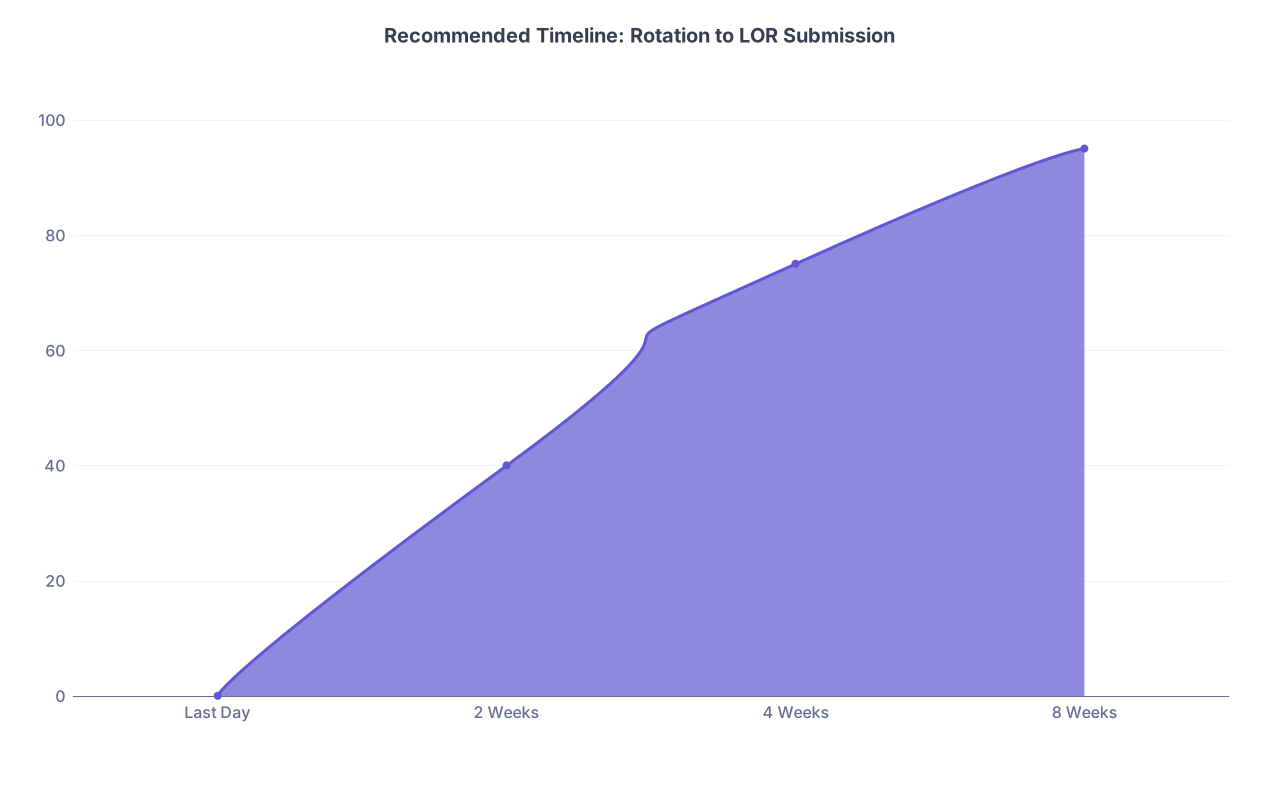
| Category | Value |
|---|---|
| Last Day | 0 |
| 2 Weeks | 40 |
| 4 Weeks | 75 |
| 8 Weeks | 95 |
The percentages here are rough, but you get the idea: most good letters are written within 4–8 weeks of your rotation. Your job is to keep the attending’s memory fresh.
On your last day
- Thank them in person.
- If you have not sent the email with documents yet, tell them it is coming.
If it is an observership with less contact, you still follow the same pattern, but you need to be realistic: observership letters are inherently weaker unless you found ways to be very visible (presented cases, wrote notes in draft, etc.).
Email #1: Within 24 hours
Subject: “Thank you and LOR materials – [Your Name], [Rotation dates]”
Send everything you promised.
Email #2: Gentle reminder (3–4 weeks before deadlines)
If ERAS opens in September and you finished in June, you might send:
“Dear Dr. Smith, I hope you are doing well. I wanted to gently check in about the letter of recommendation you kindly agreed to write for my internal medicine residency applications. ERAS opens on [date], with programs beginning to review applications on [date]. If you need any further information from me, I am happy to provide it. Thank you again for your support.”
Do not send this every week. One or two reminders maximum, spaced a few weeks apart, unless they specifically ask you to ping them again.
Confirming submission
Some attendings tell you when they upload; some do not. If they tell you they submitted, you do not keep asking. If you are unsure and the deadline is near, you can check ERAS and, if still missing, send one last very polite reminder.
Specialty-Specific Nuances for IMGs
Not all specialties weigh USCE and LORs the same way. Internal medicine and family medicine often place heavy emphasis on strong US-based LORs. Surgical fields care a lot about what a surgeon says about your hands, OR behavior, and grit.
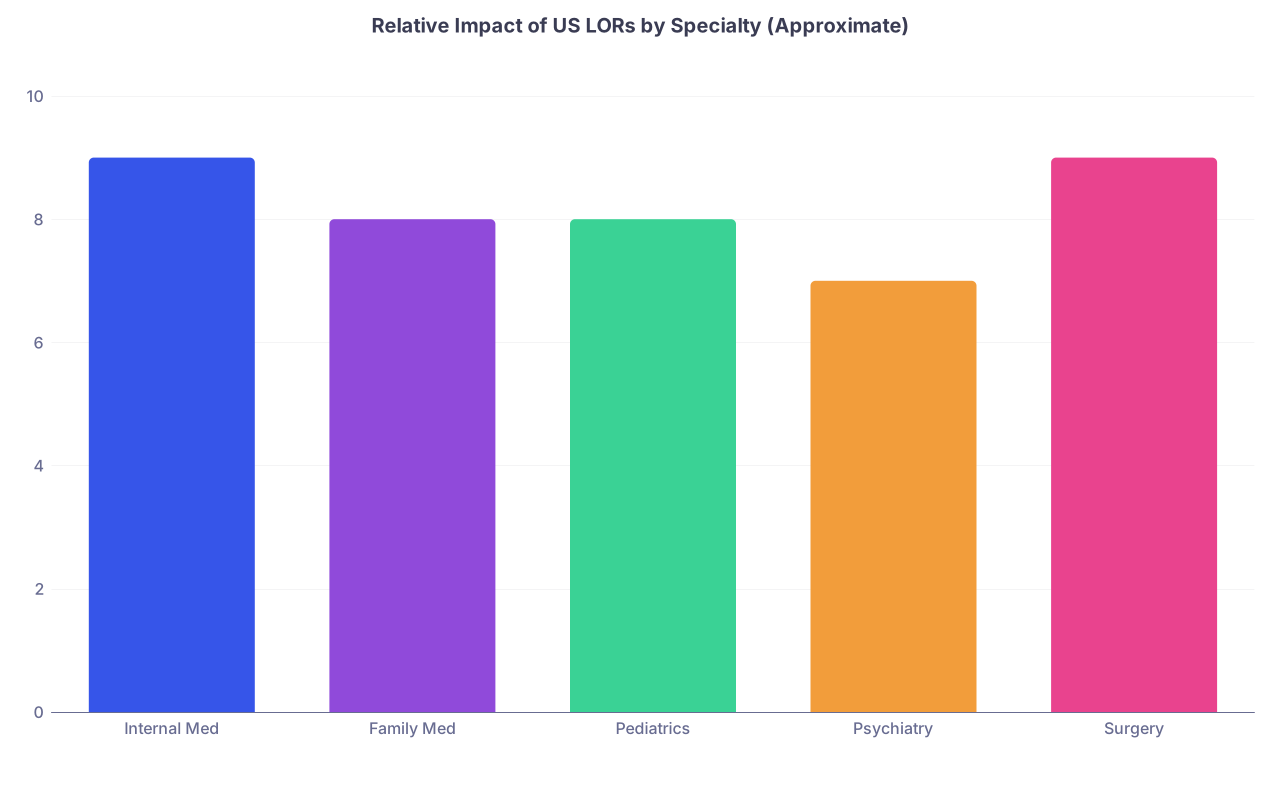
| Category | Value |
|---|---|
| Internal Med | 9 |
| Family Med | 8 |
| Pediatrics | 8 |
| Psychiatry | 7 |
| Surgery | 9 |
(Scale 1–10: how much good US LORs change your odds, especially as an IMG.)
If you are targeting:
- Internal Medicine / FM: Prioritize inpatient ward rotations and continuity clinics where you actually manage patients. You want letters saying you already function at intern level.
- Surgery: Make sure you are in the OR, scrubbed in, not hiding in the corner. Ask smart, brief questions. Show you can handle stress, long hours, and still be polite at 6 pm.
- Psychiatry: Emphasize communication, rapport with difficult patients, and team collaboration with social work / case management.
- Pediatrics: Show you can speak with both kids and parents, calmly and clearly.
You adjust your daily micro-conversations accordingly.
Common Mistakes IMGs Make (and What To Do Instead)
Let me be blunt about the patterns I see over and over.

Mistake 1: Asking for a letter after a weak, quiet rotation
You were physically present but invisible. You did not seek feedback. You did not speak up during rounds. Then you send an email 2 months later requesting a letter.
Result: generic, boilerplate LOR your competition can beat easily.
Fix: If you realize you have been invisible halfway through, you still have time. Ask for mid-rotation feedback, then deliberately increase your engagement and visibility.
Mistake 2: Over-asking and trying too hard
Attending is drowning in work and you keep hovering: “Anything else I can do? Can I do this? Can I do that?” every 5 minutes. You become noise.
Fix: Offer help at logical transition points (after rounds, when tasks are being handed out). Take ownership of a manageable number of patients or jobs and execute them flawlessly. Depth over annoying enthusiasm.
Mistake 3: Focusing only on attendings, ignoring residents
Residents often influence how attendings view you. In some programs, attendings literally ask the senior: “How was this student?”
Fix:
- Be professionally helpful to residents: notes, checking labs, updating families.
- Ask residents for micro-feedback too. “Anything I can do tomorrow to make your life easier and improve as a trainee?”
They will remember you as an asset, not a burden. That energy travels upward.
Mistake 4: Treating observerships like shadowing
If all you do is follow someone silently and nod, your letter is dead on arrival.
Fix for observerships:
- Ask if you can write draft notes (even if they do not enter the chart) for teaching purposes.
- Ask if you can present cases verbally during clinic or team huddles.
- Volunteer to prepare a short, focused presentation (e.g., “10-minute talk on new HFpEF guidelines”).
You are trying to create teachable moments so the attending has material to write about.
Practical Daily Checklist: Are You Building a LOR Today?
You do not need a complicated system. Use a simple mental checklist.
At the end of each day, ask yourself:
- Did I:
- Take clear responsibility for at least 1–2 patients or tasks?
- Show my clinical reasoning at least once to the attending or senior?
- Communicate something clearly to the team, nurses, or a family?
- Learn something specific and apply it?
If the answer is “no” for two days straight, you are coasting. Correct course immediately.

| Step | Description |
|---|---|
| Step 1 | Day 1-2: Intro & Goals |
| Step 2 | Week 1: Feedback Seed |
| Step 3 | Weeks 1-4: Daily Micro-Conversations |
| Step 4 | Week 2-3: Mid-Rotation Feedback |
| Step 5 | Last Week: Pre-Ask Conversation |
| Step 6 | Last Day: In-Person Thanks |
| Step 7 | Within 24h: Email with Materials |
| Step 8 | 3-4 Weeks Pre-Deadline: Reminder |
Print that flowchart in your head. Follow it.
How Many LORs and From Whom?
You generally want:
- 2–3 strong US clinical letters in your specialty
- 1 additional letter from another clinician (or research if it is truly strong and detailed)
| Priority | Who | When to Ask |
|---|---|---|
| 1 | Inpatient attending, your specialty | After 3-4 weeks rotation |
| 2 | Outpatient attending, your specialty | After 3-4 weeks clinic |
| 3 | Research mentor with clinical overlap | After major project |
| 4 | Other specialty attending | If they know you very well |
Do not chase big names who barely know you. A department chair who writes “I met her twice; she seemed fine” is worse than a community hospital attending who writes a detailed, passionate letter.
Final Words: What Actually Converts USCE into LOR Power
Strip away all the fluff and you get three core truths:
Strong letters are built, not requested.
You earn them through deliberate, visible work and intentional feedback conversations spread across the rotation.Your conversations write your letter for you.
Every time you show clinical reasoning, initiative, communication, or teachability, and make that visible in a concise update, you give your attending a future sentence for your LOR.You control more than you think.
The IMGs who win are not necessarily the smartest. They are the ones who treat USCE like an extended interview and who engineer the month so that, when they finally ask, the attending already has the story written in their head.
Follow the conversation-by-conversation plan, and your US clinical experiences will stop being “time served” and start being what they should be: a pipeline of strong, specific letters that make program directors comfortable ranking you high.