
It is June. You are an IMG staring at your ERAS worksheet.
Under “US Clinical Experience” you have… one short observership. Maybe a tele-rotation. Nothing hands-on.
You know the reality: programs filter on “USCE required.” You have six months before applications lock in. And right now your clinical section looks thin, generic, and unimpressive.
Here is the good news: six months is enough time to turn a weak USCE profile into a competitive, coherent clinical portfolio. Not perfect. But much, much better than where you are today.
I am going to walk you through exactly how to do that.
Step 1: Get Completely Clear on What “Counts” as USCE
Before you fix the problem, you need to know the rules of the game. A lot of IMGs waste months chasing the wrong type of experience.
What program directors actually value
Think in tiers. Some experiences move the needle. Some barely register.
| Type of US Experience | Hands-On? | PD Value (Low–High) |
|---|---|---|
| US Residency (Prelim/TY) | Yes | Very High |
| Sub-I / Acting Internship | Yes | Very High |
| Inpatient Elective | Yes | High |
| Outpatient Elective | Yes | High |
| In-person Externship | Yes | High |
| Shadowing (informal) | No | Low–Moderate |
| Observership (formal) | No | Moderate |
For IMGs post-graduation, you realistically are dealing with:
- Hands-on externships (often paid)
- Observerships (formal, structured)
- Shadowing (informal, usually arranged directly)
- Tele-rotations / virtual observerships (lowest value, but can fill small gaps)
Priority is simple: the more you touch the chart and the patient, the more it helps you.
The non-negotiables in 6 months
In the next half-year, you need:
- At least 2 solid USCE entries (each minimum 4 weeks)
- At least 2 strong US clinical letters of recommendation
- One clear “anchor” experience that aligns with your specialty
If you are at zero, you are aiming for:
- 8–12 weeks total experience
- 2–3 letters
- At least one rotation in your target specialty
That is the bar. Everything we build now is to hit that bar with the highest possible quality.
Step 2: Build a 6-Month Clinical Upgrade Plan
Stop thinking “I just need some USCE.” Start thinking like this:
“In the next 6 months, I will intentionally stack experiences that:
(1) are hands-on or close to it,
(2) generate strong letters, and
(3) show commitment to my chosen specialty.”
Here is the structure that works.

Month 1: Specialize your strategy
First, pick your realistic specialty. Not the fantasy. The one you can actually match into with your scores, YOG, and profile.
- If your profile is average or weaker: think IM, FM, psych, peds
- If you have strong scores + research in surgery, OB, etc., fine—but still anchor most USCE in one field
Then build:
- A list of 20–30 hospitals / clinics / universities that:
- Have history of taking IMGs
- Are in your specialty or closely related (IM ⇢ cards, pulm, hospitalist; FM ⇢ primary care; psych ⇢ community programs)
Sources:
- Program websites (check residents’ medical schools)
- IMG forums and match lists
- LinkedIn profiles of IMGs in your target specialty
Months 2–3–4: Stack 2–3 rotations intelligently
Ideal pattern:
- Rotation 1 (4–8 weeks): Target specialty at a community hospital / academic-affiliated hospital
- Rotation 2 (4 weeks): Same specialty or strong adjacent specialty
- Rotation 3 (2–4 weeks, optional): Outpatient or subspecialty clinic
If money is tight and you can afford only two:
- Do two 4-week rotations in the same or closely related areas
Example (Internal Medicine hopeful):- 4 weeks inpatient IM at a community program that takes IMGs
- 4 weeks outpatient IM or hospitalist service at another site
Step 3: Find Actual Positions Fast (Without Wasting Weeks)
Most IMGs lose time here. Browsing random “observership” Google results and ending up on overpriced, low-yield agencies.
You do not have that luxury.
Core strategy: Three-channel hunt
Use three parallel channels. Same week. Not sequentially.
- Formal university and hospital programs
- Paid externship/observership companies (carefully selected)
- Direct outreach to private practices and community hospitals
1. Formal programs
Search directly:
"Hospital Name" + clinical observership international medical graduate"Department of Internal Medicine" + visiting observer"International visiting physician program" + [city/state]
Target:
- Community programs with associated teaching hospitals
- Mid-tier universities that are IMG-friendly (not just top-10 brand names)
Track everything in a simple spreadsheet:
| Site / Program | Type | Status | Start Month Target | Notes |
|---|---|---|---|---|
| Community Hosp A | Observership | Applied | Month 2 | IMG-friendly |
| University B | Externship | Pending | Month 3 | Fee $2,000 |
| Clinic C (Private) | Shadowing | Contacted | Month 2–4 (flex) | Emailed Dr. Smith |
Apply to at least 15–20 options in the first 10 days. That volume matters.
2. Paid externships and observerships
There are some decent paid programs and a lot of bad ones.
Quick screening rules:
- Hands-on? Requirement to have malpractice coverage is a positive sign.
- Clear description of:
- Number of clinic days per week
- Types of notes you are allowed to write (even if not in EMR)
- Opportunities for LoRs
- Affiliated with a residency program? Better.
- Price point: Many real externships will cost, but anything that looks like a tourist package is a red flag.
Do not blow your entire budget on a single 2-week fancy-sounding “rotation” that produces a generic letter.
3. Direct outreach (underrated but effective)
You email and call.
Target:
- Community hospitals with residency programs
- Busy private practices in your specialty: “Internal medicine clinic [city]” or “Family medicine practice accepting new patients [city]”
Script for email (shorter is better):
Subject: International physician seeking short-term clinical observership
Dear Dr. [Name],
I am a [year]-graduate physician from [Country], planning to apply for [Specialty] residency in the upcoming ERAS cycle. I will be in [City] from [Month–Month] and am seeking a 4-week observership in an outpatient [specialty] clinic to gain US clinical exposure and understand local practice standards.
I am fully vaccinated, HIPAA-trained, and can assist with non-clinical tasks (chart prep, literature reviews, quality projects). If you occasionally host observers or would consider it, I would be very grateful to discuss.
CV attached for your reference.
Sincerely,
[Name], MD (foreign)
[Contact]
Send 20–30 of these. Most will ignore you. A few will not. Those few matter.
Step 4: Turn Each Rotation into a “High-Yield” Experience
Here is where many IMGs fail. They do the month. They show up. They are nice. And they walk away with:
“To whom it may concern, Dr. X observed patient care in my clinic and was punctual and professional.”
Useless.
You need to engineer a strong story and a strong letter.
Before day 1: Do your homework
For each rotation:
- Study basic US documentation norms for that specialty:
- IM/FM: SOAP notes, discharge summaries, medication reconciliation
- Psych: HPI structure, mental status exam, risk assessment
- Have a quick-reference note template ready (even on paper or in Word) so you can practice.
Set three private goals for the rotation:
- Earn one strong letter.
- Get at least 3–4 specific clinical anecdotes for interviews.
- Demonstrate at least one concrete quality project / mini-initiative.
On the rotation: Behave like a sub-I, not a tourist
You want attendings to say to PDs:
“This person functioned at the level of our own 4th-year medical students.”
So you:
- Pre-round on patients when possible.
- Present concisely (30–90 seconds). No rambling.
- Offer reasonable differential diagnoses and plans.
- Ask targeted questions, not constant basic ones.
Daily checklist:
- See patients? Yes, with or without direct EMR access.
- Present to someone? Attending, resident, or fellow.
- Do one extra thing:
- Look up one paper on a topic from today’s patients.
- Offer to draft a patient education handout.
- Prepare a 5-minute teaching presentation for the team.
This is how people remember you.
Step 5: Secure Strong US Letters the Right Way
Letters matter as much as the experience itself. Possibly more.
Here is the playbook.
Who should write your letters
Priority order:
- Program-affiliated attendings in your target specialty
- Example: IM attending at a hospital with an IM residency
- Clinic or hospital attendings where your role was consistent and direct
- Fellows only if co-signed by attendings
- Avoid: only residents, non-physician letters for core LoRs
When and how to ask
Do not wait until the last day and mumble, “Can you maybe write me a letter?”
At around week 2–3 of a 4-week rotation, say something like this:
“Dr. [Name], I am applying for [Specialty] residency this September. I was hoping to ask whether you would feel comfortable writing a strong letter of recommendation based on my work here so far.”
You emphasize the word “strong.”
If they hesitate at all, back away politely and ask someone else.
Once they agree:
- Provide:
- Your CV
- Brief personal statement draft (even if rough)
- One-page “summary of my work here” (cases seen, responsibilities, any small project)
That “summary” is where you can steer the content.
Example structure:
- Dates of rotation
- Setting (inpatient IM service, 15–20 patients/day)
- Your roles: pre-rounding, writing sample notes, presenting, patient education
- Specific patients or situations where you contributed something meaningful
You are not writing the letter for them, you are reminding them what you actually did.
Step 6: Fill Gaps with Strategic Extras (Research, QI, Tele-rotations)
If your next six months cannot be 100% clinical, you still have options.
Add one small but real project to each rotation
Ask early:
“Dr. [Name], do you have any ongoing QI or small projects where I could help? I am particularly interested in [readmissions, diabetes control, screening, etc.].”
Possible small wins:
- Audit of uncontrolled diabetics in the clinic over 3 months
- Simple chart review looking at readmission causes
- Creating a patient education handout that gets used regularly
Even if it never becomes a publication, you can list:
- “Quality improvement participant – [clinic], [topic]”
And it gives your letter writer more to say.
Tele-rotations: When are they acceptable?
Reality: Tele-rotations are low-impact. They are not worthless, but they are not equal to in-person USCE.
Use them only:
- If you are overseas and coming to the US in 2–3 months and want to:
- Build early relationship with an attending
- Convert to an in-person rotation later
- Or if you are filling a small gap and the same person will write you a letter
Never rely on them as your primary USCE.
Step 7: Optimize How USCE Appears on ERAS
You can do solid work and still look weak on paper if you document it poorly.
How to structure your ERAS “Experience” entries
For each experience, you need:
- A clear, professional Title
- A credible Organization name
- Bullet points that show activity, not just presence
Bad:
Title: Observership
Organization: Hospital XYZ
Description: I observed inpatient medicine and learned about US healthcare.
Better:
Title: Clinical Observer, Internal Medicine
Organization: XYZ Community Hospital (Affiliated with ABC University)
Description (3–4 bullets):
- Attended daily inpatient rounds with internal medicine teams managing 10–15 patients per day with complex comorbidities
- Performed focused histories and physical exams under supervision and presented assessments and plans to the attending
- Participated in medication reconciliation, discharge discussions, and patient education for chronic disease management
If it was hands-on:
Title: Clinical Extern, Family Medicine
- Conducted supervised patient interviews and exams in high-volume outpatient primary care clinic (12–18 patients per day)
- Drafted visit notes using SOAP format for attending review and incorporated feedback to improve clinical reasoning
- Counseled patients on lifestyle modifications and preventive care under direct attending supervision
You are showing:
- Volume
- Responsibility
- Clinical thinking
Step 8: Focus All This Toward Your Target Specialty
Scattered USCE screams “I will apply anywhere.” PDs see that and think: “No clear commitment.”
You want a coherent story.
Example: Internal Medicine IMG, 2 new rotations
You build:
- 4 weeks inpatient IM externship (Community Hospital A)
- 4 weeks outpatient IM / hospitalist service (Hospital B)
- Optional: 2 weeks cardiology clinic or endocrinology clinic
Your letters:
- 1 from inpatient IM attending
- 1 from outpatient IM attending
In your personal statement and interviews, you emphasize:
- Managing chronic disease in both settings
- Seeing transitions of care (admissions ⇢ discharge ⇢ clinic follow-up)
- US drug formularies, documentation, and multidisciplinary teamwork
That is a coherent IM story.
Example: Psychiatry IMG, mostly outpatient
You build:
- 4 weeks community psych clinic
- 4 weeks inpatient psych or consult-liaison if possible
- Optional: tele-psych exposure
Your letters:
- 2 from psychiatrists actively working with residency programs or teaching roles
In your story, you focus on:
- Safety assessments
- Risk management
- Collaborative work with social workers, therapists, primary care
Again: coherent.
Step 9: Common Mistakes to Avoid in These 6 Months
Let me be blunt about what will waste your time and money.
Paying thousands for one 2-week prestigious observership
Looks good on Instagram. Does not fix your portfolio.Collecting 5 weak, generic letters instead of 2 strong ones
Programs prefer quality over volume. Three letters total is usually enough.Spending 3–4 months “researching options” and applying too slowly
You need to spam applications in the first 10–14 days. Then adjust.Not clarifying hands-on vs observational expectations before paying
Ask directly:- “Will I be allowed to take histories and perform physical exams under supervision?”
- “Will I have the opportunity to draft notes (even if not in the official EMR)?”
Being passive on rotation
The quiet IMG who stands in the back will not get a strong letter. You must earn visibility.
Visual: How Your Portfolio Should Shift in 6 Months
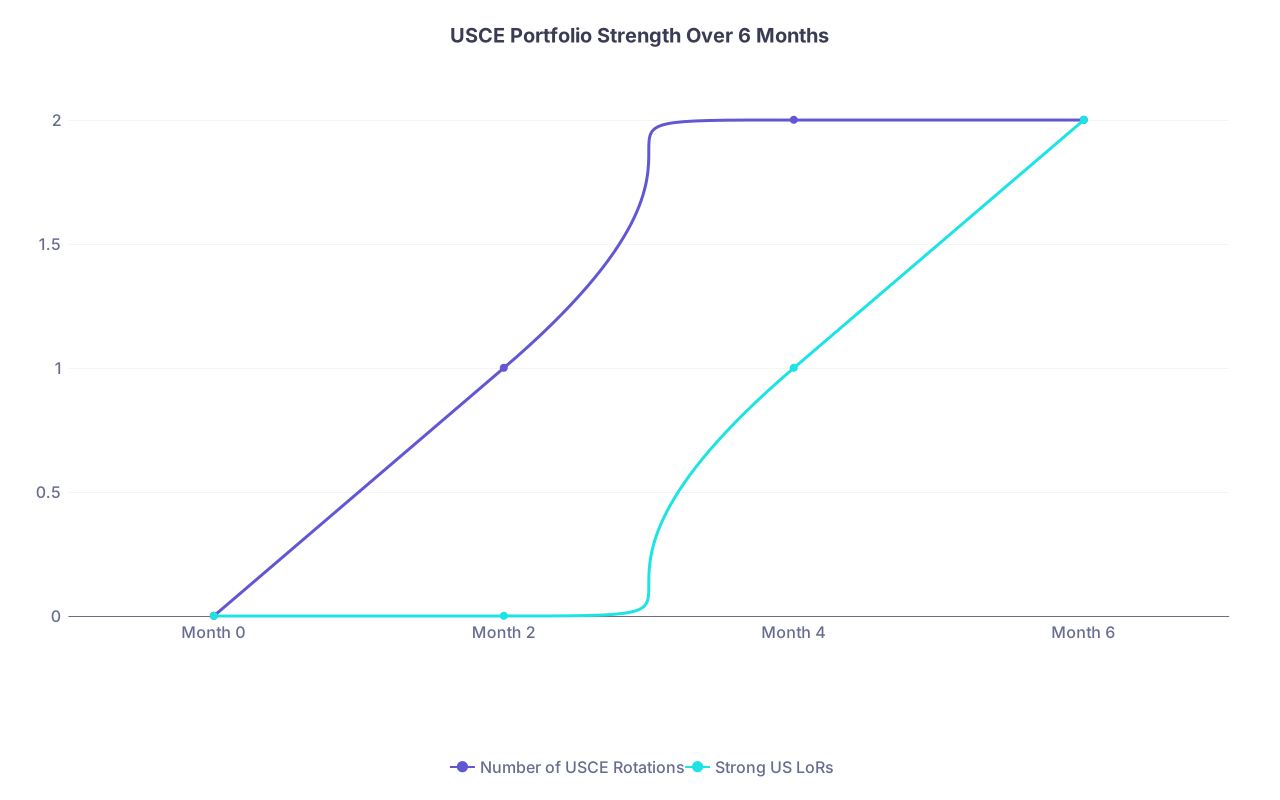
| Category | Number of USCE Rotations | [Strong US LoRs](https://residencyadvisor.com/resources/us-clinical-experience-imgs/converting-usce-into-strong-lors-a-conversation-by-conversation-plan) |
|---|---|---|
| Month 0 | 0 | 0 |
| Month 2 | 1 | 0 |
| Month 4 | 2 | 1 |
| Month 6 | 2 | 2 |
By Month 6, you want the graph to look like this:
- At least 2 rotations
- At least 2 strong letters
- Experiences clearly aligned with a single specialty
Step 10: Put It All Together into a Realistic Weekly Routine
During an active rotation, your weekly structure should look something like this:

Monday–Friday (clinic / hospital days):
- 7:00–5:00: Rotation (including commute)
- 6:00–7:00: Review 1–2 interesting cases from the day, read guidelines or UpToDate
- 7:00–7:30: Update rotation log (patients seen, responsibilities, any feedback)
- Once per week: Prepare a brief 5–10 minute teaching presentation
Saturday:
- 2–3 hours:
- Refine ERAS entries
- Update CV
- Draft bullet points for what you actually did this week to later share with letter writers
- 2–3 hours:
- USMLE practice or specialty reading (if Step 2 still pending)
Sunday:
- Light review, plan for upcoming week
- One email to an attending or coordinator about potential future opportunities or projects
This is how you squeeze every drop of value from those four weeks.
If You Are Starting Very Late (Applications in <3 Months)
If you are under 3 months from ERAS submission and just waking up to this, you do not have six months. So you triage.
Priority list:
- One 4-week rotation in your target specialty that finishes before or just after ERAS opening.
- One strong US letter from that rotation.
- Aggressive networking during that rotation:
- Ask attendings where you should apply.
- Ask if their program considers IMGs.
- Express clear interest in their institution.
You might add a second rotation later in the season and upload a new letter mid-cycle, but your main priority is getting something solid into the application by the time PDs first review it.
Your Next Action Today
Do not just nod along and move on. Open a document and:
- Write your target specialty at the top. Commit.
- List 3 possible USCE windows over the next 6 months (e.g., “Jul–Aug in-person in NY,” “Sep–Oct flexible, any state”).
- Draft a short email template for direct observership outreach.
- Shortlist 10 hospitals/clinics today and send at least 5 emails.
If you do that in the next 2 hours, you have already started upgrading your clinical portfolio.