Any USCE is not good USCE. That belief has sunk more IMG applications than a low Step score.
If you’re an IMG, you’ve probably heard some version of: “As long as you have U.S. clinical experience, you’re fine. Observerships, externships, shadowing – it all counts.”
That’s wrong. And it is dangerously comforting.
Program directors do not treat all “USCE” equally. Some types of experience help you. Some are neutral. Some are a red flag when they see what you call “USCE” in your CV versus what they consider actual clinical work.
Let’s dismantle this properly.
What Programs Actually Mean by “USCE”
Programs are not confused about this. Applicants are.
When most residency programs say “USCE,” they are implicitly thinking of one thing: clinically hands-on, supervised experience in a U.S. healthcare setting that mimics the role of a medical student or intern.
That usually means:
- You touch patients.
- You write notes that go into the chart (even if cosigned).
- You present patients on rounds.
- You’re evaluated formally and can generate a meaningful LOR.
Contrast that with what a lot of IMGs list as “USCE”:
- Two-week “observership” in a private clinic where they never touched a patient.
- Three-month “externship” that is actually shadowing with a glorified certificate.
- Online “tele-externship” where they watched cases on Zoom.
- A “research externship” that is basically data entry and PubMed.
Program directors are not fooled by clever wording. They see the structure, setting, and supervisor, and they know exactly what bucket your experience belongs in.
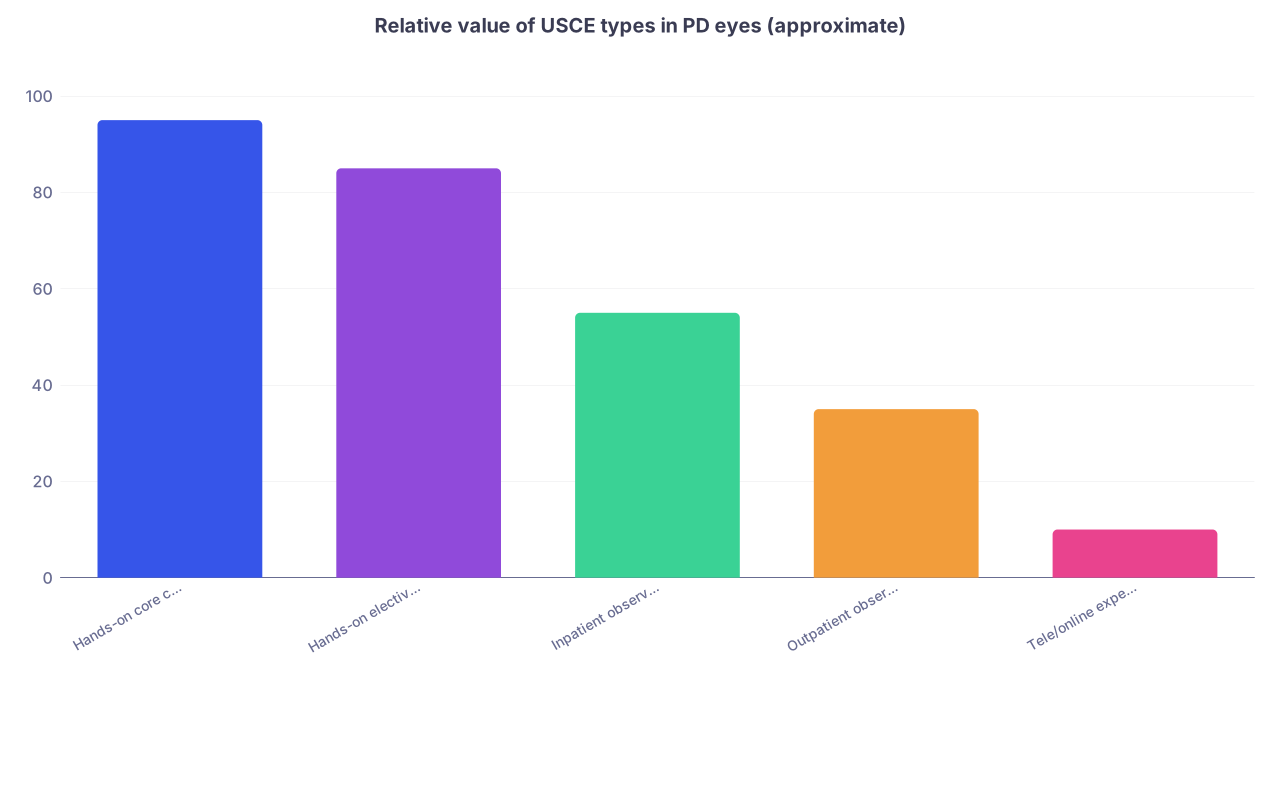
| Category | Value |
|---|---|
| Hands-on core clerkship | 95 |
| Hands-on elective/subI | 85 |
| Inpatient observership | 55 |
| Outpatient observership | 35 |
| Tele/online experience | 10 |
Those numbers aren’t from a single study; they’re a reality check based on PD survey trends and what consistently shows up in match outcomes. Hands-on inpatient experience and strong letters track with better match rates. Passive, short, outpatient-only observerships barely move the needle.
You do not have to like this. But you do need to understand it.
The Hidden Hierarchy of USCE (That No One Explains Honestly)
I’ve seen this play out dozens of times with IMGs who are confused why their “1 year of USCE” did not help much. Then we dig and find out:
- 4 months: outpatient shadowing in private practices
- 3 months: fee-based observerships through small clinics
- 5 months: “tele-externships” during COVID
On paper, that’s “12 months of USCE.” In PD reality, that is closer to 2–3 months of meaningful exposure, and even that depends heavily on letters.
Here’s the rough hierarchy of value, from strongest to weakest, for most Internal Medicine/FM/IM subspecialty–oriented IMGs:
| Type of Experience | Typical PD Perception |
|---|---|
| U.S. core clerkships (as enrolled student) | Gold standard |
| U.S. electives/sub-internships (hands-on) | Very strong |
| Structured IMG “externships” with notes & presentations | Moderate to strong |
| Inpatient hospital observerships | Moderate if letters strong |
| Outpatient-only observerships | Weak to moderate |
| Telemedicine/online “USCE” | Very weak / often ignored |
And then there’s the subtle but critical twist: setting and supervisor matter almost as much as label.
- Experience at a U.S. academic center with residency programs >> random private office with no trainees.
- Supervision by a core faculty/residency PD >> lone community doc who has never been involved in GME.
- Inpatient > outpatient for most IM specialties, particularly if you want hospital-based training.
You can call something “externship” all you want. If the attending writes, “She observed me in clinic and was very punctual,” that is a shadowing letter in a cheap suit.
What the Data and PD Surveys Actually Show
Let’s pull away from marketing language and look at what the people selecting you actually say.
The NRMP Program Director Surveys (for IM, FM, etc.) are clear on a few consistent points:
- U.S. clinical experience is valued, especially for IMGs, but they rarely define it as “any exposure.”
- Letters of recommendation in the specialty from U.S. physicians are high-impact factors.
- Demonstrated performance in a U.S. clinical environment (clerkships, electives, sub-internships) is especially important for IMGs.
Programs aren’t looking for “time spent in a building with American patients.” They want proof of:
- Clinical reasoning in a U.S. system.
- Communication with patients and teams in U.S. context.
- Reliability and work ethic judged by someone they trust.
Those things require you to actually do work, not stand behind the attending with a folded arms and a visitor badge.
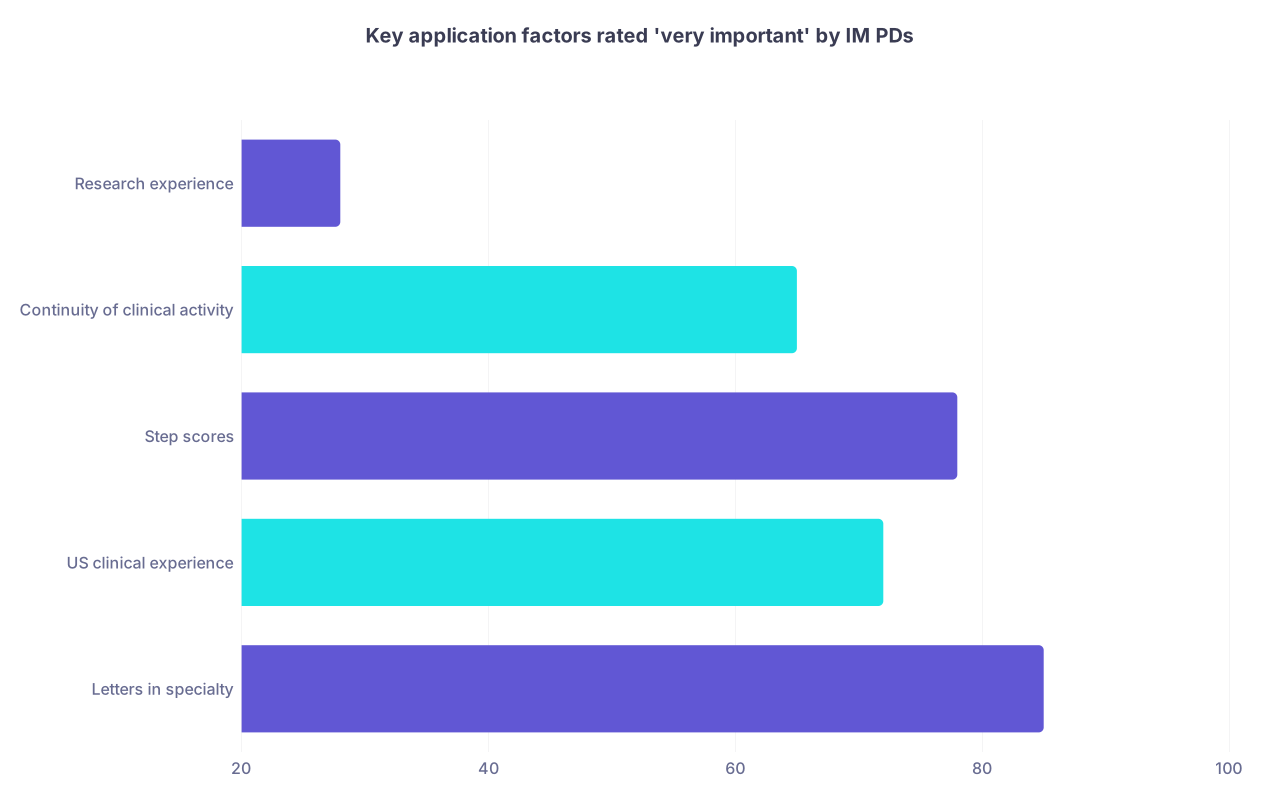
| Category | Value |
|---|---|
| Letters in specialty | 85 |
| US clinical experience | 72 |
| Step scores | 78 |
| Continuity of clinical activity | 65 |
| Research experience | 28 |
Again, values are representative of published survey trends, not an exact year’s percentages. The point is this: “US clinical experience” is valued, but it is the form and depth that determine reality.
If your “USCE” produces weak, generic, observational letters, you’re not playing the same game as the IMG who did two strong IM electives at a teaching hospital and has letters from an associate program director.
Common IMG Traps: Expensive, Useless, or Actively Harmful “USCE”
The market preys on IMGs who believe “anything counts.” That myth keeps a lot of third-rate observership mills in business.
Trap 1: The Pay-to-Sit Observership
You pay thousands to sit in a private practice, mostly outpatient, where:
- You’re not allowed to touch patients.
- There’s no structured curriculum.
- No residents or students are around.
- The attending has limited or no GME involvement.
Will this ruin your application? No. Will it transform your chances? Also no. At best, it shows “some exposure to U.S. outpatients.” At worst, PDs shrug and mentally downgrade it.
Trap 2: The “Externship” That Is Just Shadowing Rebranded
Plenty of services slap the word “externship” on what is, functionally, an observership:
- You don’t write notes.
- You don’t place orders, even in a pseudo-mode.
- No one expects you to pre-round, present, or follow a list of patients.
If you’re not performing core clinical student functions, you are not doing what PDs imagine when they hear “externship.”
I’ve sat with IMGs who proudly write “Clinical Externship – Internal Medicine” and then admit in conversation: “I just followed the attending, asked questions, and watched.” That will unravel instantly in an interview.
Trap 3: Overloading on Outpatient Only
Many IMGs stack outpatient-only experiences thinking volume will substitute for quality. Six months in ambulatory clinics ≠ one strong inpatient elective at a teaching hospital.
For Internal Medicine especially, program directors want to know: Can you handle wards? Admissions? Cross-cover? Night float dynamics? Outpatient-only exposure doesn’t answer that.
Trap 4: Online / Tele “USCE”
Let me be blunt: most PDs do not care that you watched telemedicine visits from another country. Online “tele-externships” exploded during COVID; the problem is that the bar did not.
You’re already an IMG. The main question is: can you function in their clinical environment with their patients and their systems? You cannot demonstrate that through Zoom from 8,000 miles away.
How PDs Actually Read Your USCE Section
Picture the PD screening 1,200 files who has 15 seconds on your CV before deciding “interview” or “no.”
This is roughly the mental checklist for an IMG’s “US Clinical Experience” section:
Where was it?
- U.S. academic hospital with residency program? Good.
- Community hospital? Could be fine.
- Random private clinic? We’ll see.
What did you do?
- Notes? Presentations? Patient interaction?
- Or just “observed patient care and learned about the U.S. system”? (A classic filler phrase that screams passive.)
Who supervised you?
- Core faculty, PD, APD, or known teaching doc? Stronger.
- Solo practitioner in dermatology when you’re applying IM? Weak and misaligned.
What letters did it generate?
- Length, specificity, and credibility matter more than the line item itself.

| Step | Description |
|---|---|
| Step 1 | See USCE entry |
| Step 2 | Private clinic / office |
| Step 3 | Counts as strong USCE |
| Step 4 | Moderate value - observership |
| Step 5 | Weak to moderate value |
| Step 6 | Low value / unrelated |
| Step 7 | Hospital-based? |
| Step 8 | Hands-on role? |
| Step 9 | Specialty aligned? |
Notice what’s missing: no one is counting raw “months of USCE” like it’s money in a bank account. Quality, setting, and role matter more than total duration once you clear a basic minimum.
Strategic USCE for IMGs: What Actually Moves the Needle
No, you don’t need five different U.S. hospitals and a year of unpaid work. You need a few high-yield blocks that generate credible performance evidence.
For most IMGs in IM/FM/Neurology/Peds–type fields, an efficient pattern looks like this:
- Total of 3–4 months of meaningful U.S. clinical exposure.
- Majority (or all) in your target specialty.
- At least part of it in an environment with:
- Existing residency programs, or
- Strong academic affiliations, or
- Physicians heavily involved in teaching.
From that, you want:
- 2–3 strong U.S. letters in your specialty, ideally from faculty who know what a good resident looks like.
- Evidence in your CV and PS that you actually did clinical work: presentations, pre-rounding, taking histories, notes.
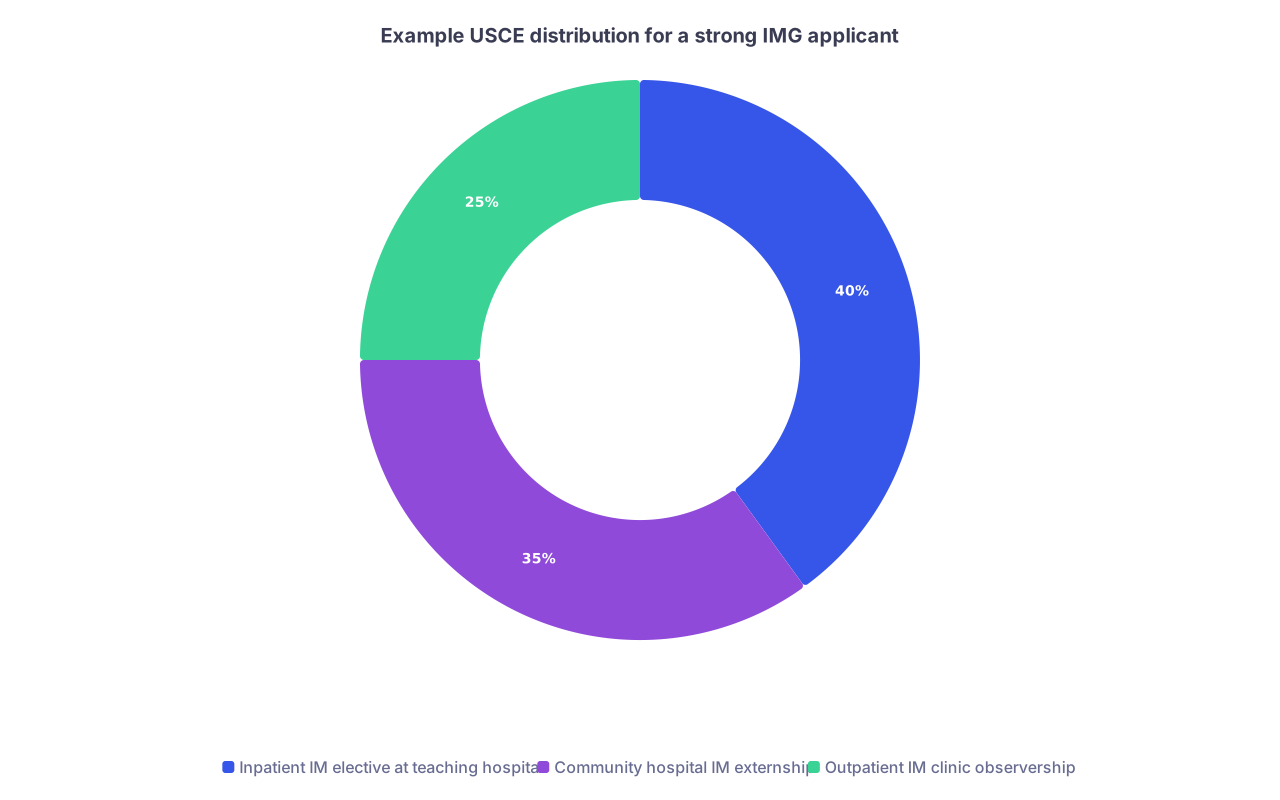
| Category | Value |
|---|---|
| Inpatient IM elective at teaching hospital | 40 |
| Community hospital IM externship | 35 |
| Outpatient IM clinic observership | 25 |
Notice that outpatient experience can still play a role. It’s just not the foundation. You don’t need to erase observerships; you need to stop pretending they equal hands-on electives.
How to Judge a USCE Opportunity Before You Waste Time and Money
You should interrogate any “USCE” offer with the intensity of someone who knows they only get a few real chances. Because you do.
Critical questions:
- Will I interact directly with patients? History, physical, counseling?
- Will I write notes? Even if they are “student notes” cosigned?
- Will I present on rounds or in some structured setting?
- Will there be residents or medical students around?
- Is my supervisor part of a residency program or known teaching faculty?
- Is there a formal evaluation or structured feedback process?
- Are letters from this experience typically used successfully by other IMGs?
If the answers are vague or defensive, walk away. “You’ll learn a lot by seeing American patients” is a polite way of saying, “You will be watching from the wall.”

You are not a first-year student desperate for exposure. You are close to residency age. Programs want to see you operate closer to intern level, not tourist level.
The Role of Weak USCE: When “Any” Is Actually Fine
Here’s the nuance. “Any USCE” isn’t completely worthless. It just doesn’t do what people think.
Low-yield USCE can help if:
- You have a massive gap with no clinical activity. Even a modest observership is better than a dead zone.
- You’re extremely early and trying to get a feel for U.S. culture and norms before doing higher-impact rotations.
- It’s cheap, local, and doesn’t block you from better opportunities.
Where IMGs get burned: they spend thousands and months on low-yield experiences and then run out of time, money, or visa options before setting foot in a high-yield hospital-based role.
Your first observership can be “any.” Your critical pre-application USCE cannot.
Packaging Your USCE So It Actually Signals What You Did
Another quiet killer: weak descriptions. Many IMGs undersell their best experience by describing it like shadowing. Or oversell shadowing with inflated language that collapses during interviews.
For strong, hands-on experience, your descriptions should include:
- Setting: inpatient vs outpatient; teaching vs community.
- Role: pre-rounding, independently seeing patients (with supervision), presenting, writing notes.
- Scope: admissions, discharges, follow-ups, case presentations, QI projects.
For example:
Clinical Elective – Internal Medicine, XYZ University Hospital
Inpatient ward rotation functioning at U.S. 4th-year medical student level. Independently obtained histories and performed physical exams; presented new admissions and daily follow-ups on rounds; authored draft progress notes and discharge summaries for supervisor review; participated in morning report and case conferences.
That reads very differently from:
Observed internal medicine practice and learned about the U.S. healthcare system. Attended clinic visits and discussed cases with attending.
Both might be “USCE” in your mind. Only one looks like what PDs want when they say “U.S. clinical experience preferred.”

Reality Check: You Cannot Fix Everything With USCE
Let me kill another quiet myth: strong USCE does not erase everything else.
- Very low Step scores + brilliant USCE = still a long shot at many programs.
- Huge multi-year gaps + brief USCE right before applying = suspicious.
- Completely unrelated USCE (e.g., pure cosmetic derm) when applying to IM = misaligned.
USCE is one lever among many. But if you’re an IMG, it’s one of the few levers you can still move after you’ve taken exams. That’s exactly why you cannot afford to waste it on vanity observerships.
Bottom Line: What You Should Actually Do
Strip away the marketing. Forget the comforting myths. For an IMG targeting U.S. residency:
Not all USCE is equal. Hands-on, inpatient, specialty-aligned experience at teaching or hospital-based sites beats long lists of passive observerships and tele-rotations.
Aim for depth, not just duration. A focused 3–4 months of strong USCE that generates serious letters will outperform a scattered year of low-yield experiences almost every time.
Interrogate every opportunity. If you are not touching patients, not writing notes, not presenting, and not supervised by someone involved in training, then what you have is exposure, not meaningful USCE—and residency programs can tell.