
You’ve been lied to about US clinical experience.
The idea that you “must have 12 months of USCE to match” is one of the most persistent, expensive, and harmful myths pushed on international medical graduates. It drains savings, delays careers, and sends people into predatory observership mills that do absolutely nothing for their match odds.
Let me be blunt: outcomes data does not support the claim that you need a full year of USCE. Not even close.
What Programs Actually Care About (Spoiler: It’s Not 12 Months of Anything)
Program directors aren’t sitting there with a spreadsheet sorting IMG applicants by “months of USCE” and drawing a line at 12. That’s not how this works.
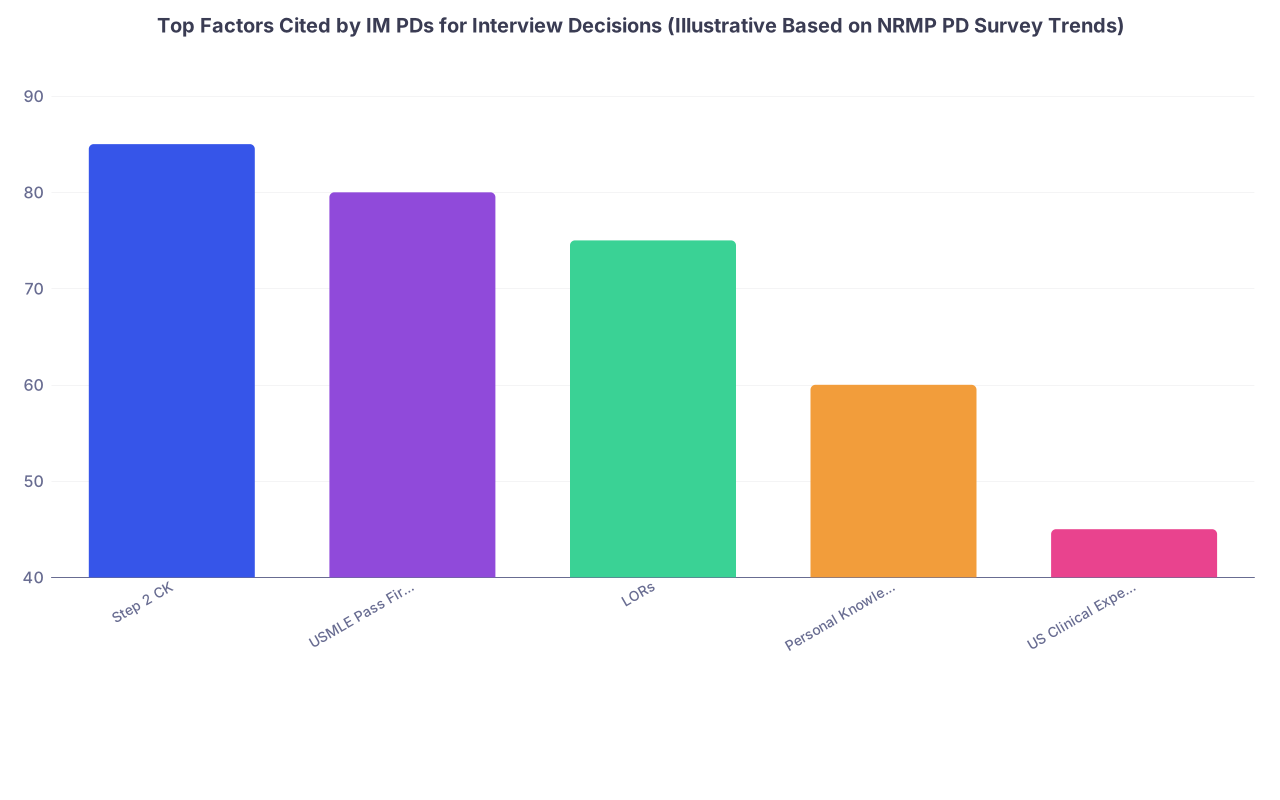
Look at what they themselves say. NRMP’s “Program Director Survey” (the only large-scale, systematic snapshot of what PDs care about) consistently lists these as top factors:
- USMLE Step 2 CK score
- Passing USMLE exams on first attempt
- MSPE / Dean’s letter
- Class ranking/grades
- Interview performance
- Personal prior knowledge of the applicant
- Letters of recommendation in the specialty
US clinical experience shows up, yes. But not as “one year mandatory” and not as a top-3 driver.
| Category | Value |
|---|---|
| Step 2 CK | 85 |
| USMLE Pass First Attempt | 80 |
| LORs | 75 |
| Personal Knowledge | 60 |
| US Clinical Experience | 45 |
Those numbers are representative of the pattern: exam performance and LORs dominate. USCE is mid-tier. Important, but not the make‑or‑break god people treat it as.
I’ve sat in selection meetings where an IMG’s packet was discussed like this:
“Step 2 253, solid research, two strong US letters from known faculty, 3 months of US rotations.”
“Yeah, interview.”
Not one person stopped to ask, “Why not 12 months?”
Because they don’t care about that number the way you think.
The “Year of USCE” Myth: Where It Comes From
The myth has three main sources:
Program misinterpretation.
Some program websites have lazy boilerplate: “We prefer 6–12 months of US clinical experience.” That’s not data. It’s copy-paste text nobody has updated since 2012.Forum echo chambers.
One person with 12 months of USCE and a good match result posts their story. They attribute causality to the thing they sacrificed most for — the year in clinics — not to their 245+ score and strong letters. Confirmation bias wrapped in survivor bias.Predatory USCE “providers.”
Observership mills, “externship” agencies, and middlemen make a lot of money selling fear. “Programs require 12 months of USCE” is a great sales pitch. It’s just not true.
You’ll notice something if you actually examine match data: many matched IMGs have far less than a year of USCE. Some have none, especially if they’re from well-known schools with strong home letters and recent graduation.
What Outcomes Data Actually Shows About USCE
Let’s anchor this in match outcomes, not vibes.
ECFMG and NRMP data consistently show these patterns for IMGs:
- Higher Step 2 CK → higher match rate.
- Recent YOG → higher match rate.
- No USMLE failures → higher match rate.
- Strong specialty-aligned applications (research, LORs, personal statement) → higher match rate.
USCE is part of the story, but it’s not linear and it’s not “12 months or bust.”
The Diminishing Returns Problem
You see meaningful benefit going from 0 USCE → 2–3 months of solid, hands-on experience in your target specialty. You see less benefit going from 3 → 6 months. And going from 6 → 12 months? That’s where the curve flattens hard.
Programs want to know:
- Can you function in a US hospital system?
- Do you understand documentation, communication norms, and team structure?
- Do you have at least 1–2 US letters from people who actually worked with you clinically?
You do not need 12 months to answer those questions. You need 2–3 quality rotations. Quality means:
- Direct patient care (not shadowing silently in the back)
- Daily assessment by attendings or senior residents
- Real notes, presentations, case discussions
- A path to a detailed, personalized letter
| USCE Amount | Typical Impact on Application |
|---|---|
| 0 months | Red flag for many IM-specialty programs, especially if older grad |
| 1 month | Minimal unless very strong letter or big-name recommender |
| 2–3 months | Major jump; enough to prove function and get 1–2 solid letters |
| 4–6 months | Marginal gains; better for very weak/noncompetitive profiles |
| 7–12+ months | Diminishing returns; often indicates overcompensation or misadvised strategy |
Will more months ever help? Sure — if your profile is otherwise weak (borderline scores, older YOG, no research). But even then, another 6 months of observing isn’t what rescues the application. Strategic, high-yield experiences might. Not time served.
The Quality vs Quantity Trap
Here’s where a lot of IMGs go off a cliff: they chase months instead of value.
I’ve seen this pattern too many times:
- Step 2 CK 248.
- YOG 3 years ago.
- Two solid rotations at mid-tier US academic hospitals.
- Decent research in their home country.
Then someone tells them, “You need at least a year of USCE to be competitive.” So they:
- Buy 6–8 more months of low-quality “externships” in community clinics or no-name offices.
- Delay applications a cycle.
- Spend $10,000–$30,000 on fees, housing, travel.
And what do they end up adding?
- Repetitive, low-impact experiences.
- Weak, generic letters that say nothing more than “hard-working and punctual.”
- A longer gap since graduation.
They traded a timely application and potential research or Step improvement for a pile of “Experience: Clinic observer, City X” entries no one is impressed by.
Quality USCE looks like:
- Sub-I / acting internship equivalents where you’re writing notes (even if not in the official chart)
- Inpatient or structured outpatient rotations with teaching rounds
- Exposure to multidisciplinary teams, EMR, and US-style handoffs
- Faculty that know how to write match-relevant letters and actually do it
Quantity USCE looks like:
- Shuffling between private office practices observing 10-minute visits
- Standing in the corner of an exam room like a coat rack
- No formal evaluation, no feedback, no letter or a one-paragraph template letter
The first kind helps your match odds. The second kind pads your CV and empties your bank account.

Specialty Differences: Where USCE Actually Matters More
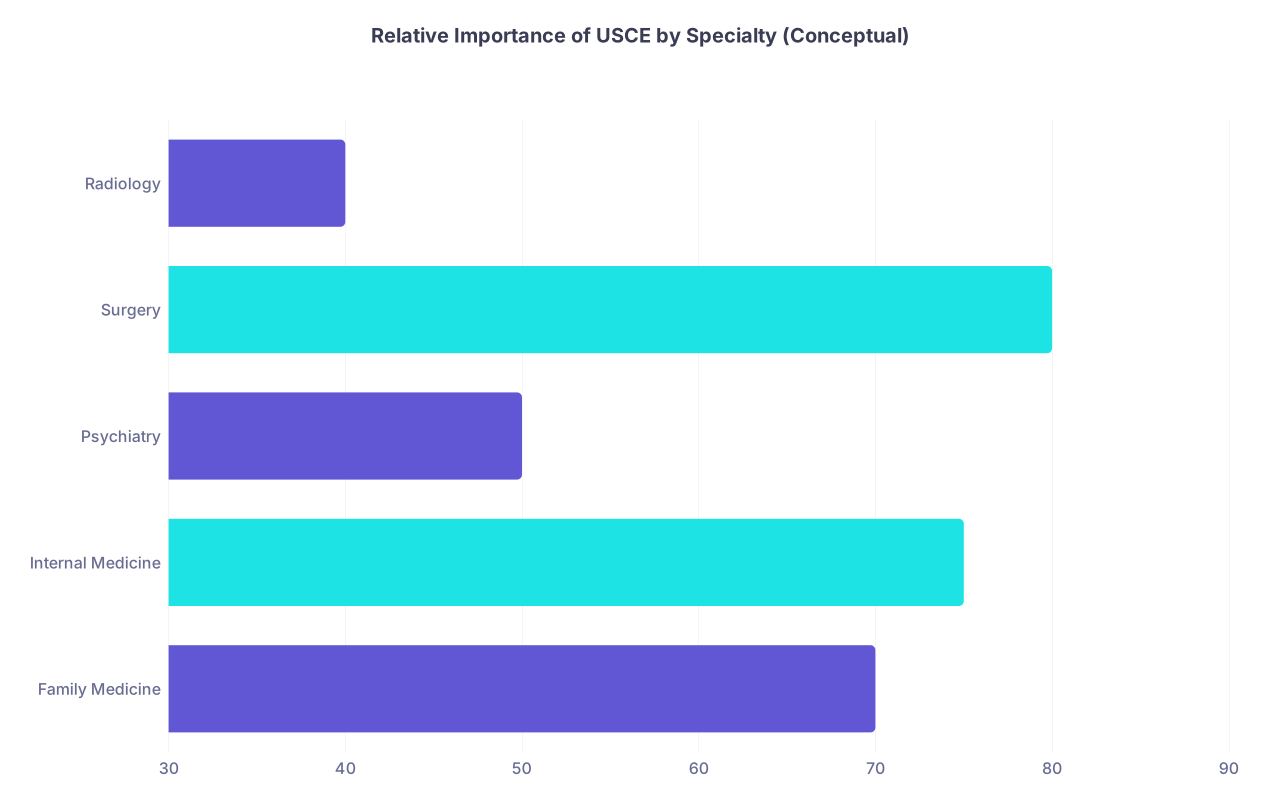
The “need a year of USCE” myth also ignores specialty context. Not all fields care equally.
Internal Medicine / Family Medicine
These are the bread-and-butter IMG specialties.
Patterns I’ve seen and that align with survey data:
- Programs want clear evidence you can function in US systems.
- They strongly prefer US letters in IM/FM.
- They often like at least 2–3 months of relevant USCE.
But they do not require 12 months. What matters is:
- At least one strong US letter from an inpatient IM/FM rotation.
- Ideally another letter (US or strong home institution) backing up your competence.
- Enough USCE to show you’re not starting from scratch.
You’ll find some community programs saying “6 months preferred.” But look at their current residents. Many won’t have that.
Surgery / Procedural Specialties
Here, USCE can matter more — but still not in a “one year” way.
For surgery, EM, OB/GYN, etc., what really matters is:
- Performance on a genuine, high-intensity US rotation (sub-I, AI, formal elective).
- A letter from a surgeon/ED/OB attending that clearly says you function at or near US senior medical student level.
- Evidence of procedural interest, stamina, and team fit.
Again: one excellent 4-week sub-I with a gold-standard letter beats eight months of unstructured “surgical observership” any day.
Psychiatry
Psych cares more about communication, insight, and professionalism than about how many months you trailed behind someone on wards.
A couple of targeted psych rotations plus coherent narrative (and decent scores) will do more work than an arbitrary number like “12.”
| Category | Value |
|---|---|
| Family Medicine | 70 |
| Internal Medicine | 75 |
| Psychiatry | 50 |
| Surgery | 80 |
| Radiology | 40 |
Where Long USCE Does Make Sense (Sometimes)
I’m not saying long USCE is always a mistake. I’m saying the blanket rule “everyone needs a year” is garbage.
Extended (6–12 months) USCE might be justifiable if:
- You’re an older graduate (5+ years since YOG) trying to show recent clinical activity.
- You had a USMLE failure and are trying to rebuild trust with a track record of sustained, supervised US work.
- You’re doing a structured non-ACGME clinical fellowship that leads directly to strong letters and PD-level advocates.
- You’re changing fields and need a whole new specialty‑specific portfolio.
Even in these cases, quantity is still not the main value. The structure, supervision, and letters are.
If your plan is: “I’ll just keep adding months in random observerships until programs think I’m worthy,” you’re solving the wrong problem. If your Step scores are weak and your YOG is older, 12 months of low-value USCE won’t magically hide that.

| Step | Description |
|---|---|
| Step 1 | Have 2-3 months solid USCE? |
| Step 2 | Prioritize getting 2-3 high-quality rotations |
| Step 3 | Older grad >5 years or USMLE fail? |
| Step 4 | Consider targeted extended USCE with strong supervision |
| Step 5 | Focus on scores, research, application quality |
The Real Levers: Where to Put Your Time and Money Instead
Every month you spend chasing extra USCE is a month you’re not:
- Improving your Step 2 CK (or Step 3) score
- Strengthening your English and communication
- Doing structured research with potential publications
- Refining your personal statement and application strategy
- Working in your home country or elsewhere to avoid large CV gaps
- Building relationships that turn into powerful letters
I’ve seen people postpone taking Step 2 or Step 3 so they could “finish one more observership block.” That’s backwards. A 10–15 point jump on Step 2 or a solid Step 3 score will move your match odds more than going from 4 → 8 months of random USCE.
If we’re being clinical about return on investment:
- First 2–3 months of strong USCE: High ROI
- Step 2/3 score improvements: Very high ROI
- Additional 3–9 months of generic USCE: Low to very low ROI
- High‑quality research in your target specialty: Moderate to high ROI, especially for academic-leaning programs

How Programs Actually Read “A Year of USCE”
Here’s a dirty little secret: to some program directors, a full year (or more) of USCE can actually raise questions.
They wonder:
- Why did this person need so much pre-residency time to get ready?
- Were they unable to match for multiple cycles? Why?
- Are they overcompensating for something hidden? (Multiple failures, professionalism issues, visa complications?)
I’ve heard PDs say variations of:
“If someone has 14 months of observerships and no USMLE failures, I’m curious why they spent so long in limbo. What’s the story?”
They don’t view more months as inherently better. At some point, it starts to look like drift.
You’re better off presenting a coherent, contained story:
- Graduated 2–3 years ago
- Took and passed USMLEs with competitive scores
- Did 2–3 months of targeted USCE in your chosen specialty
- Got 2–3 strong letters
- Applied promptly with a focused application
That profile looks decisive and prepared. Not desperate.
Common Pushbacks — And Why They’re Weak
You’ll hear a few standard lines from the “year of USCE” crowd.
“Everyone I know who matched had at least 12 months.”
No, everyone you talk to in your circle who matched might have had that. That doesn’t mean the thousands of other matched IMGs follow the same pattern. That’s sample bias.
“But program X says they require 6–12 months of USCE.”
Some do write that. Look at their actual residents. Many won’t meet that printed requirement. Web text lags reality. “Preferred” is not the same as “filter cut-off.”
“More USCE can’t hurt.”
It can. It can drain money, postpone exams, delay application cycles, and extend your YOG gap. Opportunity cost is real harm.

So What Should You Actually Aim For?
A realistic, data-aligned target for most IMGs:
- 2–3 months of high‑quality, hands-on USCE in your target specialty (or closely related)
- At least 1–2 strong US letters from those rotations
- USMLE Step 2 CK (and Step 3 if taken) strong for your specialty and visa status
- A timely application, not delayed to chase arbitrary USCE quotas
If you’re an older grad or had setbacks, you might stretch to 4–6 months, but with clear structure and purpose, not just “more is more.”
The key word is enough, not maximum.
Key points:
- There’s no outcomes-based evidence that IMGs need a full year of USCE to match; 2–3 months of solid, supervised USCE with strong letters is high-yield for most.
- Beyond a few months, the returns on extra USCE drop sharply, while exam scores, application timing, and letter quality matter far more.
- Chase quality and strategy, not an arbitrary “12‑month” target invented by rumor, outdated websites, and people trying to sell you rotations.