
The dogma that “you must stack as many short USCEs as possible” is wrong. Programs do not count observerships like Pokémon cards.
If you’re an IMG, you’ve probably heard this exact line from someone: “Bro, do four different 4‑week rotations. Program directors love variety.” Usually from another applicant, not an actual PD.
Let me be blunt: there is zero solid evidence that five scattered 3–4 week USCEs beat one or two well‑chosen, longer, high‑quality blocks. In fact, when you look at what programs actually value—continuity, strong letters, and believable integration into a team—the “short and many” strategy often backfires.
Let’s unpack what the data, PD surveys, and real‑world outcomes actually show.
What Program Directors Really Prioritize (Not What WhatsApp Says)
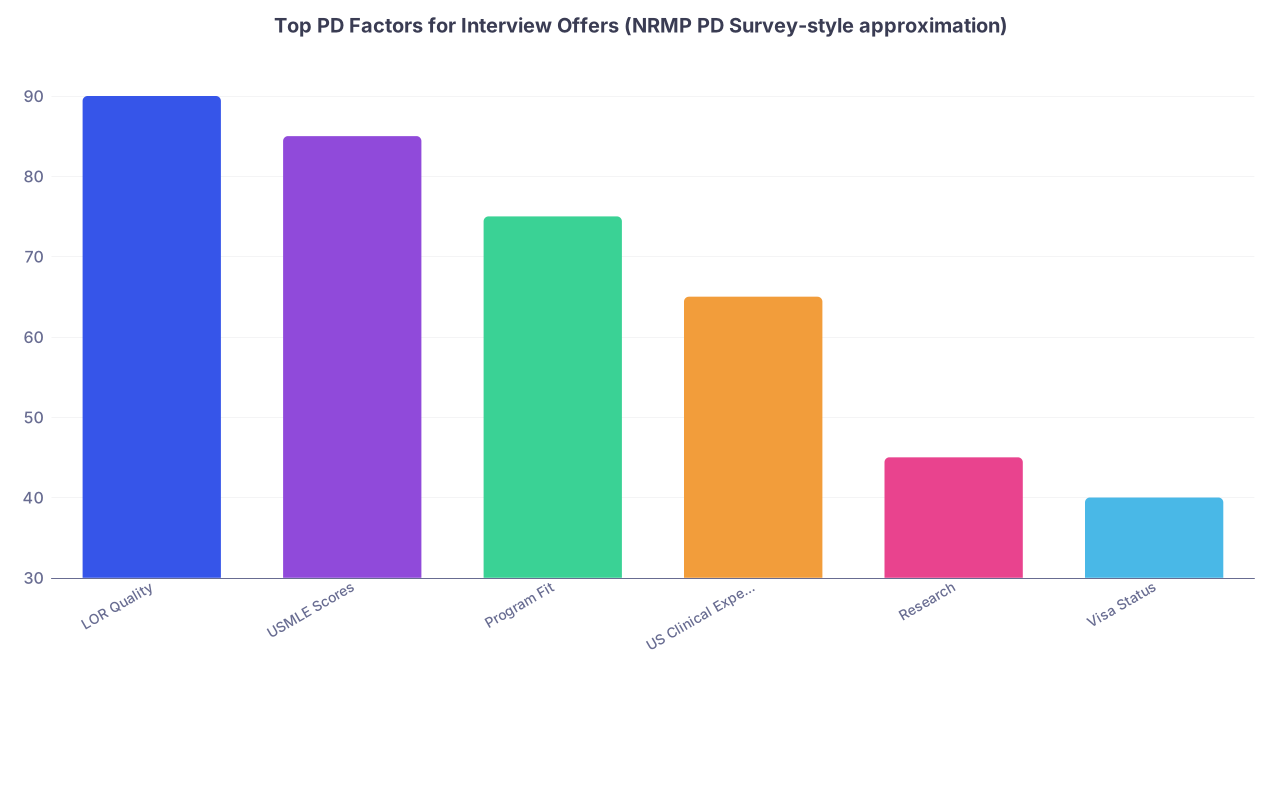
| Category | Value |
|---|---|
| LOR Quality | 90 |
| USMLE Scores | 85 |
| Program Fit | 75 |
| US Clinical Experience | 65 |
| Research | 45 |
| Visa Status | 40 |
Start with reality, not folklore.
Every few years, the NRMP surveys program directors about what influences their interview and ranking decisions. No, they don’t ask “How many 4‑week observerships should an IMG do?” But if you read between the lines, the picture is crystal clear.
Consistently, across specialties, the top items are:
- USMLE/COMLEX scores
- Letters of recommendation in the specialty
- Evidence of program fit / commitment to specialty
- Performance in US training environments (for IMGs: USCE, especially hands‑on and within the US healthcare system)
Here’s the part people conveniently ignore: “US clinical experience” as a box is much less important than what that experience produces—strong specialty‑specific letters and convincing proof you can function in a US system.
A four‑week observership where you trail behind three attendings, never write a note, and end up with a generic letter? It exists only to make you feel like you’re doing something.
A 12‑week hands‑on sub‑internship where you carry patients, pre‑round, present, write notes, and the attending knows your strengths and weaknesses? That generates the type of letter PDs actually read.
Multiple short blocks sound impressive. “I’ve done 5 US rotations.” But PDs are not scoring you by quantity like they’re doing inventory.
They ask two questions:
- Did this person function like a junior resident in a US environment?
- Did someone I trust stake their reputation on this applicant in a letter?
Those questions are much easier to answer “yes” after one longer, immersive experience than after five short cameos.
Why Long Blocks Often Beat Multiple Short USCEs

The main myth: “More blocks = more letters = more chances.” On paper, sounds logical. In practice, this runs into three hard walls.
1. Depth beats breadth for letters
Strong LORs require time. Nobody writes a powerful letter based on 8–10 half‑days of casual observation.
Think about these two scenarios:
- Applicant A: Does a single 12‑week medicine sub‑I at a university‑affiliated hospital, closely mentored by one attending and one senior resident. They carry 4–6 patients, present on rounds, communicate with nurses, and stay late some days.
- Applicant B: Does three separate 4‑week “observerships” in three cities. Mostly shadows, occasionally presents one patient, never writes notes because of EMR access issues.
Who gets the letter that says:
“This applicant functioned at the level of an intern on our busy inpatient service, demonstrated ownership of patients, and communicated effectively with staff and families. I would rank them in the top 10% of students I’ve worked with in the past five years.”
You do not get that sentence from four weeks of, “This is patient in room 12, can I present him?” once a day.
Longer blocks:
- Let attendings see your growth, not just a snapshot.
- Give you room to make mistakes, recover, and show resilience.
- Provide enough material for detailed, credible letters (with concrete examples, not clichés).
And PDs are trained to sniff out fluff letters instantly. Generic = weak = forgettable.
2. Continuity proves you can actually function like a resident
Residents don’t work in 4‑week glimpses. They show up, day after day, month after month, in the same system, with the same expectations.
One 8–12 week block at the same site shows:
- You can adapt to a system and keep up.
- You can maintain performance beyond the “honeymoon” week.
- You’re not just tourism‑hopping hospitals to pad a CV.
I’ve seen countless CVs like this:
3/2023: 4‑week observership, community hospital, New York
4/2023: 4‑week observership, outpatient clinic, New Jersey
5/2023: 4‑week observership, university hospital, Pennsylvania
It looks busy. It does not scream reliability or depth. It screams “short‑term visitor” who never actually integrated into a team.
Program directors aren’t idiots. They know a serial observership tourist when they see one.
3. Exposure does not equal evaluation
Another ugly truth: in many short USCEs—particularly observerships—no one is actually evaluating you in a structured way.
No mini‑CEX.
No formal presentation assessments.
Often no meaningful feedback at all.
So yes, you “saw how US medicine works.” That’s useful for you, but it’s almost worthless as a signal for programs.
PDs care about signals. And high‑fidelity signals require prolonged, observed performance. Which is exactly what a longer block gives.
When Multiple Short Blocks Do Make Sense
Now, I’m not saying multiple short USCEs are always useless. They’re not. They just aren’t the magic key they’re marketed as.
There are a few very specific scenarios where multiple short blocks are rational.
1. You’re legitimately undecided between two specialties
If you’re honestly torn between internal medicine and neurology, or FM vs IM, then doing two different 4‑week rotations—one in each—can help you decide and get at least one letter in your eventual specialty.
What doesn’t make sense is randomness: a 4‑week cardiology observership, a 4‑week outpatient orthopedic observership, a 4‑week nephrology clinic. That reads more like vacation than strategy.
2. You’re targeting a very specific geographic region
Programs care about “why here?” If you’re dead set on matching in the Midwest, doing two 4‑week rotations at different Midwest institutions can demonstrate regional commitment, especially if you have a local tie (family, spouse, etc.).
Still, even then, you’d prefer:
- One longer block at a strong anchor program
- One shorter at a nearby or affiliated program
Not six random 2‑week experiences in five states.
3. You have a visa/time constraint and cannot physically stay for a long block
This is a real limitation for some applicants. If your visa, finances, or job back home limit you to 4–6 weeks maximum, fine. In that case, choose the highest quality short experience you can find and stop obsessing about number.
More short rotations do not compensate for the lack of depth if all of them are low‑involvement shadowing.
What the Limited Data and Patterns Actually Show
There’s no RCT comparing “3×4 week USCE” vs “1×12 week USCE” for IMGs. Obviously. But we do have:
- NRMP PD surveys
- Outcome patterns from institutions that take many IMGs
- What PDs say when they’re off the record
Let’s be honest: programs that regularly match IMGs (big community IM, FM, some university‑affiliated programs) tend to favor:
- USCE in their own or similar settings
- At least one strong US letter from someone who understands US training levels
- Clear, consistent narrative: “I’m an IM applicant, I’ve actually done IM in the US, and somebody in IM is willing to back me.”
That’s incredibly hard to demonstrate with five scattered, shallow exposures.
To drive this home, here’s a simplified comparison of how PDs typically interpret different USCE patterns.
| USCE Pattern | Likely PD Interpretation |
|---|---|
| 8–12 weeks at one reputable IM/FM program with strong letter | Serious, integrated, can function on a team; high-quality signal |
| 4 weeks at one solid site, strong letter; plus 1–2 shorter rotations | Adequate depth plus some breadth; reasonable profile |
| 4–5 short observerships at 4 weeks each, no clear anchor or strong letter | Fragmented, tourist pattern; weak signal on actual performance |
| 0 USCE but strong USMLE and home country residency experience | Risky but not impossible; depends heavily on country/training reputation |
Notice the pattern: the single strongest configuration isn’t “maximum number of rotations.” It’s “one meaningful anchor experience plus maybe a couple of supporting ones.”
The Hidden Costs of Chasing Multiple Short USCEs

People rarely talk about the opportunity cost and red flags that come with chasing many short rotations.
Cost and burnout
Every USCE block costs:
- Travel
- Housing (often short‑term, expensive)
- Application or “program fee”
- Lost income from not working at home
Four or five short stints in different states can burn through $10,000+ very quickly. Money that might’ve been better spent on:
- A longer, higher‑quality, more hands‑on sub‑I
- Step 3
- A research position that leads to US publications and networking
More is not always better. Sometimes more is just more expensive.
Fragmented narrative
Admissions committees read stories, not spreadsheets. When they look at your timeline, they ask, “Does this make sense?”
A messy pattern like:
- Jan: 4‑week nephrology observer
- Mar: 4‑week GI observer
- May: 4‑week cardiology observer
- Jul: 4‑week urgent care observer
…may raise the question: “What exactly is this person applying for? IM? Cards? GI? EM? Anything that moves?”
It’s better to have:
- One main IM/FM inpatient rotation
- One aligned outpatient or subspecialty experience
- Possibly research or QI attached to one of them
Cohesive. Focused. Defensible.
So, What Should an IMG Actually Aim For?
](https://cdn.residencyadvisor.com/images/articles_svg/chart-relative-impact-of-usce-qualities-on-match-value-8667.svg "Relative Impact of USCE Qualities on Match Value")
| Category | Value |
|---|---|
| Quality of LOR from USCE | 95 |
| Hands-on responsibilities | 85 |
| Duration at one site | 75 |
| Total number of USCE sites | 45 |
| [Prestige of hospital name only](https://residencyadvisor.com/resources/us-clinical-experience-imgs/why-prestigious-hospital-names-in-usce-dont-guarantee-interviews) | 40 |
Strip away the noise. If you’re planning USCE as an IMG for the match, the hierarchy looks more like this:
- Strong, specific US LORs in your specialty
- Hands‑on or at least high‑involvement roles where you’re evaluated like a junior trainee
- Reasonable duration at one place (usually 8–12 weeks is ideal, 4–8 is workable)
- Logical specialty and geographic alignment with your application
- Total number of different sites—this is last, not first
If you can only afford or arrange one rotation: pick the best, longest, most involved one you can. Do not split it into two random short observerships just to inflate your “USCE count.”
If you can do two or three blocks: make one of them a clear anchor (longer, more responsibility, likely to yield a strong letter), and let the others play supporting roles.
A Simple Mental Test Before You Book Anything
Before paying for another short USCE, ask yourself:
“If this rotation disappeared from my CV completely, but I kept my best letter, would my application materially weaken?”
If the honest answer is “No, not really,” you probably don’t need that rotation.
Programs don’t care how many hospital lobbies you’ve walked through. They care who has seen you work, for how long, and whether that person is willing to say, in writing, “I would trust this applicant with my patients.”
FAQ (4 Questions)
1. Is four weeks of USCE enough, or do I absolutely need 8–12 weeks?
Four weeks at a solid site with a high‑involvement role can be enough to get one strong letter, and for some applicants that’s all they manage and they still match. But in competitive environments and for less‑known schools/countries, 8–12 weeks at one or two sites gives a far stronger and more believable signal. If you have the choice between 12 weeks at one good program vs 3×4‑week low‑involvement observerships, take the 12‑week option every time.
2. Do programs literally count how many USCEs I have?
No. They glance at your experience to see: did you do USCE, is it in this specialty, and did anything real come out of it (letters, responsibilities, narrative fit)? They’re not awarding extra points just because you wrote “USCE” six times on your CV. Often they barely register more than your main one or two experiences.
3. Are observerships useless compared to externships or sub‑Is?
Not useless—but clearly weaker. Hands‑on externships/sub‑Is are superior because they mimic actual resident responsibilities and generate higher‑quality letters. An observership can still help if it’s your only option or if you use it to build a strong relationship with one attending who writes you a detailed letter. But stacking observerships without genuine involvement quickly reaches diminishing returns.
4. If I already did several short USCEs, should I still pursue a long one?
If you have the time and money, yes—especially if you don’t yet have at least one excellent US letter in your target specialty. Your previous short USCEs aren’t wasted, but they’re not a substitute for one anchor rotation where you’re truly evaluated. The long block can “rescue” a scattered profile by giving PDs one clear, strong data point to trust.
Key points:
Multiple short USCEs are massively overrated. One longer, high‑quality, hands‑on block that generates a strong letter usually beats several shallow observerships. Programs care about depth, evaluation, and believable performance—not how many hospital badges you’ve collected.