
Most IMGs start USCE planning a full year too late. That is why their ERAS ends up padded with observerships instead of meaningful clinical roles.
You want the opposite. Real responsibility, strong letters, and a clean, logical story from Step 1 all the way to ERAS submission.
I am going to walk you through that timeline. Month by month. Phase by phase. At each point: what you should be doing, what is already too late, and what you absolutely must not mess up.
Big Picture: 24-Month USCE + ERAS Timeline
If you are 18–24 months from your desired Match, you are on time. If you are closer, you are in catch‑up mode. Either way, follow this structure.
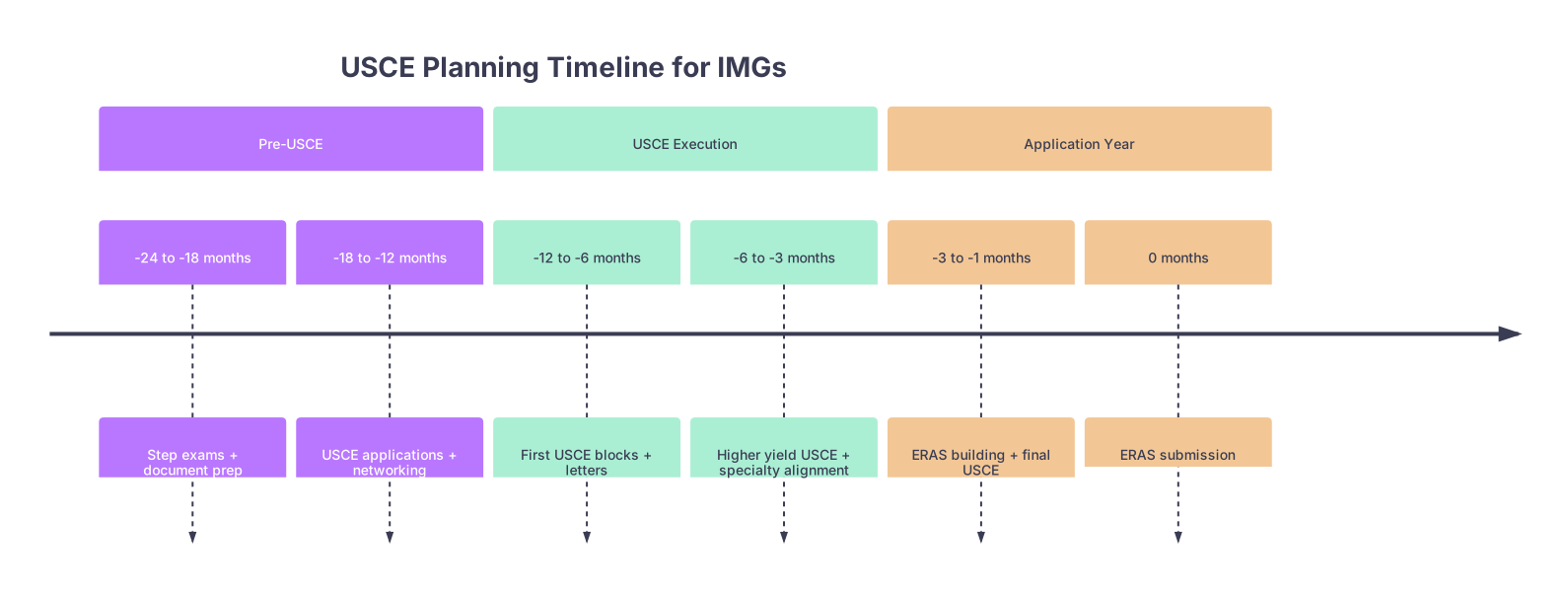
| Period | Event |
|---|---|
| Pre-USCE - -24 to -18 months | Step exams + document prep |
| Pre-USCE - -18 to -12 months | USCE applications + networking |
| USCE Execution - -12 to -6 months | First USCE blocks + letters |
| USCE Execution - -6 to -3 months | Higher yield USCE + specialty alignment |
| Application Year - -3 to -1 months | ERAS building + final USCE |
| Application Year - 0 months | ERAS submission |
Now let’s zoom in and get specific.
Phase 1: 18–24 Months Before ERAS – Build the Foundation
At this point you should stop thinking about rotations and start fixing your prerequisites.
Step 1: Exams and Eligibility (Months −24 to −18)
You cannot get serious USCE at many academic hospitals without key pieces in place.
By about 18–24 months before ERAS, you should:
- Have Step 1 done (preferably passed on first attempt; high pass if graded, obviously).
- Be planning Step 2 CK with a target completion no later than 3–4 months before ERAS.
- Start ECFMG certification pathway tasks:
- Verify medical school is in the World Directory with ECFMG note.
- Register with ECFMG.
- Understand what your Pathway requirements will be for certification.
If you are still debating Step 1 timing at this stage, you are already giving up prime USCE windows.
Step 2: Define Your Target Specialty and Geography
At this point you should pick a primary specialty. Yes, even if it might change later.
- For USCE planning, you need a working primary choice (e.g., Internal Medicine).
- Decide:
- Core specialty: IM, FM, Psych, Pediatrics, etc.
- 1–2 target regions: Northeast, Midwest, etc. (helps with networking and visas).
Scattershot USCE in random specialties and random states looks unfocused on ERAS. I see this mistake constantly.
Step 3: Document and Credential Prep (Months −22 to −18)
Programs and hospitals will ask for:
- Passport
- Immunization records and titers
- TB screening
- CV in US format
- Dean’s letter / transcript (sometimes)
- Proof of malpractice coverage (often provided by rotation agency or school)
- Background checks / drug screen (depends on site)
At this point you should:
- Create a clean, one‑page US‑style CV:
- Name, contact, education, exams, experiences.
- Remove excessive high school / irrelevant non‑clinical items.
- Assemble a digital folder with all documents scanned and labeled.
- Identify whether your country visa situation will limit:
- In‑person rotations.
- Future residency visa (J‑1 vs H‑1B friendly regions).
Phase 2: 12–18 Months Before ERAS – Aggressive USCE Planning
This is the application window for most higher‑quality USCE opportunities.
Step 4: Decide What Type of USCE You Need
Not all USCE is created equal. Programs know the difference.
| USCE Type | Direct Patient Contact | LOR Strength Potential | Typical Timing |
|---|---|---|---|
| Inpatient electives | High | Very High | Final year students |
| Sub-internships (sub-I) | Very High | Very High | Final year students |
| Outpatient clerkships | Moderate | High | Students/graduates |
| Hands-on externships | Moderate–High | High | Graduates |
| Observerships | None | Low–Moderate | Any time |
At this point you should map your needs:
- Final year student with future Match: prioritize inpatient electives or sub‑Is at teaching hospitals.
- Graduate IMG: focus on structured externships or supervised outpatient rotations where you can:
- Present patients.
- Document (even if notes are “for teaching purposes”).
- Join team discussions.
Observerships alone are weak, unless they come with unusually strong LORs from known faculty.
Step 5: Start Applying for Rotations (Months −18 to −12)
Good sites fill 6–12 months in advance.
At this point you should be:
- Shortlisting programs / hospitals / agencies that:
- Offer USCE in your chosen specialty.
- Have a track record of matched IMGs.
- Applying in parallel, not sequentially. Waiting for one response at a time is how you end up with a 2‑month gap.
Typical timeline for better sites:
- Application sent: 12–14 months before start.
- Confirmation: 1–3 months after application.
- Final documents and payment: 3–6 months before start.
- Start of rotation: 9–12 months before ERAS.
Block planning:
- Aim for 2–4 months of specialty‑aligned USCE before ERAS.
- If possible:
- 1–2 months inpatient.
- 1–2 months outpatient.
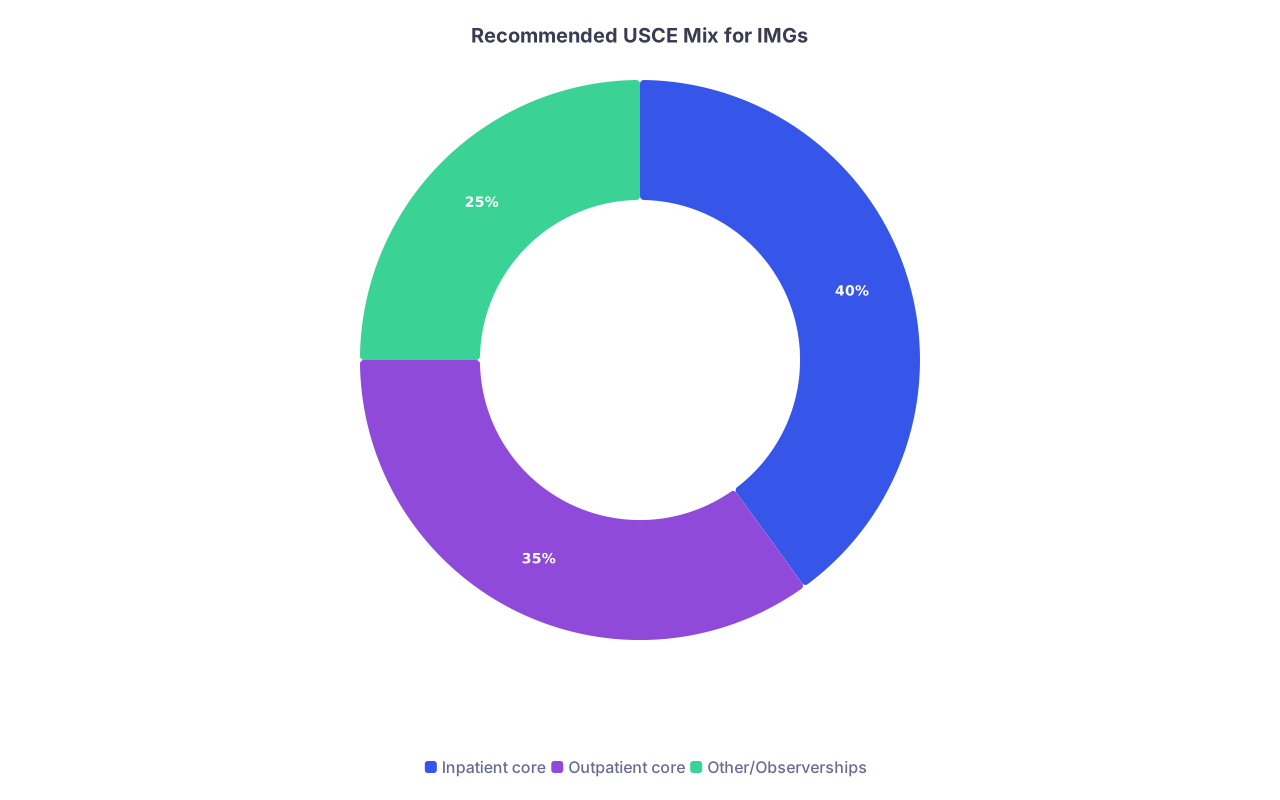
| Category | Value |
|---|---|
| Inpatient core | 40 |
| Outpatient core | 35 |
| Other/Observerships | 25 |
If money or visa is tight, better to have 2 strong, intensive months with clear responsibility and strong letters than 6 months of vague shadowing.
Phase 3: 9–12 Months Before ERAS – First USCE Blocks
Now the rotations should actually start.
At this point you should have:
- At least 1 confirmed rotation scheduled to finish no later than 1–2 months before ERAS.
- Ideally, your first US rotation already underway.
Step 6: First Rotation – How to Behave for LORs
Your first month in the US is where many IMGs either stand out or vanish in the background.
At this point (during rotation) you should:
- Be on time every single day. 10 minutes early to pre‑round if inpatient.
- Ask the attending or preceptor in week 1:
- “How do you prefer presentations?”
- “What is your typical workflow on rounds?”
- Volunteer for:
- Follow‑up calls to patients.
- Drafting notes (if allowed).
- Short literature reviews on cases.
Week‑by‑week structure for a 4‑week block:
- Week 1: Learn the system; ask expectations; master basic presentations.
- Week 2: Present patients independently; start doing simple plans.
- Week 3: Offer to handle more patients; ask if your performance is meeting expectations.
- Week 4: Request feedback and explicitly ask for a letter if feedback is positive.
Step 7: Locking in Your First LOR (9–10 Months Before ERAS)
You cannot wait “until later” to ask.
At this point (end of rotation) you should:
- Ask the attending directly:
- “Would you feel comfortable writing me a strong letter of recommendation for Internal Medicine residency?”
- Provide:
- Updated CV.
- Personal statement draft (even rough).
- ERAS Letter Request Form when ready.
- Confirm:
- That the letter will be specialty‑specific (e.g., Internal Medicine, not just “residency”).
One solid US LOR from a real teaching environment is better than three generic “observership” notes.
Phase 4: 6–9 Months Before ERAS – Strategic USCE and Step 2
This window is where you connect your USCE to your exam performance and story.
Step 8: Step 2 CK Timing and Score Release
At this point you should schedule Step 2 CK so that:
- Score is back at least 1–2 months before ERAS opens.
- You can reference “recent performance” if asked by faculty writing LORs.
Ideal pattern for many IMGs:
- Step 1 earlier.
- USCE months.
- Step 2 CK.
- More USCE (with improved clinical thinking after Step 2 prep).
Do not underestimate the fatigue: back‑to‑back rotations and Step studying without a plan will wreck both.
Step 9: Second and Third Rotations – Deepening Specialty Fit
By 6–9 months before ERAS, at this point you should:
- Be finishing or in the middle of your 2nd USCE block.
- Have at least 1 US LOR already requested, and be lining up a second.
Focus now on:
- Consistency in your specialty. If you claim devotion to Internal Medicine on ERAS but your only USCE is 3 months of Pediatrics, it looks incoherent.
- Exposure to a teaching hospital if your first rotation was purely community‑based, or vice versa.
Rotation mix example for an IMG applying to Internal Medicine:
- 1 month: Inpatient IM at community teaching hospital.
- 1 month: Outpatient IM or subspecialty clinic (cardiology, pulmonary).
- Optional 1 month: Subspecialty that matches your story (e.g., endocrine if you have research there).
Phase 5: 3–6 Months Before ERAS – Aligning USCE with Applications
Now you are entering the application year.
At this point you should:
- Have 2–3 USCE blocks completed or booked.
- Be planning the final 1–2 blocks to end just before or right after ERAS opens, not in the distant future.
Step 10: Final USCE Before ERAS (High-Yield Window)
Your last pre‑ERAS rotation is crucial. Programs love recent, US‑based clinical activity.
Ideal timing:
- Last pre‑ERAS rotation ends 0–2 months before ERAS opens.
- LOR from this rotation is uploaded by mid‑September.
During this final block:
- Tell your attending early:
- “I am applying this September for Internal Medicine. I would appreciate feedback on how I can strengthen my application.”
- Ask for specific comments in the LOR:
- Clinical reasoning.
- Communication with patients.
- Teamwork.
If your previous letters were from community or outpatient settings, try to get one from a teaching hospital with residents and students; those carry weight because the writer can directly compare you to US grads.
Phase 6: ERAS Build-Up – 0–3 Months Before Submission
Now we connect the USCE timeline directly to ERAS.
At this point (roughly June–September of application year) you should be doing three parallel tracks:
- Finalize ERAS content.
- Convert USCE into strong LORs and concrete descriptions.
- Avoid gaps in clinical activity.
Step 11: Translating USCE into ERAS Entries (June–July)
You have your rotations done or nearly done. Do not undersell them.
For each USCE block, your ERAS entry should include:
- Setting: “Inpatient Internal Medicine rotation at [Hospital], [City, State].”
- Structure: “Part of resident teaching service” or “Community attending practice.”
- Your role:
- “Presented new and follow‑up patients on rounds.”
- “Participated in management plans under supervision.”
- “Performed focused physical exams.”
No vague “exposed to” or “observed many patients.” That signals observership.
Step 12: Letter Collection and Deadlines (July–August)
At this point you should:
- Have 3–4 total LORs planned, including:
- 2–3 from US physicians in your chosen specialty.
- 1 from home institution or research if strong.
- Send ERAS Letter Request Forms to each letter writer no later than early August.
Give every writer:
- Your CV.
- Draft personal statement.
- Brief paragraph on:
- Programs / regions you are targeting.
- The strengths you hope they will emphasize.
Follow up once if no upload after 2–3 weeks. Politely. Then move on to backups if necessary.
Phase 7: ERAS Submission Month – Final 4–6 Weeks
This is where timing errors show. I have seen IMGs lose interview invites because a crucial letter came in October, not September.
Step 13: The Final 30–45 Days Before Submission
At this point (early–mid August to early September) you should:
- Have your USCE‑based LORs either uploaded or confirmed in progress.
- Be in or just finishing your final rotation if scheduled this late.
Use this period to:
- Polish your personal statement with specific references to USCE:
- Mention 1–2 key patient experiences from US settings.
- Tie them to why you want that specialty.
- Confirm:
- Step scores in ERAS.
- ECFMG status (or clear path to certification by start of residency).
- All USCE entries are chronologically coherent (no missing months that suggest inactivity).
Step 14: ERAS Submission Week
When ERAS opens for submission (typically early September):
At this point you should:
- Submit within the first 3–5 days of the opening date if possible.
- Have:
- At least 2–3 US letters already uploaded.
- All USCE blocks visible in the experiences section.
- No obvious contradictions between your stated specialty interest and your USCE pattern.
Late addition letters are fine, but your core USCE‑based LORs must be there when programs begin screening.
Sample Month-by-Month Overview (For a September ERAS)
Assume ERAS submission in September 2026. Here is a lean, realistic 18‑month plan.
| Month (Relative) | Approx Date | Primary Focus |
|---|---|---|
| -18 | Mar 2025 | Finish Step 1, start USCE search |
| -15 | Jun 2025 | Apply for USCE blocks |
| -12 | Sep 2025 | Confirm first rotations |
| -9 | Dec 2025 | First US rotation + LOR |
| -8 | Jan 2026 | Second rotation (same specialty) |
| -7 | Feb 2026 | Prepare for Step 2 CK |
| -6 | Mar 2026 | Take Step 2 CK |
| -5 | Apr 2026 | Third rotation; draft PS |
| -3 | Jun 2026 | Final USCE; request LORs |
| -2 | Jul 2026 | Build ERAS; confirm letters |
| -1 | Aug 2026 | Final checks; USCE descriptions |
| 0 | Sep 2026 | Submit ERAS |
You can compress this if you must, but then every delay becomes dangerous.
Common Timing Mistakes IMGs Make (And When They Happen)

Let me be blunt about where IMGs usually sabotage themselves:
Starting USCE search 6 months before ERAS.
Result: end up with whatever observership is available, usually starting after ERAS submission, giving them no pre‑ERAS LORs.Doing USCE in the wrong specialty.
Example: 4 months of Neurology USCE, then applying to Internal Medicine because it is “easier.” Program directors notice that mismatch.Not asking for letters during the rotation.
They go home, email 3 months later, and get a generic note or nothing at all.Taking Step 2 CK too late.
Score reports come after September, some programs auto‑screen them out.No activity in the 3–6 months before ERAS.
A blank gap right before application season looks like disengagement. Even a part‑time clinic observership or tele-clinic involvement is better than nothing.
Your timeline is the story. You want it to read: steady progression, specialty focus, recent clinical activity, strong USCE → ERAS submission.
FAQ (Exactly 2 Questions)
1. How many months of USCE do I really need as an IMG before applying?
For most IMGs aiming at Internal Medicine, Family Medicine, or Pediatrics, 2–3 months of solid, specialty‑aligned USCE before ERAS is enough to be taken seriously, if those months are strong: real responsibility, clear roles, and strong letters. More than 4–5 months rarely adds proportional value unless:
- You had a long gap after graduation and must show recent activity.
- You are pivoting specialties and need to “prove” the new choice.
If you can only afford 1–2 months, pick higher‑yield sites (teaching hospital, structured externship) and focus entirely on performance and letters.
2. I am already within 6–9 months of ERAS. Is it too late to get meaningful USCE?
No, but you are in salvage mode, not ideal‑planning mode. At this point you should:
- Immediately secure any hands‑on or closely supervised rotation in your chosen specialty that can finish before or just after ERAS opens.
- Aim for at least one strong US letter from that rotation and have it uploaded by late September.
- Fill gaps with related academic work: telemedicine preceptorships, chart review projects, or research in the same specialty.
Your timeline will not be perfect, but a short, recent, high‑intensity USCE block with a clear LOR is far better than none. Focus everything on that.