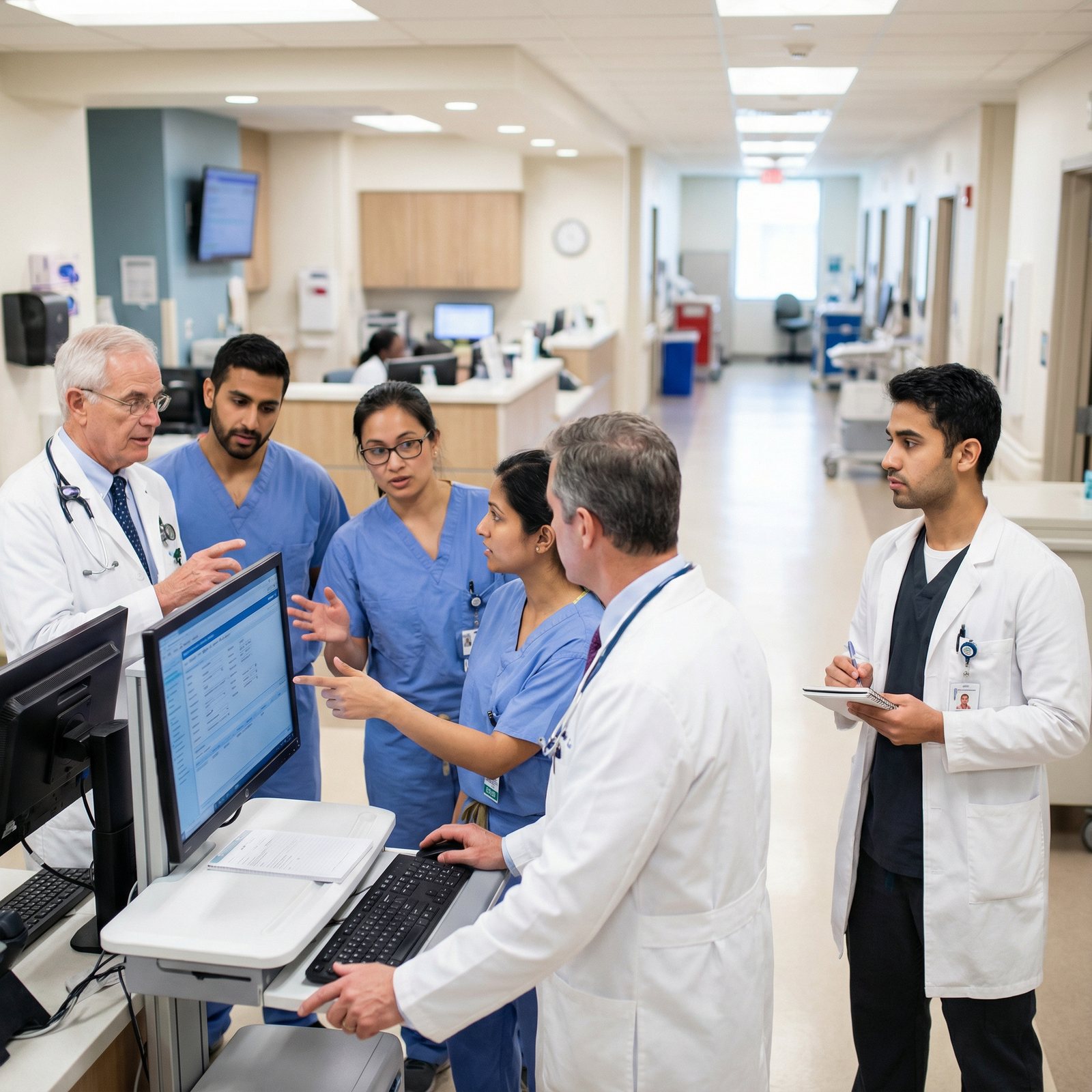
The way you structure a single USCE day can quietly separate you from the large pack of “nice, hardworking IMGs” who all look identical on paper.
Program directors do not remember who smiled the most. They remember who consistently executed high‑yield clinical tasks that made the team’s life easier and showed real residency‑level thinking. That is what you are aiming for.
Let me walk you through how to build that into your day, hour by hour, task by task.
The Core Idea: Think Like a PGY‑1, Not a Shadow
Most IMGs waste USCE by acting like students on a sightseeing tour. They “observe,” write a few half‑baked notes, ask generic questions, and then wonder why letters read, “Pleasant and enthusiastic observer.”
The bar is higher.
The IMGs who end up with strong LORs and interview‑level comments from attendings do three things:
- They reliably own specific, concrete tasks.
- They anticipate next steps in patient care (and articulate them).
- They communicate like junior residents, not passive observers.
You cannot bill. You cannot place independent orders. But you can absolutely function like a supervised intern. That starts with a structured day.
A High-Yield USCE Daily Blueprint
I am going to structure this around a typical inpatient day, but the principles apply to outpatient as well. Adjust the time blocks to your actual rotation.
To give you a clear picture of how successful IMGs actually use their time:
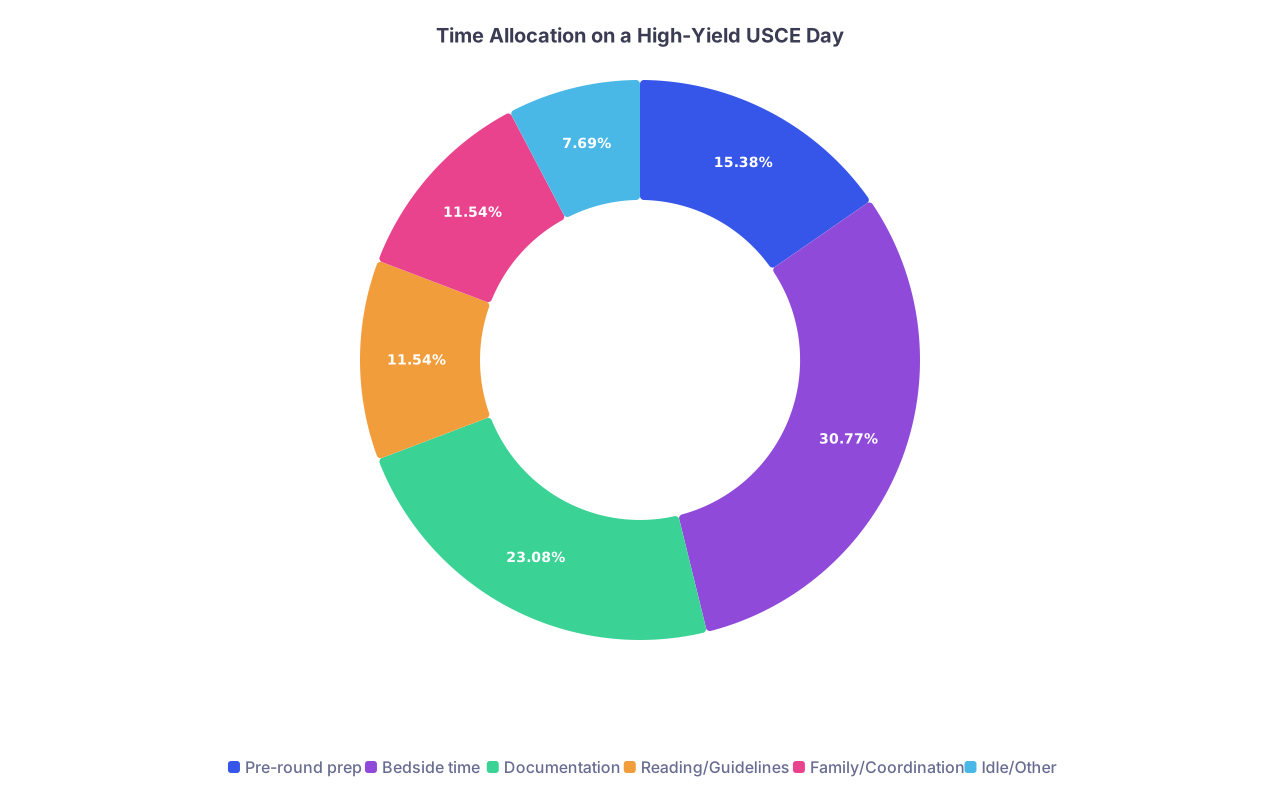
| Category | Value |
|---|---|
| Pre-round prep | 60 |
| Bedside time | 120 |
| Documentation | 90 |
| Reading/Guidelines | 45 |
| Family/Coordination | 45 |
| Idle/Other | 30 |
That is a six‑hour direct‑care block (typical for many observers/externs) but the relative proportions hold even for longer days.
1. Early Pre‑Rounds: Quiet Work That PDs Actually Hear About
If you want an attending to say, “They functioned at the level of a strong intern,” it starts before anyone sees a patient.
1.1 Arrive early with a plan
“Arrives early” is useless on its own. “Arrives early, pre‑reviews charts, and brings organized data to rounds” is what shows up in letters.
Concrete pre‑round tasks that impress:
- Identify your assigned patients (or at least 2–4 patients you will follow closely).
- Review overnight events:
- New consults, overnight notes, rapid responses, cross‑cover notes.
- Any code blue or transfer to ICU.
- Scan vitals and trends:
- Fever curves, blood pressure trends, oxygen requirement, heart rate changes.
- Review new labs and imaging:
- Flag abnormal values and any deltas (K dropped from 4.2 to 3.0; creatinine rose from 1.1 to 1.9).
- Look for results that “close the loop” on a question (e.g., D‑dimer, troponin, CT PE).
Then you translate that into 1–2 clear, resident‑level questions or suggestions for each patient:
- “Her creatinine bumped from 1.2 to 1.9 after starting vancomycin. Could this be contrast vs. vanc vs. prerenal from diuresis? Should we check a urine sodium / FeNa?”
- “His oxygen requirement went from 2L to 5L overnight with increasing work of breathing. Should we repeat a CXR or get an ABG this morning?”
That is how you show clinical reasoning without overstepping.
1.2 Micro‑pre‑rounds at the bedside
If the rotation allows you to see patients before formal rounds (some do, some do not):
- Introduce yourself clearly and briefly:
- “Good morning, Ms. X. My name is Dr. ___, I am a visiting physician working with your team.”
- Focused update:
- Ask about overnight symptoms: pain, breathing, confusion, chest pain, new issues.
- Verify major events: “Did anyone talk with you overnight about…?”
- Physical exam:
- Quick targeted exam aligned with the main problem (lungs on a pneumonia patient, volume status on a CHF patient, neuro status on a stroke patient).
You are not doing full H&Ps every morning. You are doing problem‑focused, efficient checks that feed directly into rounds.
2. Rounds: Where You Either Look Like an Observer or a Resident
Rounds are the stage. This is where attendings subconsciously decide whether you are “a nice student” or “someone I would trust with 10 patients.”
2.1 Present like a PGY‑1, not a third‑year
Your main USCE clinical performance data point is how you present cases.
High‑yield structure for inpatient follow‑up presentations:
- One‑line ID with problem:
- “Mr. X is a 68‑year‑old man with COPD and HFpEF admitted with acute hypoxic respiratory failure due to community‑acquired pneumonia, now hospital day 3.”
- Overnight events:
- “No fevers, no chest pain. Required increase from 2L to 4L O2 for several hours overnight, now back to 3L.”
- Vital trends:
- “Tmax 37.9, HR 88–102, BP 110–135/65–75, RR 18–24, O2 sat 92–95% on 3L.”
- Focused exam (relevant positives/negatives):
- “Scattered crackles at the right base, no wheezing, JVP 6–7 cm, no LE edema, alert and oriented x3.”
- Key data:
- “WBC down from 15 to 11, lactate normalized, creatinine stable at 1.0. Blood cultures no growth at 48 hours. CXR yesterday with improving right lower lobe infiltrate.”
- Assessment and plan by problem:
- “1) CAP with improving oxygenation: Continue ceftriaxone/azithro, consider switch to oral tomorrow if stable; 2) COPD: Continue scheduled bronchodilators, no steroids currently as no wheezing or increased sputum; 3) DVT prophylaxis: Continue enoxaparin; 4) Dispo: If O2 requirement continues to fall and he walks safely, likely discharge in 24–48 hours.”
You do not have to be perfect. You do have to be structured, concise, and show you know what the active problems actually are.
Common IMG mistakes on rounds:
- Repeating the entire admission H&P every morning.
- Listing labs with no interpretation: “WBC 12.1. Creatinine 1.3. Sodium 135. Potassium 3.7. Chloride…” (Residents zone out.)
- Ending with “Plan: continue current management” with no specifics.
Do the opposite. Summarize, interpret, propose.
2.2 Volunteer to follow specific issues
Residents pay attention to people who relieve their cognitive load.
Examples of high‑yield tasks to grab during or right after rounds:
- “I can follow up the CT chest result and update the note.”
- “I will clarify his home medication list with the pharmacy and family.”
- “I will check back with PT later and see if he is safe for home vs rehab placement.”
Then you actually close the loop and report back. That is what differentiates “polite offer” from “reliable team member.”
3. Midday: Turn Downtime into Documented Value
Every rotation has dead time. The question is whether you fill it with your phone or with tasks that end up in your LOR.

3.1 Own the first draft of documentation
If your rotation allows you to write notes (externships, hands‑on electives, some observerships with “mock” notes):
- Ask explicitly on day 1:
- “Would it be helpful if I pre‑draft daily progress notes for the patients I am following?”
- Use institutional templates but sharpen the assessment and plan.
- Emphasize problem‑based structure, not organ‑system chaos.
Attending‑level impression: “She wrote accurate, well‑organized notes that we could co‑sign with minimal edits.” That is exactly the kind of language PDs want to see in a letter.
If notes are “for learning only,” still do them. Residents will notice the way you think and will often say things like, “Her notes are as good as my interns’.” That sentence has made it into countless LORs.
3.2 Structured high‑yield literature checks
Here is where most students mess up. They either never read, or they disappear for two hours and come back with a 20‑page UpToDate printout nobody asked for.
You want micro‑targeted questions with fast, clinically relevant answers:
- “What is the recommended duration of antibiotics for uncomplicated gram‑negative bacteremia?”
- “What is the latest guideline‑recommended DAPT duration after NSTEMI with DES in a high bleeding risk patient?”
- “Which patients with COPD exacerbation benefit from steroids and what dose/duration is preferred?”
You find the answer in 10–15 minutes and bring it back in a 1–2 minute summary:
- “I checked IDSA guidelines and a recent NEJM trial. For uncomplicated gram‑negative bacteremia with good source control, 7 days total therapy was non‑inferior to 14 days. So if he keeps improving, 7 days is reasonable.”
That kind of focused evidence‑based input makes an attending think, “This person will raise the level of our residency morning reports.”
4. Bedside Time That Actually Shows Up in Letters
“Good bedside manner” is vague fluff unless the attending hears specific examples from nurses, patients, and residents.
You want concrete behaviors that third parties will repeat.
4.1 Become the patient’s “go‑to explainer”
You cannot change orders, but you can translate medicine into human language.
High‑yield tasks:
- After complex family meetings, stop by and re‑explain in simpler terms (without contradicting the team).
- Before a procedure (LP, colonoscopy, cath), review what will happen in plain language.
- Help patients understand their daily plan:
- “Today we are watching your oxygen, making sure you can walk safely, and if you stay stable, we will talk about discharge tomorrow.”
Important boundary: Always frame it as “This is what your doctors have planned” and avoid freelancing new information.
Nurses notice who patients ask for. They will say things like, “She always made sure the family understood everything.” Attendings believe nurses.
4.2 Practice focused, repeatable exams
Nobody is impressed by a 15‑minute head‑to‑toe exam repeated on the same stable patient every day. They are impressed by:
- Your ability to track JVP and volume status in a CHF patient over time.
- Your consistent neuro checks in a stroke patient.
- Your trending of lung findings and work of breathing in a pneumonia/COPD patient.
Pick 1–2 exam skills per rotation and track them relentlessly. Mention changes on rounds:
- “Her JVP decreased from about 10–11 cm to 6–7 cm since yesterday, and her orthopnea improved from 3 pillows to 1.”
That is resident‑level language coming from a visitor. Very memorable.
5. Afternoon: Follow‑Through and Systems Thinking
Afternoons are where your “I can help with that” from the morning either turns into trust or just noise.
5.1 Close every loop you opened
If you said you would:
- Call the PCP for collateral information.
- Clarify the medication list with the pharmacy.
- Talk to PT/OT about discharge readiness.
- Follow up on a consult recommendation.
Then by late afternoon, you should have one of two things:
- A completed action with a brief summary:
- “I spoke with the PCP. She confirmed that the patient has not taken his metoprolol for 3 months due to dizziness.”
- Or a documented attempt:
- “Tried reaching PCP twice, left a detailed message, will try again tomorrow.”
Report it to the resident, and if appropriate, include it in your note. That tells everyone you can be trusted with patient‑care tasks.
5.2 Start thinking like a discharge planner
Nothing wins attendings over faster than a student who actually understands disposition.
High‑yield discharge prep tasks:
- Check whether the patient has:
- Transportation home.
- Someone to help at home.
- The ability to manage medications and follow instructions.
- Confirm follow‑up appointments are appropriate:
- “He is being discharged after NSTEMI with new stent and diabetes meds adjusted. Cardiology follow‑up in 1–2 weeks and PCP in 1–2 weeks are scheduled.”
- Help prepare a simple medication list the patient can understand.
You can say to the team:
- “I reviewed his discharge meds with him using the teach‑back method. He can correctly explain how to take his insulin and new antiplatelet.”
PDs know that interns who understand discharge planning save the service significant chaos.
6. Cross‑Cover Mindset: Showing PDs You Will Be Safe at Night
Program directors care obsessively about one thing: Will you be safe and effective when the attending is asleep and your senior is running three codes?
You cannot actually cross‑cover as a visiting IMG, but you can show you understand the thinking.

| Step | Description |
|---|---|
| Step 1 | Identify change in status |
| Step 2 | Assess ABCs |
| Step 3 | Call for help |
| Step 4 | Initiate basic interventions |
| Step 5 | Gather focused data |
| Step 6 | Generate differential |
| Step 7 | Check relevant labs/imaging |
| Step 8 | Propose plan to senior/attending |
| Step 9 | Stable vs Unstable |
Translate that into daily behavior by:
- During debriefs, ask “cross‑cover” questions:
- “If this had happened at 3 a.m. instead of 10 a.m., what would you want the intern to do first before calling you?”
- When a new issue arises (e.g., tachycardia, new fever), articulate:
- What you would check immediately.
- What you would prioritize in your differential.
- Which orders you think would be reasonable.
Example:
- “If his heart rate went to 140 at night, I would first confirm the blood pressure and oxygenation, check mental status, review recent fluids, meds, and pain, then consider whether this is sepsis progression, new arrhythmia, PE, or pain/anxiety. I would get an EKG and basic labs while calling the senior.”
That answer makes attendings think, “She understands hierarchy, priorities, and safety. I can trust her at 2 a.m.”
7. Outpatient USCE: How to Structure a High-Yield Clinic Day
Clinic looks different, but the same logic applies: own specific tasks and think like a resident, not a tourist.
Key clinic‑day building blocks:
- Pre‑visit chart review (1–2 minutes per patient):
- Last visit’s plan.
- Key diagnoses and meds.
- Outstanding tests or follow‑up items.
- Pre‑brief with attending or resident:
- “For Mr. X, I will focus on his diabetes control and recent ER visit for chest pain.”
- In‑room tasks:
- Focused HPI.
- Medication reconciliation.
- Brief focused exam.
- Identify and prioritize agenda items: “Today, the three main issues we should address are…”
- Post‑visit wrap:
- Present concise case.
- Propose 2–3 concrete plan items: med adjustment, testing, referrals, follow‑up interval.
You also want one high‑yield longitudinal project for continuity clinic if possible, such as:
- Tracking A1c and adherence in a poorly controlled diabetic over your rotation.
- Developing a simple asthma action plan template for the attending’s patients.
- Creating a BP log and follow‑up plan for uncontrolled hypertension.
When attendings write letters, they remember “She systematically improved how we follow up our diabetic patients,” not “She saw a lot of patients.”
8. What PDs Actually Hear About: Translating Your Day into LOR Language
You are not just doing tasks to be “helpful.” You are feeding specific narrative bullets that attendings and residents end up verbalizing.
Here is how your structured day maps to what PDs read:
| Daily Behavior | Typical LOR Language |
|---|---|
| Early chart review and organized presentations | "Consistently prepared, presented patients succinctly, and functioned at the level of a strong PGY‑1." |
| Drafting accurate notes and plans | "Her documentation and clinical reasoning were on par with our interns; we frequently adopted her plans with minimal changes." |
| Focused literature checks with practical input | "He independently sought out and applied current evidence, enhancing our management decisions." |
| Discharge planning and coordination with PT/PCP | "Demonstrated mature systems-based practice and was instrumental in facilitating safe discharges." |
| Patient education and bedside communication | "Patients and nurses repeatedly commented on her clear explanations and compassionate care." |
That is the whole game. You are scripting the future letter by how you structure your day now.
9. How to Avoid the Two Big USCE Traps
Two patterns sink otherwise smart IMGs.
9.1 Trap 1: The Overeager “Pseudo‑Resident” Who Oversteps
This person:
- Argues with nurses.
- Tries to change orders independently.
- Contradicts the attending in front of patients.
- States decisions as if they have authority: “We will discharge you tomorrow,” “We are going to stop this medication.”
Fix:
- Always frame clinical thoughts as suggestions:
- “Could we consider…”
- “Would it be reasonable to…”
- Defer major discussions to the team in front of the patient:
- “Let me ask the team and we will come back with a plan together.”
- Remember your role is “high‑functioning trainee,” not “junior attending.”
9.2 Trap 2: The Invisible Shadow
Friendly. Shows up. Never actually does anything memorable.
You avoid this by:
- Owning 2–4 patients deeply instead of floating around every room superficially.
- Volunteering for specific follow‑ups.
- Delivering concrete, visible work products: notes, literature summaries, patient education, med reconciliation.
If at the end of the week, if I ask the resident, “What exactly does this IMG do all day?” and they struggle to answer, you lost.
10. A Sample Structured USCE Day (Inpatient IM)
To put it all together, here is a simple scaffold you can adapt:
- 06:45–07:30 – Pre‑round chart review on your 3–4 patients; outline micro‑plans.
- 07:30–08:15 – Bedside micro‑pre‑rounds: focused HPI/PE updates on your patients.
- 08:15–11:00 – Rounds:
- Present your patients.
- Volunteer for 1–2 follow‑ups per patient.
- 11:00–12:30 – Documentation and follow‑ups:
- Draft progress notes.
- Call family / PCP / pharmacy as appropriate.
- Check consult notes and PT/OT recommendations.
- 12:30–13:00 – Quick lunch plus targeted reading:
- 1–2 clinical questions from your patients.
- 13:00–15:30 – Bedside and system work:
- Patient/family teaching.
- Discharge planning tasks.
- Re‑checks on any unstable or borderline patients.
- 15:30–16:30 – Touch base with team:
- Update resident on completed tasks.
- Ask 1–2 “cross‑cover mindset” questions about interesting cases.
- Finish any late notes or sign‑outs.
You are not doing “extra.” You are doing the same general day as everyone else but with sharper, more intentional, resident‑like execution.
11. The Meta‑Skill: Daily Reflection Tied to Your Future Application
At the end of each day, take 5–10 minutes and write down:
- 1 patient where you contributed meaningfully.
- 1 clinical question you answered.
- 1 systems issue you helped with (discharge logistics, coordination, medication safety).
- 1 skill you want to sharpen tomorrow (presentation, exam, communication).
Those notes later become:
- Concrete stories for your personal statement and interviews.
- Bullet points you can quietly remind your letter writers about when they agree to write for you.
They also keep you honest. If you see a week of “followed along and watched,” you know you are not structuring your day aggressively enough.
With this kind of structured, high‑yield day, you stop being “an IMG who rotated here” and start being “that IMG who basically worked like one of our interns.” That is the level that moves PDs.
Once you can reliably run a day like this, the next step is to convert it into powerful letters and compelling interview narratives. How you do that—without sounding rehearsed or arrogant—that is a whole separate strategy conversation.