
It is 3:12 a.m. on your first US medicine sub‑I. Your senior is admitting a crashing GI bleed. The nurse pages the team. Your resident is scrubbed in placing a central line. The cross‑cover intern is tied up with a rapid response on another floor. The only person immediately available and reading that message?
You.
If you handle that communication smoothly, nobody will remember it in detail. If you mishandle it—panic, ignore, or respond inappropriately—everybody will remember. And it will come up in your evaluation. Maybe even in your letter.
This is the level you are playing at as an IMG trying to match in the US. People assume you are smart; what they are testing is: are you safe, can you be trusted, and do you “get” how we communicate in an American hospital.
Let me break this down specifically.
1. How Pagers Actually Work on US Rotations (And What IMGs Get Wrong)
First, understand the ecosystem. You are not just “answering pages.” You are plugging into a communication system with rules—most of them unwritten.
The basic landscape
On most US rotations you will see some combination of:
- Old‑school numeric or alphanumeric pagers
- Hospital‑approved messaging apps (Voalte, TigerConnect, Epic Haiku/Canto chat, Secure Chat, etc.)
- Call room phones / unit landlines
- Personal cell phones (for callbacks, but usually not for sending PHI)
You might or might not be assigned a pager as a student. But even if you never wear one, people will expect you to understand how pager communication works and to help your team handle it.
| Tool Type | Typical Use Case |
|---|---|
| Numeric pager | Brief “call me back” messages |
| Alphanumeric pager | Short clinical updates / requests |
| Secure messaging app | Detailed, written clinical info |
| Unit landline | Immediate calls from nurses / operators |
The three core expectations about pagers
Every US physician I have worked with assumes three things about whoever is “on the pager”:
- They will respond quickly (usually within 5 minutes, often faster).
- They will close the loop (nobody is left wondering what happened).
- They will not exceed their scope, but will still be useful.
IMGs often miss #3. They either do nothing (“I am only a student”) or overstep (“I told the nurse to give 5 mg IV metoprolol”). Both are a problem.
Your job is: filter, clarify, escalate.
2. The Golden Rule: Never Ignore a Page (But Do Control the Interaction)
Here is the non‑negotiable rule. You do not ignore pages. Even if you cannot act, you can always help move the information to the right person.
Response time standards
On a typical internal medicine or surgery service:
- For urgent or STAT pages: answer immediately to 2 minutes
- For routine pages: answer within 5 minutes
- For consult questions that are not time‑sensitive: up to 10 minutes is usually tolerated, but faster is always better
If you do not have the pager (your resident does), you still help by:
- Watching for their pager going off on the desk
- Noticing unread secure messages on the team smartphone
- Saying explicitly: “Dr. Smith, you have a page from 7E about Mr. Jones with low blood pressure.”
You are not secretarial. You are demonstrating situational awareness. Programs love that.
3. The “Four‑Step” Advanced Page Response Method
This is where most students—including US grads—are sloppy. They call back and start rambling. You cannot afford that.
Use a tight 4‑step pattern every time:
- Identify yourself and the team.
- Clarify the patient and location.
- Clarify the question/concern, get data.
- Close the loop and document what you did with it.
Let’s walk through it with actual language.
Step 1: Identification
Bad: “Hello?”
Good: “Hi, this is [Your Name], the medical student with the [Service Name] team, returning a page.”
You always state:
- Who you are
- Role (medical student)
- Which team you are with
This protects your scope and orients the other person.
Step 2: Patient and location
You do not let the caller talk for three minutes before you know whom they are calling about.
Ask early:
“Which patient is this about?”
and
“Which unit are you on?”
If multiple teams are covering, ask:
“Are we the primary team or the consult team for this patient?”
This prevents you giving advice on someone who is not yours, or chasing the wrong chart.
Step 3: Clarify the actual question and get targeted data
Most pages are incomplete. “Patient looks bad” is not a useful page.
Your job is to gently extract structured information without sounding like an interrogation.
For example, nurse says: “Mr. Johnson does not look good; his pressure is low.”
You respond:
“Ok, thanks for calling. I am a medical student, so I cannot give orders, but I can reach my resident quickly. Before I do, can I get a couple of details so I can give them a clear picture?”
Then you get small, focused pieces of data, tailored to the issue:
If hemodynamics:
- Latest BP, HR, RR, O2 sat, temp
- Any recent changes (trend from last hour)
- Mental status (alert? confused? difficult to arouse?)
- Any active bleeding, chest pain, shortness of breath?
If pain:
- Pain score and location
- Vital signs
- Last pain medication, dose, and time given
If agitation or confusion:
- Onset and progression
- Safety issues (pulling lines, trying to leave bed)
- Any PRN meds given already
You are not doing a full H&P. You are building a concise “page handoff” for your resident.
Step 4: Close the loop
Always end with one of these:
- “I will call my resident right now and ask them to call you directly.”
- “My resident is here next to me; I will hand the phone to them.”
- “I will send this through our secure chat to Dr. X and let you know if they have additional questions.”
- “Our team already placed an order for X; I will confirm they saw your concern.”
And then you actually do it. Immediately.
Afterward, you document the communication to your team:
- Verbal: “Dr. Smith, the nurse from 5W called about Mr. Lee with new hypotension, 80s/50s, HR 120, more lethargic; they have not given any fluids yet.”
- If your EMR allows student notes/messages: very brief, labeled as student communication, not as official orders.
4. What You Can Say vs What You Must Not Say (Scope Boundaries)
This is where IMGs get into trouble, especially those who already finished residency abroad. You may be a fully trained physician in your home country. In this system, on this rotation, you are a medical student. Full stop.
You are allowed to:
- Receive pages and calls
- Gather clinical information
- Help clarify what is happening
- Provide factual information from the chart (“the last Hgb was 7.8 three hours ago”)
- Transmit your resident’s or attending’s already‑documented plan (“yes, Dr. X wrote to recheck K at 18:00 and replace per protocol”)
- Ask your team about next steps and then relay what they decide
You are not allowed to:
- Independently give medication orders
- Change any doses or schedules
- Approve or refuse PRN medication use
- Change code status, transfusion plans, restraint orders, etc.
- Make promises like “We will transfer him to the ICU” or “We will discharge her today”
The safest phrase when someone is pushing you for a decision:
“I am a medical student so I cannot make treatment decisions or give orders, but I will contact my resident right now and let them know exactly what is going on.”
Say it calmly. Confidently. No apology.
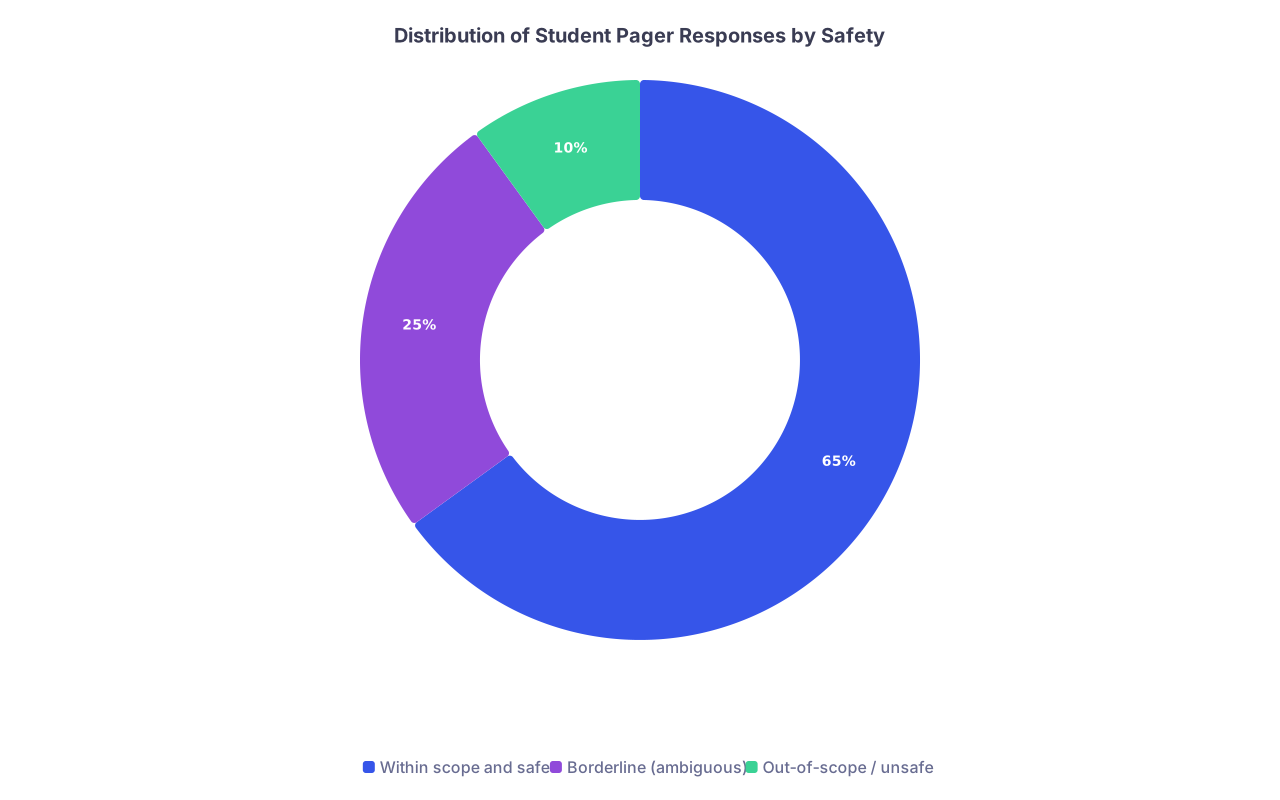
| Category | Value |
|---|---|
| Within scope and safe | 65 |
| Borderline (ambiguous) | 25 |
| Out-of-scope / unsafe | 10 |
The programs I trust are ruthless about this. Ten percent of student responses about patient care fall into the “absolutely not” category. You do not want to be in that slice.
5. Common High‑Risk Pager Scenarios and How to Handle Them
Let us go through scenarios I have actually seen, with language you can steal.
5.1. Hypotension overnight
Page: “Pt BP 78/42, HR 115, looks pale, on 2L O2.”
Your steps:
- Call back immediately.
- ID + clarify role.
- Get quick vitals trend, mental status, urine output if known, obvious source (bleeding, sepsis, etc.).
- Immediately: “I will let my resident know now; this might be an emergency.”
Then you:
Find your resident / intern in person if possible.
Give a 20‑second summary:
“Mr. X in 7E, our GI bleed. BP 70s/40s, HR 110–120, looks pale per nurse, more lethargic, on 2L O2. No fluid bolus yet. They are concerned he is deteriorating.”
Do not suggest a bolus dose unless they ask your opinion. Even if you know exactly what to do, you are still in “suggest, not order” territory.
5.2. Pain control requests
Page: “Ms. Y still 9/10 pain; asking for more meds.”
Nurses frequently hope you will approve early dosing or higher doses. You cannot.
Your language:
“Thank you for letting us know. I am a medical student, so I cannot change pain medication orders. Let me look at her chart quickly so I can give my resident a clear update.”
Then, in chart:
- Last pain med, time, dose
- Any non‑opioid options already ordered (tylenol, NSAIDs, nerve blocks)
- Previous notes about pain plan or concern for oversedation
To team:
“Ms. Y on 6W has 9/10 pain. Last IV morphine 2 mg two hours ago, plus scheduled acetaminophen. No NSAID ordered. Vitals stable, RR 16.”
Then resident decides. You relay.
5.3. “Patient wants to leave AMA”
Page: “Patient is threatening to leave AMA now.”
Your priorities:
- Patient safety
- Rapid escalation
- No independent negotiation about legal/consent issues
On call:
“Thanks for calling. Which patient and room?”
“I am a medical student and cannot handle AMA paperwork, but I will find my resident immediately.”
Then you physically go there with your resident or intern if possible. If they are stuck (code, procedure), at minimum:
“Dr. X, Mr. Z in 5E is trying to leave AMA right now; nurse says he is packing his stuff. They need you.”
You do not try to handle the AMA consent alone, no matter how well you can explain it.
6. Using Structured Communication: SBAR and Micro‑SBAR
Attendings love when you use structured formats. They sound like you have been in the system for years.
The hospital classic is SBAR: Situation, Background, Assessment, Recommendation.
As a student, your “Assessment” is often simple and your “Recommendation” is “please evaluate”. That is fine.
Example page handoff to resident:
“Dr. Smith, nurse from 6W called about Mr. K.
Situation: New hypotension—BP 82/48, HR 118, more sleepy.
Background: 72‑year‑old with sepsis from pneumonia, on day 2 of ceftriaxone, previously stable BPs 110s/60s, was on 2L O2.
Assessment (student level): Concern for worsening sepsis versus volume depletion.
Recommendation: Can you evaluate him at bedside and consider fluids and labs?”
That is high‑level communication for a student. It shows clinical thinking without pretending you are the decision‑maker.
7. Advanced Secure Messaging Etiquette (Epic, Voalte, Tiger, etc.)
Rotations are increasingly pager + app hybrids. Written communication creates a permanent record. That is good for you if you are careful; terrible for you if you are sloppy.
General rules for written messages
- Assume attendings, risk management, and lawyers could read it later.
- No jokes, no sarcasm, no venting. Ever.
- Protect PHI if using anything connected to your personal phone (follow hospital policy).
- Use short, clear, professional language.
Bad:
“Room 523 being annoying again, claiming chest pain but vitals fine, what do you want to do?”
Better:
“Room 523, Mr. L, reports new chest discomfort, 5/10, started 10 min ago while resting. Vitals currently 128/76, HR 88, RR 16, SpO2 98% RA. No radiation, denies SOB per nurse. How would you like to proceed?”
And you start that message with:
“This is [Your Name], MS4 on [Service].”
8. Cross‑Cultural Communication Nuances That Trip Up IMGs
This is the subtle stuff that affects how people feel about you, beyond the raw clinical actions.
Directness vs deference
Many IMGs are trained to be extremely deferential. So they:
- Apologize too much
- Avoid telling seniors they missed something
- Soften urgent concerns with hesitant language
On US services, you need respectful directness.
Nurse: “He looks really bad.”
You to resident: “The nurse is very concerned and describes him as ‘looking really bad’ with low BP and tachycardia. She asked for evaluation urgently.”
You do not say: “Nurse is a bit worried, might be nothing.” You carry the urgency faithfully.
Interrupting for safety
You are allowed to interrupt if safe care demands it. You just do it politely.
Resident is in the middle of reviewing labs, you get a STAT page about a patient unresponsive.
You do not text and wait. You say:
“Sorry to interrupt, but we just got a page that Mr. Q is unresponsive on 7E; the nurse is calling a rapid response now.”
Nobody will be mad about that. They will be mad if you “waited for the right moment.”
9. Call Hierarchy: Who Do You Call First?
On a teaching service, your escalation ladder typically looks like this:
Intern → Senior resident → Fellow (if subspecialty) → Attending
You, as a student, are usually “adjacent” to the intern. You rarely bypass them unless explicitly instructed.

| Step | Description |
|---|---|
| Step 1 | Bedside Nurse |
| Step 2 | Student or Intern Pager |
| Step 3 | Intern |
| Step 4 | Senior Resident |
| Step 5 | Fellow (if applicable) |
| Step 6 | Attending |
Practical rules:
- If the intern is physically available: talk to them first.
- If the intern is unavailable (in a code, procedure, or off the floor) and the page sounds emergent, you can go directly to the senior resident and say why.
- You very rarely call the attending directly as a student unless told to or in a crash‑level emergency where no resident is available.
A safe phrasing if you are unsure:
“Dr. Senior, the intern is currently in a code on 5W; we just got a concerning page from 7E about Mr. T with new chest pain and hypotension. Would you like to handle it, or should we try to reach the intern first?”
You show that you understand the hierarchy, but you are prioritizing patient safety.
10. How Pager Behavior Shows Up in Your Evaluations and Letters
Attendings do not usually write: “This student had strong hepatic encephalopathy management skills.” They write:
- “Reliable and responsive to pages.”
- “Communicates clearly with nursing staff.”
- “Demonstrates good judgment in when to escalate concerns.”
Pager etiquette is how they measure your “professionalism” and “readiness for residency,” which are actual evaluation domains.
Programs absolutely choose between otherwise similar IMG applicants based on this. Directors compare notes:
- “Did you ever have to chase them?”
- “Did they disappear when things got busy?”
- “Could you trust them to carry the team phone or pager for short periods?”
You want the answers to be:
- Never
- No
- Yes
11. Very Practical Scripts You Can Use Tomorrow
Let me give you a few ready‑made phrases you can drop into your rotation.
When answering a page
“Hi, this is [Name], the medical student with the [Service] team, returning a page from [number]. Who am I speaking with?”
When clarifying your role
“Just so you know, I am a medical student so I cannot place orders, but I can gather information and get my resident involved quickly.”
When escalating to resident
“We just received a call from [unit] about [patient], with [key issue]. Vitals are [X]. The nurse is concerned because [reason].”
When a nurse pushes for an order
“I understand the concern. I am not allowed to give orders, but I will reach my resident now and let them know exactly what is happening.”
When you are not sure if it is urgent
To the nurse:
“On a scale from routine to urgent to emergency, how would you rate this?”
Then to the team, include that:
“The nurse describes this as urgent and is worried he may deteriorate quickly.”
This helps filter without you having to judge alone.
12. Putting It Together: A 24‑Hour “Ideal” Pager Day for an IMG Student
Just to make the whole picture concrete, here is what solid pager behavior looks like during one typical call day:
Morning:
- You make sure you know which pager numbers cover your team, cross‑cover, consults.
- You ask the intern: “When the team pager goes off and you are scrubbed or with a patient, how would you like me to help? Answer and gather info, or just let you know?” (Most will say: “Answer and get info, then come find me.”)
Afternoon:
- You return two routine pages, gather structured data, and summarize succinctly to the intern. They act; you observe how they think.
- You use SBAR language without making a big show of it.
Evening:
- A concerning page comes: new fever and hypotension. You respond, clarify vitals, and immediately find the resident physically.
- You give a compact, clinically relevant summary.
- The resident tells you, “Thanks, that was helpful, let us go see them together.”
Night:
- Some minor pages come in about diet changes and family updates. You help clarify who the primary team is and whether this is something for nursing, case management, or the team tomorrow, and always loop your resident in.
- You never tell anyone “I cannot help; I am just a student.” You say, “I will connect you with the right person.”
Next morning, your resident tells the attending during feedback: “She was great with pages last night—very responsive and helped triage appropriately.”
That single sentence does more for your letter than most fancy presentations.
FAQ (Exactly 5 Questions)
1. Should I ever refuse to answer a pager or call because I am “just a student”?
No. You should not refuse to answer. You can and should clarify your role once you are on the line: that you cannot give orders or make independent management decisions, but you can gather information and connect the caller with your resident. Refusing to engage entirely looks unhelpful and unprofessional.
2. If a nurse clearly knows more about the patient than I do, should I still ask structured questions?
Yes, but keep it brief and targeted. Nurses often appreciate when you ask focused, relevant questions because it shows you are trying to understand the clinical situation. What they dislike is endless questioning that does not change what you will do next. Two or three key data points, then escalate to your team.
3. Is it acceptable to send secure messages to my attending directly as a student?
Usually not for routine matters, unless your team culture explicitly supports it. The default is to route communication through the intern and senior resident. You may message attendings if they have told you to do so for specific issues (for example, research patients, a specific follow‑up they asked you to monitor), or during urgent issues when no residents are reachable and patient safety is at risk.
4. How do I document that I received a concerning call if I am not allowed to write official notes or orders?
Your primary “documentation” is verbal and via your team’s workflow: you promptly summarize the call to your intern or senior and, if your EMR allows student notes or secure messages, you can place a short, clearly labeled student note or internal message: “Received nurse report of X at [time]. Immediately notified Dr. [Resident].” Never write notes or orders that appear to be independent decisions.
5. What if my accent or English fluency makes phone communication difficult?
Be proactive. Speak slightly slower, use simple sentence structures, and confirm key facts by repeating them back: “Just to confirm, the blood pressure was 82 over 48 and the heart rate was 115, correct?” If someone misunderstands you, stay calm and restate. You can also tell your team early on: “Phone communication is harder for me; if you ever cannot understand me, please let me know so I can correct it.” Most staff respond well to this level of self‑awareness and effort.
Key takeaways:
First, you never ignore a page; you use it as a chance to show you are reliable and safe. Second, you stay strictly within your scope while still being maximally useful: gather information, structure it, escalate fast. Third, the way you handle pager and communication etiquette is not a side detail; it is one of the most visible signals programs use to decide whether an IMG is ready to be a resident in their system.