
Your social media is in the hospital with you whether you like it or not. Program Directors already know more than you think.
If you’re an IMG chasing US clinical experience (USCE) and a residency spot, you cannot afford to get this wrong. Social media has quietly become one of the fastest ways to destroy months of observerships, LORs, and exam scores—often without you realizing what you did.
I’ve watched applicants with strong CVs get quietly dropped from rank lists because of Instagram stories and WhatsApp groups. Not Step scores. Not accents. Not “no US contacts.”
Their own online trail.
Let’s walk through the biggest mistakes IMGs make with social media during USCE and residency applications—and how to stop sabotaging yourself.
1. Believing “Nobody Is Looking” at Your Accounts
This is the first and worst mistake: assuming your social media lives in a separate universe from your medical career.
Here’s the uncomfortable truth
Program Directors don’t have to formally “screen” you online for your social media to reach them. Your digital footprint leaks in at multiple points:
- A co-observer shows your post to a chief resident
- A patient’s family finds your TikTok
- A staff member recognizes their hospital or unit in your “anonymous” post
- A resident you shadowed follows you, sees something off, and quietly flags it
No one sends you a warning email: “Dear Applicant, your meme lost you 4 ranks.” You just never hear from them again.
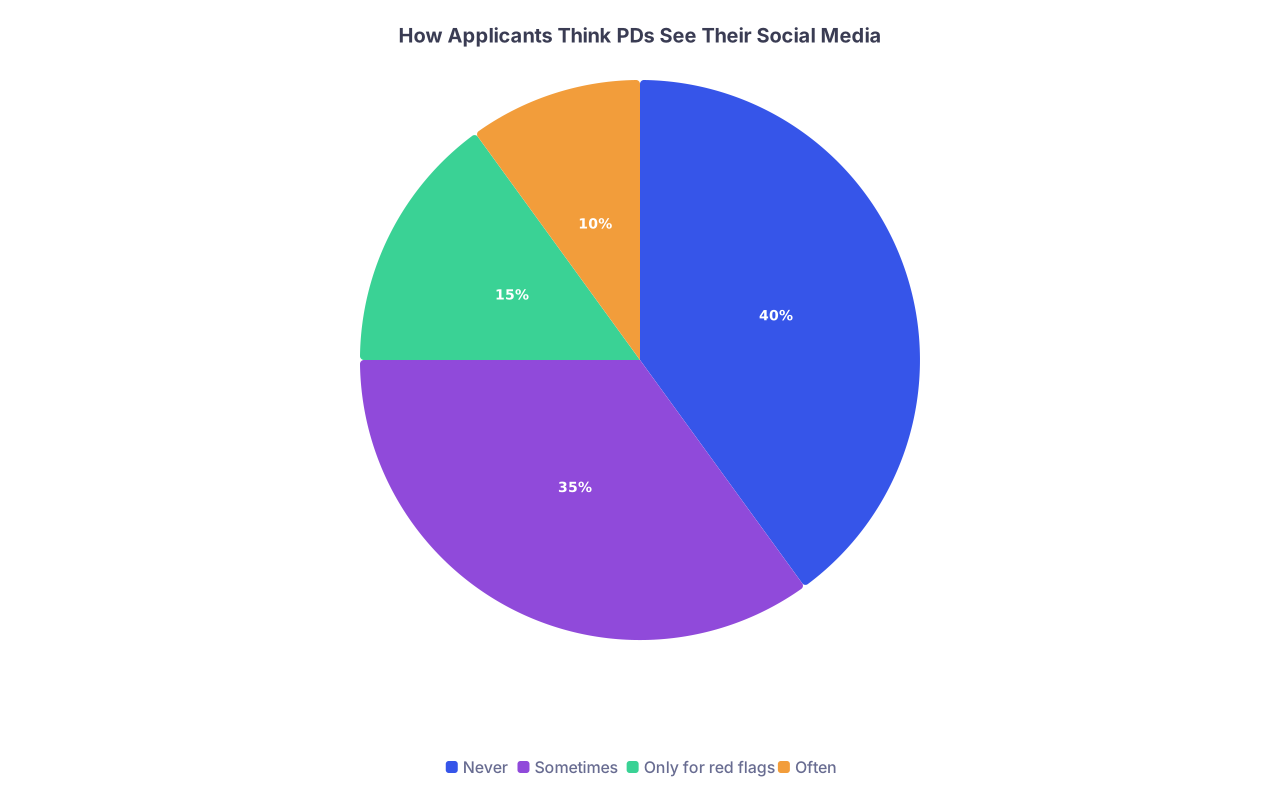
| Category | Value |
|---|---|
| Never | 40 |
| Sometimes | 35 |
| Only for red flags | 15 |
| Often | 10 |
Reality: most PDs aren’t actively stalking, but one red flag screenshot traveling in the right group chat is enough.
The fatal assumptions IMGs make
“My account is private, I’m safe.”
Private doesn’t protect you from:- Screenshots
- Someone in your rotation already following you
- A “friend of a friend” forwarding something to a resident
“I use a fake name. They’ll never find me.”
Then you:- Use the same photo as your WhatsApp
- Post your white coat with hospital badge visible
- Tag your city and specialty
They can connect those dots in 5 seconds.
“Everyone else posts this stuff.”
Yes, some people get away with it. For now. You’re not applying from Harvard Med with 10 home letters. You’re an IMG with a margin of error close to zero. You don’t get to play that game.
Rule: Assume every post, comment, DM, and story could be on your PD’s desk tomorrow morning. If it would make you sweat, don’t post it.
2. Turning Your USCE Into Content
This is the biggest trap during observerships and externships: treating your US clinical experience as “content” for Instagram, TikTok, or Facebook.
The classic mistakes
Posting selfies in the hospital
Hallway, call room, nursing station, OR entrance, ED pod. Badge visible. Unit name visible. Hospital logo on the wall.
You think: “Just a harmless picture, no patient.”
They think: “This person doesn’t understand boundaries.”Posting anything while on duty
White coat on. Scrubs on. Stethoscope. Caption: “Exhausted but blessed. 24h call life.”
You just announced you’re on service and on your phone making content.Posting schedules or case descriptions
- “Busy day: 3 appys, 1 colectomy, 1 emergent ex-lap”
- Screenshot of your schedule: “MICU – Dr. X. 7a–7p.”
That’s operational information. Some hospitals are very touchy about that.
“Anonymous” patient details
“Saw a 25-year-old with metastatic colon cancer today. So sad.”
You think: age + diagnosis is too general.
But in a small town or rare situation? Completely identifiable to someone.
I’ve watched coordinators pull an IMG off a rotation mid-month when a nurse showed them the candidate’s Instagram story from the unit. “No patient in it” didn’t save them.
What this signals to PDs
Program Directors don’t sit there debating HIPAA line by line. They ask one simple question:
“Do I trust this person with my patients, my residents, and my program’s reputation?”
Your “USCE vlog” can answer “No” for them in 15 seconds.
Safer approach during USCE
- No photos inside clinical areas. Period.
- No patient descriptions. No “cool case” summaries.
- No posts that tie you in real time to a specific hospital or service.
- If you must post:
- After the rotation is over
- Generic setting (no badges, no signs, no unit names)
- Vague captions
If you’re not sure whether something crosses a line, it probably does.
3. “Venting” About USCE Sites, Residents, or Attendings
This one ruins candidates more often than you’d think, especially IMGs who feel underused or disrespected in observerships.
The dangerous forms of venting
Direct complaints
- “This attending is so rude.”
- “US doctors don’t respect IMGs.”
- “Pointless observership, they don’t let you touch patients.”
“Anonymous” subtweets and stories
- “Some hospitals treat IMGs like shadows only.”
- “If you’re an IMG at a big-name NYC program right now, you know what I mean.”
That’s not anonymous. People know exactly where you are.
Sarcastic memes about nurses, staff, or patients
Even if you think it’s “just between friends.”
Here’s what actually happens:
- An IMG posts in a private Facebook group about a “toxic hospital in Chicago.”
- Another group member knows exactly which site that is and is friends with a resident there.
- Screenshot → resident → chief → PD.
- Next cycle, that PD becomes extremely careful about accepting IMGs from that source. You just damaged not only yourself, but those who come after you.
The silent consequence
They rarely confront you. They don’t send warning letters.
They just:
- Decline your interview
- Push you down the rank list
- Stop accepting IMGs from your home school
- Tell your USCE host to “rethink” future observer selections
You never get closure. Just silence.
What to do instead of venting online
- Use private, trusted people: one or two friends, a mentor, or advisor.
- Use journals. Write the rant. Don’t post the rant.
- If the problem is serious (harassment, discrimination, unsafe behavior), report it through proper channels, not Instagram stories.
If it feels good to post, it’s probably the wrong place to put it.
4. Joining the Wrong WhatsApp / Telegram / Facebook Groups
Some of the worst online missteps I’ve seen weren’t public at all. They were inside IMG “support” groups.
You join a WhatsApp or Telegram group: “IMGs in NYC”, “Observership September 2025”, “Residency Applicants Internal Medicine 2026.” It feels safe. It’s not.
Common landmines in these groups
Sharing screenshots of:
- EMR pages
- Patient lists
- Group messages with residents or attendings
- Schedule screenshots with doctor names
Complaining directly about:
- Named programs
- Specific attendings
- “Useless” rotations
Sharing files that absolutely should not be shared:
- Internal study material meant just for residents
- Passworded manuals
- Proprietary institutional documents
All it takes is one person in that group who:
- Is rotating with you
- Knows a resident you shadowed
- Is bitter or competitive
…and your name is attached to that behavior.

| Step | Description |
|---|---|
| Step 1 | You post in IMG group |
| Step 2 | Member screenshots |
| Step 3 | Shares with resident |
| Step 4 | Resident shows chief |
| Step 5 | Chief informs PD |
| Step 6 | You dropped from consideration |
Don’t make these mistakes
- Assuming “closed group” = private
- Assuming “everyone else is doing it” = safe
- Assuming “nobody here knows my hospital” = anonymous
You never really know who’s in these groups, who they know, or where screenshots will go.
Safer behavior with groups
Never post anything involving:
- Patient info
- Hospital systems
- Staff names
- Case details
Don’t complain by name about:
- Programs
- Cities
- Particular rotations
Ask yourself before posting:
“If this exact message were shown to the PD of my dream program with my name at the top, would I be okay with that?”
If the answer isn’t a hard yes, rewrite or don’t send.
5. Political, Religious, and Polarizing Takes That Backfire
This one’s uncomfortable, but ignoring it is stupidly naive.
You’re entering a profession where teamwork, trust, and professionalism matter more than your “brand.” You’re also applying to human beings with biases, opinions, and emotions.
Where applicants get burned
- Aggressive political rants
- Mocking or demeaning any group:
- Patients with certain conditions
- Certain nationalities, races, religions
- Gender identities or sexual orientations
- Strong, hostile language about:
- Vaccine policies
- Public health measures
- The “American system” or US culture
Do you have a right to opinions? Yes.
Does that protect you from being quietly screened out by someone who thinks, “This person will be a nightmare on my team”? No.
The IMG disadvantage here
US graduates sometimes get away with more because programs “know” them—letters, faculty, face-to-face reputation. You, as an IMG, are mostly a stack of documents and a digital footprint. Your posts carry more weight because they’re one of the few “real” pieces of you they can see.
You don’t have to be bland. But you cannot be reckless.
Safer strategy
- Avoid hostile, mocking tone about any group you may work with or under.
- Avoid public comments that make you look unstable, extreme, or unable to work in diverse teams.
- If you want to keep strong views, keep them decoupled from your identifiable medical persona:
- No white coat photos
- No hospital names
- No specialty in bio
- Strong privacy and no overlap with your professional contacts
Even then, remember: screenshots exist.
6. Sloppy “Professional” Profiles That Turn into Red Flags
Some of you try to leverage social media professionally—LinkedIn, Twitter/X, maybe even YouTube. That’s fine in theory. But done badly, it hurts more than helps.
Common self-inflicted wounds
- Inflating your USCE
- “Resident at XYZ Hospital” when you’re an observer
- “Clinical fellow” when you did a one-month elective
- Listing shadowing as “internal medicine physician”
Program Directors cross-check. If your ERAS says “Observer,” and LinkedIn says “Resident,” you just branded yourself as dishonest. That’s much worse than having fewer experiences.
Posting low-quality or shallow “educational” content
The 30-second “cardiology tip” reels that are basically copied from a review book but delivered confidently wrong? That’s how you signal poor judgment.Public arguments with other “medfluencers”
Debating guidelines? Can be okay.
Calling people idiots in the comments? Not okay.Unprofessional photos in a professional context
Your IG handle is “Dr.Smith_IMfuture” and the top pictures are clubbing, drinking, or questionable outfits. The handle and the content together paint a picture.
How to clean this up fast
Fix titles to be accurate:
- “Observer in Internal Medicine at XYZ Hospital”
- “Visiting medical student – Cardiology elective”
- “Trainee physician (IMG), pursuing US residency”
Remove or archive:
- Arguments in comments
- Posts that sound overconfident but shallow
- “Dr.” branding before you’re licensed in that country (a touchy subject for some)
On LinkedIn:
- Keep it boring and accurate.
- No exaggerated responsibilities or fake roles.
When in doubt, undersell slightly. Honesty reads better than flash.
7. Thinking Deleting Is Enough (It Isn’t)
A lot of applicants wake up late, panic, and start deleting everything three weeks before ERAS submission. It’s better than nothing, but you’re missing two things:
- Screenshots already exist.
- The internet doesn’t forget as quickly as you think.
You can’t erase all of it, but you can stop the bleeding
Here’s the priority list:
Go after high-risk content immediately
- Anything from inside a hospital or clinic
- Any patient-related comments
- Complaints about programs or attendings
- WhatsApp/Telegram groups where risky content is still live
Lock things down
- Set Instagram, Facebook, TikTok to private.
- Remove identifying details from bios (hospital names, “future [specialty] at [country]”).
- Turn off tag approvals automatically (no surprise tags from friends).
Audit your “likes” and comments
- Public likes on inappropriate content
- Comments under controversial posts that could be traced to you
Ask trusted friends to look with fresh eyes Tell them: “If you were a PD, what on my profile would make you hesitate?”
Don’t argue. Just fix it.
Deleting everything is overkill and looks weird (“Why is this person a ghost?”), but leaving obvious red flags up is worse.
8. A Simple Framework: The “PD Test”
If you remember nothing else, use this.
Before you post, comment, or send to a group, ask:
“If this exact screenshot—with my full name and photo—were emailed to:
• my USCE supervisor
• my dream program’s PD
• the GME committee
…how would I feel?”
Four possible answers:
- Proud – This shows maturity, insight, or professionalism.
- Neutral – Harmless, doesn’t hurt, probably doesn’t help.
- Mildly Embarrassed – This is your warning. Don’t post.
- Panicked – You’re about to step on a landmine.
For anything career-adjacent (medicine, patients, USCE, healthcare, politics relating to healthcare), you should only be posting 1 and 2.
If you’re consistently generating 3 or 4 in your head, that’s not “personality.” That’s poor judgment—and PDs rank for judgment.
Quick Comparison: Safe vs Risky Social Media Behaviors for IMGs
| Area | Safer Choice | Risky Choice |
|---|---|---|
| USCE Photos | Outside hospital, no logos/badges | Inside unit with badge/hospital visible |
| Patient Content | None | “Anonymous” case details |
| Group Chats | Logistics, support, resources | Complaints, screenshots, documents |
| Professional Titles | Observer, visiting student | “Resident”, “Fellow” when not true |
| Opinion Posts | Calm, respectful, general | Hostile, mocking, extreme |

FAQs
1. Do Program Directors really check social media for IMGs, or is this overblown?
Most PDs aren’t systematically searching every applicant. They don’t have the time. But that’s not how this hurts you. The danger comes from incidental exposure:
- A resident looks you up
- A co-rotator shares your post
- A staff member finds your content by accident
- A screenshot travels through group chats
PDs don’t need to be actively stalking you. They only need one clear red flag, delivered by someone they trust, to decide you’re not worth the risk—especially as an IMG they don’t know personally.
2. I already posted some questionable things during USCE. What should I do now?
Don’t panic, but don’t ignore it.
Delete anything involving:
- Hospitals (visible logos, badges, unit names)
- Patients or cases, even “anonymous”
- Complaints about programs, attendings, or residents
Lock your profiles:
- Set to private
- Remove hospital names and USCE details from bios
Clean your “professional” pages:
- Fix titles (observer vs resident)
- Delete overconfident or poorly informed medical posts
You can’t reverse every screenshot, but you can stop creating new problems and reduce the odds of something resurfacing.
3. Can I use social media positively for residency as an IMG?
Yes, but be disciplined.
Good uses:
- A clean LinkedIn with accurate experience and achievements
- Occasionally sharing neutral educational content (cited, careful, modest)
- Following programs and residents to understand culture and interests
- Engaging politely with professional content (liking, short thoughtful comments)
Bad uses:
- Trying to become a “med influencer” during your critical application years
- Mixing personal nightlife content with your medical persona
- Posting anything that could be interpreted as violating confidentiality, bad-mouthing programs, or exaggerating your role
If you’re not sure whether you’re mature enough online yet, keep it simple and low-key. Your residency match depends far more on not making obvious mistakes than on being visible on social media.
Remember:
- Your USCE and your social media are not separate worlds. One bad post can erase months of hard-earned experience.
- Anything remotely connected to hospitals, patients, or programs should be treated as if your PD will see it—because someday, they might.
- As an IMG, your margin for error is tiny. Use social media like a professional, or don’t use it at all.