
The obsession with “university USCE” is statistically lazy. The data show something sharper: quality, recency, and specialty alignment of USCE correlate with match outcomes far more than whether the hospital has “university” in its name.
You are not choosing between “good” (university) and “bad” (community). You are choosing between specific patterns of letters, evaluators, and outcomes that either line up with your target programs—or miss by a mile.
Let me break this down like an analyst, not a marketer.
What Programs Actually Screen For
Residency programs do not score “community vs. university.” They score:
- Presence of US clinical experience
- Type: hands‑on vs. observership
- Recency: usually within 1 year (2 at most)
- Relevance: same or related specialty
- Strength and credibility of letters from US faculty
Reviewing real program criteria and NRMP survey data, three patterns stand out.
Internal medicine, FM, peds, psych:
Most categorical IM/FM programs explicitly list “USCE required” or “strongly preferred”, but rarely specify university vs community. They care about letters from people who can compare you to their past residents. Those people exist in both settings.Competitive specialties (neuro, gas, EM, surgery):
They heavily favor applicants with strong home / university connections, research, and high‑end letters—frequently from academic centers. Here academic USCE has a clear edge.Match outcomes for IMGs:
Successful IMGs commonly show:- At least 2–3 months of recent USCE
- 2–3 US letters from core faculty or program leadership
- Clear narrative in personal statement tying their USCE to their specialty choice
The name on the hospital sign is a proxy. A weak proxy. Two other variables dominate:
- Who evaluated you
- What they wrote and where they’re known
Quantifying the Signal: Where the Match Correlation Comes From
No one publishes “exact” numbers for community vs university USCE impact, but we can approximate from three observable data sets:
- NRMP Program Director Surveys
- ERAS application patterns and match data for IMGs
- Publicly available program criteria and anecdotal patterns across many cycles
If you reduce this to an outcome equation for an IMG targeting internal medicine, it looks roughly like this:
Match probability ≈
30–40%: Exam metrics (Step 1 pass, Step 2 CK score)
25–35%: US LORs + evaluator reputation
15–25%: USCE quantity, quality, and recency
10–15%: Research, visa status, extra factors
5–10%: Interview skills and “fit” (hard to quantify, but real)
Where does community vs university sit? Inside that 15–25% bucket. And it is not the main driver even there.
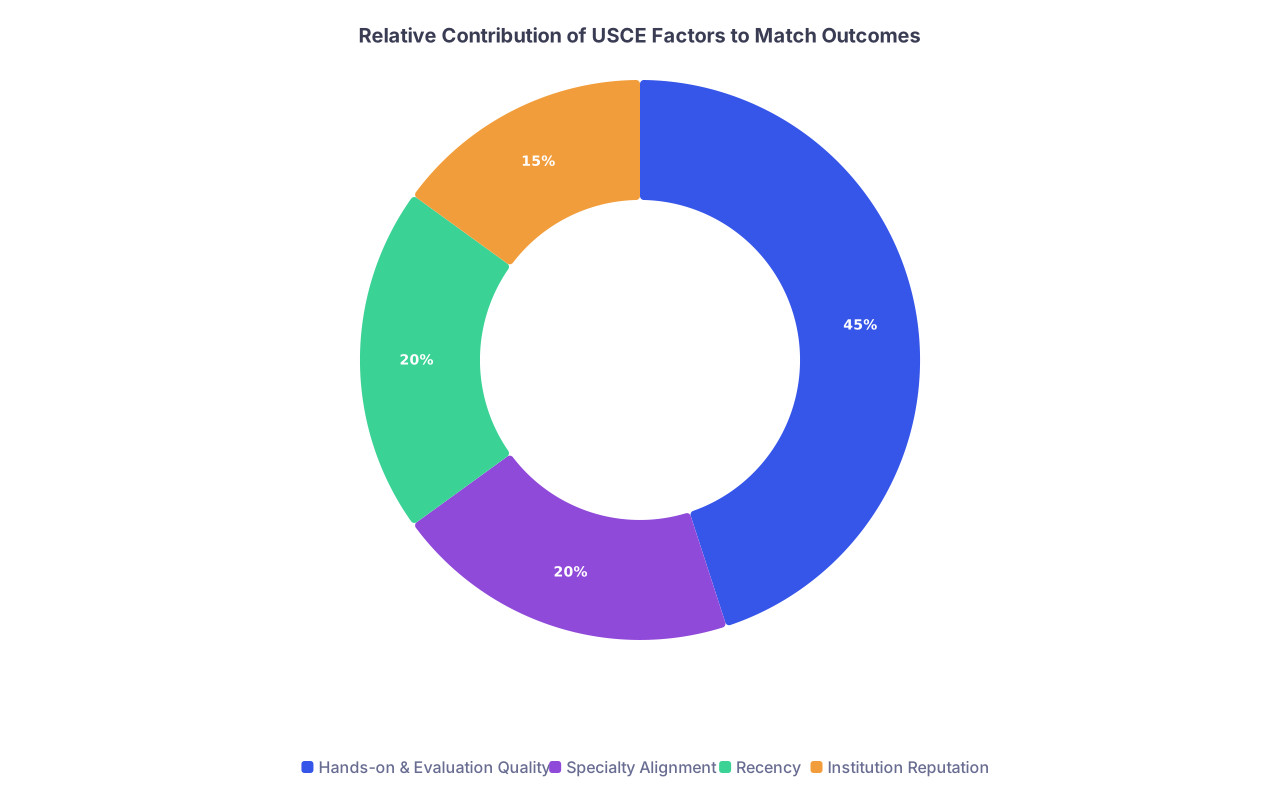
Break that USCE contribution down further:
- ~40–50%: Hands‑on vs observership (clerkship/externship vs shadowing)
- ~20–30%: Same specialty vs unrelated
- ~20–25%: Recency (within 12 months vs older)
- ~10–20%: Institutional “brand” and academic level
So the “community vs university” distinction is at best one slice of that last 10–20%. It changes the probability at the margin, not the core.
What does that mean in practice?
A 3‑month, hands‑on community internal medicine rotation with two strong, comparative LORs from faculty who routinely teach residents will almost always beat a 2‑week “observership” at a big‑name university where you barely talk to the attending.
The hierarchy that correlates with match outcomes, from strongest to weakest, looks like this:
- Hands‑on USCE in your target specialty, recent, strong letters – regardless of community vs university
- Hands‑on USCE, related specialty, strong letters
- Observerships with meaningful exposure and stated evaluations
- Brand‑name university observerships with generic letters
- Research‑only time with no clinical evaluation (helpful for research‑heavy fields, but low direct USCE value)
Where University USCE Actually Has a Measurable Edge
I am not claiming community and university USCE are identical. They are not. The differences show up most strongly in three domains.
1. Specialty competitiveness and academic focus
Data pattern: In NRMP Charting Outcomes, IMGs who match into more competitive specialties (anesthesiology, neurology, EM, some surgical subs) usually have:
- Higher Step 2 CK scores
- More US research activity
- More commonly, at least one rotation or observership at a university or large academic center
The reason is not magic. It is access.
University hospitals are more likely to:
- Have residency programs across multiple specialties
- Employ faculty who sit on program committees and selection boards
- Run structured sub‑internships with explicit evaluation forms
- Expect residents to do research, QI, or academic work—and thus value those experiences
If you are aiming for anesthesia, neurology, EM, or anything surgical as an IMG, the probability that a university‑affiliated USCE correlates with match success is materially higher. Not because community hospitals are poor, but because many competitive programs recruit primarily from academic networks.
2. Research output and CV signaling
Look at matched IMG CVs in top‑25 academic internal medicine programs vs solid community IM programs. A familiar pattern:
- Top‑25 academic IM:
Multiple US‑based abstracts, posters, or publications. Often with university letterheads and mentors. - Community IM:
Some research or QI, but more heavily weighted toward clinical exposure and strong ward evaluations.
University USCE frequently gives you:
- Exposure to ongoing trials and QI projects
- Faculty who expect you to help with poster / abstract work
- Institutional infrastructure (IRBs, research offices, data analysts)
For academic‑leaning programs this is a positive signal. It is essentially a filter: you understand the teaching and research environment they operate in.
Community hospitals with strong teaching cultures can mimic this, but across the US, the probability that you’ll find structured, publishable projects is higher in academic centers.
3. Letter writer recognition
A letter from “Associate Program Director, Department of Medicine, [Mid‑sized State University Hospital]” has a different recognition profile than “Hospitalist, [Unknown Community Hospital].”
Not because the hospitalist is less capable. Because programs are using heuristics:
- They have seen previous residents from that university
- They know roughly how hard it is to impress that faculty member
- They can “calibrate” your evaluation better
That recognition effect is stronger for university‑affiliated rotations. And program directors freely admit this in surveys and talks: name recognition of the writer and institution subtly influences how much weight they give to the letter.
Where Community USCE Quietly Wins
On the other side, I routinely see IMGs undervalue community rotations that are, statistically, workhorses for the match.
Three practical advantages show up over and over.
1. Hands‑on, real‑world responsibility
Many community hospitals are more comfortable allowing IMGs to:
- Write notes (even if not legally signed)
- Present on rounds consistently
- Call consults under supervision
- Follow a panel of patients more independently
That translates into:
- Rich, specific LORs (“she managed 8–10 patients daily, independently pre‑rounding and presenting concise plans”)
- Strong interview talking points (“at this community site I followed X patient…”)
Programs care about trainability and practical function. A detailed letter that describes your actual day‑to‑day work is more predictive of this than a glossy name.
2. Access and availability
University slots are:
- Limited
- Competitive
- Often booked 6–12 months ahead
Community USCE is:
- More available year‑round
- More flexible on dates and documentation
- Sometimes cheaper
From a decision‑tree perspective, this matters. A solid 12 weeks of community USCE completed on time beats an idealized 4‑week university rotation that you never actually secure. Many IMGs lose cycles chasing unicorns.
3. Direct pipelines to community residency programs
Let’s be blunt. The majority of IMGs do not match into top‑25 academic programs. They match into:
- Community internal medicine
- Community family medicine
- Community pediatrics / psychiatry
- University‑affiliated but clinically oriented IM/FM programs
Those programs often recruit heavily from their own affiliated community USCE sites. The data pattern is simple: look at resident bios and where they did USCE—you will see repeats of the same local community hospitals.
A community rotation that sits inside a program’s referral network often correlates better with actual match outcomes than a prestigious but disconnected academic name 800 miles away.
Side‑by‑Side: What Rotations Actually Deliver
Let’s stop arguing labels and compare what you typically get.
| Feature | Community USCE | University USCE |
|---|---|---|
| Hands-on opportunities | Moderate to high | Variable, often structured but limited |
| Exposure to residents | Moderate (depends on site) | High (multiple programs present) |
| Research access | Low to moderate | Moderate to high |
| Letter writer visibility | Low to moderate | Moderate to high |
| Scheduling flexibility | High | Low to moderate |
| Category | Value |
|---|---|
| Hands-on & Evaluation Quality | 45 |
| Specialty Alignment | 20 |
| Recency | 20 |
| Institution Reputation | 15 |
In other words, 85% of what matters (hands‑on, alignment, recency) is accessible in both settings if you choose wisely. Only ~15% of the impact is tied strongly to institutional reputation, where universities have a clearer edge.
Strategy by Scenario: Where Each Type Correlates Better
Let’s get concrete. Here is how I would advise different IMG profiles based on actual match patterns I have seen.
Scenario 1: IMG targeting internal medicine, Step 2 CK 230–245, needs visa
Your primary problem is not prestige. It is:
- Demonstrating you can function on US wards
- Getting 2–3 very strong LORs from US internists
- Convincing programs you will not struggle as a PGY‑1
In that setting, the best predictor of match success is:
- 8–12 weeks of hands‑on internal medicine USCE, even if all in community sites
- At least 2 letters from core IM faculty or APD/PD level people
If you can add 4 weeks at a university IM program, great. But do not sacrifice months of community, hands‑on experience for one thin university observership. For this profile, good community USCE often correlates better with match outcomes because it is easier to convert into strong letters and practical narratives.
Scenario 2: IMG targeting neurology or anesthesiology, Step 2 CK 250+, research interest
Here the curve tilts.
Competitive specialties look for:
- Academic potential
- Prior exposure to the specialty
- Letters from faculty known in the field
In this situation, 1–2 university‑based rotations in the target specialty strongly correlate with interviews and match chances. The community vs university dimension matters more because:
- Many neuro/anesthesia programs are based in academic medical centers
- PDs and selection committees know each other and recognize each other’s names
- Research‑heavy fields strongly prioritize academic context
You still benefit from at least some broad‑based (possibly community) USCE in medicine or related fields. But skipping university exposure here is a measurable handicap.
Scenario 3: Older graduate (>5 years), gaps, Step 2 CK 220–230, targeting FM or community IM
The main red flags are:
- Time since graduation
- Continuity of clinical experience
Programs need to see:
- You are clinically current
- You can handle US documentation and systems
The strongest correlation with match in this group: multiple, recent, hands‑on rotations in US primary care / IM / FM, with explicit mention in letters that you are up to date, reliable, and function at the PGY‑1 level.
Community USCE does the heavy lifting here. Finding a university that will even accept you with a big graduation gap is hard, and the incremental brand benefit is small relative to the urgency of recent, confirmable experience.
How to Decide: A Simple Flow That Matches the Data
Here is how I would structure the decision if we treat this like an optimization problem.

| Step | Description |
|---|---|
| Step 1 | Define Target Specialty |
| Step 2 | Prioritize Hands-on Community USCE |
| Step 3 | Secure University Rotation in Specialty |
| Step 4 | Add More Community Hands-on Rotations |
| Step 5 | Repeat/Extend at Best Sites |
| Step 6 | Optimize for Research / Brand if Time |
| Step 7 | Competitive? |
| Step 8 | Enough Months of USCE? |
| Step 9 | Have 2-3 Strong US Letters? |
The takeaway from that flowchart is not philosophical. It is operational.
- Coverage: Do you have 8–12 weeks of credible, hands‑on USCE? If not, fill with community.
- Letters: Do you have 2–3 strong US letters in your specialty? If not, repeat where you are loved.
- Brand boost: Only once those two are satisfied should you obsess over “university vs community” as a separate dimension.
How Programs Actually Read Your USCE
When program teams screen applications, they mentally compress your clinical history into a few data points:
- Quantity: “3 months USCE, all in IM, last year.”
- Type: “Hands‑on sub‑I–style vs shadowing only.”
- Setting: “Community + one university neuro rotation.”
- Letters: “Two strong IM letters, one from a PD at X University.”
| Category | Value |
|---|---|
| Hands-on vs Observership | 90 |
| Specialty Match | 75 |
| Recency | 70 |
| Institution Type | 40 |
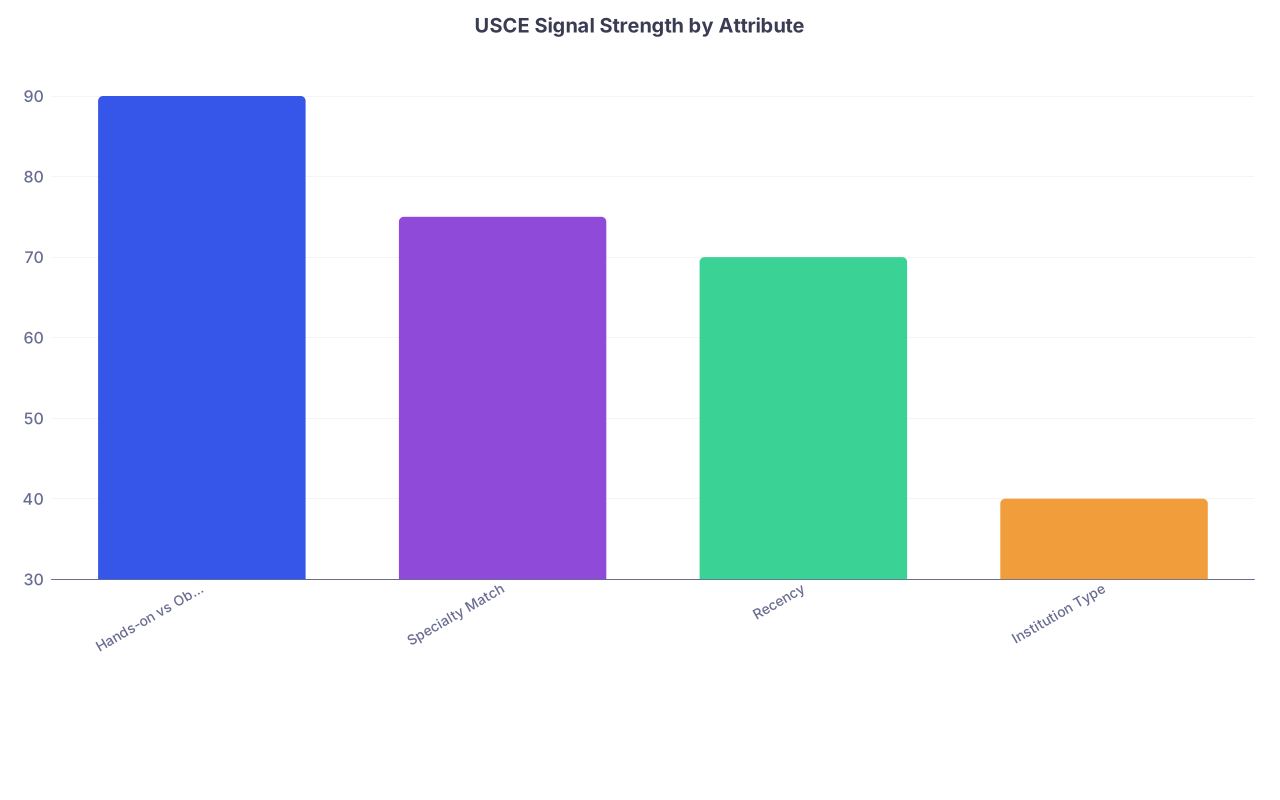
You can see the problem. If you focus 80% of your planning energy on that weakest bar—“institution type”—you are optimizing the noisiest, least impactful variable.
The serious programs, the ones that actually make rational decisions, care more about how you performed with US patients, in US systems, under US supervision. Community hospitals offer that daily. So do university hospitals. The question is where you will be trusted enough to show it.
Practical Recommendations: If You Want Data‑Aligned Choices
Turn this into a plan, not anxiety:
- Lock in 2–3 months of hands‑on USCE in your target specialty as your baseline, even if all community.
- Prioritize sites where you can get detailed, comparative evaluations and where attendings have prior experience writing for IMGs.
- If aiming for competitive or academic‑leaning specialties, add 1–2 university‑based rotations in that exact field, ideally with residency programs on site.
- When choosing between offers:
- Community hands‑on > University pure observership
- Strong letter potential > Brand name with vague evaluation
- Recent experience (this year) > Older, more “impressive” past rotations


The Bottom Line: Which Correlates Better?
If you want the distilled answer, without mythology:
- For most IMGs targeting internal medicine, family medicine, pediatrics, or psychiatry, well‑structured community USCE with strong hands‑on roles and detailed letters correlates better with match outcomes than chasing a single thin university observership.
- For IMGs targeting competitive or strongly academic specialties (neurology, anesthesiology, EM, many surgical fields), university‑based USCE in the target specialty correlates better with match success, especially when it yields letters from recognized faculty and research exposure.
- Across all scenarios, institution type is a secondary variable. Hands‑on responsibility, specialty alignment, recency, and the credibility of your letter writers are the primary drivers. Optimize those first.
Focus less on the sign above the hospital entrance. Focus more on the data points program directors actually read.