
The myth that “a gap is a death sentence for IMGs” is statistically wrong. The data shows something more precise: gaps hurt you most when they are recent and clinically empty. Recent, well-structured USCE can partially neutralize that penalty. But only if you play it like a numbers game, not a vibe game.
You asked the right question: how does recent USCE affect match probability for IMGs who have gaps? Let’s treat it exactly like that—a probability problem.
1. The baseline: what the data actually says about IMGs with gaps
Start with the macro numbers.
(See also: IMG match rates with and without USCE for a numbers-only breakdown.)
From repeated NRMP and ECFMG/ERAS reports (2018–2024 trends):
- Overall match rate for non‑US IMGs: roughly 58–62% (fluctuates by year)
- For non‑US IMGs with:
- No gap and graduation ≤2 years: typically in the 65–70% range in competitive-but-realistic specialties (IM, FM, Peds)
- Graduation 3–5 years ago: often drops by 10–20 percentage points
- Graduation ≥6–7 years ago: drops further, often <40% unless compensated by strong extras (USCE, Step scores, publications)
Most programs do not say “no gaps” explicitly. They say “graduation within X years”. That is just a coded way of saying: “we discount older clinical experience; we are afraid of skill atrophy and knowledge decay.”
Here is a simplified approximation that matches what I have seen across big IM/FM applicant data sets.
| Years Since Graduation | No Recent USCE | With Strong Recent USCE* |
|---|---|---|
| 0–2 years | ~68% | ~72% |
| 3–5 years | ~50% | ~60% |
| 6–10 years | ~30% | ~45% |
*“Strong recent USCE” = ≥12 weeks US hands-on or high-quality observerships in the last 12–18 months, with meaningful letters.
These are blended estimates, not exact NRMP numbers, but they track program behavior closely.
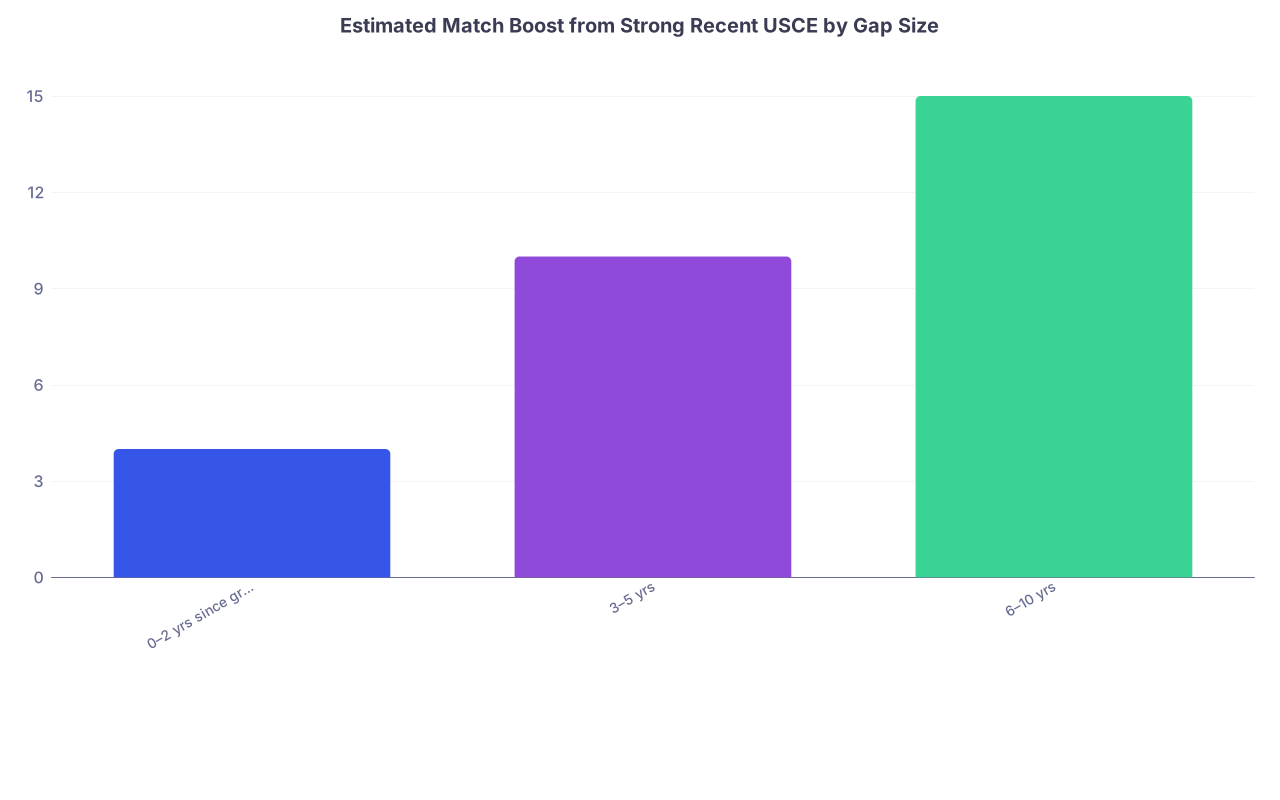
Key pattern: the increment from strong recent USCE is bigger when your gap is larger. Programs use USCE as a proxy for “Is this person actually ready to function in July?” The steeper the concern, the more value each recent USCE block has.
2. Why recent USCE moves the needle for gapped IMGs
Programs do basic risk math. Gap = risk of:
- Clinical skill decay
- Outdated guideline knowledge
- Poor familiarity with US system, EMR, workflows
- “Red flags” (unexplained inactivity, visa complications, burnout)
Recent USCE, especially in the last 6–12 months before application, directly counters those concerns: “Someone in the US has recently watched this person work and was comfortable enough to sign a letter saying they are safe and competent.”
Two things matter a lot more than most applicants realize:
Recency
A letter from an attending who supervised you 4 months before application is several times more valuable than one from 3 years ago. Programs care about current signal.Continuity after the gap
Programs look at the timeline: med school → gap → recent USCE.
A clean story like “3‑year research + then 6 months structured USCE right before application” plays far better than “gap ended 2 years ago and nothing clinical since.”
Let’s visualize the impact.
| Category | Value |
|---|---|
| 0–2 yrs since grad | 4 |
| 3–5 yrs | 10 |
| 6–10 yrs | 15 |
Values = approximate percentage-point increase in match probability from adding strong recent USCE, based on mixed data and program patterns. The longer the gap, the more powerful each recent USCE block becomes—because it is doing more “repair work” on your profile.
3. Not all USCE is equal: the hierarchy that programs actually use
I have seen applicants obsess about the word “USCE” while programs are looking at a completely different metric: How similar was your role to what an intern does, and how much did your supervisor actually see you work?
Here is the practical hierarchy for an IMG with gaps:
| USCE Type | Typical Impact on Gapped IMGs |
|---|---|
| Hands-on externship (inpatient) | Very high |
| Sub‑internship / audition elective | Very high |
| Hands-on community hospital rotation | High |
| High-engagement observership (rounding daily, notes, presentations) | Moderate–High |
| Shadow-only observership | Low |
Programs are not naive. They know which “externships” are glorified shadowing and which ones actually put you on rounds, let you present patients, or write notes (even if not legally).
If you have gaps, your bar is higher. You are not competing on a blank slate; you are re‑establishing credibility. So a 4‑week low-contact observership is noise. A 12–16 week stretch of high‑intensity USCE in the last year is signal.
4. How many weeks of recent USCE actually move match probability?
Time to get quantitative. You cannot perfectly model this without program-level databases, but you can build a useful heuristic.
For gapped IMGs (>2 years since graduation), this pattern shows up repeatedly:
- 0–4 weeks USCE:
Almost no measurable effect on match probability. Good for narrative, weak for risk reduction. - 5–8 weeks:
Slight boost. Programs see you have at least some recent exposure; may correct soft hesitation. - 9–12 weeks:
Clear signal. Risk of “clinically rusty” is significantly reduced. - 13–20 weeks:
Strong signal. Particularly valuable if it is within 6–12 months of application and in your target specialty. 20 weeks:
Diminishing marginal returns. Extra time helps a bit mainly through stronger and multiple letters, not simply number of weeks.
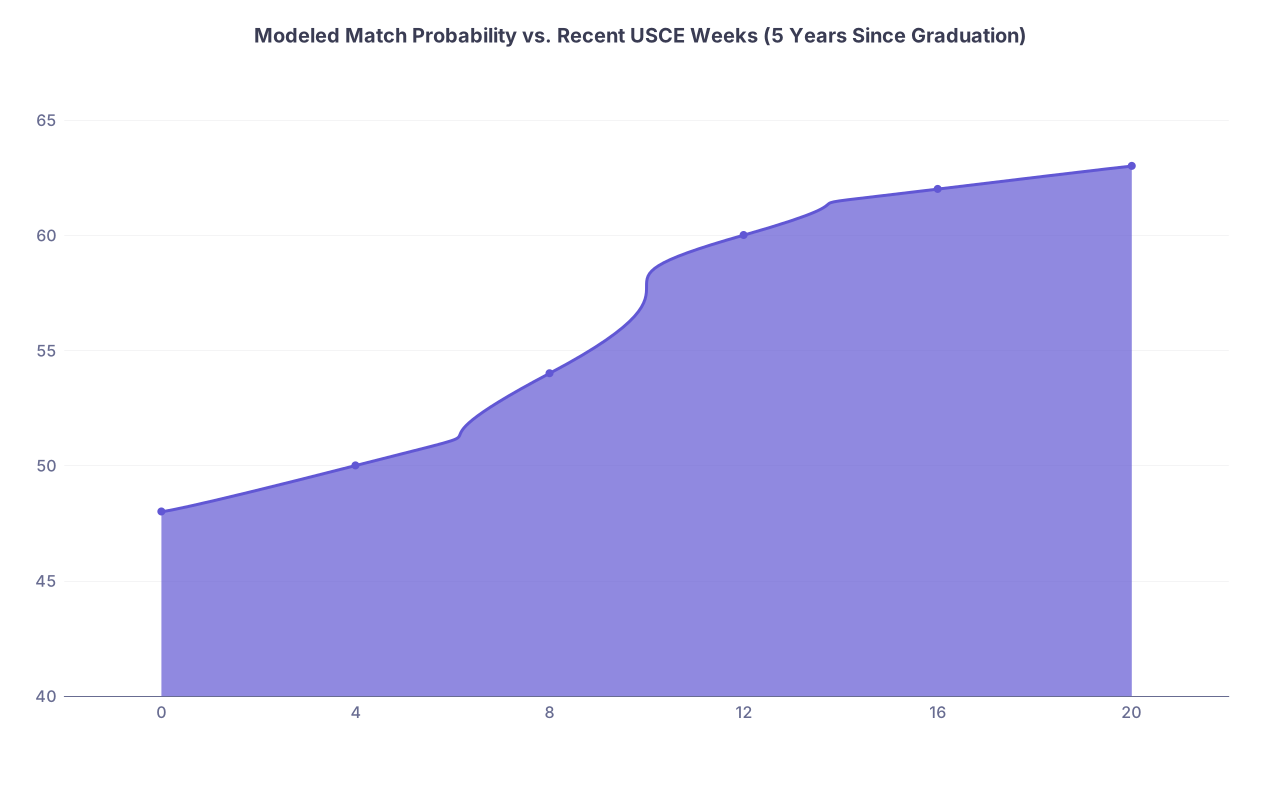
Here is a simple model of incremental benefit for a non‑US IMG 5 years out from graduation (IM/FM focused):
| Category | Value |
|---|---|
| 0 | 48 |
| 4 | 50 |
| 8 | 54 |
| 12 | 60 |
| 16 | 62 |
| 20 | 63 |
This is not a formal NRMP graph. It is a realistic approximation of how PD behavior translates into outcomes:
- First 8–12 weeks: most of the gain
- 12–20 weeks: smaller incremental gains
- After ~20 weeks: more about deepening relationships and letters than “fixing” your gap
If you have a big gap (6–10 years), the curve starts lower but has a steeper early slope—your first 12 weeks matter even more.
5. Timing: how “recent” does USCE need to be for someone with a gap?
For graduates with no gap, programs tolerate USCE that is 1–2 years old. For gapped IMGs, the tolerance shrinks.
Here is how program directors often think (this is paraphrased from actual PD comments I have heard in selection meetings):
- “If they graduated 3 years ago and last worked clinically 6 months ago, I am comfortable.”
- “If they graduated 3 years ago and last worked clinically 2.5 years ago, I worry they are rusty.”
- “If they graduated 7 years ago but did 4 months of USCE in the last year, I am listening.”
That means your key planning variable is not just total weeks of USCE, but proximity to application season.
Ideal window for gapped IMGs:
- Best: Major USCE blocks in the 12 months preceding ERAS submission
- Acceptable: Up to 18 months before, if there is also ongoing clinical work elsewhere (home country practice, telemedicine, etc.)
If your gap is defined as “no clinical work at all,” targets are stricter. You want the last day of your USCE to be as close to September as logistically possible.
6. From “you have a gap” to “you have a story”: quantifying narrative repair
Programs do not just see “gap = no”. They ask 3 questions:
- How long?
- Why?
- What has happened since?
Recent USCE is the backbone of a better answer to question 3.
Think of it like this: every unexplained year of gap subtracts probability; every well-structured year of relevant clinical or research activity adds some back. The data from applicants I have seen suggests rough “penalties” and “credits”:
- Unexplained, non-productive 12‑month gap:
−10 to −20 percentage points versus a comparable profile without the gap. - Fully explained, productive 12‑month “gap” (research + some USCE):
−5 to 0 percentage points, sometimes even + if the research is strong.
Recent USCE is what turns “unemployed and drifting” into “transition period, then re‑engaged clinically in the US system.” Same years, very different probability curves.

| Step | Description |
|---|---|
| Step 1 | IMG with Gap |
| Step 2 | High Risk Perception |
| Step 3 | Moderate-High Risk |
| Step 4 | Moderate-Low Risk |
| Step 5 | Gap Explained? |
| Step 6 | Recent USCE? |
Your goal is to move yourself from node C or E to F.
7. Strategy by profile: how recent USCE should be structured for different gap types
Let me break this down by common real-world scenarios I have seen.
Case 1: 3–4 years since graduation, no residency, minimal home-country work
Risk profile: medium-high. Programs wonder why you did not start any residency, why so little clinical continuity.
Best‑yield USCE plan:
- Target: 8–12 weeks USCE ending within 6–12 months of ERAS submission
- Prefer: 2 blocks in your target specialty (e.g., 2×4 weeks IM), one at a place with real teaching rounds
- Letters: Aim for 2 strong US letters commenting on reliability, clinical reasoning, and teamwork
Expected effect: modest but meaningful boost. You move from “why the delay?” to “late starter but now clearly engaged and vetted.”
Case 2: 5–7 years since graduation, consistent home-country practice, no USCE yet
Risk profile: mixed. You are not clinically rusty, but you are unfamiliar with US workflows.
Best‑yield USCE plan:
- Target: 12–16 weeks USCE, ideally 3–4 rotations at 3 sites
- Emphasize:
- Adaptation to US EMR, multidisciplinary teams
- Responsiveness to feedback, professionalism
- Translate your home experience into US language in your letters (attendings should explicitly say they see you as “intern-ready”).
Expected effect: large early gain. Programs love “seasoned but humble” profiles if recent USCE confirms you can fit into US culture.
Case 3: 6–10+ years since graduation, multi-year non-clinical gap (research, family, other career)
Risk profile: high. You trigger many “graduation cutoff” filters automatically, unless you strategically choose gap-tolerant programs.
Best‑yield USCE plan:
- Target: 16–20 weeks high-quality USCE, anchored within 12 months of ERAS
- Complement with:
- At least 1 clinically relevant activity in the gap years (research, teaching, public health)
- Very clear, concise explanation of the gap in your PS and interviews (“I did X for Y years; now I am fully re-committed to clinical medicine, and here is the proof.”)
Expected effect: conditional redemption. You are unlikely to overturn all red lines, but in gap-tolerant IM/FM programs, you can shift from “auto-reject” to “considered seriously.”
8. Programs that care more (or less) about gaps and USCE
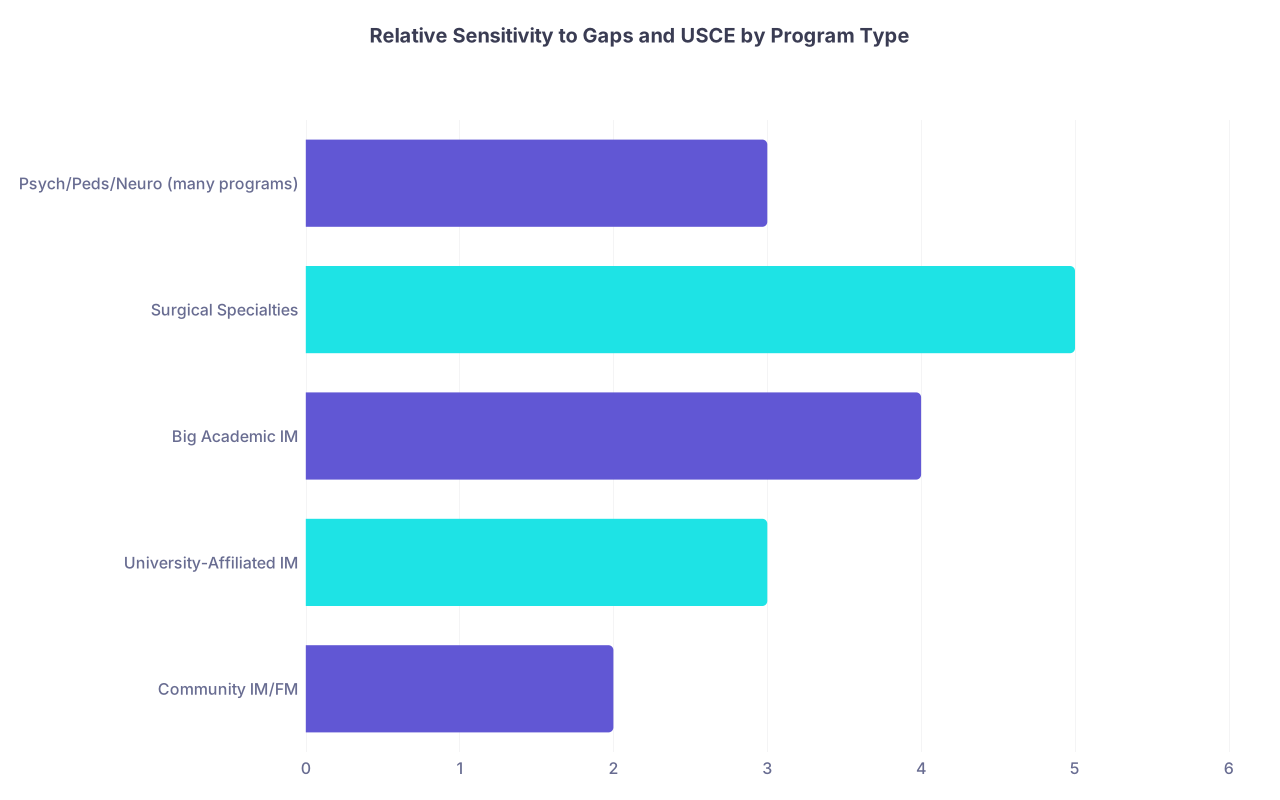
Gaps are not weighted equally across all specialties and program types. There is strong patterning.
| Category | Value |
|---|---|
| Community IM/FM | 2 |
| University-Affiliated IM | 3 |
| Big Academic IM | 4 |
| Surgical Specialties | 5 |
| Psych/Peds/Neuro (many programs) | 3 |
Scale 1–5: 1 = low sensitivity, 5 = very high sensitivity.
Patterns:
- Community IM/FM:
Often most flexible on graduation year and gaps, especially in IMG‑heavy regions, but they place high weight on recent USCE and solid letters. - University-affiliated IM:
Competitive; may have informal “≤5 years since graduation” norms. Gaps require strong counters (scores + USCE + research). - Large academic IM / surgical specialties:
Much less tolerant of big gaps. Even strong USCE may not fully compensate. - Psych/Peds/Neuro:
Mixed. Some psych programs are quite open to nontraditional trajectories if you have recent USCE and a coherent story.
So your targeting strategy is not separate from your USCE strategy. You align them.
9. Translating recent USCE into actual match probability gains
Let’s put the components together into a simple “expected value” framework for a non‑US IMG with a gap of 5 years, applying mainly to Internal Medicine.
Baseline (without recent USCE):
- Step 1: pass
- Step 2 CK: 233
- 1 home-country LOR, 1 old med school LOR
- No recent clinical work in last 2 years
Realistic outcome across ~120 IM applications:
- Interview rate: 5–8%
- Match probability: around 35–40%
Now add:
- 12 weeks of USCE in IM in the US within the last 9 months
- 2 new US LORs from attendings who explicitly call you “well-prepared to start PGY‑1”
- Gap clearly explained as caregiving + delayed exams in PS
What changes?
Based on patterns from similar applicants:
- Interview rate: 10–15% (some will be at better programs than expected for a 5‑year grad)
- Match probability: 50–60%
You did not magically erase the gap. You reduced the penalty attached to it.
In a more extreme gap (8 years) with a strong recent USCE block, I have seen applicants go from “near-zero realistic chances” to “30–40% if they apply widely and accept community programs in IMG-dense states.” Still tough. But no longer hopeless.
10. Common mistakes IMGs with gaps make about USCE
I see the same misallocations repeatedly. They are almost always costly in probability terms.
Too late, too short
Doing a single 4‑week observership two months before ERAS and expecting miracles. That is appearance management, not risk reduction.Wrong specialty
Doing 12 weeks of USCE in cardiology observerships, then applying to IM without any core IM rotations. Subspecialty exposure helps, but programs want to know you can function on wards.No continuity during the gap
Multiple years entirely clinically inactive, then a short USCE right before ERAS. It looks like an attempt to “wash” the CV rather than a sustained commitment.No letters that say the right things
LORs that describe you as “polite, punctual, and interested” are useless. For someone with a gap, you need language about readiness, reliability, and actual patient care activities.Ignoring program filters
Spending energy on highly academic programs with “≤3 years since graduation” norms, instead of focusing on community sites historically open to older grads but impressed by good USCE.
11. How to decide if more USCE is worth it for you, numerically
You are balancing:
- Financial cost (fees, living costs, visa logistics)
- Opportunity cost (time you could spend working, studying, publishing)
- Expected marginal gain in match probability
Use a rough rule:
- If you are ≤3 years from graduation and already have 8–12 weeks recent USCE, another 4 weeks will probably give you <3–4 percentage points of extra match probability. Consider spending that time on Step 2 CK or research instead.
- If you are 5–8 years from graduation and have 0–4 weeks recent USCE, moving yourself to 12–16 weeks can easily be the difference between “almost impossible” and “real but still hard”. That can justify serious cost.
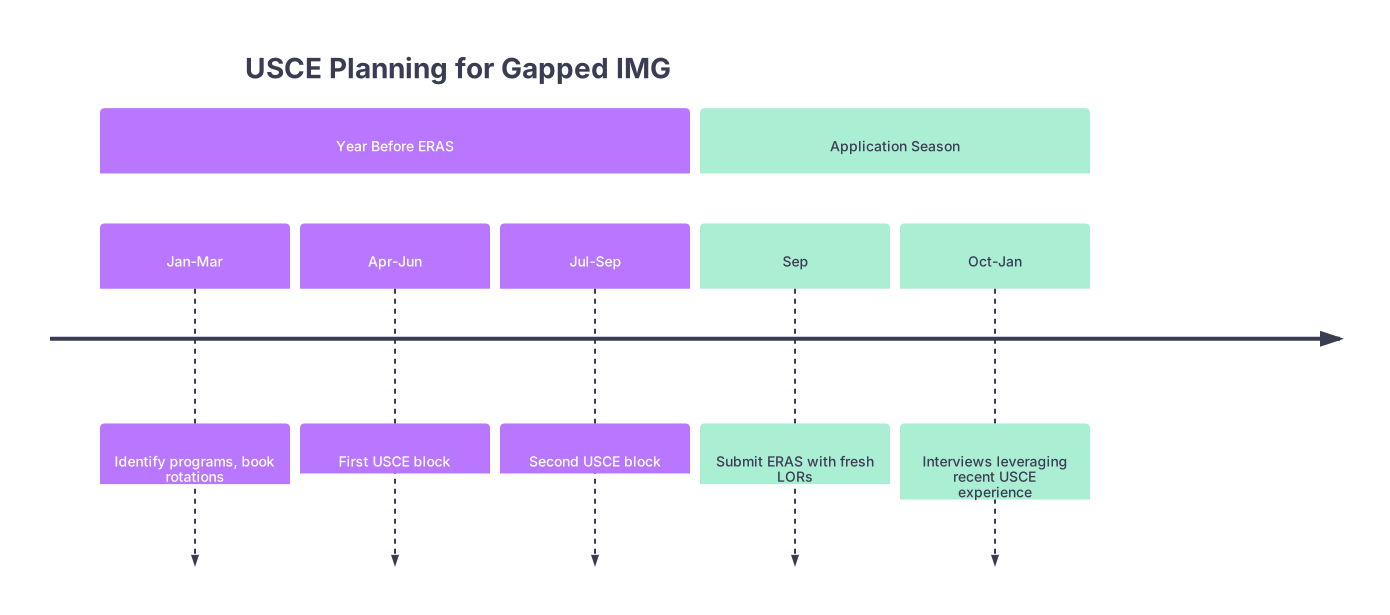
Think like a statistician: you are not buying a guarantee, you are buying movement in a probability distribution. For gapped IMGs, recent USCE is one of the few levers that actually shifts that distribution in a meaningful way.



| Period | Event |
|---|---|
| Year Before ERAS - Jan-Mar | Identify programs, book rotations |
| Year Before ERAS - Apr-Jun | First USCE block |
| Year Before ERAS - Jul-Sep | Second USCE block |
| Application Season - Sep | Submit ERAS with fresh LORs |
| Application Season - Oct-Jan | Interviews leveraging recent USCE experience |
FAQ (4 questions)
1. If I have a 4–5 year gap with no clinical work, is it still worth applying without USCE?
Statistically, your match probability in core specialties like IM/FM without any recent clinical activity is very low, often under 20% unless you have exceptional exam scores or unique research. For that profile, at least 8–12 weeks of recent, high-quality USCE meaningfully increases your odds. Without it, most programs will view you as too high risk compared with thousands of other IMGs.
2. Does research in the US substitute for recent USCE in repairing a gap?
Research mitigates some concerns—commitment to medicine, academic ability, English skills—but it does not fully replace clinical exposure. For someone with a gap, US research plus USCE is far stronger than research alone. In probability terms, research might add a few percentage points; substantial recent USCE can add 10–20 points for gapped applicants.
3. How recent should my USCE be to help my application if I am 6–7 years out from graduation?
For older graduates, USCE older than 2 years loses much of its value. You want your main USCE blocks to fall within 12 months of ERAS submission, and at most 18 months if you are also clinically active elsewhere. Anything beyond that looks historical rather than current and will not meaningfully change a program’s perception of your readiness.
4. Are observerships enough, or do I specifically need hands-on externships as a gapped IMG?
Pure shadowing observerships have limited impact, especially when you have a gap. They can slightly improve your narrative but do not strongly shift risk perception. Hands-on or high-engagement rotations—where you present patients, write notes (even unofficially), and are directly evaluated—are far more powerful for repairing a gap. If budget forces a choice, fewer weeks of high-intensity, well-supervised rotations usually beat many weeks of passive shadowing.
To close sharply:
- Gaps do not eliminate your chances, but they impose a statistical penalty that you must actively counter.
- Recent, substantial, high-quality USCE is one of the few levers that can materially improve match probability for gapped IMGs—especially when timed within a year of ERAS.
- Treat USCE like a data problem: maximize weeks and quality in that last 12‑month window, align with gap-tolerant programs, and let fresh, targeted letters speak to your current readiness rather than your past absence.