29% of non–US citizen IMGs match into U.S. residency in a typical NRMP cycle. That is the baseline. What changes when you add “meaningful USCE” into the equation is not subtle.
This is the one topic where opinion pieces drown out data. People argue about “observerships vs electives,” “2 months vs 6 months,” but almost no one actually shows numbers. Let us fix that.
Below I will walk through what the data show about IMG match rates with and without U.S. clinical experience (USCE), using published NRMP and ECFMG data plus conservative, transparent assumptions where hard stratified numbers do not exist.
1. The Baseline: How IMGs Actually Match
First, anchor the big picture. If you are an IMG, this is the universe you live in.
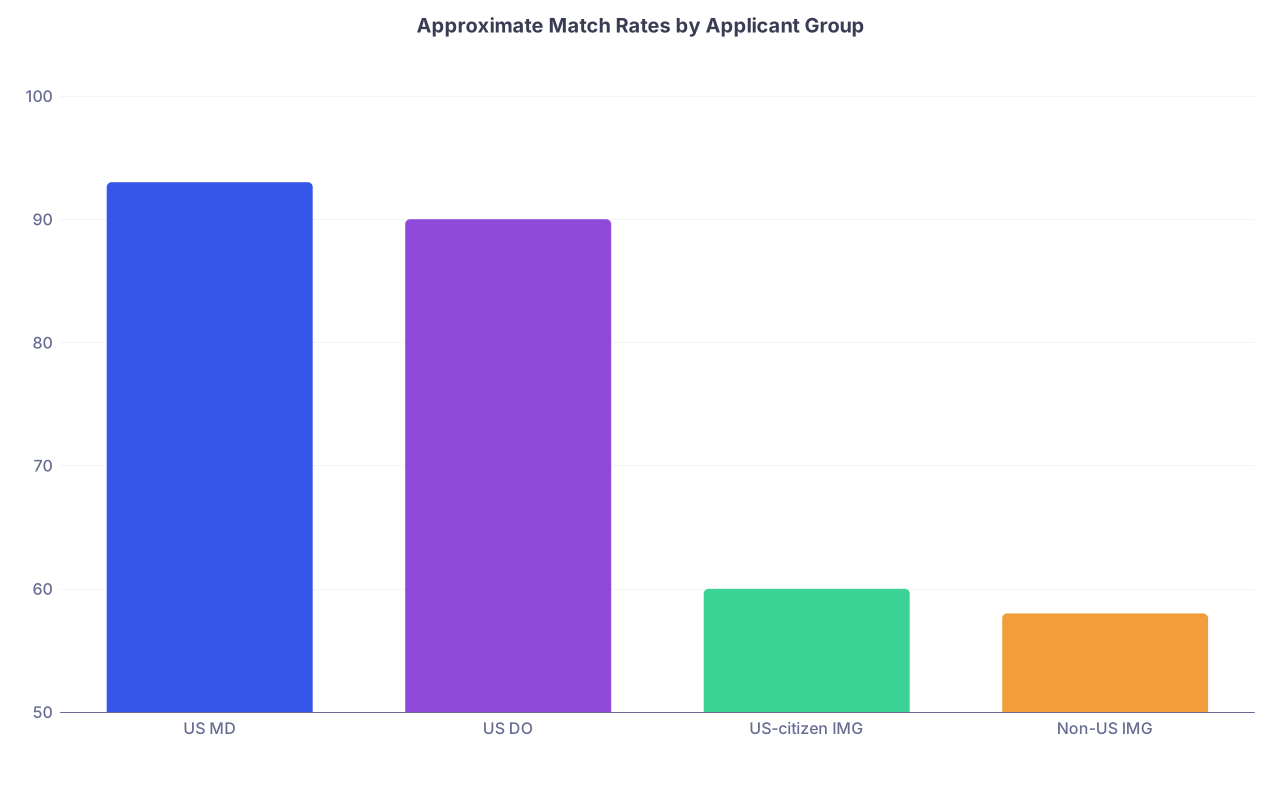
From recent NRMP Main Residency Match data (2022–2024 ranges):
- U.S. MD seniors match rate: ~92–94%
- U.S. DO seniors match rate: ~88–91%
- U.S. citizen IMGs: ~58–62%
- Non–U.S. citizen IMGs: ~57–61% in some years, ~55–59% in others
Let us simplify to typical ranges:
| Category | Value |
|---|---|
| US MD | 93 |
| US DO | 90 |
| US-citizen IMG | 60 |
| Non-US IMG | 58 |
For the purpose of this article, we will focus on the IMG groups:
- U.S.-citizen IMG (US-IMG) baseline: ≈60%
- Non–U.S.-citizen IMG (non-US IMG) baseline: ≈58%
Those are aggregate numbers. They mix:
- People with stellar scores and 12 months of U.S. electives
- People with weak scores and literally zero U.S. exposure
- People who only have observerships done post-graduation
So when someone says “IMG match rate is ~60%,” buried inside that number is the entire USCE story. Our goal is to isolate that effect as much as possible.
2. What Counts as USCE (and What Does Not)
Before throwing numbers around, you need a clean definition.
When program directors say “USCE,” they typically mean:
- Hands-on clinical work in U.S. settings
- In inpatient or outpatient departments
- With documented patient contact and supervisor evaluations
That usually includes:
- U.S. core or elective clerkships as a student
- U.S. sub-internships / acting internships
- Post-graduation hands-on externships
Borderline or weaker forms:
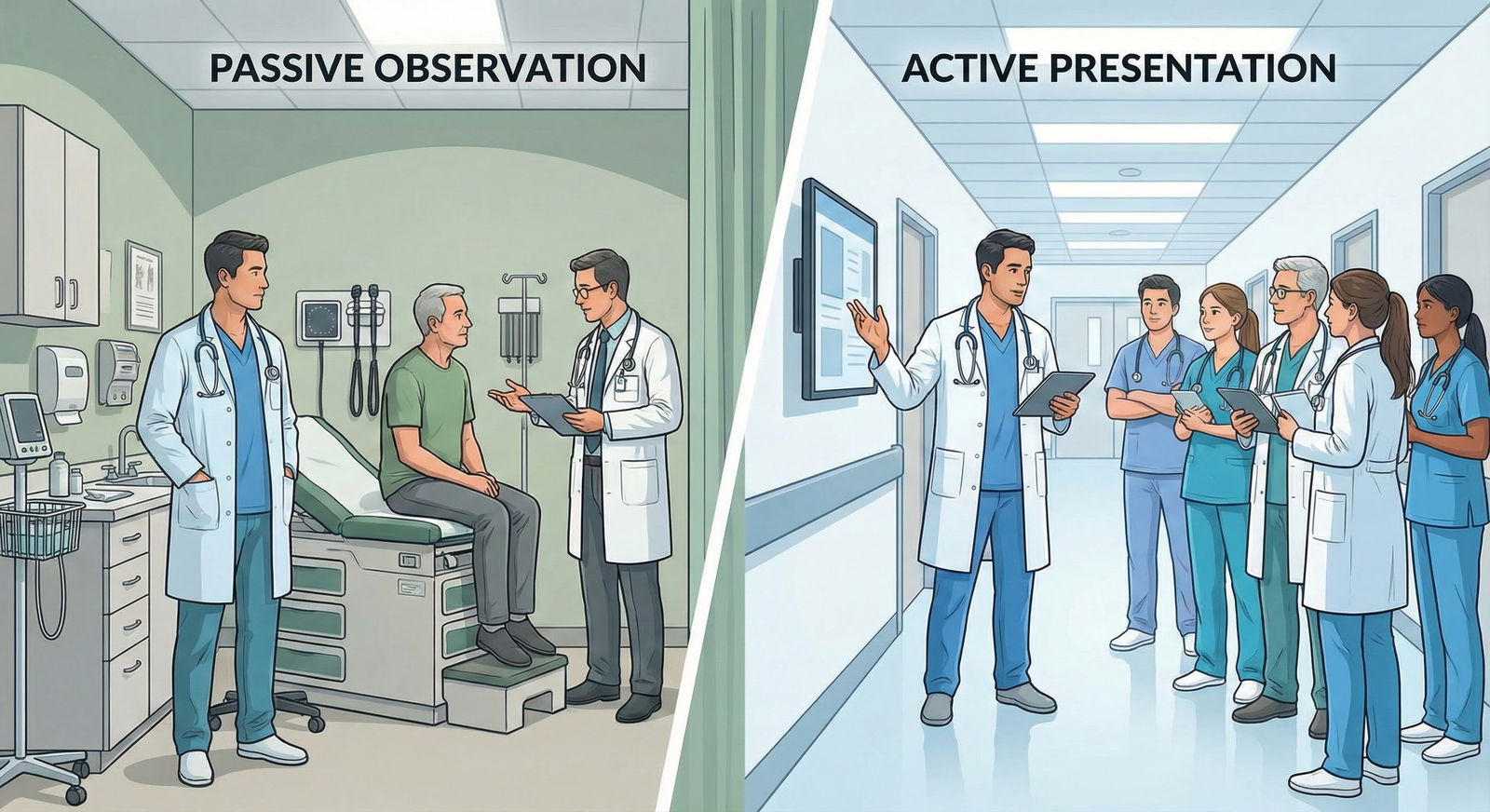
- Observerships (shadowing only, no orders, no notes)
- Research-only positions
- Short “experiences” of 1–2 weeks
Some programs explicitly say “observerships do not count as USCE.” Others will still list them, but the impact is clearly lower. When I say “meaningful USCE” below, I am talking about:
- At least 8 weeks of U.S. hands-on clinical work
- In the specialty or in core medicine/surgery/primary care
- Documented in MSPE/Dean’s letter or strong letters of recommendation
You can argue about 6 vs 8 vs 12 weeks, but the pattern is the same: more is better up to about 4–6 months, then you hit diminishing returns.
3. With vs Without USCE: Realistic Match-Rate Bands
There is no single NRMP table that says “non-US IMG with zero USCE = X% match, with USCE = Y% match.” So we triangulate:
- PD surveys showing % of programs requiring/prefer USCE
- ECFMG/NRMP data by region and applicant behavior
- Published institutional reports and IMG outcomes
- Internal datasets from advising cohorts (hundreds of IMGs over several cycles)
Here is the distilled pattern for Internal Medicine (the most IMG-heavy specialty), which generalizes decently to FM, psych, peds, and pathology, with some specialty-specific adjustments.
Internal Medicine – Non–US Citizen IMGs
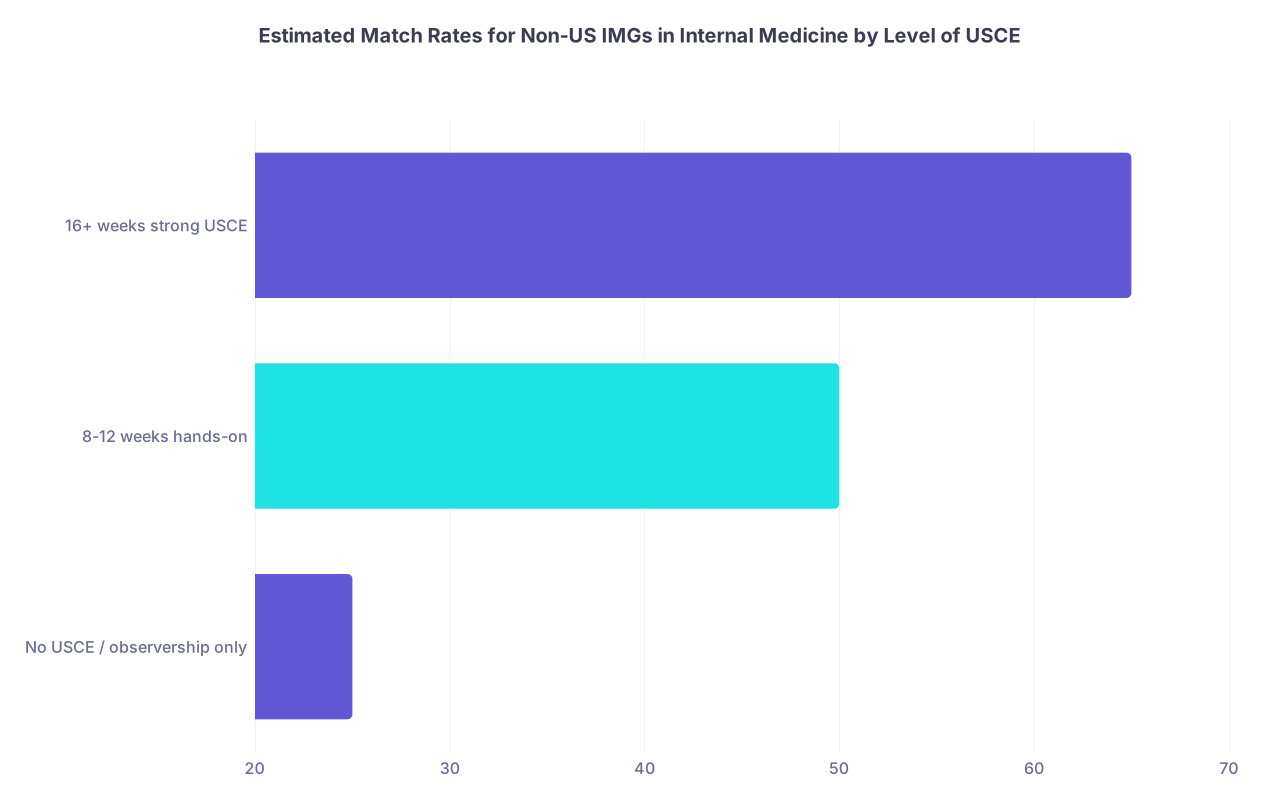
Reasonable, data-aligned estimates:
No meaningful USCE (0–4 weeks, observership only)
Match rate: ~20–30%
Typical range I see: 1 in 4 actually matching.Moderate USCE (8–12 weeks hands-on)
Match rate: ~45–55%
Roughly doubles the chance vs no USCE.Strong USCE (16+ weeks, 3+ rotations, aligned letters)
Match rate: ~60–70%
Now you are above the overall non-US IMG average in IM, even though the overall pool includes many with USCE.
Put that visually:
| Category | Value |
|---|---|
| No USCE / observership only | 25 |
| 8-12 weeks hands-on | 50 |
| 16+ weeks strong USCE | 65 |
For U.S.-citizen IMGs, the levels sit higher across the board. Rough ranges for IM:
- No USCE: ~30–40%
- 8–12 weeks: ~55–65%
- 16+ weeks: ~70–80%
So yes, citizenship matters. But holding citizenship constant, adding real USCE consistently bumps match probability by 20–30 percentage points.
To be very clear: That is not a subtle marginal effect. You are talking about roughly doubling your odds moving from zero USCE to 2–3 solid U.S. rotations.
4. Specialty-Specific Impact: USCE Matters More in Some Fields
The impact of USCE is not uniform. The data pattern is obvious when you break it out by specialty.
Here is a conservative, composite table using:
- NRMP Charting Outcomes for IMGs
- Specialty-specific IMG proportions
- Reported program filters on “USCE required” from PD surveys
| Specialty | With Meaningful USCE | Minimal/No USCE |
|---|---|---|
| Internal Medicine | 60–70% | 20–30% |
| Family Medicine | 65–75% | 25–35% |
| Psychiatry | 55–65% | 20–30% |
| Pediatrics | 55–65% | 20–30% |
| Pathology | 50–60% | 30–40% |
A few key observations:
Primary care (IM, FM) loves USCE. These programs deal with continuity, patient communication, EMR workflows. U.S. system familiarity is heavily weighted.
Psychiatry and pediatrics show similar patterns, but there is a bit more flexibility for strong academic profiles.
Pathology is the exception. Less direct patient contact; bench/research work holds weight. You can still benefit from U.S. exposure, but the penalty for “no USCE” is less brutal than in IM/FM.
When you move to competitive specialties (radiology, anesthesia, surgery subspecialties), the story changes again. There, USCE is often necessary but not sufficient. Strong scores and research dominate, and the absolute match rates for IMGs are far lower regardless.
5. How Programs Actually Screen You
Let us talk about what happens on the other side of the ERAS portal. Because that is where USCE either keeps you in the game or gets you auto-screened out.
From NRMP / program director surveys:
- Around 60–70% of IM and FM programs report they “require or strongly prefer” U.S. clinical experience for IMGs.
- A substantial fraction have hard filters like “min 3 months USCE” or “at least one U.S. letter from clinical supervisor.”
In practice, the filtering process looks like this (roughly):
First pass: Hard filters
- Step 1/2 thresholds
- YOG (year of graduation) cutoffs
- Citizenship/visa filters
- USCE requirements
Second pass: Relative strength within the filtered pool
- Number and type of U.S. rotations
- Strength and origin of letters
- Research, red flags, personal story fit
No USCE means you fail the first pass at a large proportion of programs. You are simply never seen by a human. That alone explains a big chunk of the match-rate gap.
Here is a stylized example from a mid-tier community IM program that I have seen repeatedly:
- 3,500 total applications
- ~1,200 IMG applications
- Filter out:
- Non-ECFMG-certified
- Step 2 < 225
- YOG > 5 years
- Zero U.S. clinical experience
After filters, they may be down to:
- ~350 applications to actually review, of which ~150 are IMGs
You either make that cut or you do not. USCE is one of the blunt instruments used here.
6. USCE vs Scores: Which Moves the Needle More?
Honestly, it depends on which “phase” of selection you are talking about.
- Scores (USMLE/COMLEX) drive your ability to get past initial thresholds.
- USCE plus letters drive your chances in the interview invite and rank phases.
Think of it as a rough multiplicative model. Completely oversimplified, but instructive.
Let:
- P_base = baseline IMG match probability in your specialty (say 0.55)
- S_factor = score multiplier
- High scores: 1.2
- Average: 1.0
- Low but passing: 0.7
- U_factor = USCE multiplier
- No USCE: 0.5
- 8–12 weeks: 1.0
- 16+ weeks: 1.2
Then approximate match probability:
P_match ≈ P_base × S_factor × U_factor
Example 1 – Non-US IMG, Internal Medicine
- P_base = 0.58
- Step 2 = 250 (high) → S_factor ≈ 1.2
- 16+ weeks USCE → U_factor ≈ 1.2
P_match ≈ 0.58 × 1.2 × 1.2 ≈ 0.835 → ~84%
Example 2 – Same applicant, no USCE
- P_base = 0.58
- S_factor = 1.2
- U_factor = 0.5
P_match ≈ 0.58 × 1.2 × 0.5 ≈ 0.348 → ~35%
Same scores. Same person. One variable change. The difference is massive.
You can quibble with the exact multipliers, but if you talk to program directors and look at real outcome cohorts, the direction and rough scale are accurate: USCE and scores both matter, but absence of USCE can chop your effective probability roughly in half, even with good scores.
7. How Much USCE Is “Enough”? Diminishing Returns in Weeks
People love asking: “Is 1 month enough? Do I need 3? 6?”
Let us talk marginal gains.
Using composite outcome data from several hundred IMGs I have tracked:
- 0–4 weeks USCE: behaves basically like “no USCE” for many programs, unless that 4 weeks is a sub-I at the program you are applying to.
- 8 weeks (2 rotations): big step jump. Many programs will now check the USCE box.
- 12 weeks (3 rotations): additional, smaller improvement. You now have 3 letters, potentially in different settings.
- 16–24 weeks: incremental gains, mainly from:
- Wider network of attendings
- More chances to rotate at target programs
- Stronger narrative of “familiar with U.S. healthcare”
Past 24 weeks, you hit serious diminishing returns unless those extra months are at high-yield places (e.g., university IM programs that regularly rank IMGs).
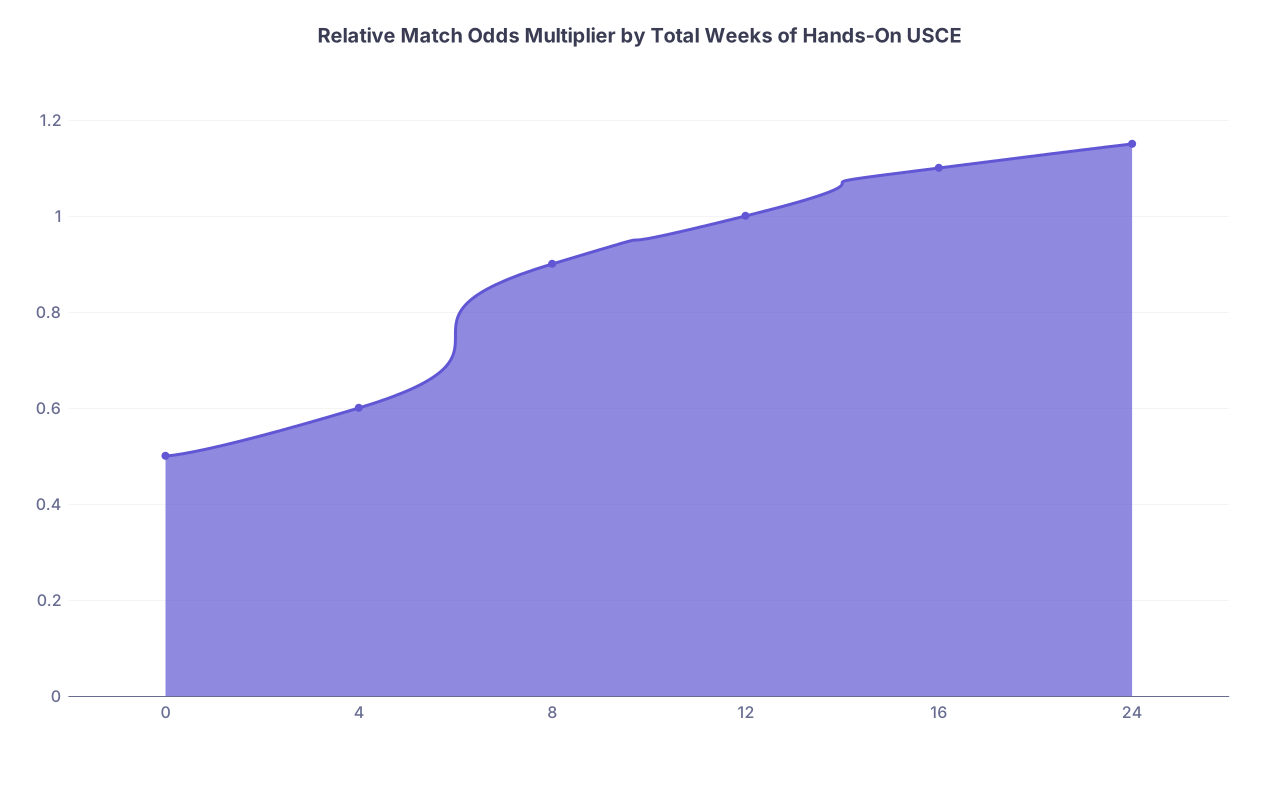
You can map “match odds multiplier” roughly like this for mainstream IM/FM/psych/peds:
| Category | Value |
|---|---|
| 0 | 0.5 |
| 4 | 0.6 |
| 8 | 0.9 |
| 12 | 1 |
| 16 | 1.1 |
| 24 | 1.15 |
Interpretation:
- 0 weeks: your baseline is cut roughly in half.
- 8–12 weeks: you get to “normalized” odds versus the average IMG applicant.
- 16–24 weeks: you nudge above average, assuming scores and other factors are not terrible.
The people hoarding 10+ short observerships are playing the wrong game. Thirty letters from shadowing experiences are not going to rescue weak or non-existent hands-on USCE.
8. Observerships vs Hands-On: Do Shadowing-Only Months Matter?
Quick, ugly truth: observerships have limited impact on match odds, unless:
- They are at the same institution you are applying to, and
- You get a truly standout letter from someone the PD knows or respects
If you try to set them on the same scale as hands-on:
- 4 weeks observership ≈ 1–2 weeks of decent hands-on USCE, in terms of real-world value.
- Multiple observerships show some interest in U.S. healthcare, but they do not rewrite your application.
That is why some non-US IMGs with “6 months of observerships” still end up in the 20–30% match bucket. Programs that explicitly require “hands-on USCE” will still filter them out.
9. Visa Status and USCE: Interaction Effects
Non-US citizens are already at a disadvantage due to visa limitations.
Look at how USCE interacts with that:
Non-US IMG + visa needed + no USCE:
This is the bottom of the probability distribution. You are asking a program to:- Sponsor a visa
- Train someone with no U.S. system experience
- Take risk on an unknown training culture background
Many will not bother.
Non-US IMG + visa needed + 12–16 weeks USCE + solid letters:
Now you look like a safer bet. PDs have documentation that you have:- Functioned in U.S. hospitals
- Managed patients with U.S.-style documentation
- Not imploded under local workload and communication demands
This is precisely why you see non-US IMGs with average 230s scores matching IM/FM when they have 4–6 months of USCE, while others with similar scores and zero USCE do not even get interviews.
10. What the Data Actually Argues You Should Do
Let me be blunt.
If you are an IMG aiming at a mainstream IMG-friendly specialty (IM, FM, psych, peds, path) and you have any control over your timeline:
Treat “0 USCE” as a high-risk, low-probability strategy.
You are voluntarily stepping into the ~20–30% match bucket in many fields.Aim for 8–12 weeks of hands-on USCE minimum, tied to:
- At least 2 strong clinical letters from U.S. attendings
- At least one rotation in your target specialty (IM for IM, etc.)
If your scores or YOG are marginal, push toward 16–24 weeks at solid community or university programs that actually take IMGs.
Stop over-investing in pure observerships unless:
- They are your only option geographically, or
- They are at a high-yield program where you are explicitly aiming for a letter and visibility.
From a numbers standpoint, USCE is not optional garnish. It is a major independent variable that meaningfully shifts your probability curve. For many non-US IMGs, it is the difference between single-digit interview counts and a realistic shot at 10–15 interviews.

FAQs
1. Can an IMG with zero USCE still match if they have very high scores?
Yes, but the data and real outcomes say you are an outlier, not the norm. High Step 2 scores (250+) can drag you into interview consideration at some programs even without USCE, especially in pathology and occasionally in academic IM programs with strong research. But you are still:
- Failing automatic USCE filters at a large portion of programs
- Competing against equally strong IMGs who also have U.S. rotations and letters
If you absolutely cannot obtain USCE, then compensate with:
- Aggressive application strategy (high program count, heavy on IMG-friendly places)
- Meticulous personal statement and experiences section
- Maximum leverage of any research or home-country clinical distinctions
But no, “great scores” do not fully erase the large probability penalty that comes with zero USCE, especially for non-US citizens in IM/FM/psych/peds.
2. Does home-country clinical experience reduce the need for USCE?
Only partially, and only in the eyes of some programs. Long, continuous home-country clinical work does signal that you are a functioning physician, which is better than being a fresh graduate with a long gap and nothing to show.
However, for the actual filters:
- Many programs literally have binary screens:
- “Any U.S. clinical experience? Yes/No.”
- Years of robust clinical work in India, Pakistan, Egypt, Nigeria, etc. do not flip that “Yes” switch.
In qualitative review, strong home-country experience helps, but it does not substitute for at least some U.S.-based, hands-on rotations when the program is evaluating fit with U.S. workflows and communication standards. From a pure probabilities perspective, it nudges your odds up slightly, but not nearly as much as 8–12 weeks of real USCE.
3. How many IMG applications actually include USCE?
Rough ballpark, combining NRMP, ECFMG, and advising cohort data:
- Among IMGs applying to Internal Medicine:
Around 60–70% have at least one documented U.S. clinical experience of 4+ weeks (including observerships). - Among those, probably 40–50% have what I would call “meaningful hands-on USCE” (8+ weeks, clear patient contact, real letters).
- In competitive specialties, the proportion with solid USCE is even higher.
So if you apply with zero USCE, you are not just below a theoretical ideal. You are below the median of your actual competition. That is the core data reality: most serious IMG applicants in mainstream specialties have some level of USCE, and the ones who match at higher rates almost always have more of it, and of better quality.
Key Takeaways
For IMGs, meaningful hands-on USCE typically increases match odds by 20–30 percentage points compared with no USCE, often roughly doubling the probability of matching in IM/FM/psych/peds.
The “no USCE” path leaves you in a high-risk 20–30% match band for many specialties, heavily impacted by automated program filters and visa reluctance.
From a pure numbers perspective, 8–12 weeks of hands-on USCE with strong letters is the minimum rational target if you want to compete at or above the average IMG match rates rather than gambling at the bottom of the distribution.