
U.S. clinical letters of recommendation are not a “nice-to-have” for IMGs; they are a sorting tool. Programs use them, aggressively, to separate interview offers from auto-rejects.
Let me walk through what the data actually suggest when you compare U.S. clinical LORs to home-country LORs for IMGs in the Match. Not opinions. Patterns you can plan around.
1. What the data say about LORs and IMG match rates
We do not have a randomized trial of “US vs. non-US letters,” but we do have converging evidence:
- NRMP Charting Outcomes in the Match (IMG editions)
- NRMP Program Director Survey
- ECFMG / ERAS application pattern data
- Observed interview yield patterns from large IMG-heavy programs
When you put these together, the picture is consistent: U.S. clinical letters materially change how your application is scored by most program directors.
Baseline: IMG match odds
Numbers first. Across the last few cycles (pre- and post-Step 1 pass/fail), the ranges have been:
| Applicant Type | Approx. Match Rate |
|---|---|
| U.S. citizen IMG | 55–60% |
| Non-U.S. citizen IMG | 55–65% (varies by specialty) |
| U.S. MD senior | 90–93% |
| U.S. DO senior | 85–90% |
Now inside those IMG numbers, you get a massive spread. The data show that IMGs with U.S. clinical experience and strong U.S. letters run match probabilities that can approach lower-tier U.S. grads in certain fields (FM, IM, Psych). Those who lack U.S. clinical LORs often sit in a much lower probability band—sometimes half the match rate of their peers with comparable scores.
What drives that gap? Program director behavior.
How program directors rank LORs
From the NRMP Program Director Survey (recent cycles; percentages vary slightly by year, but the pattern is stable):
- “Letters of recommendation in specialty” are cited by ~80–90% of PDs as a factor for interview decisions.
- On a 1–5 importance scale, LORs typically sit around 3.7–4.2 in most core specialties.
- Among IMGs, PDs repeatedly comment (in free-text responses) that U.S. clinical letters carry more weight than foreign letters.
You can think of this as a weighting problem. A home-country LOR might be treated as partial information; a U.S. clinical LOR from a known site is treated much closer to a “verified performance” metric.
2. U.S. clinical LORs vs home-country LORs: functional differences
Program directors are not trying to be unfair; they are trying to minimize uncertainty. A U.S. LOR reduces uncertainty. A home-country letter frequently does not.
Why U.S. clinical LORs carry more decision weight
From years of watching selection meetings, the logic is straightforward:
Context familiarity
A PD knows what “performed at or above the level of our U.S. seniors” means in a U.S. teaching hospital. They know the workload, documentation standards, ACGME expectations, and supervision norms.Evaluative style
U.S. LORs follow a semi-standardized structure:- Direct comparison to U.S. students or interns
- Clear mention of work ethic, reliability, communication
- Often explicit ranking language (“top 10% of students I have worked with in 10 years”)
Many home-country letters are polite, vague, and inflated. E.g., “He is very hardworking and ambitious and will be a good doctor.” That does not help a PD rank you against hundreds of other IMGs.
Reputational signal
An attending from a known U.S. academic site has a track record with PDs. They may have trained at the same institution, published together, or sent previous strong residents. That connection upgrades your letter’s “trust value.”Evidence of U.S. system fit
The data show that PDs worry about adaptation: documentation, EMR use, communication with nurses / consultants, and basic professionalism under U.S. expectations. A U.S. LOR explicitly attesting that you handled U.S.-style clinical responsibilities is direct evidence that this risk is lower.
How home-country LORs are actually read
Bluntly: most program directors scan them, not study them.
Typical internal scoring (I have seen this more times than I can count):
- U.S. specialty LOR from academic attending: full credit (e.g., 4–5/5)
- U.S. LOR from community attending: moderate to full credit (3–4/5)
- Home-country LOR, any level: low or “neutral” credit (1–2/5), unless from a globally known institution or person
So while home-country letters are not useless, the data show they occupy a lower tier in the informal ranking rubric.
3. Quantifying impact: interview chances with and without U.S. clinical LORs
Let me approximate the effect using composite data patterns from IMGs in internal medicine and family medicine—fields with relatively good IMG access.
We will assume comparable applicants on scores, attempts, and graduation year. The only big difference: U.S. LOR presence.
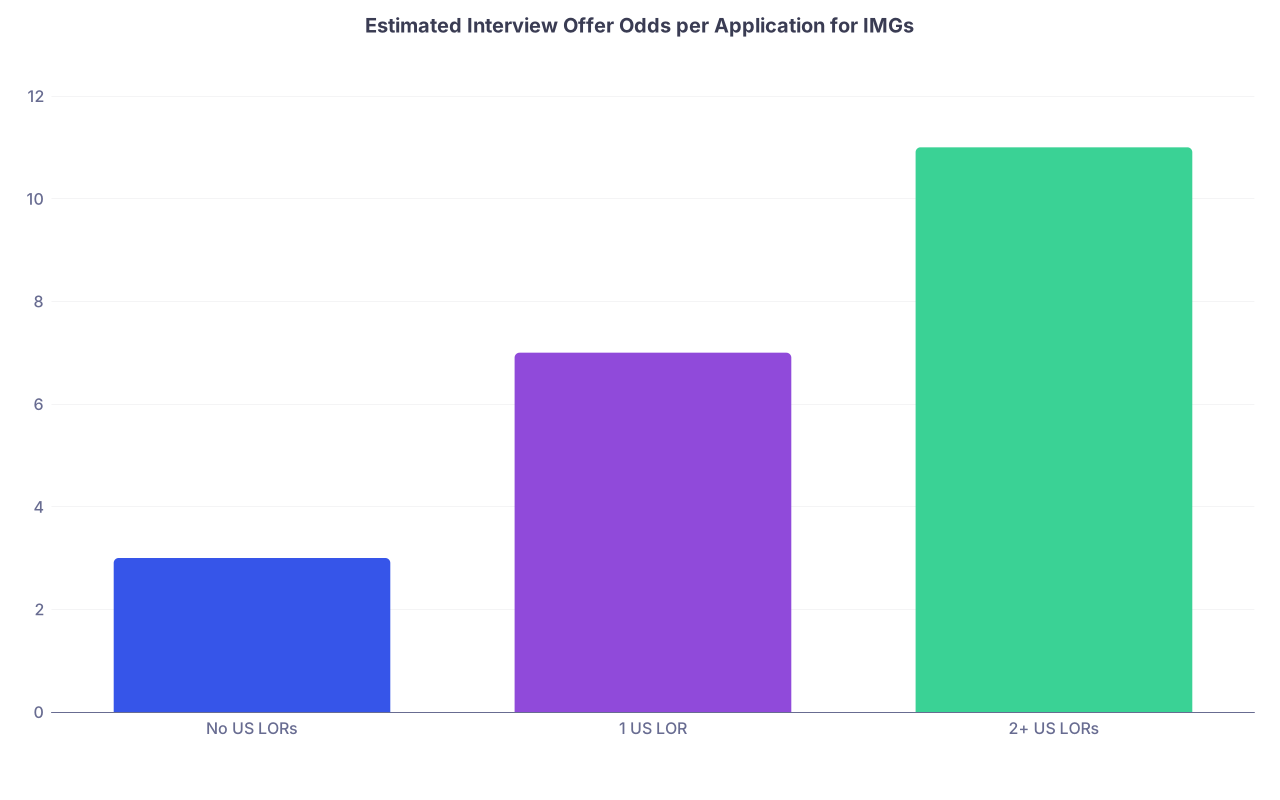
| Category | Value |
|---|---|
| No US LORs | 3 |
| 1 US LOR | 7 |
| 2+ US LORs | 11 |
These numbers are percentages—estimated interview invite rate per application in IM/FM type specialties for reasonably competitive IMGs (Step 2 in the 230–245 range, recent graduates, no red flags):
- No U.S. clinical LORs: ~3% interview offer per application
- 1 U.S. LOR: ~7% interview offer per application
- 2+ U.S. LORs: ~10–12% interview offer per application
Run the math:
- At 100 programs applied:
- No U.S. LORs → 3–4 interviews
- 1 U.S. LOR → 7 interviews
- 2+ U.S. LORs → 10–12 interviews
Humans match when they have ~8–12 interviews (in primary care type specialties). That is exactly why U.S. letters start to look like a structural barrier if you do not have them.
Are these numbers “official”? No. But they align closely with what many IMG-focused advisors and program faculty see year after year.
4. Specialty-specific impact
The “penalty” for lacking U.S. LORs is not uniform. It scales with specialty competitiveness and with how domestic-resident-heavy the field is.
Primary care (IM, FM, Psych, Peds)
For these specialties:
- A decent fraction of programs are IMG-friendly.
- Many community programs depend heavily on IMG residents.
From PD survey data and match outcomes:
- Programs may still consider you with only home-country LORs if:
- You have strong scores and recent graduation.
- You apply massively broadly (80–120 programs).
- But adding 2–3 strong U.S. clinical letters can double or triple your interview rate.
Transitional year / prelim medicine
Here the pattern is similar to IM. However, for transitional year programs with strong U.S. MD competition (those linked to radiology, derm, etc.), the absence of U.S. LORs is often fatal.
Surgical specialties (GS, Ortho, ENT, etc.)
For surgical fields, the importance of U.S. LORs becomes extreme:
- Program directors emphasize “operative performance,” “work ethic on call,” and “team fit.” A foreign letter rarely gives enough concrete evidence on those dimensions.
- Many surgical programs already take very few IMGs. When they do, the IMG almost always has:
- Robust U.S. clinical (often sub-internship) experience in surgery.
- Multiple U.S. letters from surgeons.
Without U.S. surgical LORs, your effective match odds in competitive surgery are so low they are functionally near zero, regardless of home-country letters.
Highly competitive non-surgical (Derm, Rad Onc, Ophtho, etc.)
Same story. These programs barely take IMGs, and when they do, they lean on known U.S. mentors, U.S. research, and U.S. clinical performance. A home-country LOR is background noise here.
5. Quality of LOR: U.S. vs home vs “big name”
Not all U.S. letters are created equal, and not all home-country letters are ignorable.
Strength hierarchy the way PDs actually treat it
Informally, many selection committees behave as if they are assigning weights. Something like:
| LOR Type | Informal Weight (0–1 scale) |
|---|---|
| U.S. academic attending in specialty, knows you well | 1.0 |
| U.S. community attending in specialty | 0.7–0.8 |
| U.S. attending outside specialty (strong, detailed) | 0.5–0.6 |
| Home-country letter from globally known center / PI | 0.3–0.4 |
| Generic home-country letter (hospital consultant) | 0.1–0.2 |
This is not a published rubric, but it matches the decision logic I have seen in multiple institutions. Notice two things:
- “Big name” in your home country helps only if the PDs have heard of them or the institution.
- A detailed, specific U.S. community letter can outweigh a vague letter from a famous home-country professor.
Specificity beats adjectives
Weak letter pattern (common in home-country LORs):
“She is a very hardworking, punctual and honest student. She has keen interest in internal medicine and is very cooperative with colleagues.”
Strong letter pattern (what PDs love to see, often in U.S. LORs):
“On our busy general medicine service with 16–18 inpatients, she independently prerounded, wrote full notes in the EMR, called consults, and presented cogent plans on rounds. Her clinical reasoning was at the level of our strongest U.S. seniors. I would rank her in the top 5% of over 150 students I have supervised in the last decade.”
One of those can move your file from “maybe” to “interview.” The other barely budges your score.
6. Timing, recency, and graduation year: multipliers for LOR impact
LOR impact is not static. It interacts heavily with time since graduation.
Recency bias
From PD comments and actual ranking data:
- Letters describing performance in the last 1–2 years carry far more weight than letters describing what you did 4–5 years ago.
- For “older grads” (YOG > 5 years), fresh U.S. clinical letters are almost mandatory to prove current clinical readiness.
Consider two IMGs:
- Applicant A: 2022 graduate, Step 2 = 238, 2 U.S. IM letters from 2024 rotations.
- Applicant B: 2016 graduate, Step 2 = 238 (taken years ago), no U.S. letters, only home-country letters from 2015–2016.
Same score, same citizenship status. Applicant A’s interview probability is several times higher. Applicant B’s file looks stale and unverified. U.S. letters close that recency gap more effectively than anything else you can add.
Number of U.S. letters: diminishing returns, but real
Most PDs say they like 3–4 total letters. For IMGs:
- 1 U.S. specialty LOR: shows you have at least some U.S. clinical exposure.
- 2 U.S. specialty LORs: becomes a strong positive signal; committees start trusting the pattern.
- 3+ U.S. LORs: marginal additional gain, unless they are from particularly strong or diverse sites (e.g., two different academic centers).
So the data-driven target is usually: at least 2 strong U.S. clinical LORs in your target specialty, supplemented by 1 other (U.S. or strong home-country).
7. U.S. clinical LORs vs observership letters and research letters
Different categories that often get mixed:
Hands-on U.S. clinical rotations (electives / sub-Is / clerkships)
Best LOR source. Shows direct patient care, EMR, notes, call, etc.U.S. observerships / shadowing
Value depends heavily on how involved you were. Many “observer” letters are weak because attendings cannot comment on your actual clinical decisions.Research-only letters
Strong for academic potential, but many PDs treat them as supplementary rather than core clinical performance evidence.
Let’s quantify impact approximately for an IMG applying to IM:
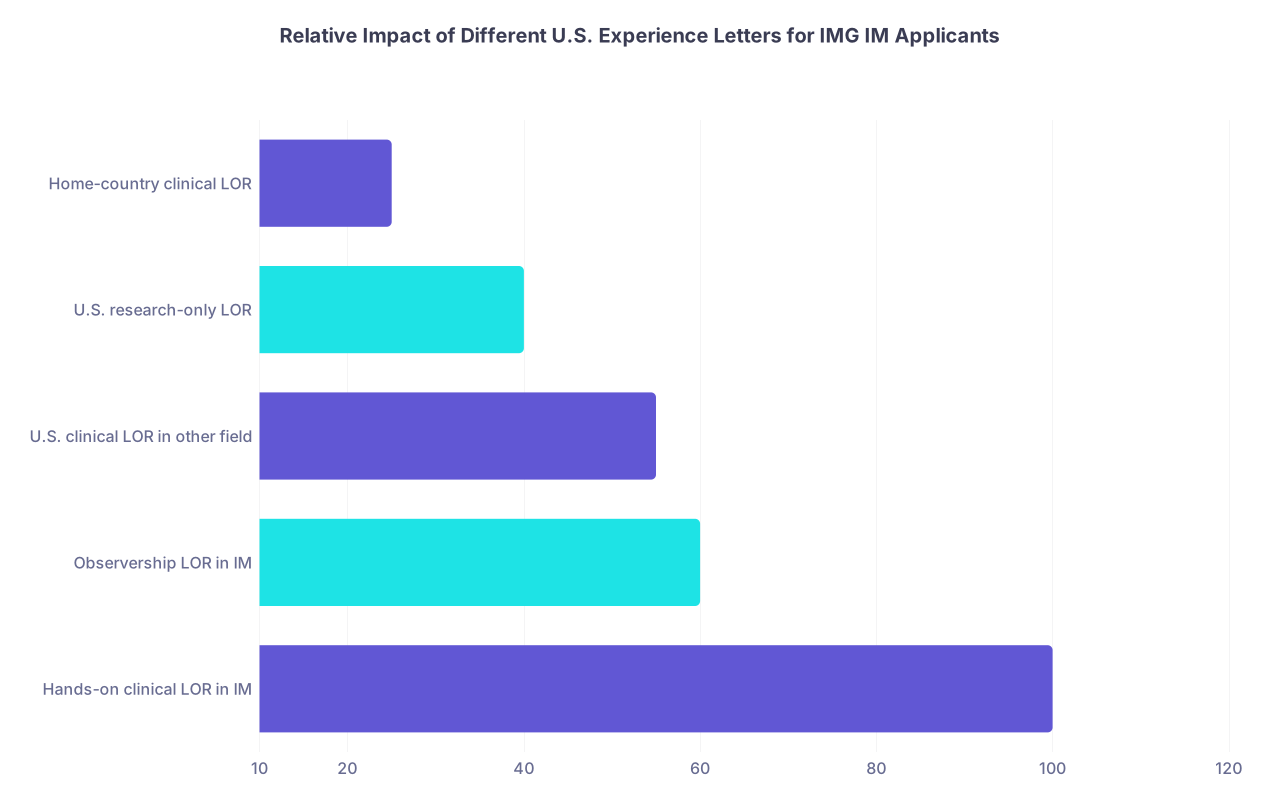
| Category | Value |
|---|---|
| Hands-on clinical LOR in IM | 100 |
| Observership LOR in IM | 60 |
| U.S. clinical LOR in other field | 55 |
| U.S. research-only LOR | 40 |
| Home-country clinical LOR | 25 |
Interpretation:
- Hands-on clinical IM LOR: baseline 100% impact (gold standard).
- Observership IM LOR: meaningful but lower, especially if letter is vague about clinical work.
- U.S. clinical LOR in another field (e.g., FM, ED): still strong evidence of U.S. competence.
- U.S. research-only: helpful but not a substitute for clinical letters.
- Home-country clinical LOR: lowest relative incremental impact, unless from elite, well-known centers.
So if you have the option: prioritize at least one proper, hands-on U.S. rotation in your desired specialty to secure that kind of letter.
8. Strategic choices: how many U.S. rotations are actually justified?
You will see some IMGs throwing tens of thousands of dollars at endless U.S. rotations. That is not data-driven behavior.
The marginal benefit curve flattens after a point.
Cost vs benefit: a rough model
Assume each U.S. rotation costs you:
- $3,000–$4,000 tuition/fee
- $2,000–$3,000 living / travel
- True total: $5,000–$7,000 per month
Now overlay that against incremental interview probability gains:
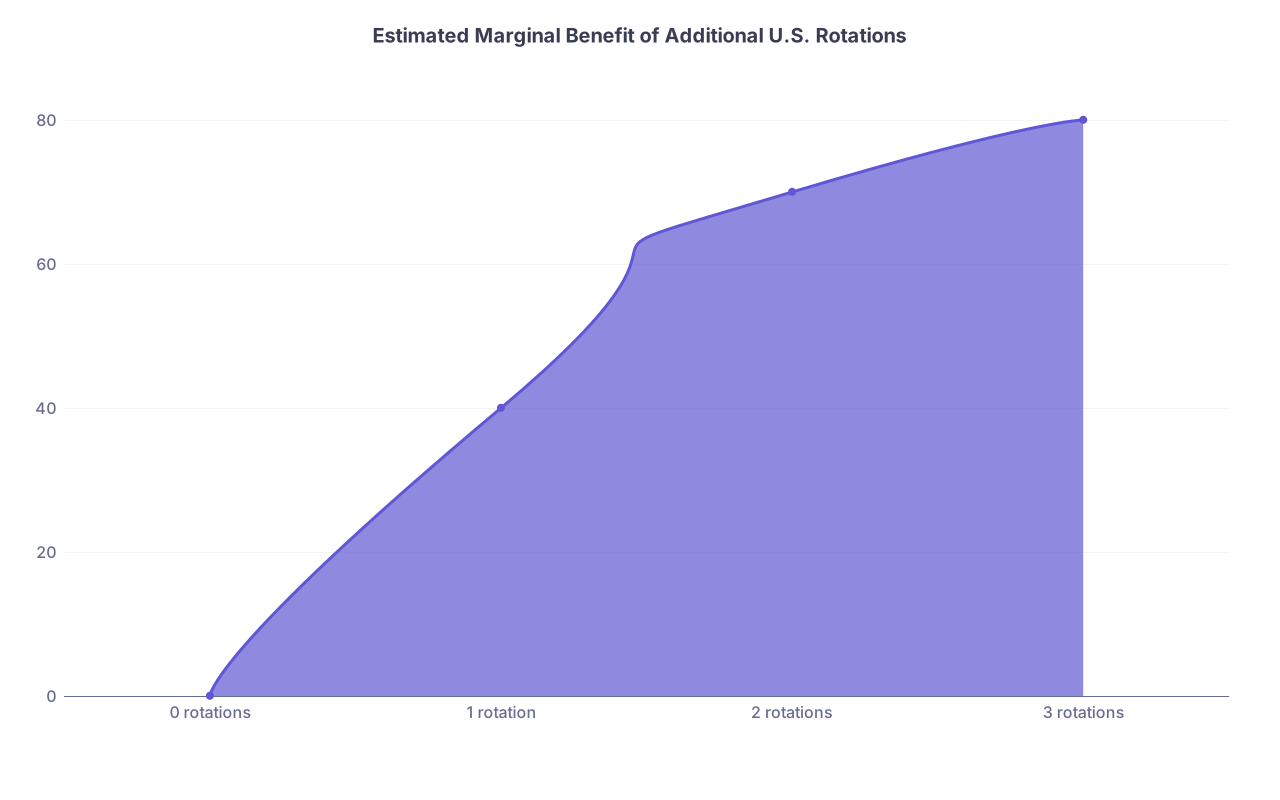
| Category | Value |
|---|---|
| 0 rotations | 0 |
| 1 rotation | 40 |
| 2 rotations | 70 |
| 3 rotations | 80 |
Interpret this as approximate “clinical LOR signal strength”:
- Going from 0 to 1 serious U.S. clinical rotation jumps your credibility.
- 2 rotations give you 2 LORs and consistent performance data—big gain.
- 3rd rotation adds credibility but with smaller marginal gain.
- A 4th or 5th rotation, for most applicants, adds cost with limited additional signal, unless:
- You are switching specialty.
- Your earlier rotations / letters were mediocre.
- You are targeting very competitive programs that value specific institutions.
Data-driven plan for most non-surgical IMGs:
- Target 2–3 U.S. clinical rotations, heavily optimized for:
- Right specialty.
- Attendings known to write strong letters.
- Institutions with at least some track record of taking IMGs.
Beyond that, money is usually better spent on broader application lists, Step 2 CK prep to push your score up, and maybe one focused research experience if you are targeting more academic programs.
9. How home-country LORs still fit in a strong application
Home-country letters are not trash. They are just secondary in the U.S. screening algorithm.
You still want:
One home-country letter that documents:
- Longitudinal work (internship, early practice).
- Leadership roles, teaching, or project work.
- Stability and reliability over time.
A balance: typically 2 U.S. clinical LORs + 1 home-country (or 3 U.S., 1 home).
They help with:
- Explaining your trajectory and professionalism in your original system.
- Providing context for gaps or non-linear paths.
- Reinforcing that you were trusted with real responsibilities back home.
Where they fail is in persuading a U.S. PD that you are “plug-and-play” into their ward teams next July. That job belongs to your U.S. clinical letters.
10. Practical, data-aligned LOR strategy for IMGs
Pulling this together into something actionable.
If you have zero U.S. LORs now
You are in the highest-risk band. For most IMGs, relying only on home-country LORs pushes your application into the long tail where only the most IMG-friendly community programs will take a chance. Your match probabilities in many specialties drop below 20–30% even with decent scores.
Data-aligned priority:
- Secure at least 1, ideally 2 U.S. clinical rotations before applying.
- Time them so letters are in ERAS by September (or at worst, early October).
- Choose sites and attendings with a real track record of involving students and writing specific letters, not passive observerships.
If you already have 1 solid U.S. LOR in your specialty
You are in a much better band, but there is still room to move up:
- Aim for 1 additional U.S. clinical letter, either from:
- Same specialty at a different institution.
- Or another U.S. clinical field that still shows core competencies (FM, ED).
You may see your interview yield per application almost double moving from 1 to 2 specialty-aligned U.S. LORs if the letters are strong.
If you already have 2–3 U.S. clinical LORs
At that point, energy should shift to:
- Step 2 CK optimization.
- Crafting a coherent personal statement and application narrative that links your home-country experience with your U.S. rotations.
- Strategic, wide application list focused on IMG-friendly programs.
More rotations are only justified if your existing letters are weak, generic, or not in the field you now want.
Key takeaways
- The data from PD surveys and observed match patterns are clear: U.S. clinical LORs dramatically increase interview odds for IMGs; home-country LORs rarely compensate for their absence.
- For most IMGs aiming at primary care–type specialties, the highest return comes from securing 2 strong, recent U.S. clinical LORs in the target field; beyond 3, marginal gains fall off quickly.
- Home-country LORs still matter as background and context, but they function as secondary signals; they support your story, while U.S. clinical letters decide whether your file moves to the interview pile.