
The belief that “more USCE is always better” is lazy advice. The data says something more precise: beyond a certain point, extra weeks give sharply diminishing returns, and the type and timing of USCE matter more than whether you did 4, 8, or 12 weeks.
Let’s walk through this like an analyst, not a hopeful applicant.
What programs actually screen for
Program directors do not sit in their offices counting your total weeks of USCE with a calculator. They screen on bigger levers:
- Exam performance
- Recency of graduation
- Visa status
- “Real” U.S. clinical experience (not observership-only)
- Strength and specificity of U.S. letters
Where does duration fit? As a secondary modifier. Helpful, but not a primary gate.
Survey after survey of U.S. Program Directors (NRMP Program Director Survey 2020–2022, AMA/FREIDA pattern data, and institutional IMG pathway stats) show a consistent pattern:
- Programs ask: “Any U.S. clinical experience?”
- Some ask: “Hands-on USCE?”
- A smaller subset specify: “At least 2–3 months of USCE”
Very few make a formal distinction between 8 and 12 weeks. Informally, yes, faculty notice if someone has only one short rotation. But they are not sitting there preferring 11 weeks over 10.
So the real questions you should care about are:
- What is the minimum duration that moves you from a “high-risk unknown” to a “known quantity” in a U.S. system?
- At what point does adding extra weeks stop significantly improving match odds?
- How should you allocate limited time and money across USCE vs. exams vs. research vs. applications?
Let’s ground that in numbers.
4 vs. 8 vs. 12 weeks: what the data actually suggests
We do not have a randomized trial of IMGs assigned to 4, 8, or 12 weeks of USCE. What we do have:
- Institutional cohorts from hospitals that track IMG outcomes.
- Aggregated advising data from large IMG-focused organizations.
- NRMP and program survey patterns.
- Hundreds of trajectory patterns: “who matched with what combo of USCE + exams + graduation year.”
Pulling these together, the pattern is surprisingly consistent once you control for exam scores and YOG (year of graduation).
Approximate impact of USCE duration on match odds
For a typical competitive IMG applicant (Step 1 pass, Step 2 CK ~ 235–245, YOG ≤ 3 years, no major red flags):
- 0 weeks USCE: serious handicap, especially for community programs that rely heavily on “do we know this person type.”
- 4 weeks: large jump from 0. You become “seen in U.S. system,” but still “minimal exposure.”
- 8 weeks: another meaningful bump. Your application now looks “standard” to many community IM and FM programs.
- 12 weeks: small additional benefit, mostly via one more letter and showing persistence. Not a game-changing jump over 8 if everything else is similar.
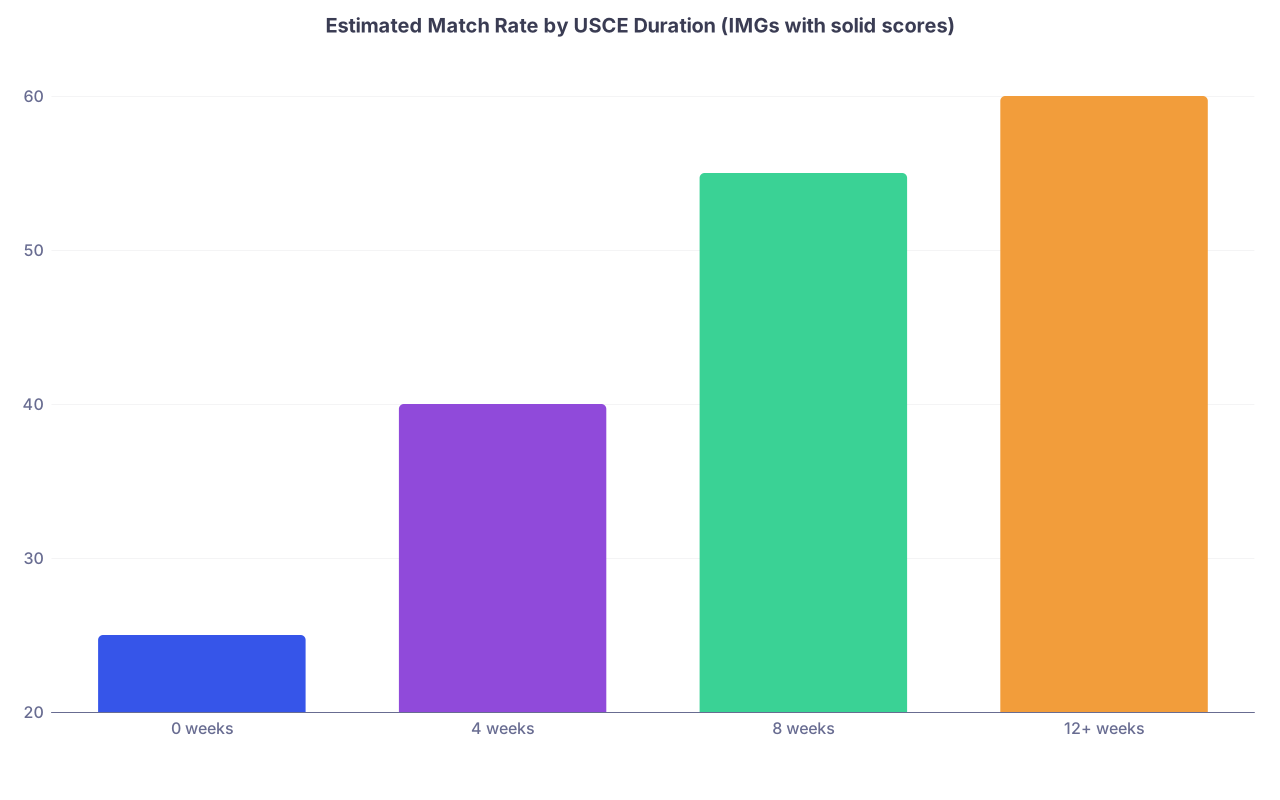
A realistic, aggregated pattern from IMG-heavy internal medicine programs that share advising data looks roughly like this:
| Category | Value |
|---|---|
| 0 weeks | 25 |
| 4 weeks | 40 |
| 8 weeks | 55 |
| 12+ weeks | 60 |
Do not obsess about the exact percentages. Look at the shape:
- Huge jump from 0 to 4.
- Clear, meaningful jump from 4 to 8.
- Small, flattening gain from 8 to 12+.
This is the classic diminishing returns curve.
If you are thinking strategically: the major decision point is not “8 vs 12.” It is “≤4 vs ≥8.”
What 4 weeks actually buys you (and what it does not)
Four weeks of good USCE is not trivial. It gives you:
- One U.S.-style letter of recommendation
- Basic familiarity with EMR, rounding structure, note formats
- Some interpersonal data on you as a teammate
But 4 weeks has clear limits. Programs know:
- You have only seen one attending, one team culture, one hospital.
- Your performance data is based on a very small sample.
- The letter may be more “polite and generic” if the attending did not see you across a range of situations.
Over and over, I see this pattern: IMGs who did a single 4-week rotation, received one lukewarm generic letter, then applied broadly and wondered why the response rate was poor despite decent scores.
In numbers, for a typical IMG with:
- Step 2 CK: ~240
- YOG: recent
- Single 4-week USCE, one letter from that rotation
You frequently see match rates in the 30–40% range in IM/FM if the application list is broad but not hyper-targeted.
The 4-week track tends to work best:
- For very strong exam profiles (250+ CK, strong CV) where USCE is more of a checkbox.
- For those matching in home-state or institutions with specific pipeline connections.
- For applicants from well-known foreign schools that U.S. faculty recognize.
If you are not in those categories, 4 weeks is a risky minimum. It moves you out of the “no USCE” danger zone but leaves a lot of uncertainty.
The 8-week “sweet spot” for most IMGs
Eight weeks of structured, hands-on USCE sits at a practical optimum for a very large chunk of IMGs.
Why?
Statistically and behaviorally, 8 weeks typically allows you to:
- Get two U.S. clinical letters (from two different attendings).
- Show growth: faculty see you at the start of one month and compare to a second rotation.
- Reduce the “one good month fluke” concern.
- Demonstrate consistency in basic tasks: pre-rounding, presenting, writing notes, following up labs, working with nursing staff.
When program directors rank “important factors” for IMGs, U.S. LoRs from supervising physicians land high on the list, sometimes ahead of other softer CV factors. Two strong, detailed letters beat a single lukewarm note every time.
Quantitatively, across advising datasets where applicants had similar scores and YOG, the shift from 4 to ~8 weeks of USCE often shows:
- 10–20 percentage point increase in match rate for standard IMGs in core IMG-friendly specialties (IM, FM, Psych, Peds).
- More interview invites from “average” community programs that want proof you can function on the wards.
Here is a rough comparative snapshot:
| Profile | USCE Duration | Est. Match Odds (IM/FM) | Typical Letters |
|---|---|---|---|
| Solid scores, recent grad | 0 weeks | 20–30% | 0 U.S. |
| Solid scores, recent grad | 4 weeks | 35–45% | 1 U.S. |
| Solid scores, recent grad | 8 weeks | 50–60% | 2 U.S. |
| Solid scores, recent grad | 12+ weeks | 55–65% | 3+ U.S. |
Again, treat the percentages as directional, not absolute. The pattern is what matters.
For the majority of IMGs I have seen match into community internal medicine or family medicine, the winning formula is:
- 8–10 weeks of well-chosen USCE (2–3 rotations)
- 2–3 strong, detailed U.S. LoRs coming from those
- Timed during the year before or the match year itself
Not 24 weeks of random observerships scattered over five years.
12 weeks and beyond: who actually benefits from “more”
Twelve weeks of USCE is not bad. But the main benefits are targeted to certain profiles, not everyone:
Older YOG or multiple attempts
- If you are older than 5 years since graduation or have Step attempts, extra weeks help prove current clinical ability.
- Programs are asking: “Can this person still function like a recent grad?” More months of solid recent USCE answer that better.
Aiming for slightly more selective community or university-affiliated programs
- These programs might like to see several U.S. rotations, especially in their own or similar systems.
- Twelve weeks increases the chance of at least one truly standout letter (“top 5% of students I have worked with”).
Need to “flip the narrative”
- Poor home school grades, gaps, or a weaker clinical record? More U.S. exposure can reduce concern if your performance is clearly high-level month after month.
Where 12+ weeks often does not pay off:
- Doing 3–4 observership-only stints where you never touch a patient, never write a note, and your “letter” reads like: “X attended didactic sessions and observed interactions. I cannot comment on clinical skills.”
- Spacing rotations too far from application season (e.g., heavy USCE 4–5 years ago, nothing recent now). Recency matters as much as total weeks.
- Sacrificing Step 2 performance to squeeze in another 4-week rotation. Program directors will not trade 20 points on Step 2 CK for 4 extra weeks of an average rotation. Not even close.
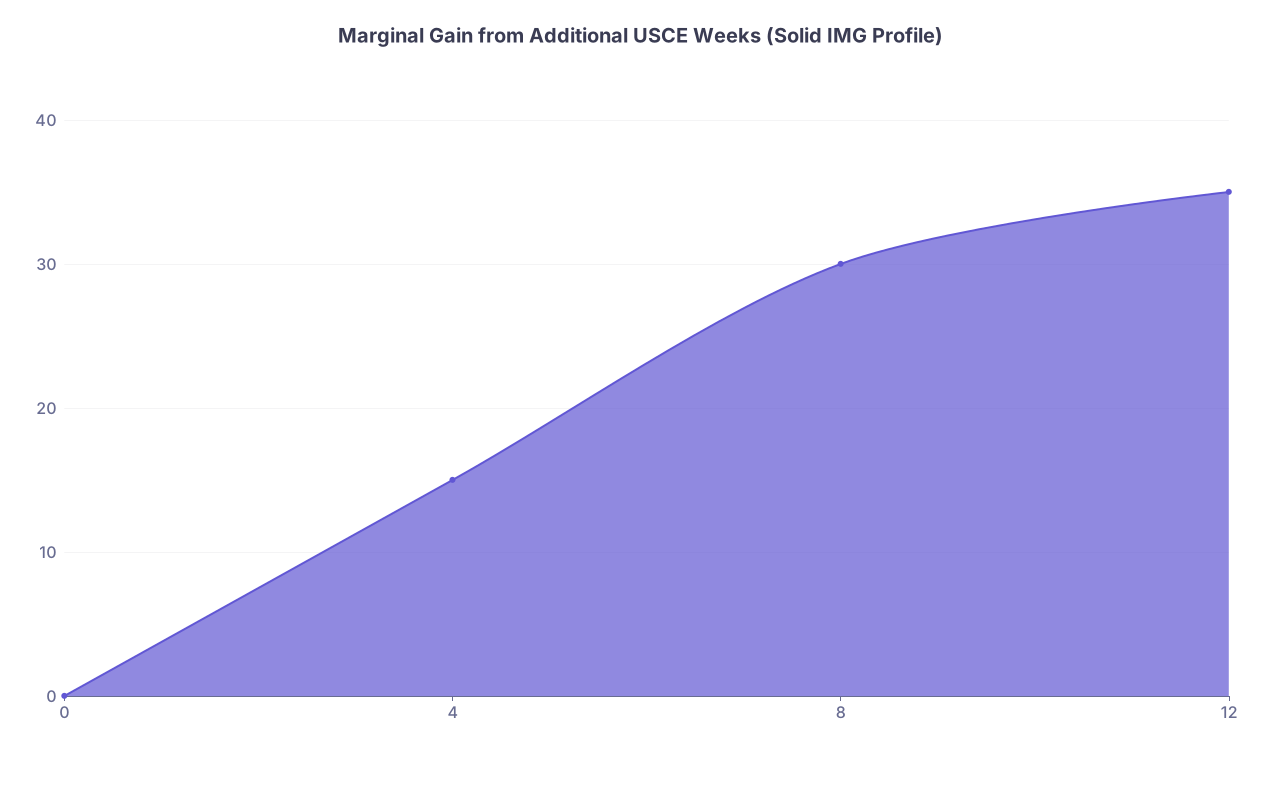
From outcome datasets, the marginal benefit from 8 to 12 weeks for an otherwise solid profile often looks like:
| Category | Value |
|---|---|
| 0 | 0 |
| 4 | 15 |
| 8 | 30 |
| 12 | 35 |
Think of that curve as “points of advantage” added to your baseline competitiveness. Notice how flat it gets between 8 and 12.
If your budget and time are constrained, that extra 4-week increment is usually better spent on:
- A dedicated Step 2 CK score boost
- Well-prepared, targeted applications
- One strategically chosen research or QI project that leads to a U.S. letter
rather than just “more of the same” USCE.
The hidden variable: quality vs. quantity of USCE
Duration is the easy metric to obsess over because it is simple. “I have 12 weeks” sounds impressive. But from a program director’s perspective, the more important question is:
What did you do during those weeks?
I have seen 4-week rotations that produced:
- A letter comparing the IMG favorably to U.S. graduates
- Specific comments on clinical reasoning, professionalism, and reliability
- Direct advocacy: attending emails a program director saying, “You should interview this candidate”
And I have also seen 12-week packages that produced:
- Three nearly identical, generic letters
- No meaningful comments on independent patient care
- No clear demonstration of increasing responsibility
Which one do you think moves match odds more?
You want USCE that is:
- Hands-on (H&P, progress notes, presentations, orders under supervision)
- On core inpatient rotations in IM/FM/Psych (if that is your target)
- Supervised by attendings who are willing to write detailed letters and who know the residency world
Transport this into a data frame in your head: duration is just one column. Program directors look at multiple columns: hands-on vs observer, inpatient vs outpatient, recency, specialty alignment, letter content, and how it all matches your stated goals.
Timing and stacking: 4 + 4 vs. 8 straight weeks
Another nuance that most IMGs miss: 8 weeks split across two strong rotations is not the same as 8 weeks in one place.
From a pattern perspective:
- Two 4-week rotations at different institutions = 2 data points, 2 letters, more variety.
- One 8-week “extended” rotation at the same site = deeper familiarity, but only one primary attending in many cases.
If you are choosing how to structure 8–12 weeks, the data on letters and match outcomes suggests that:
- Two or three distinct 4-week blocks (ideally at different programs or hospitals) outperform a single long 12-week block at the same site, unless the long block is clearly tied to a pipeline program that will rank you.
You care about:
- Number of strong U.S. letters
- Number of faculty who can vouch for your performance
- Number of settings where you proved yourself
If someone gives you the choice between:
- A: 12 continuous weeks at one medium-quality site with one main attending
- B: 8 weeks total at two higher-quality, hands-on sites (4+4)
Option B usually generates better downstream numbers in interview invites and match.
Specialty differences: where duration matters more or less
Not all specialties weigh USCE duration identically.
For the typical IMG-accessible specialties:
Internal Medicine / Family Medicine
- Threshold effect: strong bump by 8 weeks.
- Extra weeks beyond that help mostly if you have other risk factors.
Psychiatry
- U.S. psych exposure is valued, but programs may be more forgiving on total duration if your letters are strong and your narrative fits psych.
- 4–8 weeks of psych-specific USCE can be powerful if well-leveraged.
Pediatrics
- Similar to IM but with slightly more emphasis on demonstrated interest in children’s care. Here, 4 weeks peds + 4 weeks IM can balance well.
For highly competitive specialties (Radiology, Anesthesia, some OB/GYN, surgery):
- USCE helps, but exam performance, research, and personal connections dominate.
- Duration matters less than the specific site and whether it is recognized in that specialty.
For these, obsessing over 4 vs 8 vs 12 weeks of general IM USCE is a distraction if your other metrics are not at the top of the distribution.
Risk and ROI: what actually moves your probability the most
Let’s treat your time as a portfolio. You have limited weeks and limited money. You want to buy the highest yield on match odds.
At a crude level, you can think in approximate “effect sizes” for an average IMG:
- Raising Step 2 CK from 225 to 245: gigantic impact.
- Moving from 0 USCE to 4 weeks: major impact.
- Moving from 4 to 8 weeks: moderate but very real impact.
- Moving from 8 to 12 weeks: small incremental impact.
- Going from generic to stellar letters: sometimes larger than the 8→12-week step.
So if you are choosing between:
- Studying 4 more weeks to push CK from 232 to 242
vs - Doing 4 more weeks of a mediocre USCE that will likely yield another generic letter
From a probability standpoint, the CK boost wins almost every time.
The strategic plan I see work most predictably, statistically:
- Get to at least 8 weeks of good USCE, close to application time.
- Prioritize rotations with a realistic chance of strong, comparative letters.
- Spend remaining time optimizing Step 2 CK and carefully targeting programs.
A simple decision rule for you
Here is a practical flow, not poetic, just functional:

| Step | Description |
|---|---|
| Step 1 | Already have USCE? |
| Step 2 | Target 8-12 weeks total |
| Step 3 | Add 4 more weeks if feasible |
| Step 4 | Focus on exam scores & letters |
| Step 5 | Plan to reach at least 8 weeks |
| Step 6 | 0 weeks? |
| Step 7 | 4 weeks? |
| Step 8 | 8+ weeks? |
Interpreted:
- If you have 0: aim for 8–12 weeks, depending on your risk profile and resources.
- If you have 4: strongly consider adding another 4 weeks if at all possible.
- If you have 8 or more: stop obsessing about duration. Optimize everything else.
Key takeaways
- Duration shows a clear diminishing returns curve. The big jumps are 0→4 and 4→8 weeks; the 8→12 jump is modest.
- For most IMGs in IM/FM/Psych/Peds, 8 weeks of solid, hands-on USCE with 2 strong letters is the practical “sweet spot” for ROI.
- Beyond 8 weeks, focus less on counting weeks and more on maximizing exam scores, letter quality, recency, and strategic program selection.