
It’s August. You’re staring at your ERAS profile.
Under “US Clinical Experience” you’ve got…a couple of observerships from 2019, maybe an externship from 2020. Since then? Gap, maybe home-country work, maybe some research.
You’re asking the question every IMG with “old” USCE asks:
“Is this too old to matter, or can it still help me match?”
Let me be blunt: old USCE isn’t ideal. But it’s not useless. The mistake most applicants make is either:
- Hiding it because they’re embarrassed it’s old, or
- Listing it lazily, so it looks like random shadowing instead of real value.
You’re not going to do that. Here’s how to think about it — and exactly how to present it so it still works for you instead of against you.
1. Does Old USCE Still Help? The Real Answer
Programs care about recency. That’s real. But “old” doesn’t automatically mean “trash.”
Here’s the rough hierarchy:
| USCE Age | Typical Program Reaction |
|---|---|
| Within last 12 months | Strong, clearly relevant |
| 1–3 years old | Still useful, needs good framing |
| 3–5 years old | Marginal, depends how you present |
| 5+ years old | Mostly context, not a main asset |
So:
- If your USCE is 1–3 years old: still clearly usable.
- 3–5 years: you have to sell it actively.
- 5+ years: it becomes background context, not “evidence of readiness” on its own.
But here’s the nuance almost nobody tells you:
Programs don’t just look at the date.
They look at the story:
- Did you build on that experience somehow (home-country work, research, teaching)?
- Did you show that you understood US systems, and does your application today look more mature because of it?
- Did you get any letters (even if they’re now too old to upload) that you can reference in your narrative?
Old USCE helps you in three big ways:
- Shows prior exposure to US healthcare and culture.
- Gives you specific content for your personal statement and interviews.
- Signals that you’re not totally “US-naïve” — you’ve seen EMR, team structure, documentation style, etc.
It’s not enough to impress on its own. But it can absolutely keep you out of the “no US experience” pile if you present it correctly.
2. How Programs Actually Think About Old USCE
Let’s strip away the myths.
Most programs are thinking about three questions:
- Can this person function safely in my clinic/hospital this July?
- Will they adapt quickly to US systems (EMR, team dynamics, communication)?
- Is their judgment and professionalism likely to be OK, or am I inheriting a problem?
Fresh USCE is clean evidence. But if yours is older, they’ll look at the combination of:
- Old USCE
- Clinical work in your home country
- Time since graduation
- Step scores and recent activity
They care less about “this was exactly 2.5 years ago” and more about “does this person look actively clinical and teachable right now?”
So if you’ve got:
- Old USCE + recent home-country clinical work → still decent.
- Old USCE + long gap + no current clinical involvement → that’s where it hurts more.
- Old USCE + strong research + clear ongoing engagement in medicine → better than you think.
3. Exactly How to List Old USCE on ERAS
You don’t bury it. You also don’t oversell it and pretend it was a residency.
You list it clearly, honestly, and with outcomes.
Where to put it
Use “Work Experiences” or “Volunteer” depending on whether it was paid.
Don’t pretend an observership was an externship. Programs can tell.
How to title it
Bad:
“Observer, Medicine, Hospital”
Better:
“Clinical Observer – Internal Medicine (Inpatient)”
“Clinical Extern – Family Medicine Clinic”
“Clinical Rotation – Neurology (Hands-on)” if it truly was.
What to emphasize
You want to hit these themes:
- Exposure to US EMR / documentation
- Interprofessional communication (nurses, case management, etc.)
- Systems-based stuff (discharge planning, insurance issues, follow-up)
- Bread-and-butter clinical exposure in your chosen specialty
Example ERAS description for a 2019 IM observership:
Observed inpatient Internal Medicine team on a busy academic hospital service (average 14–18 patients). Participated in pre-round discussions, case presentations at the bedside, and daily teaching rounds. Regularly reviewed EMR to follow test results, imaging, and consultant recommendations. Attended multidisciplinary rounds with case management and social work, which introduced me to US discharge planning and follow-up processes.
Then you add 1–2 skills/outcomes that connect to now:
This rotation was my first exposure to US clinical documentation and problem-based assessment/plan format. I later adopted this structure in my home-country practice and teaching, which improved clarity of communication within our team.
Now it’s not “that old observership I did once.” It’s: “this is where I first saw US-style medicine, and I actually integrated what I learned.”
4. What If My USCE Is 4–6 Years Old?
Now we’re in the gray zone.
Your USCE can still:
- Prove you didn’t just land in the US yesterday and apply blindly
- Show that you’ve seen US standards of care and patient expectations
- Give you stories for interviews that demonstrate maturity
But you have to connect it to recent activity.
You do that in three places:
- Experience description – show how you used what you learned later.
- Personal statement – one short paragraph connecting old USCE to current practice or goals.
- Interview answers – when they ask “Tell me about your US experience,” you answer with then → now.
Example for a 2018 Family Medicine observership, now applying for 2025 Match:
In 2018, I completed a four-week clinical observership in a US family medicine clinic. That experience changed how I approached primary care in my home-country practice. I saw the impact of continuity, preventive counseling, and structured chronic disease follow-up. When I returned, I started a simple hypertension follow-up registry in our clinic based on what I observed, which improved our follow-up rates and control in a resource-limited setting.
Now your old USCE isn’t “stale.” It’s the seed. And you show what grew out of it.
5. Can I Still Use Old USCE for Letters of Recommendation?
Technically? Maybe. Strategically? Usually not, unless:
- The writer knows you very well, AND
- They can update the letter (dated this year) and mention ongoing contact, AND
- You have no stronger, more recent clinical letters.
Most programs prefer:
- Letters from the last 12 months
- At most last 2 years
- From people who supervised you in a real clinical context
If your USCE is older than that, I’d treat letters from those rotations as backup, not your core three.
If you ask for an updated letter from an older USCE supervisor, tell them clearly:
- You understand the rotation was a while ago
- You’d be grateful if they could speak both about your performance then and any ongoing interaction you’ve had (emails, updated CV, discussion of your current clinical work)
Worst approach: sending a 2019 letter as-is. That screams “no one recent is willing to vouch for me.”
6. How to Talk About Old USCE in Your Personal Statement
Don’t make your personal statement a travel diary.
Use old USCE surgically:
- 1 short paragraph max
- Clear reason why it mattered
- Direct line from that experience to your current motivation/skills
Example:
During a four-week internal medicine observership at [Hospital Name] in 2019, I saw a model of team-based care that I had not previously experienced. Watching residents synthesize complex problems into concise assessment and plan notes, and then discuss them confidently with attendings, gave me a clear picture of the standard I wanted to reach. Since then, both in my home-country hospital and through independent study, I have worked to structure my thinking and documentation in a similar way, which has made me a more organized and reliable clinician.
Short, specific, and connected to growth. That’s what you want.
7. How Much Does Old USCE Actually Move the Needle?
Let’s be realistic. Old USCE isn’t going to magically push you into a hyper-competitive program. But it can absolutely change which bucket you land in.
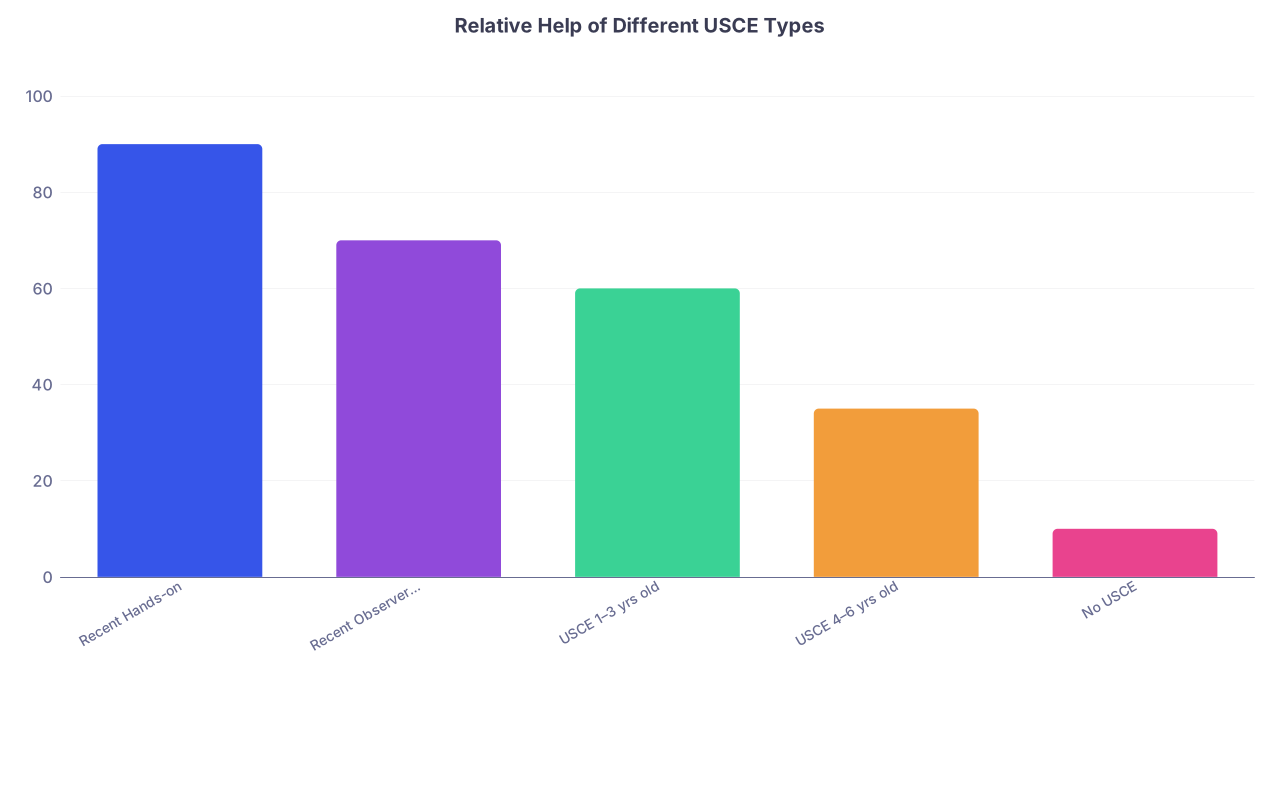
Roughly:
| Category | Value |
|---|---|
| Recent Hands-on | 90 |
| Recent Observership | 70 |
| USCE 1–3 yrs old | 60 |
| USCE 4–6 yrs old | 35 |
| No USCE | 10 |
Think of it this way (numbers are conceptual, not literal):
- Recent hands-on USCE: very strong signal.
- Recent observership: moderate but still clearly helpful.
- USCE 1–3 years old: still decent, especially with good narrative.
- USCE 4–6 years old: mild positive; needs context and connection.
- No USCE: real handicap for many programs, especially community IM/FM/Neuro/PSY that expect some.
So yes, old USCE can still keep you out of the “no US experience” reject pile in a lot of places. That matters.
8. If I Have Old USCE, Should I Try to Get New USCE Too?
If you can, yes. Especially if:
- You’re >3 years from graduation
- Your last USCE was >3 years ago
- You’ve had gaps or mostly non-clinical work recently
Even a short, recent observership stacked on top of older USCE radically improves the story:
- “I first saw US medicine in 2019, and I’ve returned now in 2024 with more maturity and experience to refine what I learned and update my understanding.”
If you can’t get new USCE before applications open, consider:
- Lining something up for late fall/winter and mentioning it in your application as “upcoming US clinical observership, Nov–Dec 2025”
- Or using it as an update email later in the season
Programs prefer done over planned, but “upcoming” is still better than nothing, if it’s real and you can actually show it later.
9. Common Mistakes IMGs Make With Old USCE
I see the same errors every year:
Leaving it off because they’re embarrassed it’s old
– Bad. Then you look like you have zero US exposure.Overselling it as fully hands-on when it wasn’t
– Programs know which hospitals offer what. If your interview stories don’t match, it hurts you.Writing useless descriptions
– “Learned a lot and observed many patients.” That tells nobody anything.Not connecting it to current skills
– The whole point is: “I learned X there. Now I apply it doing Y.”Relying on old letters as the backbone of their LOR set
– Makes your application feel frozen in time.
Don’t overcomplicate this. Be honest, specific, and show growth.
10. Quick Checklist: Are You Using Your Old USCE Correctly?
Here’s a simple flow.

| Step | Description |
|---|---|
| Step 1 | Have old USCE? |
| Step 2 | 1-3 years old |
| Step 3 | 3-5 years old |
| Step 4 | 5+ years old |
| Step 5 | List fully on ERAS with strong descriptions |
| Step 6 | Connect clearly to recent clinical work |
| Step 7 | Use as background context only |
| Step 8 | Supplement with recent home-country work |
| Step 9 | If possible, arrange new USCE/observership |
| Step 10 | Age of USCE |
If you:
- List it clearly
- Describe it specifically
- Connect it to your current practice or learning
- Avoid leaning on ancient letters
…then yes, your old USCE can still help your match chances.
FAQ (Exactly 5 Questions)
1. My only USCE is a 4-week observership from 2019. Should I still apply, or wait until I get new USCE?
Apply. Waiting an extra year just to replace old USCE with slightly newer USCE is usually a bad trade unless your entire application is weak (no Step 3, low scores, big gaps). Use what you have now, frame it well, and if you can, add new observerships during or after this cycle.
2. Should I put month and year for my old USCE, or just year, to make it look less old?
Put accurate dates. Programs can see your graduation year and everything else; trying to hide timing just makes you look evasive if it’s noticed. Better to be honest and then explain how you built on that experience.
3. Can I call my observership an “externship” to make it sound stronger?
No. Don’t do that. Programs know which places offer real externships and which offer only observerships. Mislabeling is a fast way to lose trust, and once they doubt your honesty, the rest of your application suffers.
4. My USCE is old, but my home-country clinical work is very recent and solid. Which should I highlight more?
Highlight your recent home-country clinical work as your main clinical foundation, and use old USCE as a supporting feature: “this is where I saw US systems for the first time and started shaping my practice.” Don’t anchor your whole clinical identity on a month you spent in the US years ago.
5. Is it better to have old USCE or no USCE but strong research and scores?
Old USCE + strong research + strong scores beats “no USCE + strong research + strong scores” in most IM-friendly programs, especially community ones that want proof you’ve at least seen US medicine. Research is helpful, but for many programs, some USCE— even old—tips the scale that you can adapt clinically.
Key takeaways:
- Old USCE isn’t ideal, but it’s still an asset if you’re honest, specific, and connect it to who you are now.
- Use your experience descriptions and personal statement to show growth from that USCE, not just tourism.
- Don’t rely on ancient letters; let your recent clinical work and a clear, mature story carry your application.