You’re staring at the ERAS calendar and your CV at the same time.
On one side: deadlines creeping closer.
On the other: your US clinical experience section that looks… thin. Maybe 0–2 months of USCE, maybe none yet, maybe something starting in three months.
The question in your head is very specific:
“Should I delay applying to Match until I complete more USCE, or just apply now and hope for the best?”
Let’s answer that directly.
The core decision: delay vs apply now
Here’s the blunt version:
- If your application is fundamentally non-competitive for most programs right now (no or almost no USCE, mediocre scores, older YOG, weak English, no LORs), delaying to build real USCE is often the smarter move.
- If your application is borderline but viable (some USCE, okay scores, recent grad, at least 2 decent US letters), it’s usually better to apply this cycle and keep building CV items, rather than sit out entirely.
- If you’re aiming for a very competitive specialty as an IMG (Derm, Ortho, Plastics, Optho, ENT, etc.) and your profile is weak, not delaying is basically throwing money in the garbage.
But you’re not here for generalities. You need a way to decide for your situation.
We’ll build that.
What program directors actually care about with USCE
USCE isn’t just some checkbox. It’s serving a few specific purposes in a PD’s mind:
- Can you function safely in the US healthcare system?
- Can you work in a team: nurses, case managers, EMR, pages, sign-out, etc.?
- Do US physicians actually trust you enough to put their name on a strong LOR?
- Are you serious about training in the US, or are you just casually applying from abroad?
USCE that matters usually looks like this:
- Hands-on: sub-internships, externships, audition rotations, visiting student rotations.
- Inpatient or core specialty relevant to what you’re applying for (IM for IM, FM for FM, etc.).
- Recent: ideally within the last 1–2 years.
- With real responsibilities: presenting patients, writing notes, calling consults under supervision, being evaluated.
Pure observerships, shadowing, or online “tele-rotations” help a bit, but they’re weak currency. I’ve seen PDs literally ignore observerships below the experience section unless the letter writer is a known name.
So the key question is: are you missing this kind of USCE, or do you just want “more” for comfort?
Quick self-assessment: should you delay?
Use this like a checklist. Be brutally honest.
1. Your USCE status
Which bucket are you in?
| USCE Level | Typical Situation |
|---|---|
| None | Still abroad, no US rotations yet |
| Weak | 1–4 weeks observership or one short externship |
| Moderate | 2–3 months mix of observership + 1–2 hands-on rotations |
| Strong | 3+ months mostly hands-on in your target specialty |
If you have:
- None or only observerships, and you’re not a current US student → programs will be skeptical.
- Strong USCE → delaying just for “more” is almost never worth it.
2. Scores and red flags
You can get away with less USCE if your Step scores and other metrics are strong.
Roughly:
- Step 1: pass vs fail only now, but PDs still care about how clean your transcript looks.
- Step 2 CK:
- 250+ as IMG: you get a lot more forgiveness on USCE.
- 235–249: solid; you still benefit from meaningful USCE.
- 220–234: you need every advantage, including USCE and very strong letters.
- <220 or multiple fails: you need a very targeted strategy, and USCE becomes almost mandatory if you want any realistic shot.
If you have repeated failures + no USCE, applying now is mostly just burning money in most specialties.
3. Year of graduation (YOG)
This one hurts, but ignoring it is worse.
- 0–3 years from graduation: you have room to delay 1 year if it meaningfully changes your profile.
- 4–6 years: one extra “gap” year starts to get painful, but can still be justified if you build a strong USCE + research year.
7 years: delaying again without a very clear plan usually makes things worse, not better. You already have an “old grad” problem; adding “another year and still not much USCE” is a red flag.
4. Letters of recommendation
Ask yourself:
- How many strong US letters can you get right now? “Strong” means: detailed, specific, from attendings who supervised you in US clinical care.
- Are your current letters mostly from your home country, short, generic, or from non-clinical faculty?
If right now you’d submit 3–4 weak or non-US letters, but in 6–9 months you could have 2–3 strong US clinical letters from real USCE, that’s a serious argument in favor of delaying.
Now let’s plug this into actual scenarios.
When you should strongly consider delaying
If you see yourself in one of these, delaying is not just “maybe okay”; it might be your only rational move.
Scenario 1: No USCE and no US letters, pre-arranged USCE is 3–6 months away
Example:
- IMG, YOG 2022
- Step 2 CK: 228
- No USCE yet, but you’ve been accepted to two 4-week hands-on IM rotations starting January
- Only have 3 letters from your home country
If you apply this September:
- You’ll apply with no USCE and no US letters.
- PDs will see “gap after graduation + no proof you can work in the US system.”
- Even if you do rotations in January–March, most programs will already be deep into interview season or done.
If you delay:
- Next cycle, you could have:
- 2 months hands-on IM USCE
- 2 solid US letters (maybe 3)
- Clear explanation of your “gap” year as dedicated to US preparation and clinical work
In this scenario, I’d tell you: don’t waste a cycle. Delay, do the USCE well, then apply with a real shot.
Scenario 2: Older grad with major gaps and zero US experience
Example:
- YOG 2017
- Step 2 CK: 223
- No USCE, no active clinical practice in home country for 2+ years, just some tutoring or non-clinical work
Here’s the harsh truth: if you apply right now, your match probability is extremely low. Program directors see someone who’s been out of clinical medicine and never worked in the US. That’s two giant strikes.
Your only semi-viable path is:
- Commit to 6–12 months of:
- USCE (even paid externships)
- Or active clinical practice + some USCE + maybe research;
- Then apply once with:
- Recent clinical experience
- US letters
- Credible story of being clinically active again
Delaying is not optional here. It’s survival.
Scenario 3: You’re switching target specialty and have zero relevant USCE
Example:
- You did prior US psych observerships and letters.
- Now you’ve decided to apply to internal medicine with zero IM USCE.
- YOG is recent, scores are decent.
Applying this cycle with only psych USCE for IM is not fatal, but it’s dumb if you have the option to correct it. One or two good IM rotations with strong letters can completely change how your application reads.
When you should not delay (and just apply)
Now the opposite side. There are many IMGs who overthink and lose years, when they could’ve matched earlier.
Scenario 1: You already have “enough” USCE for your profile
What usually counts as “enough” to justify applying:
- 2–3 months of mostly hands-on USCE in the specialty you’re applying to
- 2+ strong US letters from those rotations
- Reasonable Step 2 CK (let’s say 230+ for IM/FM/psych/peds as IMG; slightly more for competitive places)
In that setup, delaying a year for an extra 1–2 months of similar USCE isn’t a good trade. Programs aren’t ranking you 40th instead of 10th because you had 3 months instead of 5.
Where they do drop you is:
- No USCE
- Only observerships
- No US letters
- Old grad with nothing recent
If you’re not in those categories, don’t get stuck chasing perfection.
Scenario 2: You’re a recent grad with solid scores and ongoing USCE
Example:
- YOG 2024
- Step 2 CK: 245
- One 4-week IM hands-on rotation done, one more booked soon after ERAS opens
- At least 1 strong US letter in hand, and another one likely by October
Apply.
You can:
- Submit ERAS with what you have.
- Add new letters later in the season as rotations finish.
- Mention ongoing USCE in your personal statement and during interviews: “I’m currently doing an inpatient IM rotation at X Hospital where I’m responsible for…”
You don’t need your entire ideal CV complete by September 15 to apply. That’s a myth.
Scenario 3: Your main problem isn’t USCE
Some people obsess about USCE because it feels “doable,” while ignoring bigger problems.
If your real issue is:
- Multiple Step failures
- Very low CK
- Very old YOG
- Significant professionalism red flags
Then adding 4–8 weeks of USCE doesn’t magically fix it. In these cases, your strategic focus might need to be:
- Targeting community programs with higher IMG intake
- Re-taking exams if possible (for Step 2 CK if you haven’t passed yet)
- Getting meaningful research or strong mentorship
- Considering backup specialties or even alternate countries
USCE is part of the solution, not the whole answer.
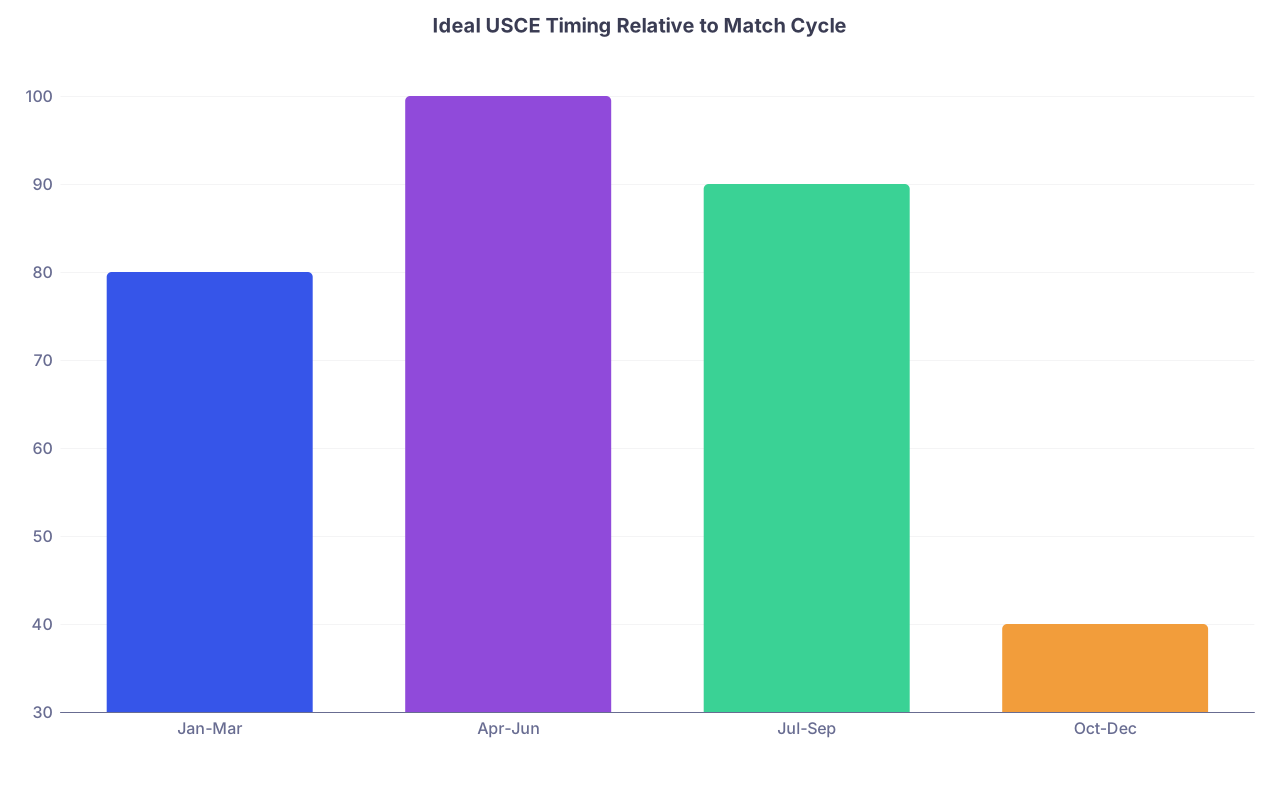
How timing of USCE interacts with the application season
Here’s where people mess up: the calendar.
| Category | Value |
|---|---|
| Jan-Mar | 80 |
| Apr-Jun | 100 |
| Jul-Sep | 90 |
| Oct-Dec | 40 |
Rough rule of thumb:
- USCE before ERAS submission (Jan–Aug): best. You get letters in time, and you show up on paper as already experienced.
- USCE during interview season (Sep–Jan): still helpful. Letters can be uploaded mid-season, and you can talk about it in interviews.
- USCE after rank lists are due (Feb onward): almost no impact on that year’s Match. It might help for SOAP or the following cycle.
So if your planned USCE:
- Starts after October or November of the current cycle → it basically belongs to the next cycle.
- Is in June–August → you can squeeze it into the same cycle, but be smart about letter request timing and ERAS updates.
If your only USCE is scheduled after rank list deadlines, and you’re asking whether to apply now or delay to use that USCE properly, delaying usually wins.
Money and emotional cost: don’t ignore this
People don’t like to say this out loud, but it’s real:
Applying to 100+ programs:
- Application fees can easily hit $2,000–$3,000.
- Plus exam costs you already paid.
If your current profile is so weak that your true interview probability is near zero, applying “just to see what happens” is not a noble experiment. It’s gambling.
Also the emotional cost:
- Every week of no invitations hurts.
- You’ll second-guess everything.
- It can drain your energy for the next cycle.
Sometimes it’s better to accept: “This year is for building. Next year is for applying.”
A simple decision framework
Let me make this even more concrete. Ask yourself these questions in order.

| Step | Description |
|---|---|
| Step 1 | Start |
| Step 2 | Strongly consider delaying |
| Step 3 | Delay and build strong app |
| Step 4 | Consider mixed strategy, maybe limited apps |
| Step 5 | Apply this cycle |
| Step 6 | Consider 1 more USCE rotation but still apply |
| Step 7 | Delay only if you can add major improvements |
| Step 8 | Any hands-on USCE? |
| Step 9 | USCE scheduled before Jan? |
| Step 10 | >= 8 weeks hands-on in target specialty? |
| Step 11 | Can get 2+ US LORs from it? |
| Step 12 | Strong scores & recent YOG? |
| Step 13 | YOG <= 3 years? |
And another practical comparison:
| Situation | Better Choice |
|---|---|
| No USCE, older grad, low CK | Delay and build strong USCE |
| No USCE but CK 250+, YOG recent | Apply, but add USCE ASAP |
| 2–3 months hands-on USCE, 2 US LORs | Apply now |
| Only observerships, USCE hands-on starts after January | Usually delay |
| Switching specialty with no relevant USCE | Usually delay or do hybrid (limited apps) |
How to make a “delay year” actually worth it
If you decide to delay, it has to be strategic. A wasted year just makes YOG worse.
Your delay year should aim to add at least two of these:
- 2–4 months hands-on USCE, ideally in your target specialty
- 2–3 strong US clinical letters (specific, detailed, from inpatient or core rotations)
- US-based research with at least abstracts/posters, ideally in your specialty
- Clear, recent clinical work (even in your home country) to prove you’re actually practicing
- Improved English and communication (yes, this matters on rotations and in interviews)
And then document it clearly:
- Update your CV
- Mention it in your personal statement
- Ask letter writers to emphasize growth and current clinical competence
Don’t avoid the gap. Explain it as purposeful preparation.
The bottom line
Here’s what all this boils down to:
Delay if your current application is dead on arrival
No / almost no USCE, no US letters, older grad, weak scores, and your planned USCE is after this season anyway. In that case, save the money, build real USCE plus letters, and apply once with an actual chance.Apply now if you’re already “good enough,” not perfect
If you’ve got at least some solid hands-on USCE, 2+ US letters, decent scores, and recent graduation, don’t burn a whole year just to chase a bit more USCE. Apply, and keep adding experiences along the way.Your USCE timing matters as much as the quantity
USCE happening after rank lists are due doesn’t help this cycle. If your main USCE is in the future and you want it to actually count, delaying is often the only logical choice.
If you walk away with one question to keep asking yourself, it’s this:
“Will waiting a year transform my application from ‘probably no interviews’ to ‘realistic chance,’ or just from ‘okay’ to ‘slightly better?’”
If it’s the first, delay and build.
If it’s the second, apply and compete.