
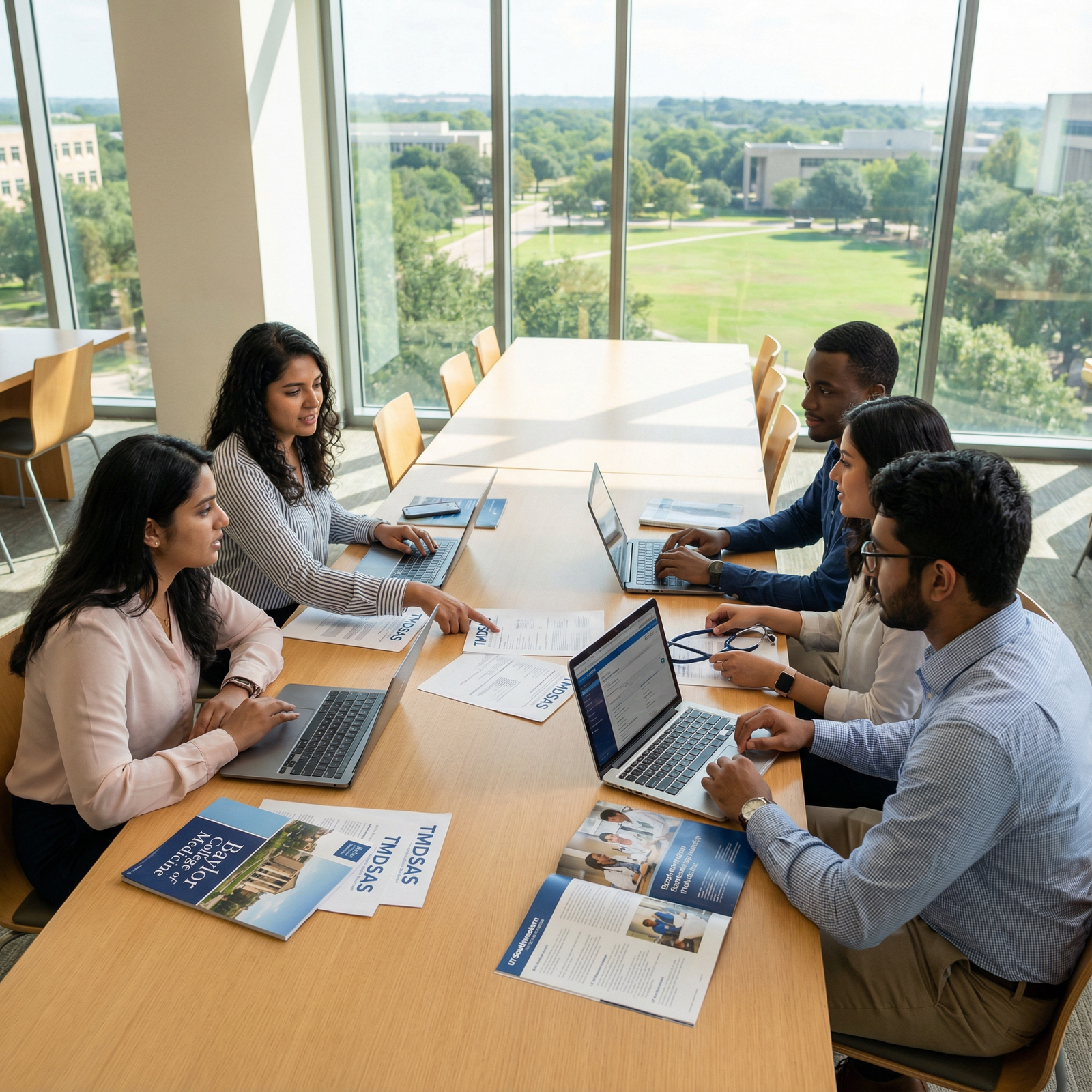
Understanding the TMDSAS Medical School Application Landscape
Applying to Texas medical schools is uniquely structured compared to the rest of the country. Instead of using AMCAS or AACOMAS, most public Texas medical schools—and several dental and veterinary schools—use TMDSAS (Texas Medical and Dental Schools Application Service). If you’re serious about attending medical school in Texas, you’ll need to master the TMDSAS application system.
TMDSAS is more than just a form; it’s a comprehensive snapshot of who you are as a future physician. A winning TMDSAS application does three things well:
- Demonstrates academic readiness for the rigor of medical school
- Clearly explains your motivation and fit for medicine
- Shows a sustained pattern of service, leadership, and growth
The sections below break down each essential component of a strong TMDSAS Medical School Application and provide actionable strategies to stand out to Texas medical schools.
Academic Record: Building a Strong Scholastic Foundation
Your academic record is the backbone of your application. For TMDSAS schools, your GPA trend, course rigor, and completion of prerequisites all signal whether you’re ready for the demands of medical school.
Transcripts: More Than Just a GPA
TMDSAS will ask you to report and send official transcripts from every college or university you’ve attended:
- Undergraduate transcripts (including community college and dual-credit courses)
- Post-baccalaureate and graduate transcripts, if applicable
- Study abroad or special program transcripts, when they list graded coursework
While many applicants focus only on their overall GPA, Texas medical schools also pay close attention to:
- Science GPA (BCPM): Biology, chemistry, physics, math coursework
- GPA trends: An upward trend in later semesters can partially offset a weaker start
- Course rigor: Taking challenging upper-division science classes (e.g., physiology, biochemistry, microbiology) demonstrates readiness
Actionable tips:
- Aim for a 3.5+ overall and science GPA to be broadly competitive, though some schools will consider applicants below this threshold if other components are strong.
- If your GPA is lower:
- Show a clear upward trend in your last 60–90 credit hours
- Consider a post-bacc or special master’s program to demonstrate academic growth
- Use TMDSAS essays and optional sections to contextualize academic challenges (without making excuses)
Course Prerequisites for Texas Medical Schools
Each TMDSAS-participating medical school sets its own prerequisite requirements, but they typically include:
- Biology: 2 semesters with lab
- General Chemistry: 2 semesters with lab
- Organic Chemistry: 2 semesters with lab (some schools accept biochemistry in place of second organic)
- Physics: 2 semesters with lab
- English or writing-intensive courses: 2 semesters
- Statistics and/or math: At least 1 semester, sometimes more
Check each school’s website carefully—requirements can differ slightly among Texas medical schools (e.g., Dell Med, McGovern, UTMB, Texas Tech, UT Southwestern, etc.).
Strategic advice:
- Complete most prerequisites by the time you apply, even if a few are in progress.
- Take upper-division sciences (cell biology, genetics, immunology, neuroscience) to show readiness for medical school-level content.
- If you have withdrawals, repeats, or pass/fail courses in science, use your TMDSAS essays or optional sections to briefly and professionally explain patterns, if needed.
MCAT Scores: Planning, Preparation, and Performance
The MCAT remains a central screening tool for Texas medical schools. For the TMDSAS application, a thoughtful MCAT strategy is critical.
Understanding the Role of the MCAT in TMDSAS
The MCAT evaluates your ability to reason, analyze, and synthesize scientific and social science information, not just memorize facts. Texas medical schools use MCAT scores to:
- Screen for academic readiness
- Compare applicants across different institutions and grading systems
- Predict likelihood of success on future standardized exams (e.g., USMLE Step exams)
Competitive applicants to TMDSAS schools often present:
- MCAT scores at or above 508–510+ for the most selective programs
- 500–507+ for many other schools, depending on their overall profile
The original article mentioned 500+ as a general benchmark; in recent cycles, aiming higher than 500 will make you more competitive, especially for in-state applicants.
MCAT Preparation: Building a Successful Study Plan
To optimize your MCAT performance:
Plan your timing strategically
- Ideally take the MCAT by late spring or early summer of your application year (e.g., April–June)
- Ensure your score is back before or soon after you submit your TMDSAS application to avoid delays in review
Choose a preparation strategy that fits your learning style
Options include:- Self-study using reputable commercial books (Kaplan, Princeton Review, Blueprint, etc.)
- Online prep courses (live or recorded)
- Tutoring or small-group prep
- A structured study calendar over 3–6 months
Use full-length practice exams
- Complete multiple AAMC full-length exams under test-day conditions
- Review errors in detail and adjust your strategies accordingly
- Track your performance by section (C/P, CARS, B/B, P/S)
Consider retaking only with a strong plan for improvement
- TMDSAS schools see all MCAT attempts
- Retake only if:
- Your prior score is significantly below your target school ranges
- Your practice scores are consistently higher than your previous official score
- You have enough time to prepare meaningfully
Bonus prep tip: Integrate CARS practice into your weekly routine early; consistent reading (scientific articles, humanities essays) improves performance.

Personal Statement and Essays: Telling a Compelling Story
The TMDSAS personal statement and essays are where your application becomes more than numbers. Strong writing can differentiate you from thousands of applicants with similar GPAs and MCAT scores.
TMDSAS Personal Statement: Your Core Narrative
TMDSAS allows a personal statement of up to 5,000 characters describing your motivation for pursuing medicine. This is your opportunity to:
- Answer: Why medicine? Why you? Why now?
- Demonstrate insight, maturity, and reflection
- Connect your past experiences with your future goals as a physician
Key elements of a strong TMDSAS personal statement:
A clear, authentic motivation for medicine
- Go beyond “I want to help people”
- Use specific, meaningful experiences (clinical work, family experiences with illness, research, community service) to illustrate your journey
- Show how your exposure to medicine has deepened your understanding of the profession’s realities (both rewarding and challenging)
Reflection, not just description
- Don’t just list what happened—explain what you learned, how you grew, and how it shaped your path
- Discuss how experiences strengthened qualities like resilience, empathy, communication, and teamwork
A coherent, engaging structure
- Use a focused introduction (a brief scene, reflection, or experience) that leads into your central themes
- Organize your statement around 2–3 key themes (e.g., service, perseverance, commitment to underserved populations)
- End with a forward-looking conclusion tying your experiences to your goals as a future Texas physician
Professional tone and clarity
- Avoid clichés, overly dramatic language, and unverified claims
- Use plain, clear language that sounds like you—just your most polished self
Process tips:
- Start drafting 3–4 months before you plan to submit your application.
- Write multiple drafts, then get feedback from mentors, advisors, or writing centers.
- Read your statement out loud to ensure it flows naturally and is in your authentic voice.
TMDSAS Additional Essays (Where Applicable)
Depending on the cycle and school requirements, TMDSAS may include or encourage additional essays such as:
- Personal Characteristics essay: Often asks you to describe qualities or experiences that would contribute to the diversity and quality of the medical school class.
- Optional essay or “Disadvantaged” statement: A chance to provide context for significant life challenges, disruptions, or systemic barriers you’ve faced.
- School-specific secondary essays: Submitted later, directly to individual Texas medical schools.
Use these essays to:
- Highlight aspects of your identity, background, or experiences not fully covered elsewhere.
- Explain unusual academic or personal circumstances succinctly and professionally.
- Show that you understand and align with each school’s mission, particularly around serving Texas communities.
Letters of Evaluation: Choosing Advocates Who Know You Well
Letters of evaluation (letters of recommendation) provide external validation of your readiness for medical school. TMDSAS has specific requirements and options for these letters.
TMDSAS Letters of Evaluation Requirements
TMDSAS typically allows:
- 3 individual letters of evaluation, or
- 1 health professions committee letter (which may summarize multiple evaluations), or
- A combination as outlined in TMDSAS guidelines
At least one letter should be from a science faculty member who has taught you, and additional letters may come from:
- Non-science faculty
- Research mentors
- Clinical supervisors (physicians, PAs, NPs, nurses)
- Volunteer or service supervisors
- Professional work supervisors
Selecting and Supporting Your Letter Writers
The best letters come from people who know you well and can speak to your:
- Academic ability and intellectual curiosity
- Work ethic, reliability, and professionalism
- Interpersonal skills and teamwork
- Compassion, integrity, and maturity
How to secure strong letters:
Cultivate relationships early
- Go to office hours, ask questions, and engage meaningfully in class or lab
- In clinical and volunteer environments, take initiative and build trust
Ask strategically and professionally
- Request letters at least 6–8 weeks before you need them
- Ask, “Would you feel comfortable writing me a strong letter of recommendation for medical school?”
- If someone hesitates, consider a different writer
Provide supporting materials
- A concise CV or resume
- A draft of your personal statement or a short summary of your goals
- A list of specific qualities or experiences you hope they might highlight
Follow up and express gratitude
- Politely remind writers of upcoming deadlines
- Send a thank-you note after they submit and update them on your application outcomes
Strong, detailed letters can tip borderline applications into the “interview” pile—don’t treat this section as an afterthought.
Activities and Experiences: Demonstrating Readiness Beyond the Classroom
Texas medical schools want evidence that you’ve tested your interest in medicine and developed key professional competencies. TMDSAS provides structured sections to list your Extracurricular and Volunteer Activities, Employment, Leadership, and Research.
Clinical and Volunteer Experiences
Your clinical and service experiences show that you:
- Understand what physicians actually do
- Have interacted with patients and healthcare teams
- Are committed to service and community engagement
Examples of impactful experiences:
- Volunteering in hospitals, free or mobile clinics, hospice, or EMS
- Scribing for physicians in emergency departments or clinics
- Working as a medical assistant, CNA, EMT, or patient care tech
- Long-term involvement with community organizations (food banks, shelters, mentorship programs, health outreach)
Focus on:
- Longevity and consistency over last-minute, short-term volunteering
- Depth of impact—what you did, what you learned, and your responsibilities
- Any leadership roles (coordinating volunteers, training new members, leading initiatives)
Research Experience
While not mandatory for every Texas medical school, research can significantly strengthen your TMDSAS application, especially if you’re targeting research-heavy programs like UT Southwestern.
Valuable research experiences include:
- Basic science or bench research
- Clinical or translational research
- Public health or outcomes research
- Quality improvement projects
When describing research on your TMDSAS application:
- Clarify your role (data collection, analysis, literature review, presenting findings)
- Note any posters, presentations, or publications
- Highlight what research taught you about scientific thinking, persistence, and handling setbacks
Leadership, Employment, and Other Experiences
TMDSAS also values well-roundedness and professionalism outside of traditional premed spaces.
Relevant experiences may include:
- Leadership positions: Club officer roles, team captain, peer mentor, orientation leader
- Paid employment: Working to support yourself or your family (on or off campus)
- Non-clinical community service: Tutoring, advocacy, outreach, or service unrelated to healthcare
- Unique backgrounds or skills: Military service, entrepreneurship, language skills, creative arts
In your entries, always describe impact and growth, not just responsibilities.
Quality Over Quantity: Curating Your Experiences
Rather than listing every minor activity, emphasize:
- Your most meaningful and sustained roles
- Experiences that align with Texas schools’ missions (e.g., serving rural or underserved populations)
- Experiences that demonstrate resilience, adaptability, cultural humility, and teamwork
Track your activities early in undergrad with a simple spreadsheet (organization, role, start/end dates, hours, supervisor contact, key reflections). This makes TMDSAS entry much easier later.

Additional TMDSAS Components: Showing Depth and Distinction
Beyond the core sections, TMDSAS offers opportunities to further distinguish your Medical School Application.
Employment and Professional Experience
TMDSAS allows you to list job experiences, whether or not they are medically related. These can powerfully demonstrate:
- Time management while balancing work and academics
- Responsibility, reliability, and professionalism
- Financial independence or supporting family obligations
Examples:
- Working part-time while carrying a full course load
- Serving as a resident assistant (RA)
- Holding positions in customer service or hospitality that strengthened your communication skills
Be explicit about skills gained (conflict resolution, teamwork, leadership) and how those skills translate to a medical career.
Diversity and Life Experiences Statements
Many Texas medical schools value diversity in all its forms—racial, socioeconomic, geographic, educational, cultural, and experiential. If TMDSAS offers a diversity essay or optional essay, consider using it if you can contribute meaningfully.
You might discuss:
- First-generation college student experiences
- Growing up in a rural or medically underserved area
- Immigration experiences or bilingual/multilingual abilities
- Major life obstacles (e.g., illness, caregiving responsibilities, financial hardship) that shaped your perspective
Approach these topics with reflection and maturity, focusing on:
- How these experiences have shaped your values and goals
- How they motivate you to serve specific communities in Texas
- What unique perspectives you would bring to your medical school class
Explaining Academic or Personal Challenges
TMDSAS often includes optional sections where you can briefly explain:
- Academic disruptions (e.g., a poor semester due to illness, family emergency)
- Gaps in education or employment
- Extenuating circumstances affecting performance
Use this space only when necessary, and:
- Be concise, factual, and professional
- Avoid blaming others
- Emphasize what you learned and how you’ve grown since
Putting It All Together: Strategy and Timing for TMDSAS Success
A winning TMDSAS application is not built in a few weeks—it reflects years of intentional preparation. To maximize your chances of admission to Texas medical schools:
Start Early and Apply Early
- Begin drafting essays and gathering letters months before the application opens.
- Submit your TMDSAS application as early in the cycle as reasonably possible (ideally in May or June), since Texas schools often interview on a rolling basis.
- Ensure MCAT scores and letters of evaluation are sent promptly to avoid delays.
Align Your Application with Texas Medical Schools’ Missions
TMDSAS schools often emphasize:
- Service to Texas communities
- Training physicians who will remain in Texas, especially in underserved or rural areas
- Commitment to diversity, equity, and inclusion in healthcare
Demonstrate in your essays, activities, and interviews:
- Genuine familiarity with Texas health challenges (rural access, border health, uninsured populations, etc.)
- A realistic understanding of Texas practice environments
- If applicable, a strong geographic or personal tie to Texas
Seek Feedback and Iterate
- Use pre-health advising offices, writing centers, or experienced mentors.
- Ask for feedback on clarity, coherence, and impact, not just grammar.
- Revise multiple times; polished applications reflect care and professionalism.
TMDSAS Application FAQs
1. What is TMDSAS and how is it different from AMCAS?
TMDSAS (Texas Medical and Dental Schools Application Service) is the centralized application service for most public Texas medical, dental, and veterinary schools. It differs from AMCAS in several ways:
- Focused primarily on Texas institutions
- Uses a different GPA calculation and course classification system
- Often includes slightly different essay prompts and character limits
- Has its own timeline, fees, and residency determination process
If you’re applying both in Texas and out of state, you may need to complete both TMDSAS and AMCAS applications.
2. What MCAT score and GPA do I need to be competitive for Texas medical schools?
There is no universal cutoff, but broadly:
- GPA: Many competitive applicants have 3.5+ overall and science GPAs, though successful applicants can fall above or below this depending on school and context.
- MCAT: Competitive total scores are often in the 508–515+ range for the more selective Texas medical schools; other schools may consider applicants in the 500–507 range, especially in-state applicants with strong other components.
Always review each school’s published class profile and remember that a strong application balances academics, MCAT, experiences, and personal attributes.
3. How important is the personal statement in a TMDSAS Medical School Application?
The personal statement is critically important. For many admissions committees, it is:
- The first in-depth impression of who you are beyond numbers
- A way to assess your communication skills, maturity, and insight
- A key factor in deciding whom to invite for interviews
A compelling, reflective, and well-structured statement can significantly strengthen your TMDSAS application, especially if your metrics are average but your experiences and story are strong.
4. Can I submit letters of evaluation after I submit my TMDSAS application?
Yes. You can submit your TMDSAS application before all letters of evaluation have arrived. However:
- Your application is not fully complete for review until all required letters are received.
- It’s best to have letters submitted as early as possible in the cycle so schools can review your file without delay.
Request letters early, monitor their status in TMDSAS, and follow up politely with your letter writers as deadlines approach.
5. How many Texas medical schools can I apply to through TMDSAS, and should I apply to all of them?
TMDSAS allows you to apply to all participating Texas medical schools if you choose. The exact number changes slightly as schools open or close, but it typically includes:
- Multiple MD (allopathic) programs
- Several DO (osteopathic) programs now participating
- Dental and veterinary schools (if applicable to you)
You do not have to apply to every school, but many in-state applicants apply broadly within Texas to maximize interview opportunities. Choose schools based on:
- Mission fit (e.g., research focus vs. primary care vs. rural health)
- Geographic preferences
- Your competitiveness relative to each school’s typical academic profile
By understanding how each component of the TMDSAS Medical School Application works together—academic record, MCAT performance, personal statement, letters of evaluation, and experiences—you can build a cohesive, compelling application that reflects your readiness to train and practice as a physician in Texas. Thoughtful preparation, strategic planning, and authentic storytelling will help your application stand out in a highly competitive process.


