
The belief that “any postbacc or SMP will dramatically boost your chances” is statistically wrong. The data show a very specific pattern: structured academic enhancers can transform the odds for certain applicants, but barely move the needle for others.
This is not about generic “improvement.” It is about quantifiable shifts in acceptance probability, measured against national AAMC and AACOM data, school-linked program outcomes, and realistic applicant profiles.
Let us translate “Should I do a postbacc or SMP?” into numbers.
1. Baseline Odds: Where You Start Statistically
Before estimating how much a postbacc or Special Master’s Program (SMP) helps, we need to anchor baseline odds.
Using AAMC data (aggregated across recent cycles) as a frame:
- Overall MD acceptance rate: ~42–43% of applicants accepted at least to one MD school.
- For DO, AACOM data show acceptance rates typically in the 35–40% range, depending on the year and applicant pool.
Those are global averages. Individual odds vary sharply by GPA and MCAT.
GPA and Acceptance Probability
Approximate MD acceptance by GPA alone (AAMC Table A-23 style, rounded for clarity):
- cGPA 3.8–4.0: ~65–75% acceptance
- cGPA 3.6–3.79: ~55–65%
- cGPA 3.4–3.59: ~40–50%
- cGPA 3.2–3.39: ~30–40%
- cGPA 3.0–3.19: ~20–30%
- cGPA 2.8–2.99: often under 15–20%
These change materially once MCAT is incorporated, but the pattern is robust: once your cumulative and science GPA slide below 3.2–3.3, MD odds decrease non-linearly.
For DO schools, the acceptance curve by GPA is shifted slightly “down” (meaning higher acceptance at a given GPA), but applicants under ~3.0 still face significant headwinds.
MCAT and Acceptance Probability
Approximate MD acceptance by MCAT (again rounded):
- 521–528: 75–85%+
- 515–520: 65–75%
- 510–514: 55–65%
- 506–509: 40–50%
- 502–505: 30–40%
- 498–501: 20–30%
- <498: usually <15–20%
Most committees evaluate GPA and MCAT together. A 3.0 GPA with a 517 MCAT and a strong SMP is not viewed the same as a 3.0 with a 501 and no graduate work.
So the central question becomes:
How much does a well-executed postbacc or SMP shift you from your current “box” in the GPA–MCAT grid into a more favorable one?
2. What Postbaccs and SMPs Actually Do (Mechanically and Statistically)
Postbaccs and SMPs are not magic. They intervene in two measurable ways:
- They adjust your academic record (undergraduate vs. graduate).
- They provide an extra performance signal in a context similar to, or even more demanding than, medical school.
Academic Mechanics: GPA Repair vs. GPA Overlay
Key distinction:
- Undergraduate postbacc (formal or DIY):
- Courses are almost always undergraduate-level.
- They do not change your original undergrad GPA; they add to it.
- AMCAS: shows your original cGPA/sGPA and then combined with postbacc, but med schools can see trend and breakdown.
- SMP or science master’s:
- Graduate-level courses.
- Graduate GPA is calculated separately from undergrad GPA.
- Committees explicitly interpret a strong SMP as evidence you can handle medical-school-level work even if undergrad GPA is lower.
Data from multiple admissions deans show a clear pattern:
Undergraduate GPA is still the primary academic screen, but a very strong SMP can partially override a weaker undergrad record. A mild SMP performance does not.
Types of Programs and Their Purpose
Functionally, academic enhancer options fall into three categories:
Career-changer postbacc
- For non-science majors with little or no prerequisite coursework.
- Goal: build a science record, not repair one.
- These students often had solid original GPAs (3.4–3.7+) in humanities or social sciences.
GPA-repair / undergraduate postbacc
- For students with completed prerequisites but weak science or cumulative GPAs.
- Goal: demonstrate a new performance trend in rigorous sciences.
- Often DIY at a local university or formal at institutions like UC Berkeley Extension, Temple ACMS, etc.
SMP / special master’s / Med-School-Linked MS
- Graduate-level, usually 1–2 years.
- Often share courses with the MD1 class or tightly correlate with medical curriculum (e.g., Georgetown SMP, EVMS Medical Master’s, Cincinnati SMP, BU MAMS).
- Some have conditional interview or matriculation agreements.
Each category shifts the odds differently based on starting profile.
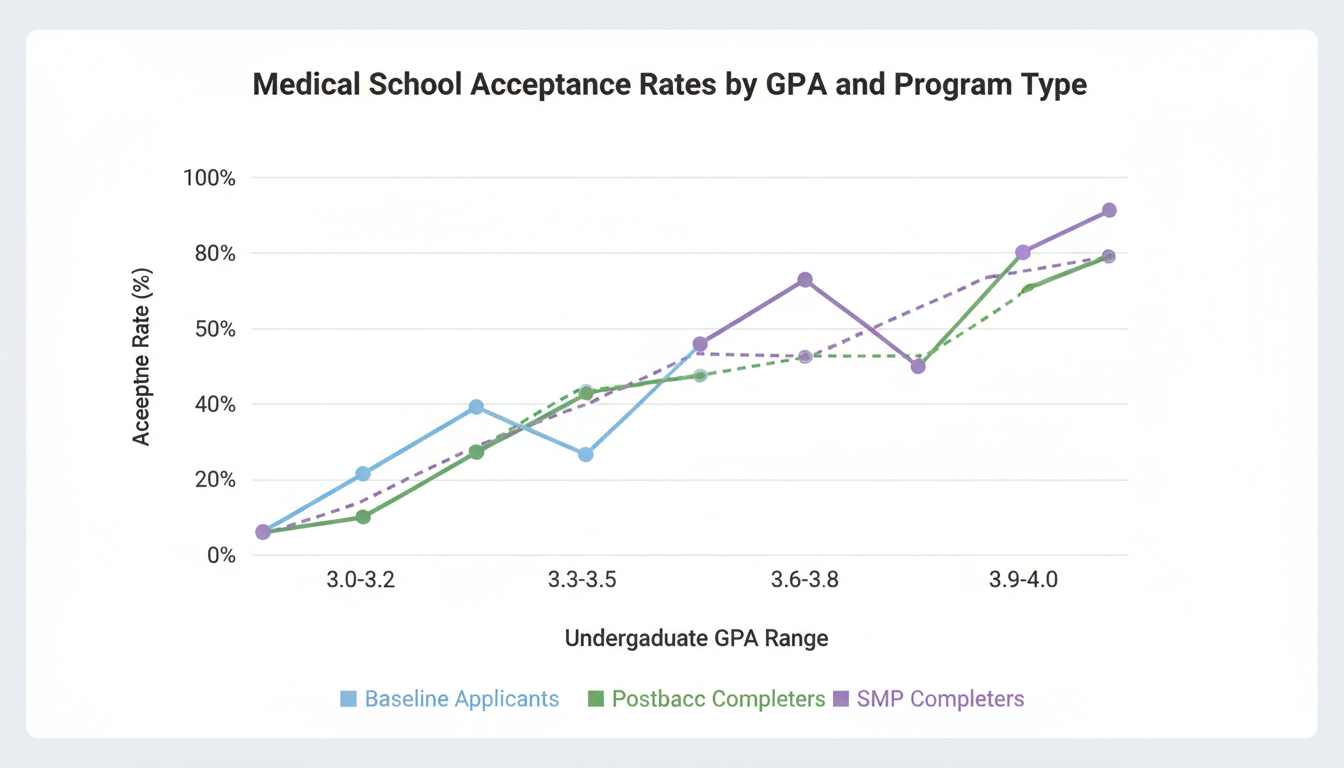
3. What the Data Show: Quantified Impact on Odds
Exact multi-institutional randomized data do not exist (ethical and logistical reasons), but we have:
- AAMC and AACOM acceptance trends.
- Published outcomes and internal data from named programs.
- Longitudinal advising data from premed offices and academic enhancers.
When triangulated, the pattern is remarkably consistent.
Scenario A: Strong GPA, Weak or No Science Background (Career Changer)
Typical baseline:
- cGPA 3.5–3.8 in a non-science major.
- Minimal or no science prerequisites.
- No MCAT yet.
Without a postbacc, this applicant is simply ineligible. With a structured career-changer postbacc:
- Programs like Bryn Mawr, Goucher, Scripps, Columbia, and others report:
- Medical school acceptance rates commonly in the 90–100% range for students who:
- Complete the program,
- Meet MCAT thresholds,
- Apply broadly.
- Medical school acceptance rates commonly in the 90–100% range for students who:
Quantitatively, their odds shift from 0% (cannot apply) to roughly 2–3x the national average (~90% vs ~40%). Here the question “How much does it raise my odds?” is straightforward: the postbacc creates eligibility and leverages an already strong GPA.
Key point: these programs select for strong undergrad records. The postbacc does not compensate for poor prior performance; it amplifies an already solid trajectory.
Scenario B: Moderate GPA (3.2–3.4), Average MCAT, Incomplete Story
Baseline profile:
- cGPA: 3.25
- sGPA: 3.15
- MCAT: 507
- Decent clinical exposure, mid-tier state school graduate.
Using national MD data, a 3.2–3.39 GPA with an MCAT in the 506–509 range might see:
- MD acceptance probability: ~25–35% (broad range, but directionally accurate).
- DO acceptance probability: likely higher, perhaps 35–45%, given more holistic review and different GPA distributions.
Impact of a Strong Undergraduate Postbacc
Suppose this applicant completes 30–40 credits of upper-level sciences (e.g., biochemistry, physiology, microbiology) with a 3.8–3.9 in the postbacc.
Resulting academic picture:
- Original undergrad: 3.25 cGPA, 3.15 sGPA.
- Combined undergrad + postbacc: maybe 3.35–3.45 overall, 3.4–3.5 science (depending on denominator size).
- MCAT unchanged at 507.
Data from advising offices and admissions commentary suggest:
- This kind of strong trend can increase MD acceptance odds to somewhere in the 35–50% range for a broadly targeted application list (especially with in-state schools and some mission-fit privates).
- DO odds may move into the 50–65% range.
In relative terms, that is roughly a 1.3x–2x increase in odds, not a guarantee. The improvement is primarily due to:
- A higher combined GPA.
- A steep upward trend in the most recent 1–2 academic years.
Impact of an SMP Instead
If the same applicant instead pursued a reputable SMP and achieved:
- Graduate GPA: 3.7–3.8 in MS-level biomedical sciences.
- Demonstrated performance in courses graded alongside M1s.
Then the admissions frame shifts:
- Undergrad GPA is still 3.25, which remains a concern.
- However, a strong SMP performance often functions as a “second chance” data point at medical rigor.
Outcome patterns from well-regarded SMPs show:
- MD acceptance for strong performers can land in the 50–70% range depending on:
- Program linkage strength.
- MCAT score.
- State residency and school list.
For DO schools, with this profile, acceptance odds might approach or exceed 70% for applicants applying broadly.
Hence for this mid-3 GPA cluster, a strong SMP can roughly double or occasionally triple MD odds compared to the same person applying with only their undergrad record. The caveat: only if the SMP GPA is high (≥3.6–3.7). Mediocre SMP performance yields minimal benefit and can even be damaging.
Scenario C: Low GPA (≤3.0), Even With a Decent MCAT
This is where applicants often overestimate what academic enhancers can do.
Profile:
- cGPA: 2.8
- sGPA: 2.7
- MCAT: 510
- Some red flags (early F’s/withdrawals, inconsistent trend).
Using MD data, a 2.8 GPA, regardless of MCAT, yields extremely low baseline odds: often below 10–15% for MD, sometimes lower, especially at more competitive schools.
Postbacc Route
If this applicant adds 40–60 credits of strong recent work:
- Postbacc GPA: 3.8–4.0.
- Combined undergrad + postbacc: maybe 3.1–3.2 total, 3.2–3.3 science.
Then:
- MD schools now observe:
- Sub-3.0 original record.
- Long, robust upward trajectory with high recent performance.
- DO schools observe:
- A more competitive combined GPA, especially if grade replacement (now largely removed) is not in play but trend is strong.
Outcomes from advising data suggest:
- MD acceptance might move into the 15–30% band with a very strong narrative, strong MCAT, and an aggressively optimized school list.
- DO acceptance could potentially rise to 40–60% for broad, well-targeted applications.
Numerically, that is a 2x–4x increase over their baseline odds, but the absolute probability of MD admission may still remain modest compared with the average applicant.
SMP Route From a ≤3.0 Starting Point
Here the risk data become more concerning.
Most quality SMPs have minimum GPA cutoffs (often 3.0+). For those that accept applicants around 2.7–2.9:
- Internal data often show highly bimodal outcomes.
- Students either perform extremely well (3.7+ GPA) and dramatically improve their prospects, or struggle and confirm committees’ concerns.
A 2.8 undergrad GPA + 3.8 SMP + 510 MCAT can move an applicant into:
- MD acceptance likelihood: roughly 30–50% in favorable cases, especially where linked interview or matriculation pathways exist and the SMP is respected.
- DO outcomes: can be 60%+ if the performance is strong and clinical / service components are solid.
However, a 2.8 undergrad + 3.2 SMP GPA often underperforms even a well-done postbacc in admissions impact, because the message becomes: “struggled in undergrad, and then was average in medical-level coursework.”
The data pattern:
- High SMP performance from a low GPA → big shift, but high risk.
- Average SMP performance from a low GPA → sometimes worse than taking more undergrad coursework.

4. Linked vs Non-Linked Programs: Conditional Boosts
Not all SMPs and postbaccs function identically. Program design can add an additional, quantifiable bump.
Linked SMPs and Postbaccs
Some programs have:
- Guaranteed interview agreements.
- Conditional acceptance pathways (e.g., “If you maintain X GPA and Y MCAT, you receive a seat or high-priority consideration”).
Examples (program features change over time; applicants must verify current policies):
- EVMS Medical Master’s: historically strong MD/DO placement with conditional interview options.
- Cincinnati SMP: linkage-style benefits for high performers.
- Some state university SMPs tied to their own MD/DO schools.
Data from such programs often show:
- 70–90%+ matriculation into MD or DO for students who:
- Complete the program,
- Hit explicit GPA/MCAT benchmarks.
However, note the conditional: the published high success rates are usually for students who meet internal performance thresholds, not for every matriculant.
This is crucial. The denominator you care about is often “students like me who achieve X or better,” not “everyone who started.”
Non-Linked Academic Enhancers
Independent MS in biomedical sciences or DIY postbaccs have no formal interview or seat guarantee.
Their impact is purely:
- GPA trend.
- Demonstrated rigor.
- Enhanced letters of recommendation from science faculty.
These can still be powerful, but the incremental improvement is usually smaller:
- Think absolute MD acceptance boosts of 10–25 percentage points, not 50+ points, for mid-range applicants.
- For DO, sometimes larger if the postbacc significantly changes the GPA distribution.
5. The Interaction with MCAT: Compounding or Limiting Factor
Statistics from AAMC show that applicants with both a high GPA and high MCAT have multiplicative gains in acceptance probability.
Example:
- 3.6–3.8 GPA with 516–518 MCAT → often 70–80%+ MD acceptance.
- 3.1 GPA with 516–518 MCAT → still significantly below that, but far better than 3.1 with 505.
For academic enhancers:
Strong postbacc/SMP + strong MCAT (e.g., ≥512):
- Frequently converts to above-average acceptance rates compared with national averages, especially if GPA deficiency is not extreme.
- The MCAT validates that the improved academic trend reflects actual mastery.
Strong postbacc/SMP + weak MCAT (e.g., ≤503):
- Data suggest the benefit of the academic enhancer is partially neutralized.
- The MCAT acts as a broad cognitive and content check; weak scores raise doubts even if your SMP GPA looks good.
Weak postbacc/SMP + strong MCAT:
- Often interpreted as “good test-taker, inconsistent coursework performance.”
- Limits the potential uplift in odds and can cap the effective benefit of the MCAT.
The data-driven takeaway:
The largest gains in acceptance probability occur when a strong SMP/postbacc is paired with an MCAT that is at or above the median for admitted students at your target schools.
6. Risk, ROI, and When the Data Argue Against a Program
Applicants often ask, “Will this postbacc/SMP guarantee admission?”
Statistically: no. What we can estimate is risk-adjusted return.
Financial and Time Cost
Typical ranges:
Postbacc (1–2 years):
- Cost: $15,000–$50,000+ depending on institution and living costs.
- Time: 1–2 application cycles.
SMP (1–2 years):
- Cost: $30,000–$70,000+ (tuition, fees, living).
- Time: 1–2 application cycles.
Then factor:
- Lost income.
- Interest on potential graduate loans.
- Additional delay in starting residency.
From a data perspective, these investments are justified when:
- Your baseline odds are low or moderate (say 10–40%).
- The realistic, program-specific uplift pushes your odds into a substantially higher band (e.g., 40–70%).
- Your own academic behaviors and life situation suggest you can plausibly be in the top third of your cohort.
If you already have:
- cGPA 3.7, sGPA 3.65, MCAT 516, and reasonable ECs,
the incremental boost from a postbacc/SMP is minimal. Data suggest such applicants are better served by improving clinical exposure, non-clinical service, or school list strategy.
When the Numbers Argue Against an SMP/Postbacc
Patterns where the quantitative ROI is questionable:
Severe non-academic red flags (disciplinary, legal, pattern of professionalism issues):
- Academic enhancers cannot statistically overcome these in many cases.
Repeated academic failure across multiple attempts:
- If you have already attempted and underperformed in prior repair attempts, an SMP becomes high risk. Data from programs show such students have lower completion and placement rates.
Inability to commit to full-time, high-intensity study:
- SMPs especially resemble M1 in pace. Part-time work often correlates with lower performance and reduced benefit.
Financial pressure that would severely constrain your future options:
- If the cost would force you into an unsustainable debt load and you are already below average academically, the expected value may be negative.
7. Practical Translation: Approximate Uplift by Profile Type
While exact numbers vary by year and personal profile, the data converge on rough ranges.
Below are very general, directional estimates of how much a well-chosen, well-executed academic enhancer can shift MD/DO odds. These assume strong extracurriculars and good application strategy.
Career-changer (3.5–3.8 GPA, no science)
- Baseline MD odds without science: ~0% (cannot apply).
- After top-tier career-changer postbacc and MCAT ≥510:
- MD: often 80–95% at least one acceptance.
- Effective uplift: from 0 to very high; these programs are essentially structured pipelines.
3.2–3.4 GPA, MCAT 506–510, moderate academic weaknesses
- Baseline MD odds: ~25–35%.
- After strong postbacc (≥3.7) or SMP (≥3.6) + MCAT unchanged:
- MD: roughly 40–60% depending on school list and state residency.
- Uplift: ~1.5x–2x.
≤3.0 GPA, MCAT 505–512, significant upward trend potential
- Baseline MD odds: ~5–15%.
- After 30–60 credits of A-level postbacc or a high-performing SMP:
- MD: ~20–45% (wide band; heavily school- and program-dependent).
- DO: ~40–70% in many cases.
- Uplift: potentially 2x–4x, but starting from a low base.
Already-competitive applicant (GPA ≥3.6, MCAT ≥512)
- Baseline MD odds: often 60–80%.
- Postbacc/SMP uplift on academic grounds alone: marginal, perhaps a few percentage points, unless there is a specific weakness (very weak science trend, long gap, etc.).
- Focus usually shifts to experiences, narrative, and strategy.
The thread connecting these estimates: the lower your starting odds, the larger the potential relative gain, but the weaker your academic track record, the higher the risk that you will not reach the performance levels that actually confer that gain.
Key Takeaways
- The data show that postbaccs and SMPs do not offer uniform boosts; they can convert a 10–30% applicant into a 40–70% applicant, but only with strong performance and appropriate program fit.
- Undergraduate GPAs remain central in screening, yet a high-performing SMP or substantial A-level postbacc can partially “reset the clock” and double or even triple acceptance odds for specific profiles.
- The statistically strongest returns occur when a robust academic enhancer is combined with a competitive MCAT and targeted school list, while weak performance in these programs often confirms, rather than repairs, academic concerns.