The number one reason premeds get AACOMAS verification delayed is not grades. It is misreporting repeated courses.
AACOMAS handles repeats very differently from AMCAS, and a surprising number of strong applicants sabotage themselves with avoidable coursework-entry errors. If your academic history includes any retakes, withdrawals and re-enrollments, “grade replacement” rumors, or complicated post-bacc work, you need to treat repeated-course reporting as a precision task, not an afterthought.
Let me break this down specifically.
1. The AACOMAS Reality: How Repeats Actually Work
(See also: Crafting a Compelling Disadvantaged Statement Without Oversharing for more details.)
Before you can report repeats correctly, you need to understand how AACOMAS treats them in the GPA calculation. A lot of your anxiety probably comes from outdated or AMCAS-based advice.
The old myth: “AACOMAS grade replacement”
Historically, AACOMAS used a true grade replacement policy: if you repeated a course, only the most recent grade counted in GPA calculations. That policy ended years ago.
Current reality (post-2017):
- All grades from all attempts are included in GPA calculations.
- There is no grade replacement in your AACOMAS GPA.
- Repeats are still flagged as such, but they are not removed from GPA.
So if you took:
- Gen Chem I: C (first attempt)
- Gen Chem I: A (second attempt, retake)
AACOMAS will:
- Include both the C and the A in your science and overall GPAs.
- Mark both as part of a repeated set in your record.
- Show schools the pattern of improvement, but not erase the initial C.
This means the “repeat” designation is about accurate academic history, not gaming the GPA.
What counts as a repeat in AACOMAS terms?
AACOMAS treats a course as repeated if:
- It is the same course content taken again, even if:
- The course number changed slightly (e.g., CHEM 101 → CHEM 101A).
- You took it at a different institution (original at a community college, repeat at a university).
- It has a slightly different title but is clearly the same required course (e.g., “Anatomy & Physiology I” vs “Human Anatomy and Physiology I”).
It is not enough that it “covers similar material.” It must reasonably be considered the same course being retaken, not just another course in the same field.
2. Build Your Course Inventory Before Touching AACOMAS
The applicants who get this right do not start by typing into AACOMAS. They start offline with a structured inventory of every course attempt.

Step 1: Get every official transcript in front of you
You need:
- All undergraduate institutions (including:
- Community colleges
- Study abroad with US transcripts
- Dual enrollment during high school if they appear on a college transcript)
- Post-bacc programs
- Graduate programs (if applicable)
- Summer sessions at other schools
No exceptions. AACOMAS expects every college-level course, even if:
- It was not premed-related.
- You withdrew.
- You failed and never repeated it.
- It was dual credit that you think “should not matter.”
Step 2: Create a master spreadsheet
Set up a spreadsheet with at least these columns:
- Institution
- Term (e.g., Fall 2021)
- Academic status (Freshman, Sophomore, etc., for your reference)
- Course number (exactly as on transcript)
- Course title (exactly as on transcript)
- Credits (credit hours; match the transcript)
- Grade (as shown on transcript, including W, F, WF, etc.)
- Course type flag (e.g., “Science – BIO,” “Math,” “Non-Science”)
- Potential Repeat? (blank at first)
- Confirmed Repeat Set ID (you will assign these)
Do not worry about overkill here. This is how you catch problems before AACOMAS does.
Step 3: Manually scan for anything that looks like a retake
Highlight or flag rows if:
- The course number and name are identical across terms.
- The course title is nearly identical and clearly the same sequence (e.g., “General Chemistry I” taken twice).
- Your transcript literally labels something as “Repeated” or “Repeat of CHEM 101.”
You should not flag:
- “Intro to Biology” → “Cell Biology” (not a repeat; different content)
- “General Chemistry I” → “General Chemistry II” (sequence, not repeat)
- AP or IB credit followed by a college course (AP credit is not a repeated course in AACOMAS logic)
3. How AACOMAS Wants You to Mark Repeated Courses
Once your spreadsheet is mapped, you can begin translating that information into AACOMAS coursework entry fields.
Key AACOMAS fields for each course
For every course, AACOMAS has you enter:
- Institution
- Term and year
- Course number
- Course title
- Subject (from AACOMAS category list)
- Credits
- Grade
- Course type flags (e.g., honors, repeated, remedial, etc.)
For repeats, the critical element is the “Is this a repeated course?” designation.
The principle: Every attempt in a repeated set must be flagged
If a course is repeated:
- Every attempt in the sequence must be marked as “Repeated.”
- That includes:
- The original attempt with a failing or low grade.
- Any intermediate attempts (e.g., D then C then A).
- The final high-grade attempt.
You do not only mark the most recent attempt. Marking only the second or third attempt while leaving the original unmarked is a classic verification problem trigger.
Example: Simple two-attempt repeat
Transcript:
- Fall 2020 – BIOL 101 – General Biology I – 4.0 credits – Grade: D
- Spring 2021 – BIOL 101 – General Biology I – 4.0 credits – Grade: A
AACOMAS entries:
- Fall 2020 BIOL 101 – mark “Repeated” = Yes
- Spring 2021 BIOL 101 – mark “Repeated” = Yes
Even though the A is stronger, the D stays in your GPA and must still be labeled as “repeated.”
Example: Multi-attempt repeat with different institutions
Transcript:
- Community College:
- Summer 2019 – CHEM 101 – General Chemistry I – 4.0 credits – Grade: F
- State University:
- Fall 2020 – CHEM 111 – General Chemistry I – 4.0 credits – Grade: C
- Summer 2021 – CHEM 111 – General Chemistry I – 4.0 credits – Grade: A-
AACOMAS:
- Summer 2019 CHEM 101 – mark “Repeated” = Yes
- Fall 2020 CHEM 111 – mark “Repeated” = Yes
- Summer 2021 CHEM 111 – mark “Repeated” = Yes
Different institution, different course numbers, same course content. All must be flagged.
4. Special Scenarios That Confuse Applicants
This is where most smart premeds trip up. Edge cases, institutional quirks, and confusing transcript labels can lead to inconsistent reporting.

Scenario 1: Withdrawals and repeats (W, WP, WF)
If you withdrew from a course and then took it again, the question is: Does the original withdrawal count as a “repeated” attempt?
AACOMAS generally expects:
- If the institution itself labels the original as part of a repeat set, then:
- Mark both the W attempt and the completed attempt as repeated.
- If the withdrawal stands alone without any “repeat” annotation:
- The completed later course is still a normal course.
- Many applicants do not mark the original W as “repeated,” but do mark the later enrollment as repeated only if the school defines it as such.
To minimize risk:
- Check your institution’s transcript legend and repeat policies.
- When in doubt, you may:
- Mark both attempts as repeated if your school policy clearly treats that W as an attempt of the same course.
- Or contact AACOMAS for clarification with specific courses in front of you.
What you should not do is randomly mark some W courses as repeated and leave others unmarked with no institutional logic behind it.
Scenario 2: “Grade forgiveness” or institutional replacement policies
Many universities have policies like:
- Grade forgiveness
- Academic renewal
- Repeat-to-replace
Your transcript might:
- Show both grades but annotate the first as excluded from GPA.
- Or hide the original grade from the GPA summary but list it in the course history.
For AACOMAS:
- You still enter every attempt exactly as it appears on the transcript.
- You do not delete or hide the earlier attempts.
- You do not adjust the credits or GPA based on institutional forgiveness.
AACOMAS recalculates GPA from scratch, ignoring your institution’s internal forgiveness. So if your university “forgave” a D when you got a B on the retake, AACOMAS will still include both the D and the B in their calculated GPA.
Your job:
- Enter both attempts.
- Mark both as repeated.
- Let AACOMAS do the math.
Scenario 3: Course number changed, content the same
Example:
- 2019: PSYC 201 – General Psychology – 3 credits – C+
- 2021: PSYC 2001 – General Psychology – 3 credits – A
Same course, renumbered. You must:
- Enter exactly what appears on each transcript.
- Mark both as repeated.
AACOMAS does not care about the specific number. They care that it is clearly the same course retaken.
Scenario 4: Cross-listed or equivalent courses
Example:
- Original: BIOL 220 – Human Physiology – 3 credits – D+
- Repeat at another institution: EXSC 220 – Human Physiology – 3 credits – A
The titles and content match closely; one is under Biology, the other under Exercise Science.
You should:
- Treat these as repeated if they are functionally equivalent (and especially if your advisor or registrar considers them equivalents).
- Mark both as repeated in AACOMAS, even though the course prefixes differ.
Scenario 5: Series and sequences – what is not a repeat
You must not mark these as repeated:
- General Chemistry I → General Chemistry II
- Organic Chemistry I → Organic Chemistry II
- Anatomy & Physiology I → Anatomy & Physiology II
These are sequences, not retakes. Both are unique courses and should not carry the repeated flag unless you literally re-enrolled in the same course (same part of the sequence).
5. Step-by-Step: Entering a Repeated Course Set in AACOMAS
Let us walk through an actual, realistic example from start to finish.
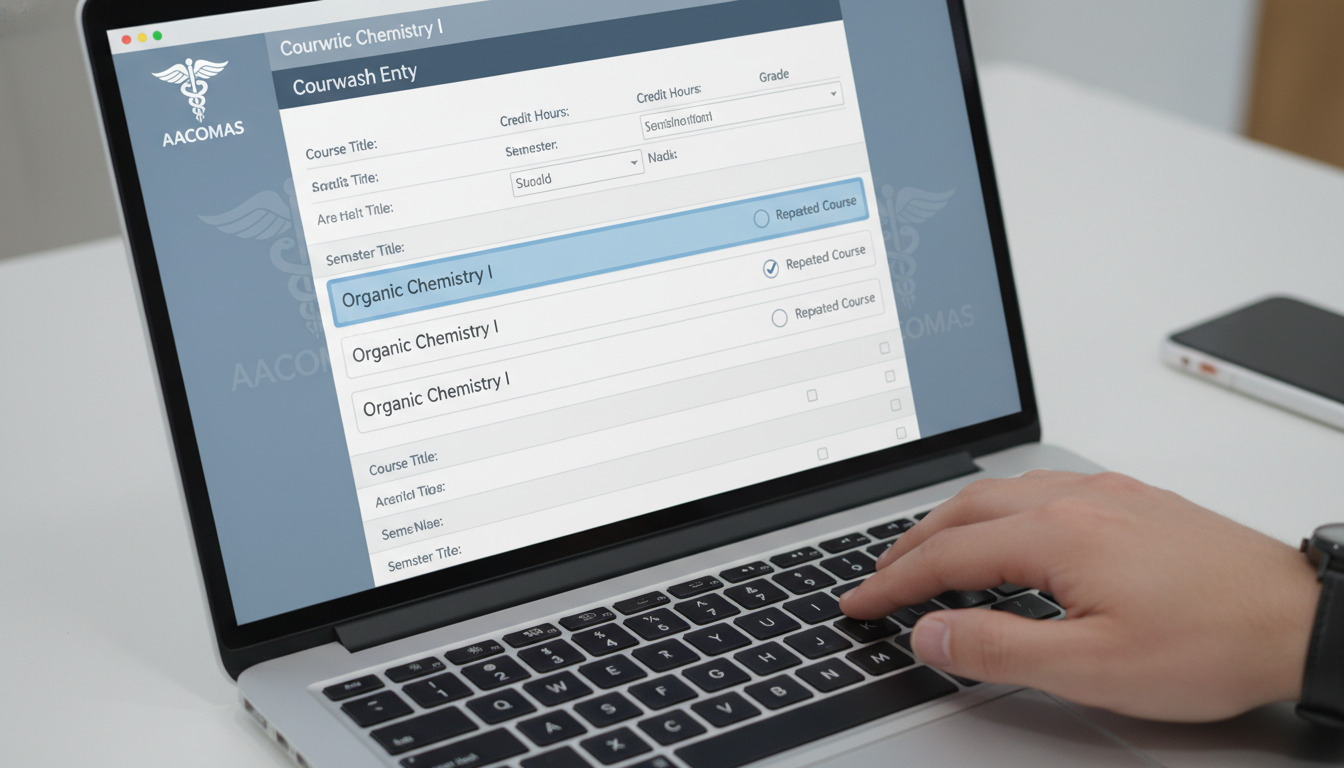
Example transcript history
At University A:
- Fall 2018 – MATH 101 – College Algebra – 3.0 credits – Grade: F
- Spring 2019 – MATH 101 – College Algebra – 3.0 credits – Grade: C-
At Community College:
- Summer 2020 – MATH 110 – College Algebra – 3.0 credits – Grade: A
You decide to apply via AACOMAS in 2024.
Step 1: Enter each institution and term
In AACOMAS:
- Add University A with appropriate dates.
- Add Community College with appropriate dates.
- For each, add terms:
- University A: Fall 2018, Spring 2019
- Community College: Summer 2020
Step 2: Enter courses exactly as on transcripts
For Fall 2018, University A:
- Course number: MATH 101
- Title: College Algebra
- Subject: Match to “Mathematics” in AACOMAS list
- Credits: 3.0
- Grade: F
- Mark “Is this a repeated course?” → Yes
For Spring 2019, University A:
- Course number: MATH 101
- Title: College Algebra
- Subject: Mathematics
- Credits: 3.0
- Grade: C-
- Mark “Is this a repeated course?” → Yes
For Summer 2020, Community College:
- Course number: MATH 110
- Title: College Algebra
- Subject: Mathematics
- Credits: 3.0
- Grade: A
- Mark “Is this a repeated course?” → Yes
Step 3: Double-check internal consistency
Ask yourself:
- Have I marked every attempt as repeated?
- Do course titles clearly indicate it is the same course?
- Do credits match transcripts exactly?
- Have I avoided combining or “fixing” grades based on forgiveness policies?
Only when the entire set is consistent should you move on.
6. Avoiding Common Verification Problems
AACOMAS verification staff compare your self-entry line by line against official transcripts. Inconsistencies with repeats are easy for them to spot.

Problem 1: Marking only the last attempt as repeated
This is likely the most frequent error.
Example:
- Applicant flags only the most recent A in Organic Chemistry I as repeated.
- Leaves the original C+ unmarked.
To AACOMAS, that looks inconsistent: how can you have a “repeated” course if there is no earlier attempt also flagged? They will correct it, but repeated inconsistencies slow verification and can raise questions.
Solution: If any course in a set is repeated, all must be.
Problem 2: Trying to “fix” GPA by omitting earlier attempts
Occasionally, applicants:
- “Accidentally” leave off an earlier F in a course they later aced.
- Claim they “did not think it counted” because of institutional forgiveness.
AACOMAS will:
- See the F on the transcript.
- See no matching entry in coursework.
- Flag the discrepancy and correct it, and in serious cases may treat it as misrepresentation.
Your strategy is not to hide past grades. Your strategy is to present a clear pattern of improvement and trust admissions committees to understand growth.
Problem 3: Misclassifying different but related courses as repeats
Do not mark as repeats:
- Introductory Statistics at Community College → Biostatistics at University
- Human Anatomy → Human Physiology
- General Biology → Microbiology
These are separate courses. Mislabeling them dilutes the meaning of “repeated” and can create confusion.
Problem 4: Inconsistent handling of Ws and audits
You must:
- Enter all W grades that appear on your transcript.
- Enter audits (if transcripted) with the correct grade notation (often “AU” or similar).
- Usually do not flag stand-alone Ws or audits as repeated unless they are clearly part of a repeat policy.
Randomly marking some Ws as repeated and others not, with no institutional logic, is a red flag.
7. Strategic Framing: How Repeats Look to DO Schools
You are not only feeding a computer system. You are also presenting a narrative to admissions committees.
How DO schools typically view repeats now
Since AACOMAS ended grade replacement:
- DO schools now see the full academic arc more clearly.
- Significant early struggles followed by solid A/B performance in similar or identical courses can be a strong positive signal.
- Patterns matter:
- One or two early F’s retaken successfully? Often survivable.
- Chronic repetition of the same course without improvement? Concerning.
Your accurate reporting:
- Shows honesty.
- Demonstrates that you did “the hard work” of mastering the content.
- Allows reviewers to see your resilience and upward trajectory.
Should you explain repeated courses in your application?
In many cases, the patterns speak for themselves. However, you should consider a brief explanation if:
- You had multiple F’s or withdrawals in the same course or sequence.
- There were clear, time-limited circumstances (illness, family crisis) documented by your school.
- Your transcript shows extreme anomalies (e.g., straight A’s except one disastrous term).
Possible venues:
- AACOMAS “Academic Explanation” section (if available in your cycle).
- Secondary applications that ask about academic difficulties.
- Do not write a long, defensive narrative in your personal statement.
The explanation should:
- Be brief and factual.
- Accept responsibility.
- Emphasize what changed and how your later performance demonstrates readiness.
8. A Quick Checklist Before You Submit
Use this as your final pre-submission audit specifically for repeated courses:
Transcripts
- All institutions listed in AACOMAS match the transcripts you requested.
- Every transcripted course, even non-science or failed, appears in AACOMAS.
Identifying repeats
- All clearly retaken courses (same or equivalent content) are identified in your spreadsheet.
- Course number changes and cross-institution equivalents are considered and checked.
- Sequences (I → II) are not incorrectly marked as repeats.
AACOMAS entry
- Every attempt in each repeated set is marked as “Repeated.”
- Credits and grades are entered exactly as on the transcript.
- Institutional grade forgiveness has not led you to delete or “fix” earlier attempts.
Special cases
- W, WF, WP, and audits are entered accurately.
- Any ambiguity about W + later completion is resolved based on institutional policy or AACOMAS guidance.
- Study-abroad courses with US institution transcripts are handled consistently.
Narrative awareness
- Your academic history shows a coherent story of improvement where applicable.
- You have identified, but not obsessed over, possible explanation points for secondaries.
Once this checklist is clean, you have done what serious applicants do. The rest is up to the verification team and the committees.