
The way most premeds build their school lists tells admissions committees one thing: “I have no idea how this process actually works.”
And yes, they really can tell.
I’ve sat in on meetings where adcoms flip through applicant data and quietly shake their heads at the school list. Not because the student is bad. Because the targeting is delusional, naïve, or clearly driven by Reddit rumors instead of reality. That school list, which you treated like an afterthought in June, becomes a glaring red flag in December.
Let me show you how insiders actually think about school lists—and why yours probably screams that you do not understand admissions.
The Hidden Message Your School List Sends
Every school list is a story.
To you, it’s just “places I’d be happy to attend.”
To admissions staff, it’s a behavioral data point that reveals how you see yourself, how you understand the process, and how realistic you are.
When a committee member sees:
- A 3.4 GPA, 505 MCAT with 24 MD schools, 0 DO, 0 SMPs
- Or a 3.9 GPA, 522 MCAT with only 6 schools, all T10 research monsters
- Or a 3.7 GPA, 513 MCAT with 32 applications sprayed across the entire U.S. with no clear pattern
They don’t just see “a list.” They see:
- How you assess your own competitiveness
- How well you understand mission fit
- Whether you did real research or just pulled names from a ranking list
- Whether you understand state/regional bias and yield protection
- How likely you are to be one of those “why didn’t I get in anywhere?” cautionary tales
Admissions offices know which applicants submitted smart, targeted lists—and which ones were gambling.
And yes, they talk about it in committee. I’ve heard versions of:
“Good applicant, but she clearly didn’t understand this cycle. Look at this list—no safety net at all.”
You think they only evaluate your stats and essays. They’re also evaluating your judgment.
The Three School Lists That Scream “Clueless”
Let’s start with what’s going wrong. Because most of you fall into one of these three archetypes.
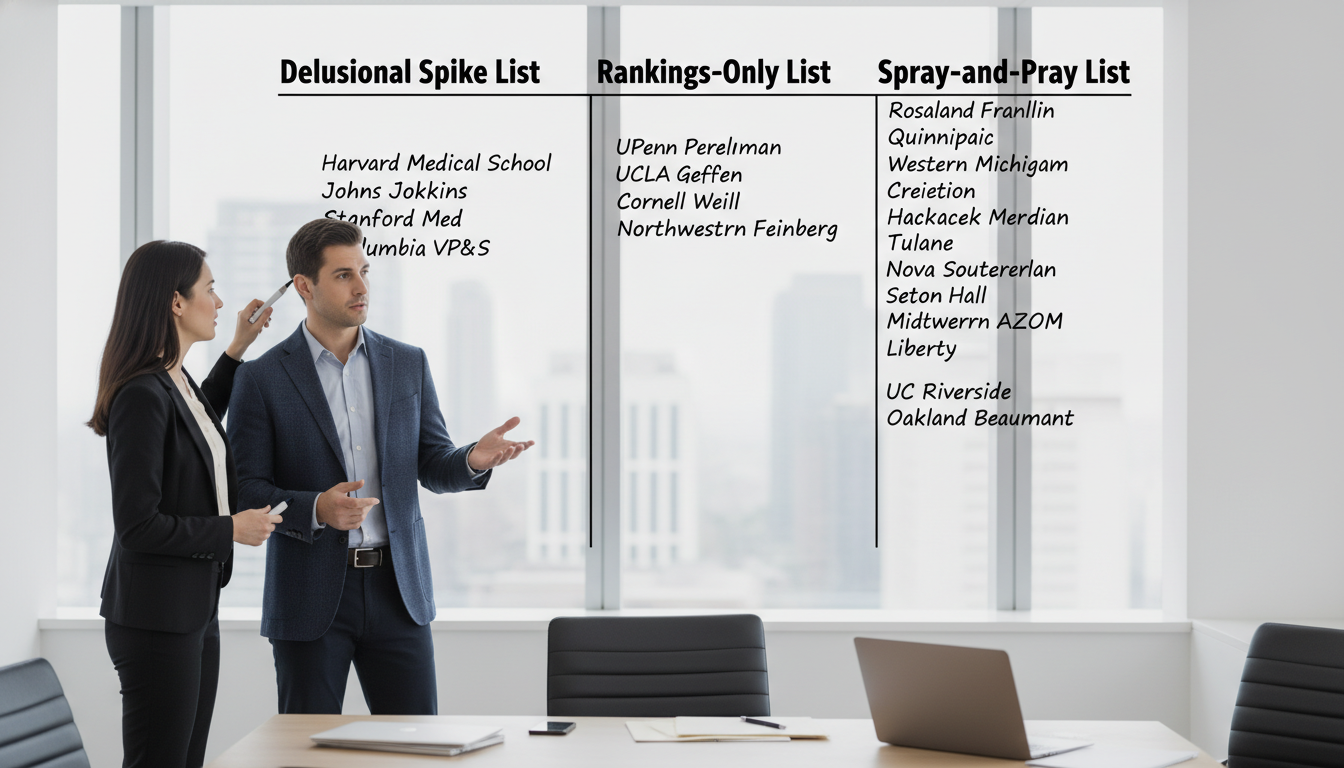
1. The Delusional “Spike” List
This is the student with mid-range stats and a couple of strong experiences who believes they’re a “hidden gem” destined for a T10.
Profile looks something like this:
- 3.6 sGPA, 510 MCAT
- Research: 1200 hours, 1 poster, no publications
- Clinical: 250 hours of volunteering, some shadowing
- Non-clinical service: scattered, 50–100 hours
- School list: 18 MDs, 11 of them Top 20, 7 mid-tier research schools
- No DO. No state mid/low tiers beyond home state.
Common internal narrative:
“I know my numbers aren’t T10-level, but my story is powerful and my rec letters are amazing. If I can just get in front of them, I’ll stand out.”
Here’s what experienced faculty think when they see this list:
- “They don’t understand how numbers filter applicants at screening.”
- “They overestimate how much their ‘unique story’ moves the needle at hyper-selective places.”
- “They didn’t build a safety floor. If the top doesn’t bite, they’re done.”
At several schools I know, a 510 with 3.6 simply never sees human eyes at T10s unless there’s a very specific hook (first-gen with extremely compelling adversity, institutional feeder school, URM with specific recruitment goals, etc.). You won’t see that written anywhere official, but it’s how filters get set when 10,000–15,000 applications flood in.
Your spike doesn’t counter that. It has to climb after you clear the automated triage.
2. The Rankings-Only List
You can spot this list instantly.
- Almost all schools are on USNWR’s “Best Research” list
- No mission-driven community schools
- No newer schools
- No DO
- No serious attention to geographic bias
The profile might actually be solid:
- 3.82 cGPA, 518 MCAT
- Strong research, maybe 1–2 pubs
- Reasonable clinical, decent volunteering
Then every school on the list is:
- UCSF, Harvard, Columbia, Penn, Johns Hopkins
- Michigan, Pitt, Duke, Northwestern
- NYU, Stanford, Chicago, Mayo
This screams two things to us:
- You think rankings equal training quality.
- You didn’t read missions, class profiles, or regional preferences.
Here’s the uncomfortable truth: there are students from top state schools with 3.85+ and 520+ who get shut out from that list every year. Why? Because they treated the process like a prestige lottery instead of match-making.
I’ve seen chairs mutter, “They didn’t apply to any of the good regional schools where they’d have been auto-interviewed. Risky.”
3. The Spray-and-Pray List
Then there’s the “I’ll apply everywhere and something will stick” approach.
Example:
- 3.7 GPA, 509 MCAT
- Clinical: 200 hours
- Research: 300 hours, no pubs
- Non-clinical: 150 hours
School list:
- 35–45 MDs
- Scattered across entire US
- No clear thought about state ties, missions, or competitiveness bands
- 0–2 DOs, added late as a panic move
The red flags from the inside:
- No understanding of screening thresholds vs. holistic review
- No respect for how much secondaries + interview travel/virtual prep will drain them
- No targeted story for mission fit, because they’re busy trying to be “generic good” for 40 different institutions
A dean I know at a midwest MD school put it perfectly:
“The 42-school applicant tells me they’re terrified but not strategic. They’re reacting, not planning.”
And the secret? A wild, unfocused list does not dramatically increase your chances. It mostly increases your burnout and your credit card balance.
How Adcoms Actually Sort Applicants Long Before You Apply
Here’s the part nobody outside the room sees: by March or April, before your primary even lands, most schools already know roughly what ranges they’re targeting.
They look at:
- Last 5 years of their class stats and MCAT distributions
- Yield data by GPA/MCAT bands
- Where their current students turned down higher-ranked offers
- Which undergrad pipelines are strong or weak
- Institutional pressures (new curriculum, new campus, new DEI/research directives)
Then they build internal “swim lanes”:
- Automatic screen-outs (below certain MCAT/GPA combinations)
- “Rare exceptions” lanes (for very specific contexts)
- Priority lanes (high mission fit, high stats, ties to region)
- Deprioritized lanes (“we’ll look, but they’re unlikely to attend or unlikely to be competitive against our usual pool”)
You never see these lanes. But your file gets dropped into one of them based on a few key numbers and limited data.
Your school list either respects those lanes—or runs straight into them at full speed.
If you have:
- 508 MCAT, 3.6 GPA
- No ties to New York
- And yet you apply to every New York private including Sinai, Einstein, NYU, Hofstra, Rochester, Columbia, Cornell
Internally, most of those applications are dead on arrival. Not because you’re unworthy, but because:
- Their median is significantly above you
- Their regional preference pulls toward NE/NY ties
- Their yield model tells them you’re unlikely to attend if accepted when you have options closer to home or in-state
No one tells you that in the MSAR. They just quietly never send a secondary or never invite you to interview.
The Quiet Rules Insiders Use to Build Smart Lists
When I’ve helped students behind the scenes—ones who later matched at UCSD, Ohio State, Jefferson, MCW—the conversation never starts with “What are your dream schools?”
It starts with:
- Where do you have real geographic leverage?
- Where do your numbers sit relative to typical matriculants?
- Where does your story match the school’s actual behavior, not just its marketing?
Let’s walk through the real framework top advisors use, which most premed offices sugarcoat or never explain.
Rule 1: You Need a True Statistical Floor
Every list needs schools where:
- Your MCAT is at or above the 75th percentile of matriculants
- Your GPA is at or above the median
- And the mission is general enough that lots of applicants could plausibly fit
For a 3.6, 508 student, that might mean:
- Several newer MD programs (e.g., UC Riverside if you’re from the region, Central Michigan, Virginia Tech Carilion)
- A thoughtful number of DO schools with average MCAT closer to 505–508
If your list has zero schools where you’re clearly above water statistically, that tells us you don’t understand probability. Or worse, that you think you’re an exception to norms.
At at least 4–6 schools on your list, you should be the kind of applicant the school would be thrilled to get, not stretching to justify.
Rule 2: Geographic Reality Beats Dream Destinations
“California or bust” is a fantastic way to become a reapplicant.
Insiders know:
- California MD schools are brutally competitive even for in-state
- Certain states heavily protect their own (Texas, some Midwest states)
- Private schools say they’re national but still over-weight regional ties because those students actually matriculate
A 3.9/518 from Ohio with no west coast ties, who applies to 9 California schools and 3 local midwestern MDs, is playing an unnecessarily risky game. Fresno, Columbus, and Cincinnati will often be far more generous than LA or SF.
When we look at a list, we’re always asking:
“Where do they actually have a plausible reason to end up other than ‘I like the weather’ or ‘it’s ranked high’?”
Rule 3: Mission Fit Isn’t Marketing Copy
Most premeds read mission statements like they’re horoscope blurbs: generic, interchangeable, and flattering.
Insiders watch what schools do, not just what they say.
A few patterns:
- Schools that truly prioritize primary care will show it in their match list (lots of FM, IM, peds, psych) and community partnerships
- Heavy research schools will disproportionately select applicants with 2000+ hours and serious outputs, especially if they’re MD/PhD factories
- Jesuit/Catholic-affiliated schools care about service to marginalized populations in tangible, sustained ways
If your primary application screams “I want to be a basic science researcher, love bench work, and dream of an R01 someday”—and 70% of your schools are community/primary care heavy? That mismatch is obvious on our side.
The opposite is true too. If your list is Harvard/UCSF/WashU but you have almost no research, your list tells us you read prestige, not purpose.
A Rational Framework: Building a List That Looks Like You Know What You’re Doing
Let’s strip the emotion out for a moment and talk structure. When insiders help applicants, we think in buckets.
A typical smart MD-focused list for a reasonably competitive applicant (say 3.75, 514, decent activities) might have 25–30 schools roughly broken down as:
- 4–6 “reach” schools (your stats around or slightly below their medians, but plausible)
- 10–14 “target” schools (you’re close to their median or slightly above in one dimension)
- 4–6 “low target / safety-ish” MDs (your stats above 75th percentile, good mission alignment)
- 4–6 DO schools (chosen deliberately, not random additions in October)
The clueless list reverses this: 15 reaches, 5 realistic, 0–1 safety MD, 0 DO.
Let me give you a concrete contrast.
Case Study: Same Applicant, Smart List vs. Clueless List
Applicant:
- 3.72 cGPA, 3.68 sGPA
- 514 MCAT
- 1500 hrs clinical
- 400 hrs non-clinical volunteering (underserved)
- 800 hrs research, 1 poster
- From Illinois, no special hooks
Clueless list:
- Harvard, Hopkins, Penn, Columbia, Cornell
- UCSF, UCLA, Stanford
- Michigan, Northwestern, Chicago, Mayo
- NYU, Mount Sinai
- WashU, Duke
- Emory, Vanderbilt
That’s 18 applications. All high or extreme reach. No regional mid-tiers. No community-focused schools. Zero DO.
Smart, insider-style list might look more like:
- Reaches: 6–7 of the above (not 18), carefully chosen for some mission or profile alignment
- Targets: Rush, Loyola, Rosalind Franklin, MCW, SLU, Creighton, Jefferson, UVM, Albany, Einstein, Hackensack, Wake Forest, etc.
- Low targets: A few newer MD programs or slightly lower median schools where a 514 looks very strong
- DO: 4–5 solid DO schools aligned with their desire for clinical practice, added intentionally
The applicant hasn’t changed. Just the understanding of odds has.
The smart list doesn’t guarantee success. But it multiplies the number of places where this applicant is a preferred candidate rather than an aspirational one.
Why Your School List Might Be Actually Hurting You
Here’s a subtle point almost nobody on Reddit talks about:
A bad list doesn’t just risk no acceptances. It sabotages the quality of your cycle, even if you get in somewhere.
Here’s how:
You waste months on secondaries that were DOA from the start.
Submitting 35 secondaries in 3 weeks is a recipe for low-quality, repetitive essays. Committees can spot boilerplate. When you’re burnt out churning out essays for schools you had no real shot at, your writing quality drops everywhere—including the schools you do have a shot at.You under-apply to smart fits.
Many good regional or mid-tier schools never see your app because your ego or anxiety told you “I’m better than that.” You’d be shocked how many 3.8/517 applicants end up grateful to attend a non-T20 school they almost didn’t apply to.You send a distorted self-portrait.
A list that’s all prestige suggests insecurity, misunderstanding, or lack of humility. A list that’s all random DOs when you have 520+ and 3.9 suggests something else just as problematic: you didn’t do the work to understand the MD landscape.You risk reapplicant stigma.
Getting shut out once with an absurd list is recoverable. Twice begins to look like a pattern to some schools—especially if you reapply with the same flawed targeting.
Your school list is not a private fantasy map. It’s a strategic document that shapes everything about your application year: your stress, your essays, your interview invites, your options.
Treat it like a throwaway and the process will treat you the same way.
The Insider Way to Build a List That Commands Respect
So what does a list look like that quietly signals to adcoms, “This applicant gets it”?
It looks like this:
- Your home state schools are on there, unless there’s a clear reason not to
- There’s a clear geographic cluster or logic, not 1–2 schools per state across 20 states
- Your stats are competitive at a solid chunk of the schools
- The missions line up with what your primary actually demonstrates
- There’s an intentional mix of reach/target/low target/DO that matches your risk tolerance and finances
- You don’t treat DO as automatic backup trash, but as distinct institutions with their own strengths
An attending I know who’s sat on committees at two mid-tier MD programs said this to a student once:
“When I see a list that makes sense, I assume the applicant will also make good decisions about patients, time, and resources. It’s a subtle but real signal.”
You’re not just being evaluated on competence. You’re being evaluated on judgment.

How To Fix Your List If You’re Still Early In The Cycle
If you’re pre-application or just starting to plan, you’re in the best position.
Do this:
Define your non-negotiables.
Family constraints, financial situation, strong geographic ties, absolutely cannot-live-there regions. Be honest.Build your data sheet.
For 40–50 candidate schools, collect: median MCAT, GPA bands, in-state % vs out-of-state, mission themes, research vs primary care emphasis.Stratify ruthlessly.
Based on your actual numbers, not your dream version of them. If your MCAT is below their 10th percentile, they’re fantasy unless you have a truly rare angle.Delete redundancies.
You don’t need 12 versions of the same high-reach research powerhouse if your profile doesn’t scream “future physician-scientist.”Add insurance intelligently.
A handful of DO or lower-stat MD programs early, not as October afterthoughts.
If you’re already mid-cycle and realizing your list is a mess, the options are different but not hopeless:
- Prioritize the secondaries where you actually have a statistical and mission shot.
- Slow down and write tailored, thoughtful responses for those.
- Accept that some of your apps were donations this year—and use that as tuition for understanding the system better if you need to reapply.
The Harsh Truth: Adcoms Don’t Fix This For You
One last behind-the-scenes secret.
No one in the admissions office is sitting there saying:
“Wow, this applicant would be great at X or Y school; too bad they didn’t apply there. Let me help them.”
They evaluate the files in front of them, for their institution, within their constraints. Their job is not to optimize your overall career trajectory. It’s to build their class.
If you build a school list that screams you don’t understand admissions, they will not correct it for you. They will just quietly let the process do what it always does: favor those who respected the math, the missions, and the geography.
The students who end up with multiple acceptances and real choices aren’t always the ones with the highest stats. They’re the ones whose strategy made sense from day one.
You can be one of them. But only if you stop treating the school list like a wish list and start treating it like a blueprint.
You’ve now seen how insiders actually judge your choices. With that foundation, your next move is to learn how to tailor your primary and secondaries to those schools you’ve chosen strategically—so your file doesn’t just land in the right places, it lands with impact.
That, though, is its own conversation.