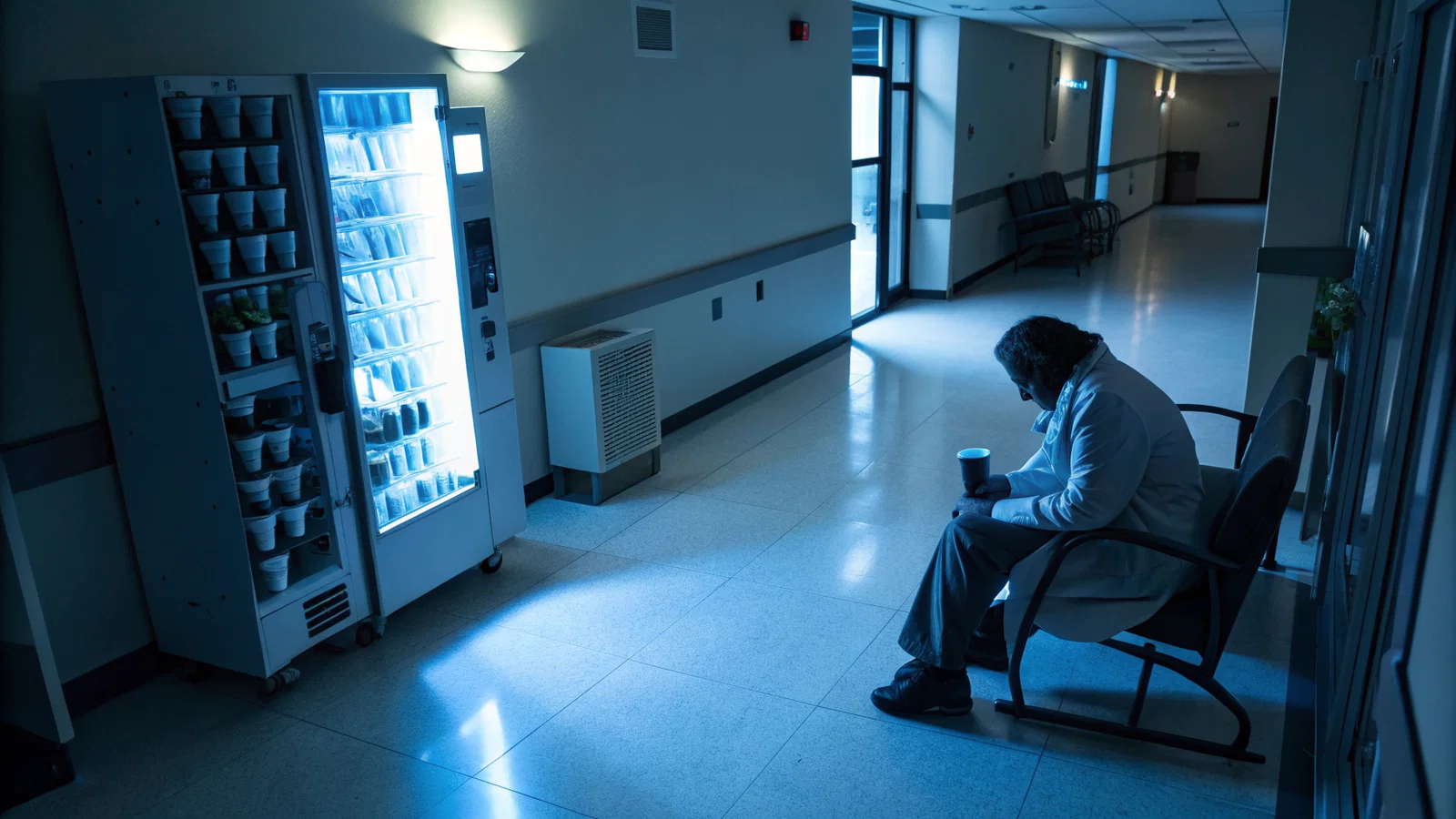
Medical school teaches you the Krebs cycle. Residency orientation teaches you how to use the EMR. But nobody teaches you how to keep from losing your mind when the pager goes off for the fourth time at 3:14 AM.
Night float operates on a completely different social code than day shifts. When the sun goes down, the formal hierarchy dissolves. Your supervisors survive the overnight grind using a specific brand of humor they can't formally teach in a lecture hall. The midnight hour transforms serious, type-A physicians into reluctant, sleep-deprived comedians.
Understanding this hidden culture isn't just about fitting in. It's an essential survival skill. Here is your practical, step-by-step guide to decoding the night shift, mastering the unwritten rules, and actually surviving until sign-out.
This article is for educational purposes only. It is not financial advice, not legal advice, and not tax advice. Figures vary by individual circumstances, so consult a qualified professional before acting.
The 3 AM Truth: What Nobody Warns You About
Day shift is about performance. Night shift is about endurance.
During the day, you are expected to be polished, eager, and strictly professional. At 3 AM, that polish cracks. The sheer volume of admissions, the critical care decisions, and the biological torture of circadian disruption strip away your daytime persona. What's left is raw, unfiltered survival mode.
Supervisors know this. They rely on dark, absurd, and highly specific humor to process the trauma and exhaustion of the job. They can't put "learn to laugh at the absurdity of a bowel obstruction at 4 AM" on your evaluation form. But they notice who cracks under the pressure and who adapts.
The Fix: Stop trying to be the day-shift intern at 2 AM.
- Drop the forced daytime enthusiasm.
- Read the room. If the senior resident is making a bleak joke about the endless stream of drunk patients in the ED, don't look shocked.
- Match the energy. Acknowledge the absurdity.
The Seven Sacred Laws of After-Midnight Humor
You want to survive the night? Memorize these laws. They are the structural integrity of the night float team.
Law 1: Never laugh at a code until you're sure it's not yours. Humor is a release valve, but timing is everything. If a code is called, you stay dead silent until you confirm your patient is safely in bed. Protocol: Verify your patient list before you crack a joke about a code.
Law 2: The coffee pot is always empty but always blamed. The empty coffee pot is the universal scapegoat for every minor inconvenience on the floor. It's a shared enemy. Protocol: When you find it empty, loudly blame the day shift. Then, make a new pot. You will instantly earn respect.
Law 3: Whatever the attending says about 'quiet nights' is now your fault. If an attending utters the "Q" word, the universe will punish you. It's a known fact. Protocol: Immediately knock on wood, throw salt over your shoulder, or aggressively insult the attending's jinx. It's mandatory.
Law 4: Dark humor is not optional, it's structural load-bearing. You will see terrible things. You will lose patients. Dark humor is how we process the unprocessable without breaking down in the supply closet. Protocol: Don't police your colleagues' dark jokes at 3 AM. They are coping. Participate or stay quiet.
Law 5: You laugh at the pager because the pager will laugh last. The pager is a cruel master. Laughing at its relentless demands is the only way to assert dominance over a piece of plastic. Protocol: When it goes off for the fifth time in ten minutes, give it a sarcastic greeting. "Oh, you're back. Missed me?"
Law 6: The nurses know more, always, forever, amen. The night charge nurse has forgotten more about clinical medicine than you will ever learn. Joking about their superiority is a sign of respect. Protocol: Self-deprecating humor regarding your own clinical ignorance compared to the nursing staff is always a winning strategy.
Law 7: By 4am, every joke is a haiku and every haiku is profound. Sleep deprivation alters your brain chemistry. A mildly funny observation at 4 AM feels like Shakespearean genius. Protocol: Laugh at your colleagues' 4 AM jokes. They think they are hilarious. Let them have it.

Who Actually Runs the Night (It's Not Who You Think)
Forget the hospital administrators. Forget the department chairs sleeping in their suburban homes. The night shift is run by a shadow government. If you want to fix your night float experience, you need to align yourself with the real power brokers.
The Night Charge Nurse This person has seen things your textbooks can't imagine. They know which patients are faking, which doctors are incompetent, and exactly where the extra blanket warmers are hidden. The Fix: Introduce yourself at 10:15 PM. Ask them what the floor needs. Bring them a coffee at 2 AM without being asked. Do this, and they will save you from making a fatal error at 4 AM.
Your Fellow Residents They become your midnight family, whether you want one or not. You will see them at their worst, and they will see you at yours. The Fix: Drop the competition. Day shift is for competing for cases. Night shift is for dividing the labor. If your co-resident is drowning in admits, take their discharge summaries. Build the alliance.
The Lab Tech and Phlebotomist The tech who prints your stat labs at 2 AM and the phlebotomist who actually finds a vein on a dehydrated patient are your most valuable allies. The Fix: Learn their names. Say thank you. Never, ever yell at them because a lab is delayed. They control your workflow. Treat them like gold.
The "Sleeping" Attending Attendings who claim they "sleep in the back room" are mythical creatures. They exist only in stories told by seniors to scare interns. Your attending is awake, scrolling on their phone, and waiting for you to figure things out. The Fix: Assume they are awake. Call them when you need them, but have your data organized before you dial.
The Rosetta Stone of Night Float Slang
Communication breaks down after midnight. You need to know what people actually mean when they speak. Here is your translation guide and how to respond.
"It's a teaching moment." Translation: I'm too tired to do this myself, so I'm forcing you to do it while I watch. Your Fix: Don't argue. Ask for the specific parameters they want, execute the task, and move on.
"Let's circle back." Translation: I have absolutely no idea what the answer is, but I don't want to admit it right now. Your Fix: Look it up yourself. Present the answer to them in twenty minutes. You'll look like a genius.
"Great opportunity for learning." Translation: This is going to suck, it's going to take three hours, and you'll thank me later (you won't). Your Fix: Grab your equipment, brace yourself, and ask for the specific learning objective upfront so you don't waste time.
"The patient is stable." Translation: Everyone stop talking so I can pretend they are stable while I figure out what to do next. Your Fix: Double-check the vitals yourself. "Stable" on night shift is a highly relative term.
"Quiet night." Translation: Jinx. You just guaranteed an admits parade. Your Fix: Immediately tell them to shut up. Seriously. Say, "Don't say that, you're jinxing us." It's the only accepted response.
Survival Protocols They Forgot to Mention
You can read all the clinical guidelines you want, but if you don't master the logistics of the night shift, you will burn out by week two. Implement these protocols immediately.
1. The Earbud Protocol Always keep one earbud in with a podcast or ambient noise at low volume. White noise is your friend. It drowns out the constant hum of the hospital and keeps your brain stimulated during charting. Rule: Never put both ears in. You need to hear the code alarm.
2. The Snack Drawer Diplomacy The resident snack drawer is sacred territory. Respect the unspoken rotation. If you eat the last of the good granola bars, you are morally obligated to replace them. Rule: Keep a secret stash of high-protein snacks in your personal locker. The communal drawer will betray you at 4 AM.
3. The Admit Memorization Trick If you can quote the last three admits' vital signs, chief complaints, and working diagnoses without looking at the chart, you're a legend. Rule: Write a one-line summary of every admit on a physical index card. Keep it in your pocket. Review it at 3 AM. It saves massive cognitive load when the ED calls for an update.
4. The 5 AM Walking Rounds Walking rounds at 5 AM with the senior resident is both punishment and privilege. It's exhausting, but it's where the real clinical reasoning happens. Rule: Have your patients' morning labs pulled and printed before the senior arrives. Anticipate their questions. This is where you prove you're ready for the next level.
5. The Sunrise Coffee Run The sunrise coffee run is the only thing separating you from the living dead. It is a non-negotiable ritual. Rule: At 5:30 AM, physically leave the ward. Walk to the cafeteria or the nearest coffee cart. The change of scenery and the caffeine hit will reset your circadian rhythm just enough to finish sign-out.

Why This Matters: The Hidden Curriculum
Let's get one thing straight. Night float humor isn't unprofessionalism. It's emotional processing.
When you are staring down a complex GI bleed at 3 AM, the ability to crack a dark joke with your co-resident isn't a sign that you don't care. It's a sign that your brain is actively regulating your stress response so you can care. These midnight bonds last longer than any lecture on patient safety. The residents you suffer through the night shift with will be the ones you call for favors ten years from now.
Your supervisors learned this the hard way. They developed this hidden code to survive. Now, it's your turn. Master the language, respect the shadow hierarchy, and learn to laugh when the pager won't stop screaming.

Key Takeaways
- Night float operates under an unwritten humor code that functions as both coping mechanism and cultural glue, the sooner you learn to laugh appropriately, the better you'll survive.
- Your real allies aren't always who you expect; the night charge nurse and unit techs are the backbone of every successful overnight shift.
- Dark humor at 3am isn't a flaw in your character, it's a feature of medical training that builds resilience and community.
- Mastering the hidden language and rituals of night float will make you a better, more connected physician, and help you actually enjoy the experience.