
It is 6:42 AM on Day 3 of your Internal Medicine rotation. Your team is standing outside Room 412. The senior resident presents a complex patient with severe hyponatremia, serum sodium sitting at a terrifying 114. The attending begins discussing the calculated rate of hypertonic saline infusion to prevent central pontine myelinolysis.
You feel the high-stress tension in the hallway. You want to ease the mood. You want to show you're relatable, confident, and part of the team. So you chime in:
"Hey, at least if we correct it too fast, they won't be able to run away from the physical therapy team!"
Silence.
Total, vacuum-sealed, air-sucking silence.
The attending lowers their glasses. The senior resident stops typing on their workstation on wheels. The intern stares intently at the floor, suddenly fascinated by the linoleum pattern. You just committed a classic MS3 rotation error. You tried to execute end-of-rotation banter on Day 3.
I am your Timeline Guide. My job is to walk you through the precise, chronological arc of your clinical training, week by week, day by day. Right now, your relational humor is completely uncalibrated. High environmental stress combined with low social capital equals social disaster. Let's fix your timeline before you turn another morning table round into a trauma response.
This article is for educational purposes only. It is not financial advice, not legal advice, and not tax advice. Figures vary by individual circumstances, so consult a qualified professional before acting.
Phase 1: Days 1 to 7, The Observation and Decompression Window
At this point you should focus entirely on listening rather than generating comedic material. You have zero social equity on this team. You are a complete variable to your attending and residents. They don't know if you are hyper-competent, clinically dangerous, or socially oblivious. Until they establish your baseline competence, any attempt at humor looks like flippancy.
The hospital has a strict, unspoken hierarchy of comedic permission:
- The Attending: Can make jokes about anything, including the medical school curriculum.
- The Senior Resident: Can make dark jokes about workload and sleep deprivation.
- The Intern: Can make jokes about their own fatigue and administrative burdens.
- The Medical Student (You): Can laugh softly at the attending's jokes. Period.
Your comedic domain during Week 1 is strictly observational and limited to completely neutral targets. Parking structure elevators. Burnt cafeteria coffee. The freezing ambient temperature of the call room. That's the entire list.
Week 1 Calibration Checklist:
- Zero sarcasm: Sarcasm requires established trust; without it, you just sound passive-aggressive.
- High attentiveness: Spend 95% of rounds reading room dynamics and 5% managing your posture.
- Map the leadership: Note the attending's baseline tolerance. Do they chuckle at resident banter, or do they cut it off with a question about lab results?
- Practice the silent nod: When a resident makes a joke, acknowledge it with a polite smile and a quiet nod. Do not attempt to one-up them.
Phase 2: Days 8 to 14, Testing the Waters with Self-Deprecation
At this point you should introduce strictly self-deprecating humor targeting your own knowledge gaps or logistical mishaps. By Week 2, the team knows you are punctual and not a threat to patient safety. Now you can humanize yourself.
Humor directional vector matters enormously in medicine. There are three directions you can punch:
- Punching Up (At leadership or hospital administration): Dangerous. You lack the job security to critique the system.
- Punching Down (At patients, nurses, or support staff): Cruel and unprofessional. Never do this.
- Punching Yourself: The only safe target for a junior trainee.
When you fail to locate an otoscope or forget the specific name of a rare dermatological rash, a light, self-deprecating comment breaks the tension without projecting incompetence.
Example: "I spent ten minutes searching for the spleen on ultrasound before realizing I was looking at the left kidney. My anatomical compass is currently pointing due south."
Watch the response metrics immediately. If the resident chuckles and offers a tip, you have successfully built rapport. If they stare blankly into the Epic chart and start typing order sets, retreat instantly. Shut down the comedy subroutines for the rest of the day.
Phase 3: Days 15 to 21, Reading the Room and Specialty Nuance
At this point you should calibrate your comedic style to the specific service you are on. Humor is not universal across the hospital; it is hyper-local. What lands as funny in the Trauma Bay will get you formally reported in the NICU.

The Service-Specific Humor Calibration Spectrum:
- General Surgery: Fast, dry, pragmatic. Keep comments brief. If you can't say it in under three seconds while retracting tissue, don't say it at all. Never make a joke while the attending is trying to identify a bile duct.
- Pediatrics: Cheerful, lighthearted, external-facing. Zero tolerance for dark humor anywhere near patient rooms or families. Keep it upbeat.
- Emergency Medicine: High-volume, gallows humor, highly stress-adaptive. However, and read this carefully, as an MS3, you are an observer of emergency humor, not a producer. You haven't earned the scar tissue required to wield dark humor cleanly.
- Psychiatry: Subtle, intellectual, hyper-aware of boundaries. Irony here is dangerous because the team is actively analyzing underlying emotional states. Stick to self-aware, reflective humor.
Week 3 Action Plan:
- Match energy, don't set it: If the surgical team is quiet and intense during a laparoscopic cholecystectomy, act like a silent piece of operating room furniture.
- Master the supportive chuckle: When your senior resident makes a mediocre joke about administrative paperwork, deliver a genuine, supportive chuckle. It is social grease for the team dynamic.
- Eliminate dark irony: If you feel an ironic comment coming on about a patient's social situation or prognosis, swallow it. You don't have the clinical context to make that call without sounding calloused.
Phase 4: Day 28 and Beyond, Achieving Professional Equilibrium
At this point you should feel fully integrated into the team's micro-culture without relying on risky jokes to build relationships. By Week 4, your evaluation is mostly baked. The team knows your work ethic, your clinical presentation style, and your baseline personality.
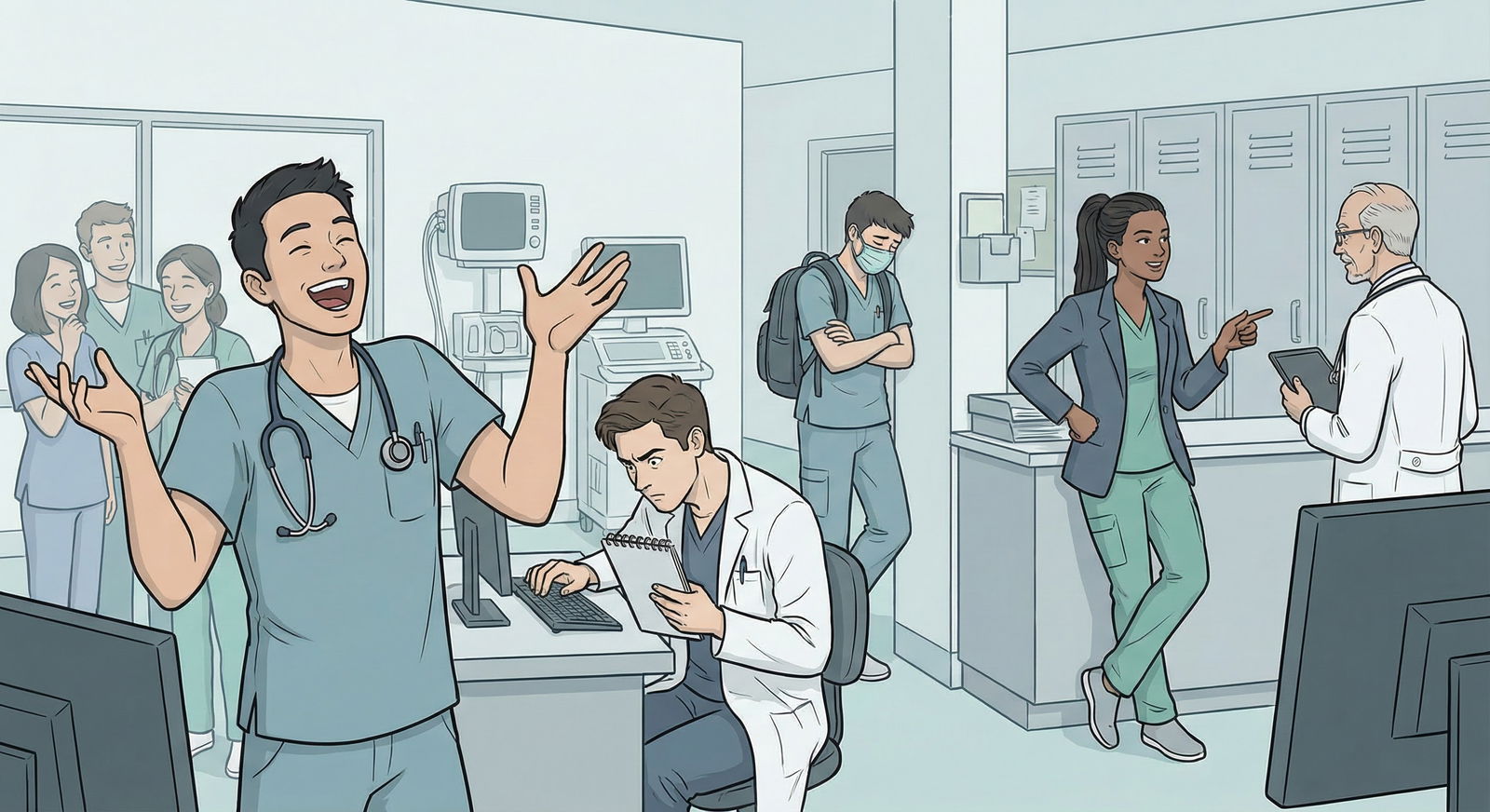
Humor at this stage should feel invisible. It isn't a performance; it is genuine situational awareness. You know when the attending is open to a light comment during morning sign-out, and you know when a unstable patient requires absolute, dead-pan seriousness.
Your Final Comedic Framework:
- Timing: Never when a computer screen is actively being typed on with urgency, never during patient encounters, and never during active codes.
- Audience: Tailored precisely to who is standing in the circle. Attending present? High filter. Just you and the intern running to evaluate a consult? Lower filter, higher empathy/supportive humor.
- Emotional Intelligence: If the resident slept two hours last night, they don't want your witty banter. They want you to pull the lab values before rounds start. Helpfulness is always funnier than a joke.
Review your weekly humor log. Drop any ambitions of being the team entertainer. Your goal on rotations isn't to be a stand-up comedian, it's to be a reliable, observant, empathetic future physician who is easy to spend a twelve-hour shift with. Secure that High Pass first. The laughs will follow naturally.
Key Takeaways
- Humor is a lagging indicator of integration: Never force comedic rapport in Week 1. Earn clinical trust first, banter second.
- Self-deprecation is your only safe vehicle: As a junior trainee, punch only at yourself, and only regarding your own learning curve.
- Specialty context dictates everything: Calibrate your tone to the ward you are walking on, what works in the Trauma Bay will fail catastrophically in Pediatric Oncology.