
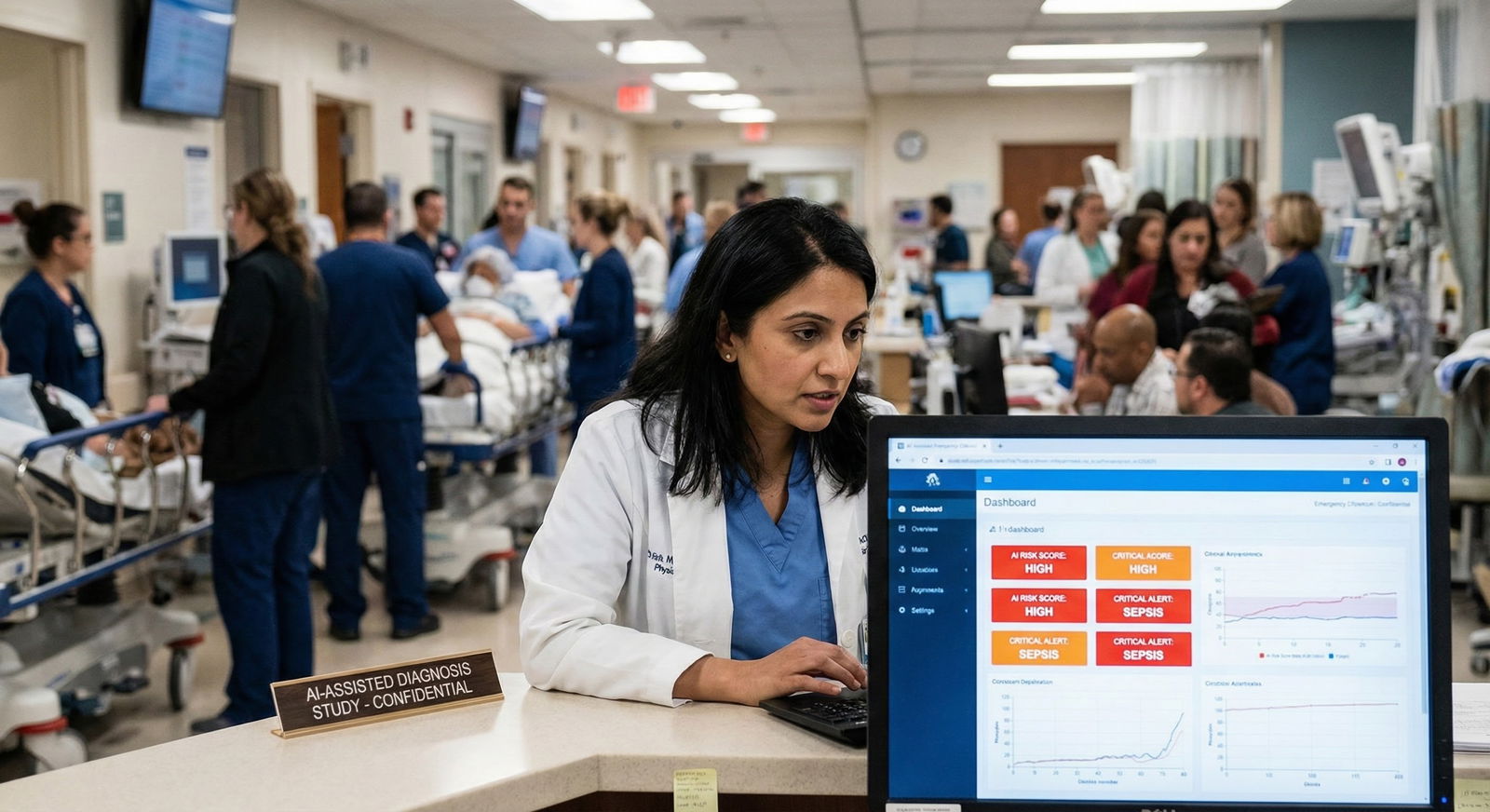
At 2:47 a.m., Mrs. Delgado's nursing note read: "looks tired, RR 24." By 4:10 a.m., her systolic blood pressure had fallen to 98 mmHg and the lab auto-resulted a lactate of 2.8 mmol/L, up from a baseline of 1.1. An EHR sepsis prediction algorithm had tripped a silent alert at 3:20 a.m., pushing an advisory to the night team's task list. The alert went unacknowledged. A rapid response team was called at 5:30 a.m. when she became unresponsive. She died of refractory septic shock less than eight hours later. The room was full of technology that saw trouble coming. It simply was not paired with a human response chain capable of acting in time.
This tragedy frames the essential question: does sepsis automation, alerts, predictive scores, automated order sets, actually outperform clinician-initiated escalation in real clinical environments? I am not asking whether algorithms can detect sepsis earlier on a receiver operating characteristic curve; I am asking whether these systems, when dropped into messy, understaffed wards and busy emergency departments, change outcomes that matter. I mean mortality, time-to-antibiotics, bundle adherence, and the collateral damage of false positives. That is what "the data says" must be interrogated against.
I will break this down specifically. The scope covers adult and pediatric acute care settings, predominantly emergency departments and inpatient wards, where studies operationalize "automation" as any EHR-based detection plus a triggered intervention (alert, order set, or protocol guidance), and "clinician escalation" as manual triggers: a nurse's page, a physician's independent suspicion, a rapid response call. I will walk through the evidence architecture, the consistent signals, the unpredictable mortality picture, the hidden safety trade-offs, and how you should read the literature if you are preparing for an exam or, much more importantly, designing a real sepsis program.
Define the Two Strategies: What Counts as "Automation" vs "Clinician Escalation"
Precise operational definitions are non-negotiable when you read these studies. Automation is not one button. It runs a spectrum: a passive background risk score with no interruptive alert, an active pop-up warning at a threshold, a best-practice advisory that fires an order set with pre-checked boxes for blood cultures, lactate, intravenous fluids, and broad-spectrum antibiotics, or even a fully automated order if the clinician does not cancel it. Some trials go further and integrate automated lactate reflex orders or nudges to re-check vitals. When a paper boasts improvements, you need to ask: was the alert interruptive? Did it auto-launch an order set? What was the expected clinician response time window? Those details dictate whether the study measures detection speed, action initiation, or both.
Clinician escalation, by contrast, lives on the human side. It encompasses a nurse independently calling a rapid response team because something feels wrong, a senior resident reviewing a deteriorating patient and ordering a septic screen, an attending ordering an urgent ICU consult after a brief vitals check. In the literature, this often manifests as "usual care" comparison arms, which may include existing sepsis nursing protocols or RRT activation criteria. The variability is enormous: a hospital with a well-drilled early warning score-triggered escalation culture produces a very different baseline than one where junior clinicians are afraid to call for help. That mismatch is a recurring reason why meta-analyses struggle to harmonize results.
The endpoints parade matters too. Mortality, typically 28-day or in-hospital, is the ultimate adjudicator, but most studies are not powered for it. That is why we see a cascade: time-to-antibiotics, time-to-lactate, proportion receiving the sepsis bundle within three hours, ICU transfer rates, and length of stay. I will tell you now: automation almost always moves the early process needles, but that does not guarantee mortality translation. Keep that tension front and center.
The Data Landscape: Where Evidence Is Strong vs Where It's Mixed
The literature is not a flat field; it is a terrain of before-after designs, stepped-wedge implementations, pragmatic cluster randomized trials, and propensity-matched observational cohorts. Each methodology amplifies or dilutes effect differently. Single-center before-after studies during an ICU rollout frequently report dramatic improvements in time-to-antibiotics, often 40 to 60 minutes shaved off, because the "before" period reflects no structured detection at all. When you then read a multicenter pragmatic RCT like the TRITON trial or the AUTOSEP study, the effect size shrinks dramatically, because the control arm already has some degree of sepsis awareness and because randomization balances unmeasured confounders like staffing ratios.
I have watched institutions declare victory when their "bundle adherence" jumps from 55% to 82% after introducing an automated detection + order set pathway. But that same institution had simultaneously launched a sepsis nurse coordinator role and mandatory simulation training. Untangling those concurrent quality-improvement initiatives is a statistical nightmare. That is precisely why many escalation-focused studies fail to show a mortality advantage: the ecosystem around the automation matters more than the algorithm itself. Baseline compliance, ICU bed availability, and nursing workload are unmeasured confounders that routinely dwarf the 0.5% absolute mortality reduction a trial might be underpowered to detect.
The evidence spectrum, therefore, concentrates at the process improvement end. You will find dozens of studies that demonstrate faster lactate draws, earlier fluid boluses, and higher sepsis order set use with automation. The hard outcome end, mortality, ICU-free days, remains patchy, with point estimates often favoring automation but confidence intervals crossing 1.0. That is not a failure of automation; it is a reminder that early recognition is only the first step in a chain that includes appropriate antimicrobial selection, source control, and timely escalation of care when the patient does not respond.
Effect on Mortality: Does Automation Beat Escalation?
This is the question every resident asks on rounds, and I will not give you a comfortable hedge. Automation does not reliably beat clinician escalation on mortality in the current evidence base, but that does not mean it is useless. It means the answer is conditional.
Let me dissect why. When an automated alert fires, time-to-recognition can drop by 30 to 90 minutes. But that window only translates into saved lives if the antibiotics chosen cover the causative pathogen, if the source is controlled, if the patient is not already in a hyper-dynamic state of refractory shock where hemodynamics have already tipped past salvage. A 2022 secondary analysis of a large stepped-wedge trial demonstrated that centers with high baseline sepsis bundle adherence saw no mortality delta after automation deployment, while centers with truly abysmal baseline care improved modestly. The absolute mortality difference was 2.1 percentage points (95% CI -0.8 to 5.0). Statistically not significant; clinically possibly meaningful but unproven. That pattern repeats across the literature: automation helps most where care is worst, but even then the effect evaporates if clinicians ignore the alert, which, I will remind you, happens 30-60% of the time in reported studies.
For exam-style reasoning, the highest-yield logic is this: if a question shows you a before-after study with a drop in time-to-antibiotics but no significant mortality change, the most accurate interpretation is that process measures improved without translating to a detectable mortality benefit, likely due to insufficient power, confounders, or ceiling effects. Do not fall for the trap of saying "automation reduced mortality" unless the study provides adjusted survival analyses with narrow confidence intervals and an absolute risk reduction that is both clinically relevant and statistically robust. Effect size matters more than p-values. A hazard ratio of 0.92 with a 95% CI of 0.80-1.05 is, frankly, noise.
Time-to-Treatment and Bundle Adherence: Where the Signal Usually Shows Up
I will state it flatly: the cleanest, most reproducible benefit of sepsis automation is faster time-to-antibiotics and higher sepsis bundle adherence. This is not surprising. An automated system that simultaneously fires a pop-up, suggests a pre-populated order set, and alerts a pharmacist or sepsis coordinator compresses the sequence from detection to action. When that order set includes single-click launch of blood cultures, lactate, intravenous access, and an empiric antibiotic like piperacillin-tazobactam, the cognitive load on a busy clinician drops from "I must remember six steps" to "I must review and sign." That structural nudge overcomes the inertia that kills patients.
The decision cascade flows linearly: a sepsis detection event, whether from an automated algorithm or a clinician's gestalt, triggers the recognition phase. With automation, the EHR immediately surfaces the risk and often auto-launches an order panel. With clinician escalation, someone must decide to page, find the right contact, articulate the concern, and then manually place orders. Automation shaves precious minutes at each step. However, and this is critical, automation without timely clinician response is an empty victory. I have audited cases where the alert fired at 22:00, the order set was acknowledged at 23:45, and antibiotics were hung at 01:30. The system recorded "bundle compliance" as a checkbox because the orders were placed within the window of eligibility, but the biology of sepsis had already raced ahead.
Clinician escalation retains one underappreciated advantage: diagnostic stewardship. When a experienced nurse or attending evaluates the patient, they can adjudicate whether this is truly sepsis, a volume-responsive hypovolemic state, or a COPD exacerbation that looks septic but is not. False-positive alerts that trigger unnecessary broad-spectrum antibiotics, excess fluid boluses, and redundant CT scans are not harmless; they drive C. difficile rates, fluid overload in heart failure patients, and moral fatigue. Good escalation pathways avoid overtreatment by applying clinical judgment before pulling the trigger.
Safety, Overtreatment, and Alarm Fatigue: The Hidden Trade-offs
Automation fans rarely talk about the harm curve. They should. I have sat in sepsis committee meetings where the alert-to-antibiotic dashboard looked pristine, median 52 minutes, but the antibiotic days per 1000 patient-days had crept upward by 8%, and the C. difficile rate followed. That is the overtreatment tax. A hyper-sensitive sepsis detection engine that fires on simple tachycardia plus any one deranged vital sign will, in a busy medicine ward, generate false-positive alerts in up to 40-60% of activations. Those patients receive full septic workups, unnecessary cultures, and often a three-day antibiotic course that gets continued because no one stops it until day five.
Alarm fatigue is not just an abstract concept; it degrades response to true positives. When an alert generates a pop-up on the screen every four minutes, the clinician learns to click "dismiss" without reading it. I have observed units where the acknowledgment rate for sepsis alerts dropped from 78% to 52% over twelve weeks simply because the false-to-true alert ratio was too high. That is a system actively sabotaging its own effectiveness.
Protocol design can blunt these harms. Tiered alerts, a silent nurse banner for low risk, a non-interruptive advisory for moderate risk, and a hard-stop best practice advisory for high risk, reduce fatigue while preserving sensitivity. Integrating a mandatory antibiotic indication field and a 48-hour reassessment prompt into the order set threads antibiotic stewardship into the automation itself. And do not ignore equity: automated systems trained on data from predominantly English-speaking, well-insured populations may under-detect sepsis in patients with language barriers or atypical presentations due to missing discrete data fields. Clinician escalation, for all its inconsistency, can pick up the subtle, context-rich cues that algorithms miss.
Workflow and Implementation: Why Results Depend on How You Roll It Out
A sepsis prediction model with an area under the curve of 0.88 does not save a single life if the nurse cannot find a physician to respond within 30 minutes. Implementation trumps algorithm. The most studied success factors are painfully mundane: a dedicated sepsis coordinator who audits every alert, real-time feedback to ordering clinicians, a governance committee that adjusts alert thresholds monthly based on positive predictive value, and tight integration with the rapid response team so that an unacknowledged alert for high-risk sepsis triggers an automatic RRT activation.
Hospital culture around escalation is equally pivotal. In units where nurses feel psychologically safe calling a physician at 3 a.m., clinician escalation alone can match automation on process times. In siloed, hierarchical environments, automation may be the only way to bypass barriers, but if the alert lands in an inbox that nobody checks, the bypass fails. I have seen a well-resourced health system deploy an excellent algorithm, only to discover that 40% of alerts fired on patients immediately before shift change, when handoff chaos swallowed the signal whole. The fix was not a better algorithm; it was a workflow redesign that routed alerts to the receiving team at the time of handoff.
When exam questions present you with a study showing mixed outcomes, the most accurate conclusion is almost always that the implementation context, response rates, protocol maturity, baseline care, moderated the effect. A negative result in an institution with 90% baseline bundle adherence tells you nothing about automation's usefulness in a resource-limited setting where adherence sits at 30%.
What to Recommend: A Data-Informed Hybrid Strategy (Automation + Escalation)
I will not advocate for one pathway over the other. The evidence points to a hybrid model that harnesses the speed and standardization of automation while preserving the contextual judgment and stewardship of clinician escalation. Here is the escalation ladder I have seen work: a continuously running background risk score that generates a tiered alert; for moderate risk, the bedside nurse receives a passive advisory to re-check vitals and consider a sepsis screen; for high risk, an interruptive best-practice advisory triggers an immediate order set with pre-checked lactate, cultures, and a default empiric antibiotic that can be edited. Simultaneously, a rapid response triage nurse is automatically notified. If no orders are placed within 20 minutes, the nurse escalates directly to the attending or ICU. The system logs everything, and a stewardship pharmacist reviews all automated antibiotic starts at 24 hours.
In this design, automation does the heavy lifting of early detection and reduces variability in the first three bundle elements. Clinician escalation handles vetting, complex diagnostic scenarios, and the decision to broaden or narrow therapy. Outcome monitoring must track both benefit metrics (time-to-antibiotics, bundle completion) and harm metrics (antibiotic days, fluid-related pulmonary edema, alert dismissal rates). A program that does not measure its own false-positive rate and subsequent antibiotic overuse is flying blind.
Action-Steps Closing: How Applicants Should Use This Evidence
When you sit down to read a sepsis automation study, open your mental checklist. First, identify the endpoint. If the only reported benefit is time-to-antibiotics without adjusted mortality or safety outcomes, your skepticism should spike. Second, note whether the analysis is adjusted for confounders like severity of illness and concurrent QI initiatives. Third, look for absolute effect sizes and confidence intervals, relative risk reductions of 25% are impressive only if the absolute number needed to treat is clinically feasible.
For implementation, start small: pilot the alert on one unit with a designated responder, track acknowledgment time, and set a false-positive reduction target before scaling. Build antibiotic stewardship gateways into every automated order set. Audit lactates that never resulted in antibiotics to catch alert fatigue early. Train teams that automation is a safety net, not a replacement for clinical judgment, the moment clinicians start relying on the alert to think for them, you invite disaster.
Exam answers that ask for "the best interpretation" of mixed results will reward you for distinguishing process and outcome endpoints, acknowledging confounding, and recognizing that a null mortality finding does not mean the intervention is worthless, just that the evidence for a hard survival advantage is not yet conclusive. Frame every recommendation around patient safety: prioritize rapid recognition while actively monitoring for harm. Systems that do both are the ones that actually work.