
Physicians now spend an extraordinary amount of time in the EHR outside scheduled clinic hours. Depending on specialty and workflow study, after-hours charting often adds several hours each week, and for many doctors it is much worse than that. The ugly part is not just the fatigue. It is that this labor often never shows up on the dashboard that leadership uses to judge productivity. Your RVUs are counted. Your pajama-time charting usually is not.
That mismatch creates a quiet leak. You feel busy because you are busy. You are working at night, clearing messages, finishing notes, fixing orders, chasing documentation. But RVU production does not reward effort. It rewards billable encounters, accurate coding, timely completion, and systems that let you repeat that process efficiently. If your EHR work spills into the evening, it can suppress all four.
I have seen this pattern repeatedly: the physician who says, “I am doing everything I can and still not hitting target,” while spending ninety minutes every night cleaning up work that should have been supported, structured, or captured better during the day. That is not grit. That is revenue erosion disguised as professionalism.
This article breaks down seven specific ways after-hours EHR time can quietly reduce RVUs, even when the work feels clinically necessary and even when you are technically seeing the same patients.
This article is for educational purposes only and is not financial, legal, tax, coding, billing, or employment-contract advice. RVU methodology, payer rules, digital billing rules, employment arrangements, and documentation requirements vary by organization, specialty, and payer, so use this as a general framework and confirm specifics with qualified professionals at your institution.
1) After-hours documentation steals from same-day billable opportunity
The first mechanism is simple and badly underestimated: time is finite, and charting at night usually means your daytime workflow is already overloaded. That overload costs visit capacity.
Every minute you spend catching up later is a minute that was not available earlier for one of three high-yield activities:
- one more patient visit
- one urgent add-on
- one clinically meaningful inbox item converted into a scheduled encounter
That is opportunity cost. Basic business logic. Strangely easy for physicians to ignore when the work is hidden behind a laptop at 9:30 p.m.
If you regularly leave clinic with six unfinished notes, your schedule may look “full,” but your operating speed is slower than it appears. You are functionally producing below capacity. Not because you are lazy. Because your workflow is borrowing from the evening to keep the day from collapsing. Over time, that means fewer same-day add-ons, fewer converted telehealth touches, fewer procedures squeezed in, and less ability to absorb profitable clinical demand.
Here is the trap. Most physicians do not feel the RVU loss in one dramatic event. They feel it as chronic drag. The patient who could have been seen today gets moved to next week. The refill issue that could have become a brief follow-up remains a non-billable message thread. The “quick double book” never happens because you are already running behind. Those are small losses. They stack.
On exams, this is the kind of concept hidden inside a straightforward question stem: the stated workload is not the whole story; the constrained resource is time allocation. Same in practice. If your charting routinely migrates into the evening, your daytime revenue engine is underperforming.
A lot of doctors push back here and say, “But I still saw all my scheduled patients.” Fine. That is not the right benchmark. The right benchmark is whether your current workflow lets you capture the full billable value of your demand without exporting clerical work into unpaid personal time. If the answer is no, your RVUs are leaking before coding even starts.
2) Delayed documentation weakens coding accuracy and level capture
This is where the problem becomes less visible and more expensive.
When you document hours after the encounter, your note quality almost always drops. Not because you are careless. Because memory decays fast, especially after a full clinic session of similar complaints, repeated refill issues, and overlapping chronic disease management. By evening, the subtle details that support higher-level coding are the first things to disappear.
What gets lost?
- the precise risk discussion in the MDM
- the failed prior treatment detail that supports complexity
- the medication management nuance
- the reason a workup was deferred
- the exact procedure specifics
- the true decision burden of the encounter
Instead, the note becomes generic. “Discussed options.” “Stable.” “Continue current plan.” That language feels harmless. It is terrible for code support.
For many specialties, especially outpatient medicine where MDM drives E/M coding, that specificity matters. A legitimately complex visit can collapse into a lower-level bill if the note does not clearly support the work performed. I have seen physicians manage multiple unstable issues, reconcile meds, review outside records, make high-stakes decisions, and then document it later in a vague template that reads like a routine follow-up. That is self-inflicted downcoding.
The second bad habit tied to delayed charting is copy-forward dependence. When you are tired and behind, copying yesterday’s structure feels efficient. It is not. It smooths away the sharp edges of today’s clinical thinking. It also creates notes that look polished but fail to show why this encounter deserved higher RVU capture than the last one.
The point is blunt: if you did high-level work but documented low-resolution thinking, the billing system only sees the low-resolution version. It does not reward what you meant. It rewards what you proved.
3) End-of-day EHR fatigue increases note errors that trigger rework
Night charting is not just slower. It is sloppier.
By the end of clinic, cognitive fatigue is real. Decision fatigue is real. The part of your brain that catches inconsistencies and missing details is weaker. That is when bad notes get signed, orders are left dangling, attestations are missed, diagnoses do not match plans, and templated exams sneak into charts where they do not belong.
Common late-night error patterns are painfully predictable:
- template mismatch: the note says annual wellness, the plan reads acute sinusitis
- problem list bloat: twelve irrelevant diagnoses clouding the actual visit
- assessment-plan disconnect: diabetes listed, but no medication decision or monitoring logic documented
- unsigned procedures or attestations
- copied normal exam language that contradicts the history or chief complaint
Each one creates rework. Rework is RVU poison.
Why? Because reopening a chart, answering coder queries, correcting note elements, dealing with claim holds, and cleaning up documentation defects all consume physician time without generating new billable work. This is the bureaucratic version of hemorrhage. Slow, annoying, expensive.
I have watched physicians spend Friday night “finishing notes,” then spend Monday morning fixing the same notes after coding questions land in the inbox. That is not completion. That is duplication wearing a lab coat.
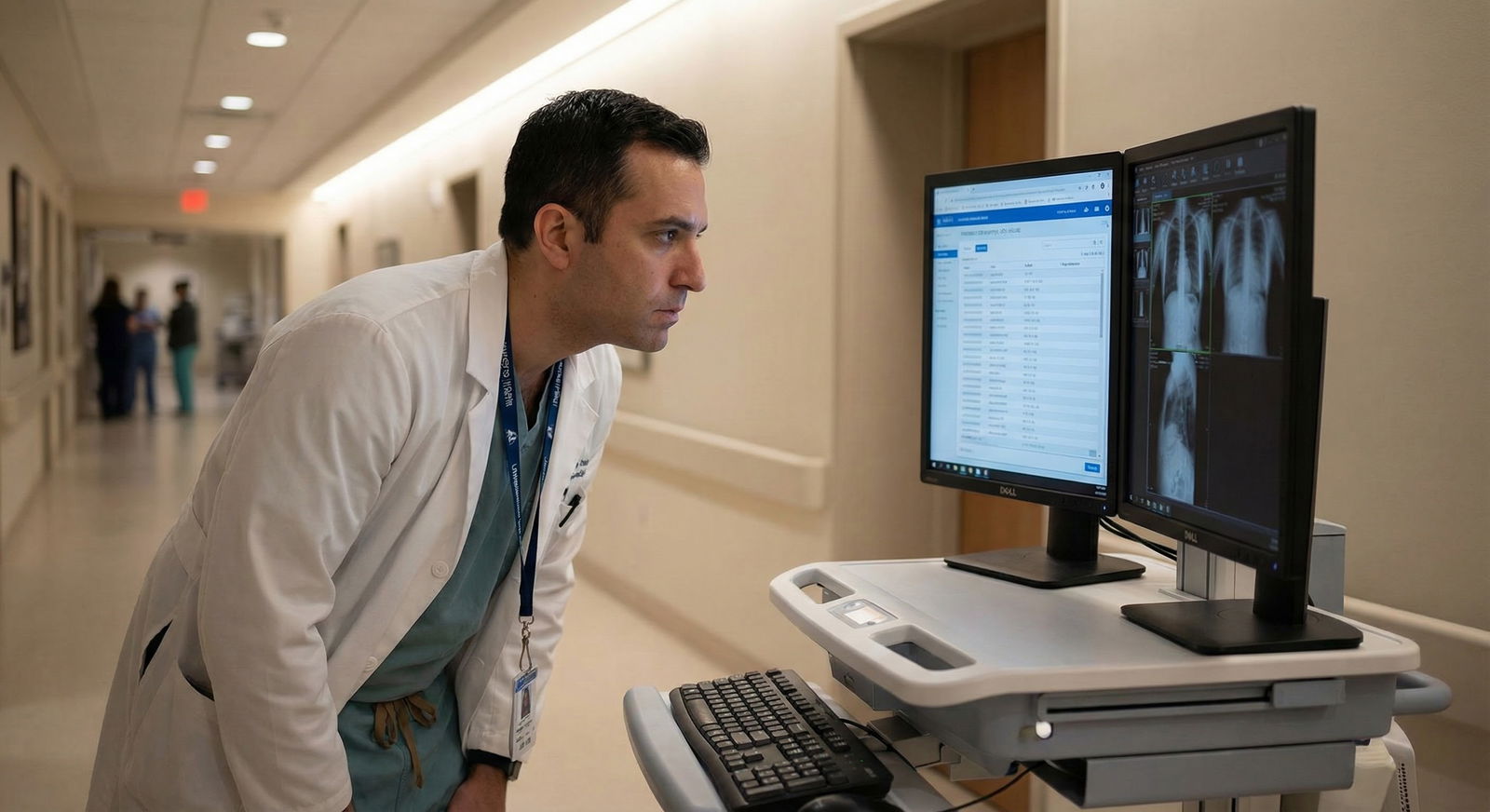
The real issue is not that errors happen. They always will. The issue is that after-hours EHR work increases the exact kind of preventable errors that steal time from future RVU-generating care.
4) After-hours inbox work blurs visit boundaries and reduces refillable revenue moments
This one frustrates me because it is so normalized.
Physicians answer portal messages at night, handle refill debates, explain lab results, troubleshoot side effects, chase prior authorization details, and resolve issues that have clearly outgrown the original visit. They do it because it feels faster, cleaner, more compassionate. Sometimes it is. It is also often non-billable and strategically terrible.
A portal message saying, “My blood pressure is still uncontrolled despite the new dose, and I am dizzy,” is not clerical maintenance. That is clinical management. A refill request that turns into medication adjustment, problem reassessment, and counseling is not a courtesy click. It is work. If handled informally at 10 p.m., it often becomes free labor. If routed properly during the day, it may justify a billable visit, a structured digital service depending on rules and workflow, or at minimum a team-mediated pathway that protects physician time.
That does not mean every message should become a visit. That would be absurd and patient-hostile. It means you should stop casually donating complex care through fragmented midnight inbox threads.
The practical principle is simple: triage after-hours inbox issues into the right lane.
- pure administrative issue: delegate
- simple refill with protocol support: route through staff process
- clinically evolving issue: schedule
- complex discussion likely to require judgment: convert to encounter structure
Doctors who do all of this informally at night become their own unpaid call center. Then they wonder why RVU performance lags despite endless effort. Because effort was spent outside billable architecture. That is why.
5) Late-night charting worsens note templating and copy-forward bloat
Exhaustion makes people lazy. Not morally lazy. Operationally lazy. You stop writing clean notes and start manufacturing bulky ones.
That is when templates metastasize. Entire review-of-systems blocks auto-populate. Normal exam language appears everywhere. Last month’s assessment gets copied forward with minimal editing. The note becomes longer, not better.
Here is the coder and payer problem: bloated notes hide the exact elements that matter. Medical necessity, decision complexity, risk, data review, procedure detail. Those should be obvious. Instead they get buried under irrelevant text. A note can look enormous and still support billing badly.
And there is a second-order effect people miss: bloated notes make future chart review slower. Tomorrow’s visit starts with extra scrolling. Medication changes are harder to find. Prior reasoning is buried. So one bad note today slows the next note tomorrow. Compounding drag. That is how pajama-time becomes a permanent tax on productivity.
6) After-hours EHR time contributes to burnout, which depresses next-day productivity
Burnout is not just a wellness buzzword. It is a throughput problem.
If you spend your evening doing clerical cleanup, you arrive the next morning with less cognitive reserve. Room turnover gets slower. You pre-chart less effectively. You are less decisive. You tolerate chart clutter instead of fixing it. You skip the extra sentence in the MDM that would support the proper code level. You avoid squeezing in the urgent add-on because you are already running on fumes.
That next-day RVU hit is real. It just does not show up with a label attached.
I have seen burned-out physicians become oddly passive around coding and scheduling. They stop pushing for appropriate charge capture. They stop structuring messages into visits. They stop documenting add-on work cleanly. Not because they do not know better. Because fatigue makes every extra step feel impossible.

This matters because the damage is delayed. Leaders may look only at daily RVU totals and miss the mechanism. But if your evenings are consumed by EHR work, tomorrow’s clinic is starting with depleted bandwidth. That is a production issue, not merely a morale issue.
7) Poor boundary-setting leads to unpaid work that crowds out RVU-generating systems
This is the most important point in the article, because it explains why the problem persists.
If you keep absorbing the EHR burden personally, your organization has no reason to fix the system. Your unpaid after-hours labor becomes the patch. That is bad for you and financially dumb for the practice.
Hard truth: many groups normalize inefficiency because conscientious physicians keep rescuing broken workflows at home. Instead of investing in scribes, cleaner templates, stronger MA protocols, pre-charting support, better routing rules, or note optimization, the system quietly relies on your evening hours. Leadership may not even realize it. Or worse, they do realize it and have learned they can get away with it.
That habit crowds out high-yield solutions such as:
- hard chart-close expectations with protected workflow redesign
- team-based documentation support
- pre-visit planning
- inbox routing protocols
- procedure and MDM note skeletons
- staff escalation ladders for messages that should become visits
Your EHR habits do not just affect your evenings. They define your RVU ceiling. If your default solution is “I will finish it later tonight,” you are capping productivity, tolerating bad systems, and teaching the organization that your personal time is free inventory.
Practical fixes: how to protect RVUs without working nights
You do not solve this by trying harder. You solve it by redesigning the work.
Start with the fixes that reliably move the needle:
- Batch inbox work instead of pecking at messages between patients. Constant inbox switching wrecks visit efficiency.
- Use note skeletons, not bloated templates. Build short structures that force capture of HPI, key data reviewed, risk decisions, and procedure specifics.
- Delegate aggressively and intelligently. Refill protocols, normal result communication, prior auth collection, and scheduling conversion should not all land on you.
- Close documentation loops in the room whenever possible. Even one sentence of real-time MDM is better than a polished but vague paragraph written six hours later.
- Review billing-supporting elements before signing. Did the note show the real complexity? Was medication management explicit? Was data review captured? Was the procedure detail adequate?
- Pre-chart selectively. Not for every patient in a heroic way. For the messy follow-up, the likely medication change, the patient with outside records, the one who always blows up your schedule.
- Set a real daily cutoff. A fake cutoff is useless. Pick a stop time, define what can wait, and build next-day catch-up rules with your team.
My recommendation is blunt: track after-hours EHR time the same way you track clinic volume. If you are spending five, seven, ten hours a week in the system at night, treat that as a measurable productivity leak. Because that is exactly what it is.
Badge-of-honor thinking is nonsense here. The goal is not to become better at suffering through the EHR. The goal is to stop letting invisible clerical work suppress visible clinical productivity.
Protect your evenings. Yes. But also protect your RVUs. The two are linked much more tightly than most dashboards admit.