
Quality dashboards do not tell you who the good doctors are. They tell you who is good at playing the metrics game.
That’s not just a spicy opinion. That’s where the evidence keeps pointing once you stop reading hospital press releases and start looking at actual data, methodology, and what happens on the ground.
We’ve built an industry around glowing scorecards, “top decile” badges, and green/yellow/red physician performance tiles. Hospital leadership stares at them in conference rooms. Consultants invoice millions to tweak them. But if you think those dashboards meaningfully distinguish a thoughtful, safe, patient-centered clinician from a reckless one, you’re giving them way too much credit.
Let’s pull this apart.
What Dashboards Actually Measure (and What They Don’t)
Start with the basics: almost all physician-level dashboards are built from a narrow slice of the data universe.
Common metrics you see at the individual doctor level:
- 30‑day readmission rates
- Length of stay (LOS)
- Mortality or “observed/expected mortality”
- ED throughput times
- Surgical complication rates
- Patient satisfaction scores (Press Ganey, HCAHPS derivatives)
- Coding patterns: wRVUs, case mix index (CMI), “documentation quality”
Those are mostly administrative data points, not clinical nuance. They’re easy to extract from billing and EHR systems, so they get used. A lot.
What you almost never see on dashboards:
- Diagnostic accuracy over time
- Appropriateness of testing and imaging
- Nuanced risk‑adjusted outcomes at case level
- Long‑term outcomes beyond 30 days
- Quality of patient counseling, shared decision-making
- How often a physician prevents bad outcomes before they become measurable events
So the first myth: “Our dashboards capture overall physician quality.”
No. They capture what is cheap and convenient to measure. That’s a very different thing from “quality.”
The Risk Adjustment Problem: Sick Patients = Bad Scores
Here’s the most predictable pattern I’ve seen in hospital after hospital: the physicians who take the sickest, most complex, or socially vulnerable patients almost always look worse on the dashboard.
Why? Because risk adjustment is not as magical as administrators pretend.
Even well‑designed models using comorbidities, demographics, and prior utilization leave a ton of residual confounding. Now add in the stuff those models never see:
- Health literacy
- Housing instability
- Caregiver support
- Access to medications and follow-up
- Language barriers
- Historical mistrust of the system
Two physicians could practice with equal skill. One works in a suburban clinic with compliant insured patients and strong home support. The other staffs the safety-net hospital, takes every uninsured frequent flyer, and absorbs out-of-network transfers with no background information. Guess whose readmission and mortality rates look better?
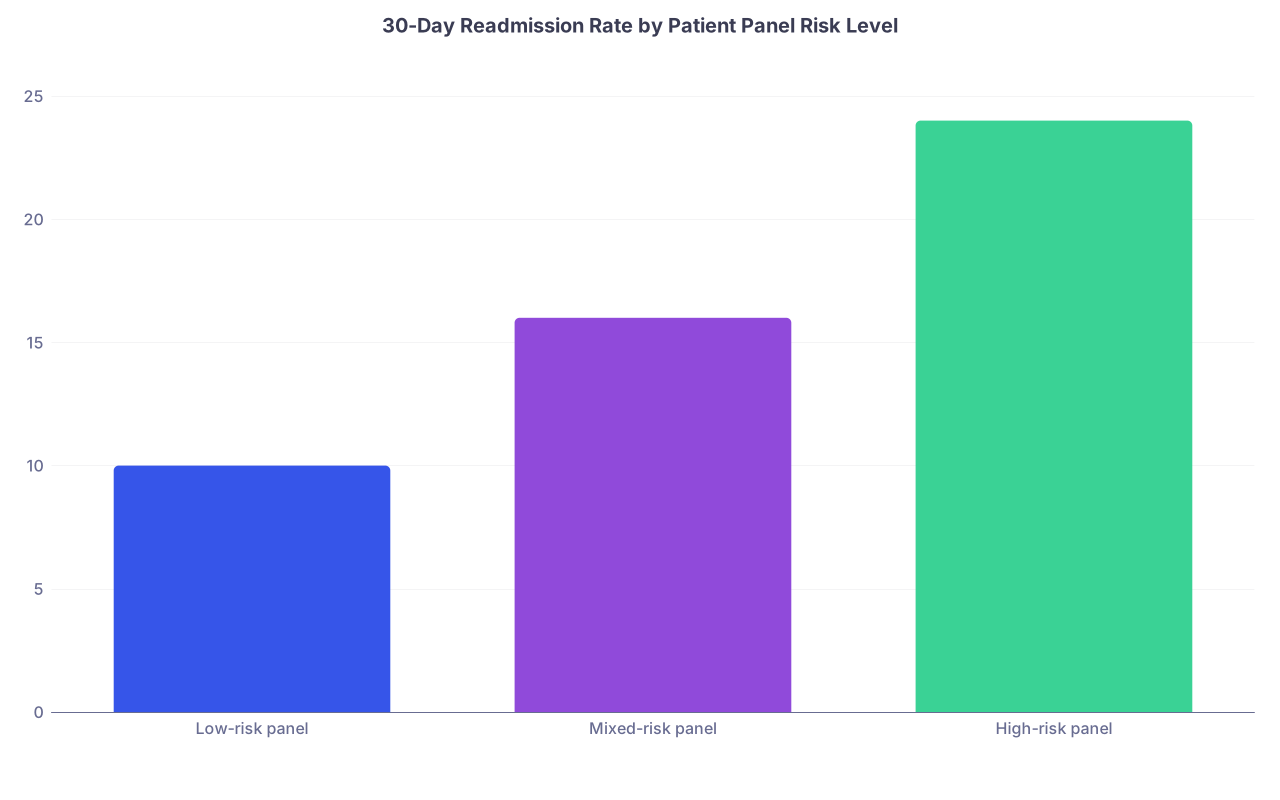
| Category | Value |
|---|---|
| Low-risk panel | 10 |
| Mixed-risk panel | 16 |
| High-risk panel | 24 |
There are published data showing exactly this: “high-performing” hospitals by CMS measures often have very different patient populations than “low-performing” ones, and penalizing the latter can worsen disparities. The same distortion happens when you compress that noise down to a single doctor tile on a dashboard.
So when you’re told, “Dr. X has higher readmissions than her peers,” the honest translation is: “We tried to adjust for risk with imperfect tools, and then we blamed the clinician for what’s left over.”
The Data Are Dirty. Much Dirtier Than Anyone Admits.
Dashboards rest on the assumption that the underlying data are clean and correctly attributed.
They aren’t.
EHR and billing data are full of landmines:
- Attribution errors: the “attending of record” isn’t always the one making the key clinical decisions, especially in teaching hospitals.
- Transfer artifacts: a patient transferred in septic from another facility dies 24 hours later, and your mortality metric dings you.
- Documentation bias: the physician who documents every comorbidity looks “sicker case mix, good outcomes.” The minimalist note writer looks like “low risk, average outcomes.” Same patients, different paper trail.
- Coding drift: hospitals under financial pressure push for more aggressive coding—this inflates expected mortality and readmission risk, making outcomes look better without changing care one bit.
I’ve watched a hospital’s “risk-adjusted mortality” magically improve after an intensive CDI (clinical documentation improvement) campaign, with zero meaningful change in actual care processes. The dashboard turned greener. The medicine did not.
| Scenario | Dashboard Result |
|---|---|
| Minimal comorbidity coding, stable care | Higher observed/expected |
| Aggressive coding, stable care | Lower observed/expected |
| New CDI program, stable outcomes | Apparent “quality improvement” |
| Safety-net population, limited coding | Worse metrics vs peers |
If your “quality” signal changes more with documentation practice than with clinical practice, it is not a reliable measure of doctor quality.
Good at Metrics vs Good at Medicine
Here’s the part nobody top‑down wants to talk about: once you tie dashboards to compensation, contracts, or public shaming, you’re no longer just “measuring quality.” You’re shaping behavior. Sometimes in stupid ways.
I’ve seen:
- Physicians avoiding high‑risk patients near the end of the month so their mortality stats stay clean.
- Surgeons steering complex cases to colleagues who “don’t care about their numbers” or who aren’t tracked as tightly.
- ED docs delaying admissions to game “observation vs inpatient” metrics, making LOS look prettier but harming throughput.
- Overuse of home health, PT/OT, and SNF referrals not because patients truly needed them, but because “it helps our readmission rate.”
That’s not hypothetical. Once you link bonuses to things like “top quartile readmissions” and “mortality index,” people start behaving like they’re in a video game trying to avoid penalties.
Some metrics align with good care (hand hygiene, timely antibiotics, vaccination rates). Others create conflicts:
- Short LOS vs adequate stabilization and patient education
- “No pain” satisfaction scores vs responsible opioid prescribing
- High productivity (wRVUs) vs time spent on complex counseling
The dashboards don’t care. They flatten all that nuance into green vs red.
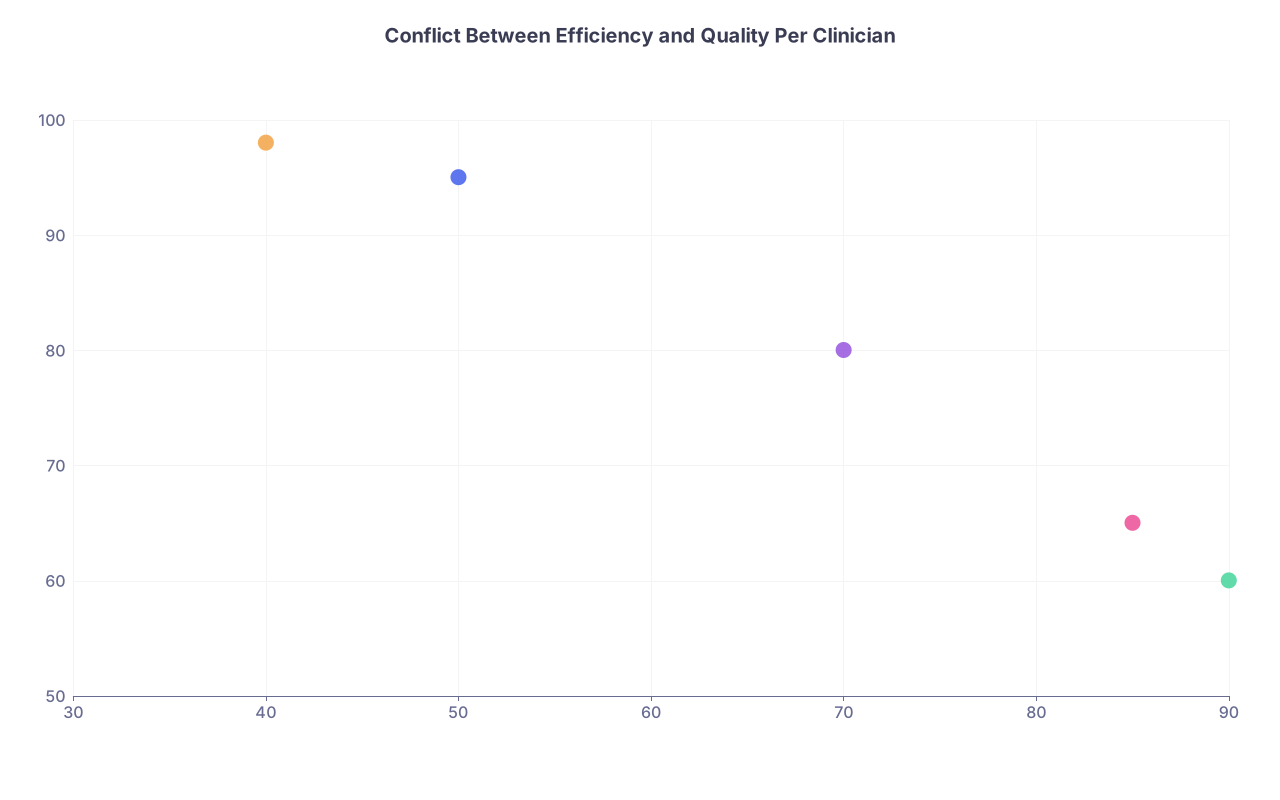
| Category | Value |
|---|---|
| Clinician A | 50,95 |
| Clinician B | 70,80 |
| Clinician C | 90,60 |
| Clinician D | 40,98 |
| Clinician E | 85,65 |
(Example: x-axis = relative productivity, y-axis = peer-rated clinical quality. The high-volume “star” is not always the high-quality clinician.)
A physician’ ability to “meet dashboard targets” is partly a function of case mix and support systems. But it’s also a function of how aggressively they game or prioritize metrics. That’s not the same thing as being a good doctor.
Patient Satisfaction: The Noisy, Weaponized Metric
Let’s address the sacred cow: patient satisfaction.
Hospitals love putting little smiley‑face dashboards next to your name. “Top 10% in patient satisfaction!” “Needs improvement.” It looks very scientific. Until you actually read the literature.
Press Ganey–style scores:
- Are heavily influenced by nonclinical factors: parking, food, wait times, decor.
- Are biased by patient characteristics (race, gender, age).
- Penalize clinicians who set limits or deliver unwelcome truths (e.g., not prescribing antibiotics or opioids, refusing unnecessary imaging).
- Show weak or inconsistent correlation with objective outcomes like mortality or complication rates.
Studies in primary care and EDs have even shown higher satisfaction being associated with higher healthcare utilization and, in some settings, higher mortality. Why? Because “satisfied” often means “I got what I asked for,” not “I received evidence-based care.”
So when an internist tells a patient with a viral URI, “You don’t need antibiotics,” that’s good medicine. When another writes the Z‑Pak to keep the peace and get a 5‑star review, that’s bad medicine. The dashboard might reward the second physician.
Dashboards that elevate satisfaction scores as equal to or above safety and appropriateness are, bluntly, incentivizing pandering over professionalism.
The Time Horizon Problem: Good Medicine Looks Bad Short-Term
A lot of physician quality lives on time scales that dashboards don’t care about.
Most hospital dashboards live in a 7‑, 30‑, or 90‑day world. That’s convenient for quarterly reports and CMS penalties. It’s horrible for evaluating things like:
- Chronic disease management decisions that pay off in years
- Conservative management that avoids unnecessary interventions
- Honest prognostic discussions that lead to hospice rather than futile ICU admissions
The hospitalist who pressures every frail 88‑year‑old into full‑court press status may “save” more lives at 30 days. The colleague who has a hard, honest Goals of Care conversation and transitions to comfort measures may show “worse” mortality numbers in the short term. One has given the patient a higher chance at aggressive, burdensome care with complications. The other has likely improved quality of life. Guess which color tile each gets.
Short‑horizon metrics systematically undervalue thoughtful, long-view medicine.
Post-Residency Reality: Dashboards in the Job Market
Let’s talk about you, post‑residency or early attending, staring down contracts and job offers.
Here’s the uncomfortable truth: in many systems, your raise, contract renewal, or even job security will be tied to performance on dashboards that are:
- Only loosely correlated with actual quality
- Heavily influenced by system factors you don’t control (bed availability, staffing, community resources)
- Vulnerable to patient mix and documentation quirks
That does not mean ignore them. That would be career suicide in some places. But do not confuse “I’m green on the dashboard” with “I am a great doctor.” And absolutely do not let a red tile automatically convince you that you’re bad.
Look for specific warning signs in jobs:
- “At-risk” compensation based on poorly risk‑adjusted metrics
- Physician scorecards that are public-shamed in meetings without case review
- Leadership that cites dashboards as the sole source of truth on quality, with zero interest in peer review or qualitative assessment
- Systems that won’t invest in care coordination, social work, or primary care access, but will happily punish you for readmissions

| Step | Description |
|---|---|
| Step 1 | New Attending |
| Step 2 | Dashboard Orientation |
| Step 3 | Pressure to Hit Metrics |
| Step 4 | Moderate Attention |
| Step 5 | Risk Avoidance and Gaming |
| Step 6 | Selective Metric Focus |
| Step 7 | Burnout and Cynicism |
| Step 8 | Mixed Impact on Care |
| Step 9 | Compensation at Risk? |
This is the ecosystem you’re entering. Pretending the dashboards are neutral, objective reality is naive.
When Dashboards Are Actually Useful
They aren’t all garbage. Some uses are genuinely helpful—if you understand the limits.
Dashboards can be useful for:
- Spotting gross outliers that trigger deeper review. If one surgeon’s wound infection rate is triple everyone else’s, that’s worth investigating.
- Monitoring system-level process changes: sepsis bundle compliance, vaccination campaigns, door‑to‑needle times.
- Personal curiosity and reflection, if you combine them with case review instead of obsession over the number.
- Research and quality improvement projects with honest methodology and clinician input.
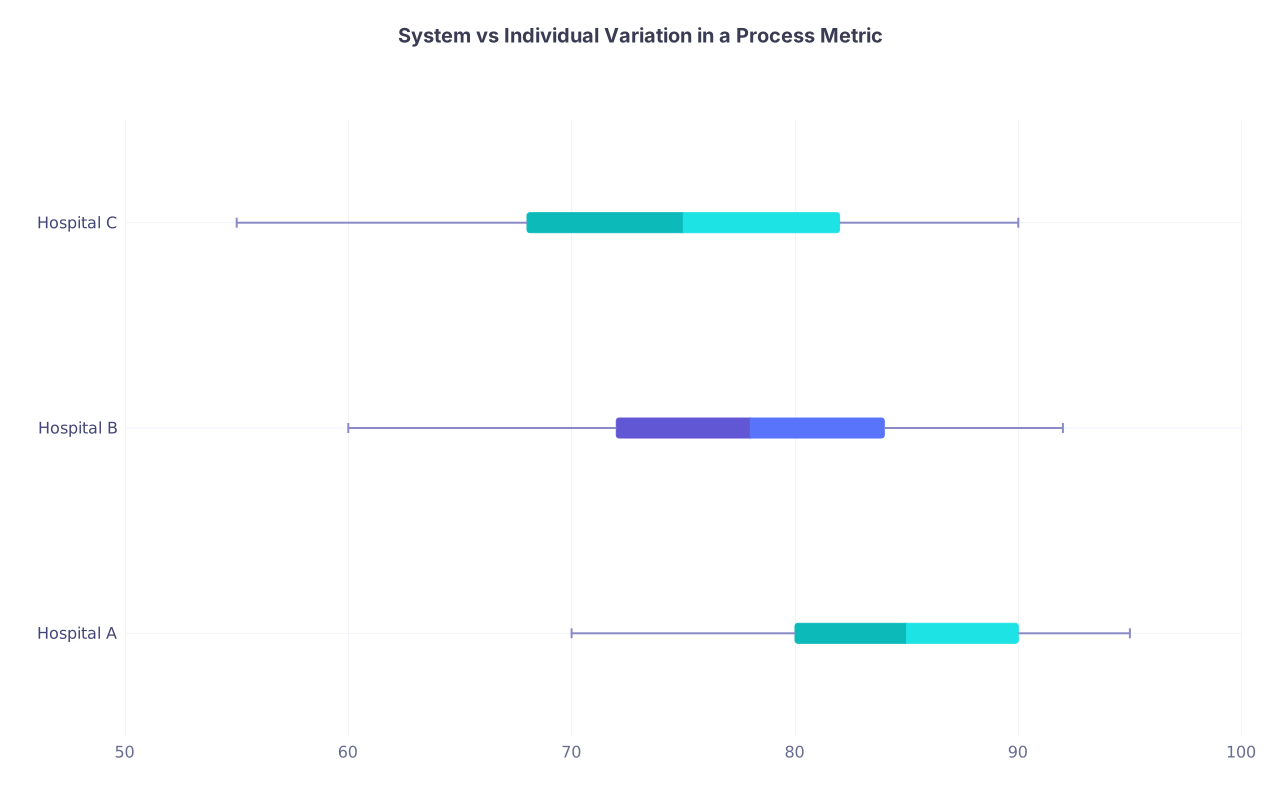
| Category | Min | Q1 | Median | Q3 | Max |
|---|---|---|---|---|---|
| Hospital A | 70 | 80 | 85 | 90 | 95 |
| Hospital B | 60 | 72 | 78 | 84 | 92 |
| Hospital C | 55 | 68 | 75 | 82 | 90 |
See that? Boxplot-level data show system spread and medians. That’s actually useful. A single red dot over your head in a dashboard isn’t.
The key: dashboards are screening tools, not verdicts. They should invite questions: “What’s behind this?” not proclamations: “You are a bad doctor.”
How to Protect Yourself (and Your Patients) in a Dashboard World
You can’t ignore the metrics. You also should not let them define you. A few practical moves:
Demand case mix context. If your panel is safety‑net heavy, insist that leaders compare like with like. If they won’t, that tells you everything you need to know about the culture.
Document truthfully but completely. Not to game the system, but to avoid being punished for incomplete coding. If a patient has severe CHF, CKD, and COPD, get them in the chart accurately. You’re not cheating; you’re preventing misleading “low risk, bad outcome” narratives.
Use dashboards as starting points, not judgments. See a high readmission rate? Pull charts. Ask: Are these predictable? Preventable? Were there system failures? Use the numbers to guide inquiry, not self-flagellation.
Push back on dumb incentives. If leadership tries to tie 20% of your pay to satisfaction scores or raw LOS without robust adjustment, call it out. Preferably with actual literature. You won’t always win, but sometimes you’ll blunt the worst ideas.
Cultivate peer feedback and self-audit. Ask respected colleagues to review your cases, techniques, or clinic patterns. That kind of grounded, expert feedback beats any green box on a dashboard.

- Protect your clinical judgment. When a metric and a patient’s best interest conflict, pause. If you consciously choose against the metric for good reasons, document your reasoning. If you always choose the metric, your practice is no longer physician-led; it’s KPI-led.
The One Thing Dashboards Will Never Capture
I’ve read hundreds of pages of “physician performance” output. You know what never appears?
- Whether a patient felt genuinely heard during a terrifying diagnosis
- Whether a surgeon had the humility to call a colleague for help mid‑case
- Whether a hospitalist apologized for a system screwup that wasn’t technically their fault
- Whether an oncologist told a family the hard truth instead of offering false hope
Those are the things patients remember. Those are the things that define real professional quality over a career.
We’ve confused “measurable” with “meaningful.” Dashboards are great at the former. Very weak at the latter.

The Bottom Line
Here’s the blunt summary:
Quality dashboards mostly measure what’s easy to count, not what makes someone a good doctor. They’re distorted by risk adjustment failures, documentation habits, and patient mix.
Once tied to money or punishment, dashboards incentivize gaming, risk avoidance, and sometimes bad medicine, especially around satisfaction scores and short-term outcomes.
Used cautiously—as rough screening tools with context and case review—they can support quality work. Treated as verdicts on individual physicians, they’re misleading at best and destructive at worst.
Respect the data, sure. But don’t confuse a green box on a dashboard with clinical excellence. And don’t let a red one overwrite what you know from real cases, real patients, and real peer feedback.