Meta description: Wondering whether to email residents after a residency interview? Learn when follow-up helps, when it hurts, and how to write a concise, professional note.

You know that weird post-interview hour when everything should be over, but your brain decides it's actually time for a full systems failure?
You replay every smile, every answer, every awkward pause. Then your eyes drift to your inbox and the spiral begins: Should I email that resident? Would that be professional? Or wildly embarrassing? What if everyone else is doing it and I'm the only one trying to "be normal" and getting punished for it? What if I send something and they screenshot it in a group chat titled Applicants Gone Feral?
I've watched applicants torture themselves over this. Honestly, I've done the same kind of mental gymnastics. Not because the question is huge on paper, but because residency applicants know the awful truth: tiny choices can feel loaded when you don't control the outcome. And emailing residents sits in that miserable gray zone where it can either look thoughtful or look like you're trying way too hard.
Here's my position. Emailing residents after your interview is usually fine. Not magical. Not required. Not fatal if you skip it. Fine. What matters is timing, tone, and intent. A short, specific, respectful message can help reinforce fit. A needy, rambling, strategically fake message can absolutely hurt. That's the difference.
This article isn't going to sell you fairy tales about "standing out" with one perfect email. That's nonsense. What I can give you is better than that: realistic scenarios, actual boundaries, and templates you can send without sounding like you've lost contact with reality.
Educational disclaimer: This article is for general educational purposes only and is not legal, financial, tax, or Match policy advice. Program communication expectations can vary, so review official NRMP guidance, program instructions, and consult your advisor or institution if you need situation-specific guidance.
It feels like a trap because, frankly, the residency process is full of social rules nobody explains clearly. You're told to show interest, but not too much interest. Be memorable, but not annoying. Be warm, but never informal in the wrong way. It's exhausting.
The resident email question lands right in the middle of that mess. If you don't email, you worry you're missing a chance to show genuine interest. If you do email, you worry you'll come off as desperate, rehearsed, or manipulative. So naturally, applicants do what anxious high-achievers do best: catastrophize from both directions.
Here's the reality I wish someone would just say out loud. Residents are people, not admissions traps. Most can tell the difference between a normal follow-up and a weird one in about five seconds. A respectful note sent once, with a concrete reason, rarely creates a problem. A sloppy or over-eager message does. That's why this isn't really about whether emailing is "allowed by the universe." It's about whether your email has a point.
If your message says, "I appreciated hearing about your continuity clinic structure, and I had one follow-up question about mentorship," that's normal. If it says, "Hi! Just circling back again because I loved every second and this program is my dream and please let me know your thoughts," that's bad. I don't mean "suboptimal." I mean bad.
Myth #1: "If I Email Residents, I'll Look Desperate or Rude"
No. Not if you act like a professional adult.
Desperation isn't emailing. Desperation is the vibe. It's the frantic frequency, the overexplaining, the emotional leakage, the message that feels like it was written during a cortisol spike. Residents don't recoil from courtesy. They recoil from burden.
Here's how these messages usually land. A brief note with a clear subject line, one specific reference to your conversation, and maybe one reasonable question? Good. A vague "thanks so much for your time" with nothing else? Harmless, but forgettable. Three emails in eight days, each somehow more intense than the last? That's where people start wondering if you understand boundaries.
The red flags are pretty predictable, and honestly, they're avoidable. Don't complain about the interview process. Don't imply they owe you reassurance. Don't paste your life story into their inbox because you suddenly feel the need to be "real." And definitely don't ask anything that corners them into a rank-related conversation. That's not savvy. That's clumsy.
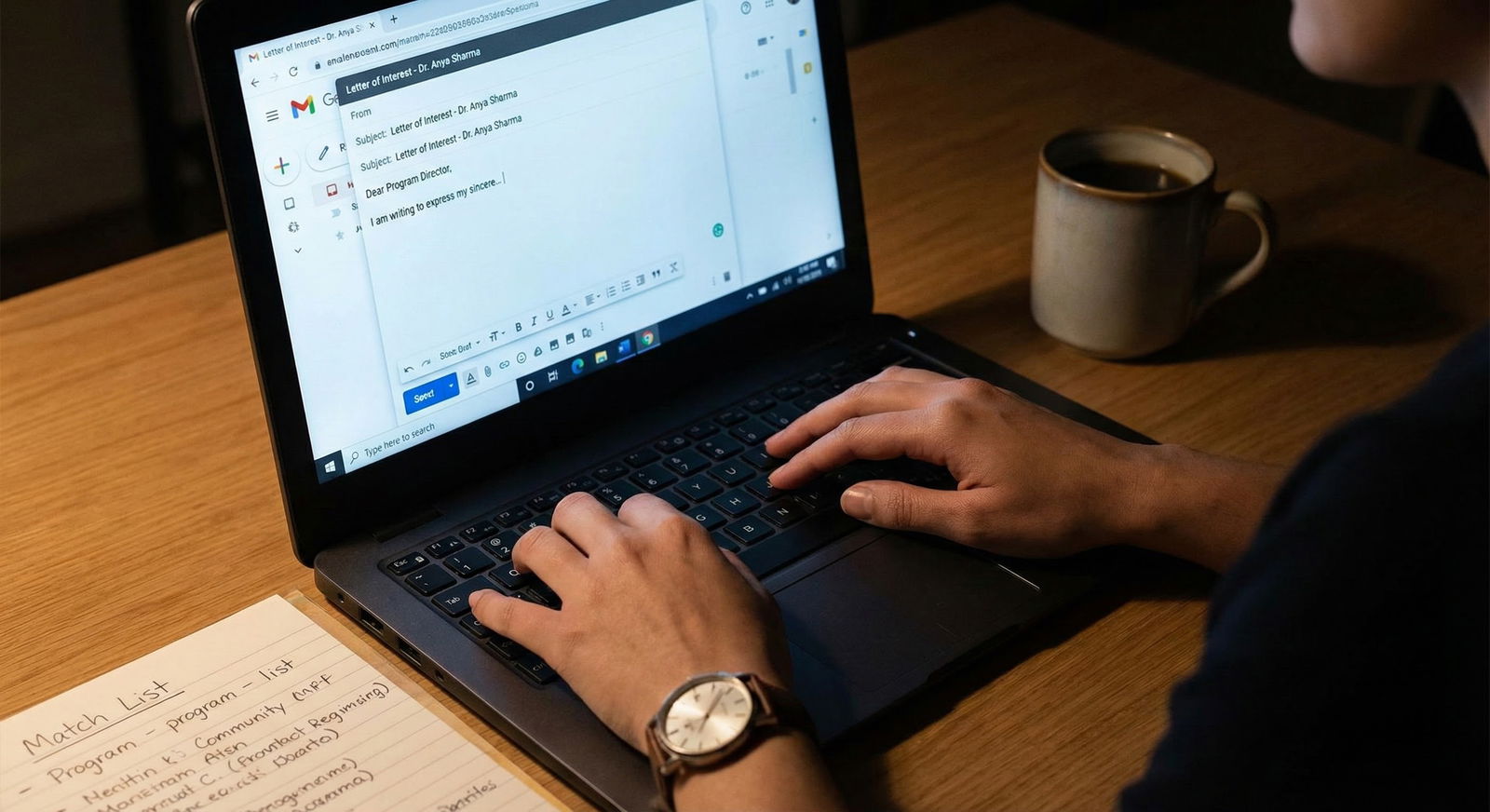
I've seen applicants sabotage a perfectly normal follow-up by trying to make it emotionally impressive. Don't do that. Residents are busy. They don't need your memoir. They need a clear, respectful message that doesn't create work for them.
So no, emailing residents doesn't automatically make you look rude or desperate. Acting rude or desperate does. That's the whole game.
Myth #2: "You Should Never Contact Residents, Program Rules Probably Forbid It"
This one gets repeated like it's gospel, and it's just not true.
Many programs are perfectly fine with informal resident contact. Some even build it into the interview day, hand out contact information, or encourage follow-up questions. Residents often expect that a few applicants will reach out afterward. It's not scandalous. It's normal professional networking.
What is true is that policies vary, and pretending they don't is lazy. Some programs explicitly discourage post-interview communication. Some keep things more tightly controlled. Some are vague enough to make everyone sweat. So yes, you need to pay attention. Read the program page. Re-read interview day instructions. If they say not to contact residents, believe them the first time.
Best practice is simple: use public or officially shared channels, stay within reasonable limits, and never treat resident outreach like a secret backchannel. If the only way you're contacting someone is by digging through Instagram, LinkedIn, or some friend-of-a-friend text chain, stop. That's the kind of move that feels clever when you're anxious and looks terrible from the outside.
There are also times when emailing just isn't worth it. If communications have already been clearly finalized, if the program has discouraged outreach, or if you're emailing just to calm yourself rather than communicate something useful, don't send it. Anxiety is a terrible co-author.
What Actually Helps: The "Specific, Professional, Minimal" Resident Message
If you're going to email, this is the formula. Not because formulas are romantic, but because they keep you from doing something dumb.
Start with a normal greeting. Use their correct name. Then mention one specific detail from your conversation or the interview day. Concrete beats generic every time. Maybe you talked about resident-run teaching conferences. Maybe they described how interns get feedback in clinic. Maybe you connected over a global health track, addiction medicine, QI work, ultrasound training, or the fact that they came from a similar kind of med school environment. Pick one thing. One.
Then say what you appreciated about that detail. Not in inflated, theatrical language. Just plainly. "I appreciated hearing how early your residents get continuity clinic ownership," or "It was helpful to hear how the program supports residents interested in medical education." That's enough.
If you have a question, ask one. Singular. Reasonable. Answerable without requiring a committee meeting. Good questions are about fit, workflow, mentorship, curriculum structure, or opportunities that came up naturally during the interview. Bad questions are anything fishing for guarantees, hidden rank signals, or insider reassurance. If your question secretly translates to "So... do you think they liked me?" don't ask it.
Then say thank you and sign off like a functioning professional.
That's the whole thing. It should feel almost boring. Boring is underrated. Boring gets sent. Boring doesn't wake you up at 2:14 a.m. in shame.
Here's what strong personalization looks like: You spoke with a PGY-2 in IM who described a strong X+Y ambulatory schedule, and you're genuinely trying to understand how that affects continuity. You met a surgery resident who mentioned simulation training and graduated operative autonomy, and that's directly relevant to how you learn. You talked with a family medicine resident who discussed community outreach and Spanish-language clinic work, and that aligns with your actual long-term interests.
Here's what weak personalization looks like: "Loved learning more about your amazing program." That could be sent to literally anyone. Which means it means nothing.
And here's what to avoid because it gets weird fast: asking how to improve your chances, asking how the program is ranking you, hinting that you'll rank them highly in hopes they'll say it back, attaching CV updates nobody requested, or sending a second note because they didn't answer the first one quickly enough. That's not initiative. That's pressure.
Timing matters too. The sweet spot is usually within 24 to 72 hours after the interview. Close enough that the interaction is still fresh, not so immediate that it feels panicked. If that window passes, it's not the end of the world. A slightly later, thoughtful note is still better than a rushed message full of typos and desperation. But after that, don't keep reopening the file. One message is usually the correct number.
The chart isn't science. Obviously. It's just the truth in picture form. The best email is not the longest one or the most flattering one. It's the one that proves you know how to communicate like a future colleague.
Realistic Scenarios: When Emailing Residents Is a Win (and When It's Not)
Let's get out of theory, because this is where applicants usually freeze.
A real win is when your message builds naturally on something meaningful. Say you interviewed at an internal medicine program, and a resident told you about their HIV primary care track or addiction consult experience. You have a genuine interest in that area, and you ask one focused question about how residents balance that with general training. That's good. It shows fit without sounding performative.
Another win: you forgot to ask something that actually matters to your decision. Not "Do people seem happy?" because every resident on Earth has answered that 4,000 times. I mean something concrete. Maybe call schedules, mentorship structure, research support, night float workflow, or how a specific elective is typically accessed. If the answer can be given quickly and helps you make a real choice, emailing makes sense.
Neutral territory? A simple thank-you. That's okay. Not powerful. Not harmful if it's short. Just don't turn a basic thank-you into a ceremonial speech. Residents are not grading your emotional sincerity on a 100-point scale.
Now the bad uses.
If you're trying to restart a conversation that fizzled because there wasn't much there in the first place, let it go. Not every resident interaction needs a sequel. If the chemistry wasn't especially memorable, forcing one more touchpoint usually helps you, psychologically, more than it helps your application.
Same thing if you're secretly hoping for a backchannel update. "Just wanted to stay in touch" often means "Please reveal if I have a chance." Residents know that. They may ignore it because they should.
The risky category is the one anxious applicants wander into when they feel they need to "be honest." Suddenly the email includes family trauma, burnout, relationship strain, financial stress, or a giant explanation of why matching there would save your life. I say this gently, but clearly: don't do that. It's unfair to the resident, irrelevant to the interaction, and often lands as boundary-blind. Save deeply personal disclosures for places where they belong. A post-interview networking email is not that place.

The test I use is brutal but helpful: does this email create clarity, or does it create emotional spillover? If it's clarity, send it. If it's spillover, close the laptop.
The Email: A Template You Can Actually Send (Without Overthinking)
Here is the safe version. Not flashy. Good.
Subject line options: Interview Follow-Up Thank You After Interview Day Appreciated Our Conversation on Interview Day
Template:
Dear Dr. / Hi [Resident Name],
Thank you for speaking with me during my interview with [Program Name]. I especially appreciated hearing about [specific detail: continuity clinic structure, simulation curriculum, teaching culture, research mentorship, community outreach, etc.]. Our conversation made me more interested in the program's approach to [relevant interest area].
If you have a moment, I had one follow-up question about [specific, reasonable question]. If not, no worries at all, I know this is a busy time.
Thank you again for your time and perspective.
Best, [Your Name] [Medical School]
If you're applying IM or primary care, your specific detail might be clinic ownership, underserved care, ambulatory training, or mentorship. If you're applying something procedural, it might be autonomy, simulation, case mix, or resident teaching in the OR. If you're research-focused, mention the project structure or scholarly support they described. Same skeleton. Different detail. Keep it concise.
A few tiny things matter more than people think. Spell their name correctly. Use the right program name. Don't accidentally send "Dear Dr. Smith" to Dr. Patel because you copied a previous draft at midnight and your brain gave up. That's the kind of mistake that haunts people because it's so preventable.
If your draft can't clear that checklist, it's not ready. Simple.
After You Send: What to Do With the Anxiety (Because Waiting Will Happen)
This is the part nobody likes. You send the email, and now you're waiting. Which means your brain starts manufacturing meaning from silence.
They haven't replied in six hours. Then twenty-four. Then three days. Suddenly you're convinced the message was bad, your subject line was weird, your tone was off, they regret meeting you, and your application is now floating in a digital trash fire.
Take a breath. Silence is normal.
Residents are busy in a way that applicants consistently underestimate. They are covering patients, answering pages, switching rotations, post-call, behind on life admin, and probably also trying to maintain some vague illusion of being a person. A non-reply usually means exactly one thing: they didn't reply. That's it. Not a coded judgment. Not an omen.
And no, that does not mean you should follow up "just checking in." Please don't. Repeated follow-ups are where normal outreach mutates into annoyance. The one follow-up rule is strict for a reason: only send another message if they explicitly invited it or if there's an actual logistical clarification that matters. Not because you're uncomfortable with uncertainty. That's not a communication need. That's anxiety asking for another hit.
If you're itching to do something productive, redirect the energy. Send a thank-you to the program coordinator if appropriate. Organize your notes from interview day while your memory is fresh. Prep for upcoming interviews. Work on your rank list reflections when the time comes. Focus on your application materials, your rotations, your actual life. Don't sit there refreshing your inbox like it owes you emotional closure.
I've seen applicants ruin their own peace by treating every unanswered email like a verdict. It's not. Some residents are warm and responsive. Some are friendly but swamped. Some answer a week later with a thoughtful note. Some never answer at all. None of those outcomes, by themselves, tells you much.
The worst-case story your brain writes is usually garbage. "They hated my email." Maybe. But much more likely? They read it, thought "nice," and moved on to managing actual patient care. That's the boring answer, and boring answers are usually the true ones.
So if you send one good email and hear nothing back, count that as complete. Done. You handled yourself professionally. That matters more than whether you got a reply.
Reflection: The Best Networking Choice Is the One You Can Stand Behind
You do not need to maximize every possible point of contact. That's how applicants end up acting strange. You need to be clear, respectful, and normal. That's enough.
If you send a brief, specific resident email within the program's norms, fine. Good move. If you decide not to email and instead send a simple thank-you to the program, also fine. Good move. What isn't a good move is chasing reassurance through outreach that has no real purpose.
My rule is simple because anxious people need rules that don't wiggle: if you wouldn't want to receive that message as a busy resident, don't send it. If your note is specific, brief, professional, and not trying to force intimacy or extract secret information, you're on solid ground.
That's the reality. Not every email helps. But one well-judged message can reflect maturity, and maturity travels further than desperation ever will.