
Most applicants handle conflicting email instructions the wrong way—and quietly damage their chances without ever knowing it.
Let me break this down specifically.
You finish an interview day. Faculty A says “Email me directly with any questions.” The program coordinator says “Please do not email faculty, direct all communication to me.” Another interviewer ends with “Feel free to reach out to the program director if anything comes up.” Now you are staring at your laptop wondering who you are allowed to email without looking clueless or disrespectful.
This is not a trivial problem. Programs care far more about professionalism signals than about the exact words in your thank‑you note. Conflicting contact instructions are a professionalism landmine. You either handle it cleanly and disappear into the “no concerns” pile—or you make just enough of a misstep that someone flags you as “a bit difficult” or “doesn’t follow directions.”
Here is how to not be that person.
Core Principle: Follow the Highest‑Priority Central Instruction
In residency communication, one rule outranks every other:
The program’s centralized written instruction beats any single person’s casual verbal comment. Every time.
Hierarchy of authority for follow‑up instructions, from strongest to weakest:
| Rank | Source / Format |
|---|---|
| 1 | Official email from program/coordinator |
| 2 | Written instructions on interview portal |
| 3 | Verbal instructions from coordinator |
| 4 | Verbal instructions from PD/APD |
| 5 | Verbal instructions from faculty |
| 6 | Offhand “reach out anytime” comments |
If the coordinator email says “Please direct all communication to the program office,” and an attending says, “Email me if you have questions,” you treat the coordinator’s instruction as binding and the attending’s comment as polite encouragement within that boundary.
So the default strategy:
- Look for the official post‑interview email or portal message.
- Follow that instruction exactly, even if it conflicts with individual faculty.
- If you deviate, you must have a clear, defensible reason and keep it minimal and professional.
Most applicants never even rank these instructions; they just email whoever seemed nicest. That is sloppy. You can do better.
Step‑By‑Step: What To Do When Instructions Conflict
Let me give you a structured decision path, because this is where people get lost in “it depends.”

| Step | Description |
|---|---|
| Step 1 | Finished Interview Day |
| Step 2 | Read email for contact rules |
| Step 3 | Check ERAS/portal instructions |
| Step 4 | Email ONLY coordinator/office |
| Step 5 | Limited email to those faculty |
| Step 6 | Use conservative mixed strategy |
| Step 7 | Post-interview email from program? |
| Step 8 | Coordinator says ALL communication via office? |
| Step 9 | Faculty explicitly invited email? |
| Step 10 | Portal has contact rules? |
Step 1: Re‑read all written instructions
Before you send a single email:
- Re‑read the coordinator’s confirmation / post‑interview email.
- Check the ERAS/Thalamus/Interview Broker portal notes.
- Look at any attached PDF with “Interview Day Information” or “Post‑Interview Policy.”
You are looking for phrases like:
- “Please direct all communication to…”
- “We kindly ask that applicants do not contact individual faculty.”
- “Post‑interview communication will not be used in ranking decisions.”
If anything along those lines is written, that is your rulebook.
Step 2: Identify the conflict type
There are a few recurrent patterns. I have seen all of these across IM, EM, surgery, and peds programs.
Global restriction vs individual invite
Coordinator: “Please send all questions to the program email; do not contact individual interviewers.”
Faculty: “Here’s my card—email me if anything comes up.”Coordinator strict, PD casual
Coordinator: “All communication through the office.”
PD in closing session: “Feel free to email me directly if you think of more questions.”No central rule, multiple invitations
No written restriction.
Multiple faculty: “Email me anytime.”
PD: “You are welcome to reach out to me as well.”Portal vs email discrepancy
Portal says: “Questions to coordinator only.”
Email (template from years ago): “You may contact your interviewers directly.”
Each pattern has a best‑practice response. Let’s go through them.
Scenario 1: Coordinator Restriction vs Faculty Invitations
This is the classic trap.
The right move is simple: obey the explicit restriction, but use the coordinator as a conduit when needed.
What this looks like in practice:
- You send a single, well‑crafted thank‑you / follow‑up to the coordinator or program inbox.
- You include brief thanks directed to specific faculty within that email.
- You ask the coordinator to forward it if appropriate—once, politely, not desperately.
Example:
Subject: Thank you for the interview day – [Your Name]
Dear [Coordinator Name],
Thank you for organizing a very thoughtful interview day at [Program Name] on [date]. I appreciated the opportunity to speak with Dr. Smith about resident autonomy in the MICU and with Dr. Lee about your global health track.
If appropriate, please extend my thanks to them for their time and insight. I remain very interested in [Program Name] because of [1 specific, concrete reason].
Best regards,
[Full name, AAMC ID, medical school]
You have:
- Followed the coordinator’s rule.
- Acknowledged faculty in a way that does not violate it.
- Demonstrated that you “get” hierarchy in medicine.
Do not:
- Email those faculty directly “just in case” on top of this.
- CC the coordinator on a direct faculty email if the rule said do not contact faculty. That looks like you trying to sneak around a boundary while pretending to be transparent.
If later you have a truly substantive question that only that faculty member can answer (e.g., about a very specific research alignment), you can route it through the coordinator:
I had one specific question for Dr. Smith regarding ICU research opportunities and was not sure of the best way to ask this given your communication policy. If possible, I would be grateful if you could either forward the question below or let me know if you prefer that I wait until after Match.
That is adult‑level professionalism.
Scenario 2: Coordinator Strict, PD Casual
Program director says “Email me directly if anything comes up,” but the coordinator email says “All communication through the program office.”
Here, you treat the PD’s comment as more nuanced than it sounded. PDs know the coordinator runs the operational side. They are not trying to undermine their own staff.
Best approach: still centralize through the program office, but leave room for the PD to respond.
Two options:
- Email the program inbox, address the body “Dear Dr. [PD] and [Coordinator Name]” if that appears consistent with prior program emails.
- Or, email the coordinator but clearly reference the PD’s invitation:
Dr. [PD] kindly mentioned we could reach out with additional questions. I am copying the program email here to follow your communication process.
If there is an absolute prohibition like “do not contact the PD directly,” then you do not directly email the PD, no matter what they said casually on Zoom. They will never penalize you for respecting a written rule their own office sent you.
Scenario 3: No Central Rule, Multiple “Email Me Anytime” Invites
This is where most applicants spray thank‑yous everywhere and clog inboxes. You do not have to do that to look appreciative.
Here is a disciplined way to handle it:
If you want to send thank‑yous, limit it to 2–4 targeted emails:
- PD (almost always reasonable)
- One or two faculty with whom you had the most substantive interaction
- Optional: chief resident or APD if they spent significant time with you
Keep them short, specific, and clearly not attempting to signal rank intent.
Example to PD when no restriction exists:
Subject: Thank you for the interview – [Your Name]
Dear Dr. [PD],
Thank you for the opportunity to interview at [Program Name] on [date]. I especially appreciated our discussion about how you support residents applying for physician‑scientist tracks and how the X+Y schedule has changed continuity clinic.
I left the day with a strong sense that your program would be an excellent fit for my interests in [brief phrase]. Thank you again for your time and leadership.
Sincerely,
[Name, AAMC ID, school]
For a faculty member:
Dear Dr. [Faculty],
Thank you for speaking with me during my interview at [Program Name] on [date]. I enjoyed our discussion about [concrete detail], and your description of [specific aspect] made the program’s culture stand out to me.
I appreciate your time and insight.
Best regards,
[Name]
Do not:
- Email every single interviewer with a generic “Thank you for your time” copied and pasted 6 times.
- Ask about rank order, chances, or “how I can improve my application now” in these emails. That is what advisors at your school are for, not interviewers.
Scenario 4: Portal Says One Thing, Email Says Another
This happens when programs update one system and forget another.
Example:
- Portal: “Please do not send thank‑you emails to interviewers.”
- Automated email sent 2 months ago: “You may reach out to your interviewers with questions.”
You always treat the more recent, more restrictive, or more centralized instruction as the operative one.
So in that example, portal wins. No direct thank‑yous. You can still send a single, restrained email to the coordinator if that is not prohibited.
If it is genuinely ambiguous (dates not clear, language inconsistent), adopt the conservative approach: coordinator only, one email, neutral tone.
Email Content: What Is Safe vs Risky Post‑Interview
The question is not just who you email, but what you say. Some content raises red flags, especially in a world of formal communication policies and NRMP rules.
](https://cdn.residencyadvisor.com/images/articles_svg/chart-common-post-interview-email-types-and-relative-ris-5983.svg "Common Post-Interview Email Types and Relative Risk")
| Category | Value |
|---|---|
| Brief thank-you | 10 |
| Clarifying question | 20 |
| Update with publication | 30 |
| Stating Rank #1 | 60 |
| [Asking about ranking chances](https://residencyadvisor.com/resources/follow-up-residency-interview/7-thank-you-email-phrases-that-quietly-damage-your-residency-chances) | 90 |
Lower number = safer, higher = riskier.
Here is the breakdown:
Safe content
- Brief, specific thanks.
- Clarification of factual program details (call schedule, elective structure, research opportunities).
- Logistical questions (timeline, second looks if allowed, how to contact GME for visa / HR issues).
These are boring. Boring is good.
Medium‑risk content (use carefully)
- Updates on significant application changes (accepted major manuscript, change in visa status, couples match partner specialty/location).
- Signals of strong interest that stop short of explicit rank statements.
Programs vary on whether they care about updates after a certain date. Some literally do not incorporate them. You send such updates only if:
- They are truly material (not “poster accepted to local meeting” level).
- There is no explicit “we do not consider post‑interview updates” statement.
Format it like a brief professional memo, not a sales pitch.
High‑risk content (usually avoid)
- “I will be ranking you #1” or “I intend to rank you highly” in programs that explicitly discouraged preference communication.
(Yes, NRMP allows it. No, programs are not required to like it.) - Fishing for feedback: “Is there anything I can do to strengthen my application in your eyes before rank lists?”
- Comparison statements: “Your program is now my top choice over X and Y.”
That will look sloppy if anyone at X or Y ever sees your email, and it sometimes happens.
If you are going to send a rank signal (at your own risk), you absolutely must obey their preferred contact pathway. Never send a “You are my #1” email to an attending when their coordinator said “no contact with faculty.” That is the easiest way to convert a maybe‑helpful signal into a professionalism concern.
Special Cases: When You Should Break the Pattern
There are a few narrow situations where contacting a specific person despite general restrictions is justified, but you still need to be careful.
1. Serious professionalism concern or mistreatment
If something during the interview day crossed a serious line—overt discrimination, policy violations, harassment—you do not need to worry about “thank‑you etiquette.” You need to get the information to the right leadership.
Here, you prioritize:
- Program Director
- DIO (Designated Institutional Official) / GME office
- Or the contact for reporting concerns if provided
You can send a calm, factual email explaining the situation. If there is a coordinator rule, you can CC them, but you do not let a “please send all questions to the office” line stop you from reporting serious issues.
2. Time‑sensitive logistics that only leadership can address
Examples I have actually seen:
- Couples match: partner’s program changed rank list deadline / situation, and you need a program director aware of a constraint.
- Visa or licensing deadline that affects whether you can start on time.
For this, you can often start with the coordinator:
I have a time‑sensitive question related to [visa / couples match logistics] that may require PD input. How would you prefer I communicate this?
If they are slow or unresponsive and the deadline is real, then emailing the PD with a clear subject line and factual content is acceptable.
Tone and Style: How Not To Sound Desperate or Clueless
You can follow all the structural rules and still undermine yourself with tone. A few blunt guidelines.
Keep it short and concrete
Three paragraphs max. Often two is enough:
- Thank them for something specific from your day.
- State your continued interest or ask your question.
- Close politely.
Avoid adjectives like “incredible, amazing, unbelievable, perfect fit.” They sound like you wrote the same email to five programs. One or two restrained descriptors are enough.
Avoid these phrases
I have seen these in actual emails that made PDs roll their eyes:
- “I know you are busy but…” (of course they are; just ask your question)
- “I just wanted to follow up…” (empty filler)
- “I’m sure you hear this a lot, but…” (also filler)
- “Your program is my dream and I would do anything to match there.”
This reads unprofessional and unstable, not flattering.
Instead, write like a junior colleague:
- Direct but respectful.
- No drama. No flattery inflation.
- Specific enough to show you paid attention.
Subject lines that do not get lost
Use clear, sortable subject lines. For example:
- “Thank you for the interview – [Your Name], [Specialty] applicant”
- “[Your Name] – [Med School] – Question about elective schedule”
- “Update – [Your Name], [Program Name] applicant (publication accepted)”
Coordinators often search by name or specialty. Help them help you.
Putting It Together: A Conservative “Template Strategy” By Program Type
If you want a simple default rule set you can follow without overthinking each program, here it is.
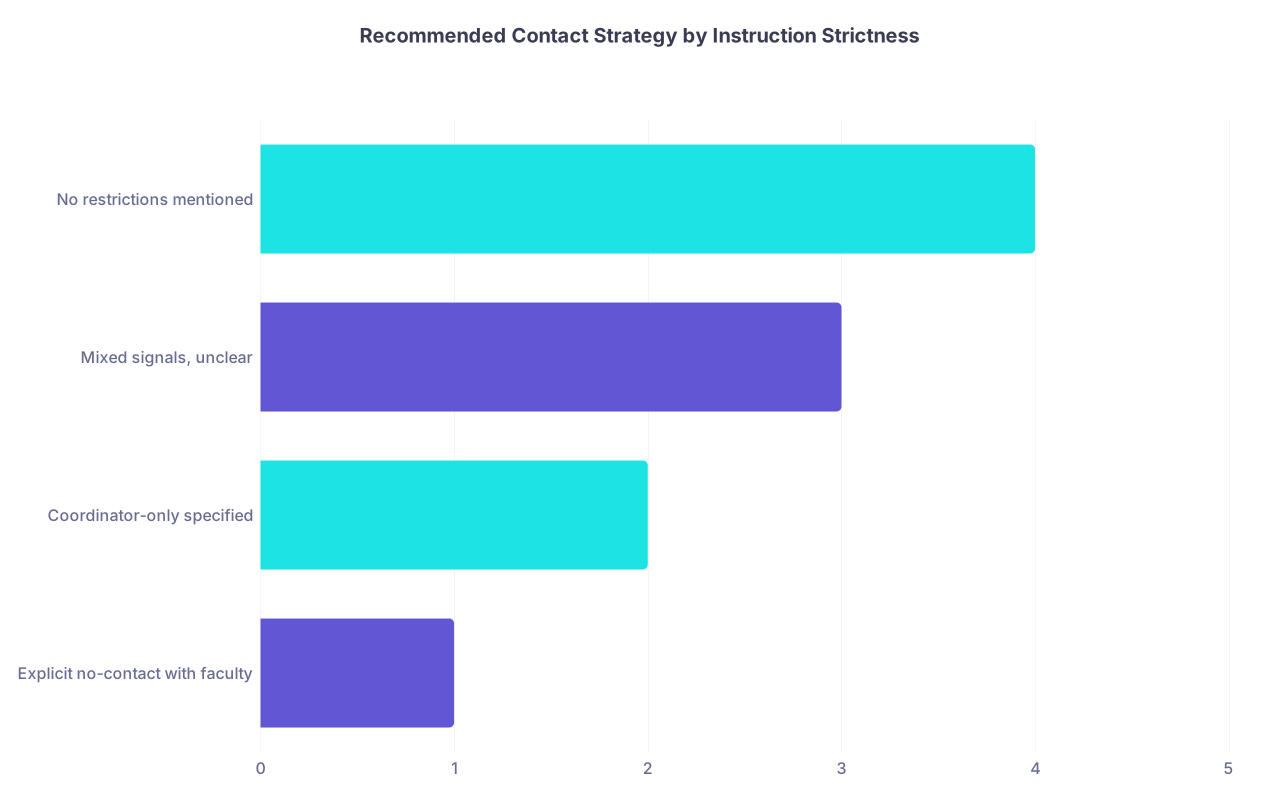
| Category | Value |
|---|---|
| Explicit no-contact with faculty | 1 |
| Coordinator-only specified | 2 |
| Mixed signals, unclear | 3 |
| No restrictions mentioned | 4 |
Higher number = more freedom to contact individuals.
Programs with explicit “no faculty contact” or “no post‑interview contact” policies
- One email max, to the coordinator or program inbox only.
- Neutral thank‑you plus any essential logistical question.
- No direct faculty or PD emails, no rank signals, no updates unless they specifically invite them.
Programs specifying “all communication through coordinator/program office”
- Single email to coordinator.
- You may mention specific faculty within that email.
- Any future necessary contact still through coordinator.
Programs with mixed/unclear signals
- Default to coordinator/program inbox.
- If faculty explicitly invited email and there is no contrary written rule, you can send 1–2 targeted faculty thank‑yous.
- Keep total number of separate emails low (3–4 total for the program).
Programs with no mention of restrictions
- You can choose to:
- Send only a PD + coordinator thank‑you, or
- Add 1–2 faculty thank‑yous.
- No mass emailing every person you met.
- You can choose to:
This keeps you on the safe side 95% of the time.
Example Set: Conflicting Instructions and Exact Emails
Let me give you one fully worked example, because this is where the “what do I literally type?” anxiety lives.
Situation
Coordinator email:
“Please direct all questions to our program email at [email protected]. We kindly ask that applicants do not contact individual faculty directly.”PD in group Q&A:
“Feel free to reach out if you have further questions about our educational philosophy.”Two faculty in 1:1:
“Here is my email, do not hesitate if you think of anything else.”
You are interested in this program and want to be polite, but you also do not want to ignore explicit instructions.
What you do
You send one email to [email protected], addressed to the PD, and incorporate thanks to faculty.
Subject: Thank you for the interview – [Your Name]
Dear Dr. [PD] and [Program Coordinator Name],
Thank you for the opportunity to interview with the [Hospital Name] Internal Medicine Residency on [date]. I appreciated hearing your perspective on balancing autonomy and supervision, and the discussion about your night float structure helped me understand how you support interns early in the year.
I was also grateful for the chance to speak with Dr. [Faculty A] about resident roles in the MICU and with Dr. [Faculty B] regarding outpatient continuity. If appropriate, please extend my thanks to them for their time.
I remain very interested in [Program Name], particularly because of [one specific, concrete feature]. Thank you again for a thoughtful interview day.
Sincerely,
[Full name]
[Medical school, AAMC ID]
You are done. You do not send separate emails to Dr. A and Dr. B. You do not try to sneak around the coordinator. You show that you listened.
FAQs
1. Do I have to send thank‑you emails at all?
No. Many programs genuinely do not care, and a growing number explicitly say they do not use post‑interview communication for ranking. A well‑done thank‑you will not magically bump you from the middle to the top of a rank list. However, a bad or unprofessional email can hurt you. If you are overwhelmed, prioritize only:
- Programs you are strongly considering ranking high, and
- Programs where there is no explicit discouragement of post‑interview contact.
2. What if a faculty member directly asks me to email them something (CV, paper, project idea) but the coordinator said not to contact faculty?
If the faculty specifically requests a follow‑up (“Send me your CV and I will connect you with X”), you can honor that, but do it transparently and narrowly. Email that faculty with exactly what they requested, CC the coordinator or program email, and keep the content strictly limited to that task. No general thank‑you, no rank talk, no extra questions. You are complying with a direct ask, not initiating new communication.
3. Is it okay to send one email to the coordinator and CC all my interviewers?
Generally no, especially if there was any hint of “do not contact faculty.” That looks like you are trying to technically obey the “send to coordinator” rule while still forcing your message into multiple inboxes. If they wanted a broadcast message, they would have given you a mechanism for that. Mention faculty by name in the body instead.
4. How late is too late to send a thank‑you or follow‑up email?
Within 48–72 hours of the interview is ideal for thank‑yous. Beyond a week, a generic thank‑you begins to look like a perfunctory checkbox and can be skipped unless you are combining it with a substantive update or question. For updates (publications, couples match info, etc.), you can send them later in the season, but always check whether the program has said they do not consider post‑interview updates.
5. Should I ever mention my rank list position in an email?
Only if:
- The program has not discouraged preference communication, and
- You are being honest, and
- You understand it rarely changes anything, and
- You obey their communication hierarchy when doing so.
Even then, keep it brief and non‑needy: “I wanted to let you know that I will be ranking [Program Name] as my top choice.” Do not add emotional bargaining, comparisons, or repeated messages. And if their official communications said “We do not want or consider rank preference emails,” then do not send one at all.
Key points:
- Written, centralized instructions from the program or coordinator always outrank casual verbal invitations from individual interviewers.
- When in doubt, use a single, concise email to the coordinator or program inbox that acknowledges specific faculty without contacting them directly.
- Your tone and restraint matter more than sending a thank‑you to every person; aim to look like a junior colleague who respects boundaries, not an anxious applicant trying to game the system.