Thank-You Emails After Second-Look Visits: What Changes and What Doesn’t
It is 9:45 p.m. You just got back from a second-look day at a program that might end up in your top three. You are half exhausted, half wired on bad conference-room coffee. Your inbox has three unread emails from other programs. Your brain is screaming, “I should send something tonight… right?” But then the doubt creeps in:
Do I send a whole new thank-you email?
Do I reply to my old post-interview email thread?
Do I restate my interest or that “you’re my number one”?
Or do I risk sounding overeager, annoying, or—worse—desperate?
Let me break this down specifically: second-look thank-you emails are a different animal from post-interview thank-yous. Some things change. Some things really should not.
I am going to walk you through exactly what matters, what is optional, and what is a waste of everyone's time (including yours).
1. The Role of Second-Look Visits: Why Your Email Needs to Be Different
Start with the reality no one says out loud during the catered lunch.
Second-looks usually matter more for you than for them.
Programs use official interview days to evaluate you. Second-looks are usually:
- For you to see workflow, team dynamics, hospital layout, call rooms, clinic reality.
- For the program to “sell” itself a bit more.
- Sometimes for borderline applicants to show genuine interest. (Yes, this happens.)
The Match rules still apply. Post-interview communication cannot be used in any binding way. But human beings read your emails. And program coordinators, chiefs, and PDs remember people who communicate clearly and maturely.
What changes after a second-look:
- You now have much more specific insight into the program.
- Your email should reference concrete things you saw or discussed.
- You are no longer in generic “thank you for the opportunity to interview” mode. That ship sailed.
What does not change:
- Basic professionalism.
- Concise, respectful tone.
- No negotiating. No trying to game the Match.
- No emotional dumping (“I’m so stressed about ranking”). Keep that for your group chat.
So second-look emails are not “Interview Thank-You 2.0.” They are short, targeted follow-ups anchored in your new experience of the program.
2. Who Actually Gets a Second-Look Thank-You (And Who Does Not)
This is where people overcomplicate things and waste hours.
After a second-look visit, you do not need to email every single person you ran into. You do not need to re-email everyone from your original interview day unless they were involved this time.
Here is the general hierarchy.
| Role | Email? |
|---|---|
| Program Director | Usually yes |
| Associate/Assistant PDs | Yes if you met |
| Program Coordinator | Yes |
| Chief Residents | Yes if involved |
| Residents you closely shadowed | Optional/targeted |
Now the nuance.
Program Director (PD)
If the PD was involved in your second-look (met with you, said hi, or clearly knew you were there), send a brief follow-up. If they were not present at all, a second email is optional but still reasonable for a top-choice program.
Your PD email is not a generic “second thank you.” It is:
- Acknowledgment of the second-look opportunity
- One or two specific takeaways that changed or confirmed your impression
- A clear, calm statement of continued interest (not a promise, not a rank declaration unless you are 100% sure and their communication policies allow it)
Program Coordinator
The coordinator is the logistical brain of the program. They made your second-look happen. You thank them.
This email can be very short:
- Thank them for arranging the visit.
- Mention one detail that shows you noticed their work (scheduling, parking help, rotation pairing).
- That is it.
Associate PDs / Assistant PDs
If you had a dedicated session, tour, or discussion with them during the second-look, email. If you never spoke directly with them this time and already thanked them after the interview, a second email is optional unless something specific ties back to them.
Chiefs and Key Residents
Limit this to:
- Residents you directly shadowed on rounds, in clinic, or during sign-out.
- Chiefs who spent obvious dedicated time (small group Q&A, sit-down chat, going through schedule with you).
Do not mass-email every resident whose name appeared on the schedule. It reads as insincere and wastes your time.
3. What Needs to Change in Your Second-Look Email Content
Your initial post-interview email was probably some version of:
- “Thank you for the opportunity to interview.”
- “I enjoyed learning about X.”
- “I remain very interested in your program.”
That is fine for the first pass. After a second-look, that level of generic language is lazy.
Now you must do three things differently:
- Anchor to specifics you just saw.
- Show that the visit actually influenced your understanding.
- Update, not repeat, your level of interest.
1. Anchor to specifics
Vague:
“Thank you for the second-look visit. It was helpful to see the program again.”
Better:
“Thank you for arranging the second-look visit on January 5. Joining Dr. Lopez and the PGY-2s on the MICU rounds gave me a clear sense of how the multidisciplinary team functions and how residents are given increasing autonomy by spring of their second year.”
That difference is not subtle. The latter sounds like someone who actually showed up and paid attention.
Name real things:
- The way sign-out was run.
- How interns pre-round and present.
- The EMR system you watched them use on rounds.
- Morning report or noon conference format.
- A specific rotation, clinic, or service you observed.
2. Show how it changed or sharpened your understanding
You are signaling that the visit pushed you closer to a stable rank decision.
For example:
- “Seeing the day-to-day structure of your continuity clinic confirmed that I would get strong longitudinal exposure to complex diabetic and rheumatologic patients.”
- “Watching the PGY-3 lead family discussions on the oncology floor reinforced that your program trains residents to handle difficult conversations with confidence by graduation.”
You are no longer in “I liked the vibe.” You are in “this is how my training would actually look.”
3. Update your expression of interest
Avoid melodrama. No “I fell in love with your program all over again.” Keep it mature.
Examples:
- “This visit strengthened my interest in ranking your program very highly.”
- “Based on both my interview day and this second-look, I am strongly considering your program near the top of my rank list.”
If, and I mean only if, you are absolutely certain a program is your true #1 and you are comfortable stating that, then yes, these second-look emails are a reasonable place to say:
- “I plan to rank [Program] as my first choice.”
But do not lie. PDs talk. Word gets around. And your conscience will remember.
4. What Should Not Change: The Core Rules Still Apply
Some applicants think second-look follow-up is a separate universe with special rules. It is not. The basics still stand.
You still keep it short
This is not a reflective essay on your growth as a future intern.
Aim for:
- 2–3 short paragraphs
- 150–250 words total per email
- No walls of text
If you find yourself describing entire patient cases from rounds or analyzing the hospital layout in three sentences, you are overdoing it.
You still don’t ask for reassurance
Do not send anything that even faintly sounds like:
- “I hope I am still being strongly considered.”
- “I would love to know where I stand on your list.”
- “I hope I am competitive for your program.”
They cannot answer that. You put them in a weird position. It reads as insecure. Bad combination.
You still don’t negotiate or hint at leverage
No:
- “I am also considering [Big-Name Program], but my visit today made your program very competitive with them.”
That is classic med student mistake. You are not a free agent being courted with contracts. You are entering a Match algorithm. You gain nothing by hinting that you have other big options.
State your interest in their program. Full stop.
You still proofread like an adult
The fastest way to undercut a positive impression: send a second-look email with the wrong program name copied from another draft.
I have seen this. Multiple times. It is not subtle.
At minimum:
- Check program name and city.
- Check PD’s name and title.
- Confirm you did not reference the wrong specialty (yes, someone once wrote “internal medicine” in an EM email).
5. Timing, Format, and Threads: The Logistics That Actually Matter
You do not need to overthink this, but there are a few details that separate the polished from the sloppy.
When to Send
Ideal window: within 24–48 hours after the second-look.
Same day if you get home by early evening and your brain still works. Next day is perfectly fine. Third day is not fatal but starts to feel like an afterthought.
Avoid sending at 1:30 a.m. If you draft late at night, schedule it for 7–8 a.m. next morning.
New Email vs. Replying to the Old Chain
If the second-look was arranged in an existing chain with the coordinator and PD/associate PD CC’d, you have two options:
- To the coordinator: Reply to that chain. It keeps logistics in one place.
- To the PD or APD: New email is usually cleaner, with a clear subject line about the second-look.
Sample subjects:
- “Thank you for the second-look visit – [Your Name]”
- “[Your Name] – Appreciation for second-look day on [Date]”
Do not bury a new thank-you three replies deep in an old scheduling thread where no one is expecting it.
One program, multiple emails?
You can send:
- One email to PD.
- One email to coordinator.
- One to a chief or resident you shadowed, if you actually had a substantial interaction.
Do not CC everyone on the same sentimental thank-you blast. Different roles, different focus.
6. Concrete Templates: What This Actually Looks Like
People learn faster from examples. So I will give you a few, but read for structure, not for copying word-for-word.
A. PD Email – Strong Interest, Not #1 Declaration
Subject: Thank you for the second-look visit – [Your Name]
Dr. [PD Last Name],
Thank you for the opportunity to return for a second-look visit on January 5. Observing the inpatient cardiology team and joining morning report gave me a much clearer sense of how residents at [Program Name] are taught to reason through complex cases in a structured but supportive environment.
Seeing the PGY-3 lead rounds and guide the intern through management decisions reinforced my impression that your program provides graduated autonomy while maintaining close attending involvement. It also highlighted how comfortable your residents are with high-acuity patients by the end of their training.
This visit strengthened my enthusiasm for [Program Name], and I will be ranking your program very highly. I appreciate the time and effort you and your residents invested in allowing me to see the program in greater depth.
Sincerely,
[Full Name]
AAMC ID: [XXXXXXX]
B. PD Email – You Are Sure It’s #1
Only use this if it is actually true.
Subject: Appreciation for second-look visit – [Your Name]
Dr. [PD Last Name],
Thank you for allowing me to return for a second-look visit on February 2. Spending the morning in your continuity clinic and watching how the attendings and residents manage complex chronic disease within a consistent patient panel gave me a concrete view of what my training would be like at [Program Name].
The atmosphere in clinic, the efficiency of your support staff, and the way residents discussed long-term management with their patients confirmed for me that this is the type of environment in which I want to train.
After this visit, I am confident that [Program Name] is the best fit for my goals, and I plan to rank your program as my first choice. I am very grateful for the opportunity to consider [Program Name] so carefully.
Sincerely,
[Full Name]
AAMC ID: [XXXXXXX]
C. Coordinator Email
Subject: Thank you for arranging my second-look visit
Dear [Coordinator Name],
Thank you very much for organizing my second-look visit on January 5. The schedule you put together, especially the chance to spend time on the general medicine service and attend noon conference, gave me a clearer picture of daily resident life at [Program Name].
I appreciate how smoothly everything ran, from parking to badges to meeting with the team. Your efforts made the visit extremely valuable as I finalize my rank list.
Best regards,
[Full Name]
D. Resident/Chief Email
Subject: Thank you for allowing me to shadow on [Service]
Hi Dr. [Resident/Chief Last Name] / [First Name if they invited that],
Thank you for letting me join your team on the MICU service during my second-look visit on February 3. Watching how you ran table rounds, delegated tasks, and incorporated teaching for the intern and student gave me a realistic sense of how senior residents lead at [Program Name].
Our conversation about how you felt supported transitioning from intern to senior was particularly helpful as I think about what I want out of my training. I appreciate you taking the time to answer my questions during a busy day.
Best,
[First Name]
Notice the common pattern:
- Immediate reference to the visit.
- One or two specifics.
- Clear appreciation.
- Brief nod to how it influences your decision-making.
No fluff. No theatrics.
7. Edge Cases: When You Should Not Send Much (or Anything)
Everyone assumes you must send something after every second-look. Not always.
Case 1: Second-look made you realize you will not rank them highly
If you walked away thinking, “This is not my place,” you still send a polite, short thank-you to the coordinator and maybe to a PD/APD if they took real time with you. You do not need to emphasize future interest.
For example:
- “Thank you again for the opportunity to visit. Seeing the day-to-day operations was very helpful as I continue to finalize my rank list.”
Notice: no “very highly,” no #1 hint. Just gratitude for their time. Pure professionalism.
Case 2: It was an extremely informal second-look
Sometimes you “drop by” for an afternoon, have coffee with residents, no structured day, no formal endorsement from leadership.
In those cases:
- Email the coordinator if they set it up.
- Optionally email 1–2 residents if your conversation was substantial.
- You can skip PD/APDs if they were not involved at all and you already sent strong post-interview thank-yous.
Case 3: You already sent a long, detailed “this is my #1” email before the second-look
Some of you commit early. That is fine. After the second-look, you do not need a second loyalty pledge.
Send a brief note like:
- “Thank you for allowing me to return for a second-look on January 20. The time on the wards and in clinic further confirmed my strong impression of [Program Name]. I remain very excited about the possibility of training with your team.”
No need to restate rank order if you already did.
8. Program Behavior vs. Your Email: Do Second-Looks Affect Ranking?
You want to know if any of this moves the needle.
Short answer: your behavior and presence at the second-look day matter more than the email. But the email is the written record that ties a neat bow on your visit.
What second-look plus follow-up can signal to programs:
- You are genuinely interested, not just collecting interviews.
- You cared enough to invest extra time and travel.
- You observed carefully and asked reasonable questions.
- You communicate concisely and professionally afterwards.
What it cannot (and should not) do:
- Rescue a disastrous interview performance.
- Override major red flags in your file.
- Create a contractual obligation for them to rank you higher.
But when programs are sorting a stack of “we like all of these people” into an actual order, the difference between two applicants can absolutely be:
- One showed up again, engaged well, and sent a thoughtful, grounded follow-up.
- The other disappeared after interview day.
That matters. Do not pretend it does not.
To visualize how programs often perceive interest signals:
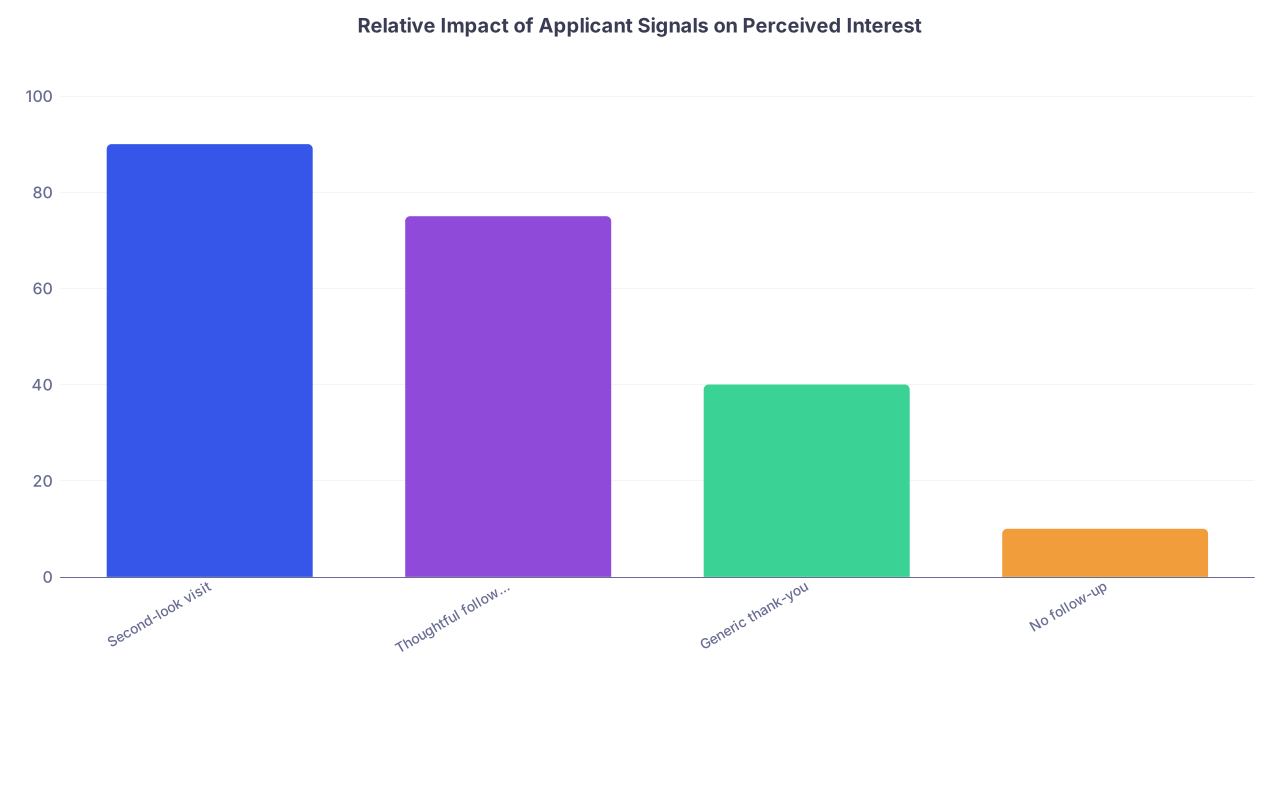
| Category | Value |
|---|---|
| Second-look visit | 90 |
| Thoughtful follow-up email | 75 |
| Generic thank-you | 40 |
| No follow-up | 10 |
The numbers here are illustrative, not scientific. But you get the point.
9. How Second-Look Emails Fit Into Your Overall Match Communication Strategy
You are not writing these emails in isolation. You are juggling:
- Initial interview thank-yous
- Occasional updates (new publication, AOA, etc.)
- Second-look follow-up
- Final “this is my #1” decisions
If you are smart, you use second-look emails to consolidate your messaging, not multiply it.

| Step | Description |
|---|---|
| Step 1 | Interview Day |
| Step 2 | Initial Thank-You Emails |
| Step 3 | Evaluate Programs |
| Step 4 | Second-Look Visit |
| Step 5 | Second-Look Thank-You Emails |
| Step 6 | Finalize Rank List |
| Step 7 | Do Second-Look? |
Notice where second-look emails sit: between your experience and your final rank list. They are the last professional impression most programs will have of you before they rank.
Two practical rules as you approach rank list submission:
- Do not email a program every few days with “updates” after a second-look. You will slide from “interested” to “clingy.”
- Treat your second-look thank-you as your closing statement unless you have a truly significant update or a one-time, final rank declaration.
10. Common Mistakes I See Every Year (And How To Fix Them)
Let me call these out bluntly.
Mistake 1: “Copy-paste with minor edits” across programs
Programs can smell this. If your second-look thank-you to three different programs is 90% identical with only names changed, you have missed the entire point of the visit.
Fix: Build each email around one or two details only that are unique to that program. It takes an extra 3–5 minutes and makes a very different impression.
Mistake 2: Emotional oversharing
Things I have actually seen:
- “I have been so anxious about this process and your second-look gave me hope again.”
- “I would be devastated if I did not match here.”
That is for your partner, your roommate, or your therapist. Not for a PD’s inbox.
Fix: Translate emotion into professional language. Instead of “devastated,” say “I would be extremely excited to train here.”
Mistake 3: Over-selling your interest when you are not actually that interested
You will be tempted to tell multiple programs they are near the very top of your list. That is fine. But do not tell three different programs they are your #1. That crosses into dishonest.
Fix: Use graded language:
- “Rank very highly” – multiple programs can get this.
- “Near the top of my list” – also can apply to several.
- “My first choice” – only one.
11. Quick Reality Check: How Much Time Should This Take?
You are ranking, traveling, finishing rotations, maybe doing sub-Is. Your bandwidth is limited.
For each program where you did a second-look:
- 5–10 minutes to draft PD email.
- 3–5 minutes for coordinator.
- 3–5 minutes per resident/chief you genuinely want to thank.
That is it. If you are spending an hour polishing each one, you are misallocating time.
If it helps, outline like this before writing:
- One sentence: date and nature of visit.
- Two sentences: specific observations (rounds, conference, clinic).
- One sentence: how it clarified/confirmed your impressions.
- One sentence: level of interest.
- One closing sentence: gratitude.
That scaffolding will keep you from rambling.
Key Takeaways
- Second-look thank-you emails are not a repeat of your interview thank-you. They must reference specific things you just saw and show how the visit sharpened your understanding of the program.
- Keep them short, targeted, and honest. Email PDs, coordinators, and key residents involved in your visit; avoid emotional oversharing, rank fishing, or copy-paste generic language.
- The second-look visit itself matters more than the email, but a clear, professional follow-up is your last written impression before programs finalize their rank lists—use it wisely.