
The letter arrives on a Tuesday afternoon. Thin envelope. Government return address. Your pulse jumps before you even open it.
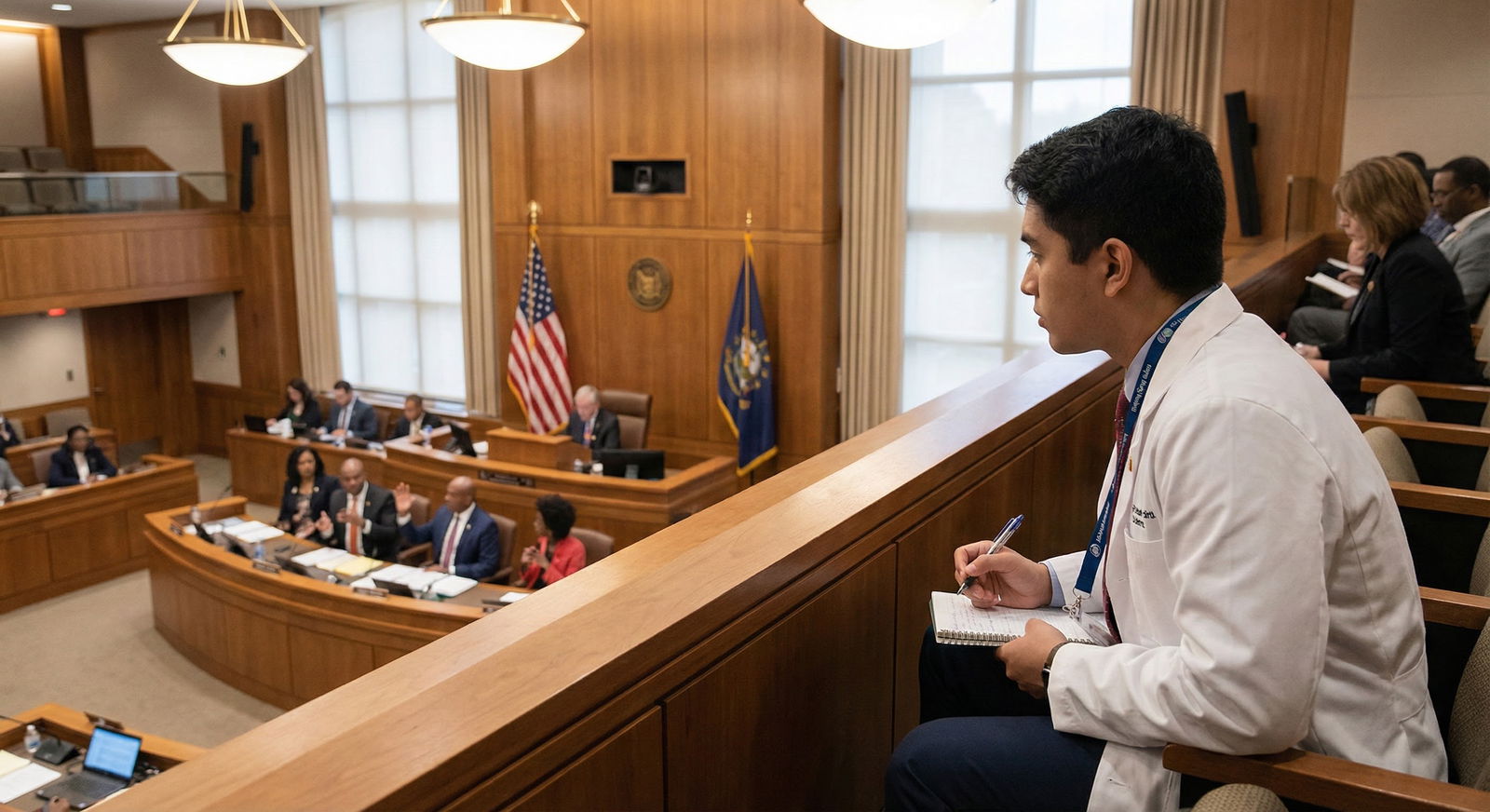
Inside: notice of a complaint to the state medical board. The issue is not a prescribing error, not a billing dispute, not a bad outcome in clinic. It is your testimony before a city council on housing and asthma. Or a thread you posted about vaccine policy. Or an op-ed on reproductive health access. Or your role in organizing physicians at a county hearing.
I have seen this exact moment derail otherwise steady people. Smart physicians do dumb things when the allegation feels political, personal, and public all at once. They fire off angry emails. They post a defiant statement online. They call the complainant. They start “cleaning up” social media. That is how a manageable board issue turns into a credibility problem.
Advocacy-related complaints are uniquely unnerving because they hit several nerve centers at once. Your license. Your livelihood. Your reputation. Your employer. And yes, sometimes your speech rights. A physician in this position often feels trapped between two bad instincts: either treat the matter as nonsense and ignore it, or treat it as war and become combative. Both are mistakes.
The correct first move is boring. Deliberate. Procedural. You respond the way a disciplined clinician responds to a critical lab value: verify, document, assess scope, get the right consultants involved, and do not create new damage.
This article breaks down seven ways to do that well.
This article is for educational purposes only and is not legal advice. State board procedures, employment implications, and constitutional issues vary widely by jurisdiction and facts, so physicians should consult qualified counsel and relevant professional advisors promptly.
Scenario: The Day the Board Letter Arrives
The first rule is simple: do not let your emotions draft your response.
A board complaint tied to advocacy feels insulting because it often is. Many of these complaints are not about patient harm at all. They are attempts to punish a physician for being visible, inconvenient, or politically unwelcome. A local official does not like your testimony. A stranger screenshots your post and strips away context. An employer gets nervous that your public comments sound too independent. Then someone uses the language of “professionalism” as a weapon. I have seen that move repeatedly.
Still, your feelings about the complaint are not the issue. The board process is.
What matters in the first hours is not whether the accusation is absurd. What matters is whether you can respond in a way that protects your license, preserves the record, and avoids handing the board or your institution new concerns. That means slowing down. Reading every page carefully. Identifying deadlines. Saving the notice. Figuring out exactly what conduct is being alleged. And resisting the nearly irresistible urge to argue your case in public before you understand the actual procedural posture.
This is the central promise of the article: your first response should be deliberate, not emotional. Documentation first. Process first. Support first. That is how physicians keep an advocacy complaint from spiraling into a broader professional crisis.
Why Advocacy Complaints Happen: What Boards Usually Care About
State medical boards generally are not in the business of deciding whether your policy position is fashionable. They care about whether your conduct suggests impaired judgment, dishonesty, risk to patients, or violation of legal and ethical duties. That distinction matters.
Protected advocacy is one thing. Conduct that creates a licensure issue is another.
A physician can speak on gun violence prevention, Medicaid expansion, masking policy, climate health, abortion access, immigrant health, or school vaccination requirements. None of that, by itself, should trigger discipline. But boards may scrutinize adjacent conduct if the advocacy includes:
- threats or intimidation
- disclosure of patient-identifying information
- harassment or discriminatory statements
- false credentials or dishonest claims
- boundary violations with patients or trainees
- misrepresentation of professional role
- workplace conduct that breaches policy or law
That is where many physicians get tripped up. They think, “This is about my viewpoint.” Sometimes it is socially about your viewpoint. Legally and administratively, however, the board will frame it around fitness to practice. Professionalism. Judgment. Compliance. That framing is not accidental.
Common complaint patterns are painfully predictable:
- Social media posts stripped of context. A screenshot captures one sentence, not the full thread.
- Public testimony on controversial issues. A physician speaks as a clinician and gets accused of “politicizing medicine.”
- Letters to the editor or op-eds. Critics claim the piece undermines public trust.
- Institutional role confusion. A doctor speaks in a personal capacity, but their bio or white coat makes it look official.
- Claims of bias or harm. The complaint alleges the physician cannot treat certain patients fairly because of advocacy positions.
That last category is especially common and often sloppy. A board may receive a complaint asserting that a physician’s public stance proves bias toward a patient population, even where no patient interaction is identified. Weak complaint. But weak complaints still consume time and attention.
The board’s core question is usually narrower than the noise surrounding the complaint: did this physician violate a rule, demonstrate unprofessional conduct, or create a legitimate concern about safe and ethical practice? Answer that question well, and the politics around the case lose some power.
First 24–72 Hours: How to Respond Without Making the Situation Worse
Here is the most practical section. If the letter arrived today, this is what I would tell you to do next.
1. Identify the deadline immediately
Do not ignore the notice. Do not assume you can ask for indefinite extra time. Find the response deadline, calendar it, and treat it as fixed until your attorney tells you otherwise. Missing a deadline is the dumbest possible way to weaken your position.
Also note exactly what the board is requesting. A narrative response? Records? Social media content? Employment documents? Names of witnesses? Scope matters.
2. Preserve everything
Your job now is to freeze the factual record.
Save and organize:
- the complaint notice and envelope
- all correspondence from the board
- screenshots of the posts or statements at issue
- full threads, not cropped excerpts
- drafts of op-eds, testimony, speeches, or letters
- event invitations and agendas
- emails showing planning, approvals, or context
- institutional policies relevant to public statements
- your CV, bios, and role descriptions if they were cited
- texts or messages that establish timing and intent
Do this carefully. Date things. Preserve metadata where possible. If social media is involved, save both screenshots and URLs. If you testified publicly, get the video, transcript, and submitted written remarks. I have seen physicians rely on memory when the hearing archive was available the whole time. Bad move. Memory is not your friend in a board matter.
3. Do not alter, delete, or “clean up” the record
This is where panic creates unnecessary exposure.
Do not delete posts unless advised by counsel after preservation. Do not edit captions to make them seem softer. Do not message people asking them to take down tags or comments in a way that looks like witness tampering. Do not retroactively reconstruct your intent in a dozen private texts. Boards and institutions are very good at spotting after-the-fact narrative engineering.
4. Do not post about the complaint
Not a cryptic thread. Not a rallying statement. Not a screenshot with “speech is under attack.” Maybe that is true. It still may be strategically stupid.
Public commentary can lock you into positions before counsel reviews the matter. It can create inconsistent statements. It can provoke your employer. It can invite more complaints. Silence here is not weakness. It is discipline.
5. Do not contact the complainant impulsively
Almost never helpful. Often harmful. Even a well-meaning attempt to “clear things up” can be reframed as intimidation or retaliation.
6. Notify the right people early
Depending on the facts, that may include:
- a physician-defense or licensure attorney
- your malpractice or professional liability carrier
- your union or physician defense organization
- institutional risk management or compliance
- department leadership, if the advocacy involved your official role
- specialty society counsel or advocacy office
Not every board complaint falls under malpractice coverage, so check. Do not assume. But ask early.
7. Start a clean timeline
Make a chronological document with dates, locations, links, and key communications. Keep opinion out of it. Build it like a case summary. You will need this later, and building it while facts are fresh is far better than reconstructing events two months into the process.

The first 72 hours are not about winning the case. They are about not losing it in a preventable way.
Build the Response Like a Clinical Note: Facts, Context, and Scope
This is the most underappreciated skill in board responses: write like a careful clinician, not like an aggrieved pundit.
3 principles matter
Facts first.
State what happened with dates, settings, and direct quotations where possible.
Context second.
Explain the purpose of the advocacy, your role, and the surrounding circumstances.
Scope discipline always.
Answer what was asked. Do not turn the response into a manifesto.
A strong response sounds precise. Calm. Respectful. It does not sound cowed, but it also does not sound furious. If the allegation misstates what you said, quote the actual language. If a post was edited by a third party or stripped from a thread, say so and attach the complete record. If you were speaking in a personal capacity, state that clearly and support it with facts. If you followed institutional policy for external speaking, document that. If your advocacy was grounded in established public health evidence, show that briefly and directly.
Do not overexplain. Physicians in trouble often make the same mistake they make in weak charting: too much narrative, not enough structure. They pour in every grievance, every political frustration, every theory about bad motives. That is counterproductive.
Here is a cleaner framework:
- Identify the allegation.
- State the underlying event.
- Clarify your role at the time.
- Quote or attach the actual statement.
- Address policy compliance and ethical boundaries.
- Correct inaccuracies without sarcasm.
- Conclude narrowly.
For example, if the complaint alleges that your testimony “used your physician status to intimidate elected officials,” the response should not spend three pages denouncing censorship. It should state where and when you testified, whether you were invited, whether you identified yourself accurately, what you actually said, and whether any threatening or inappropriate language occurred. Usually the answer is no. Say that clearly. Then stop.
One more point. Never speculate about the complainant’s motives unless counsel specifically advises it and there is a strategic reason. Even if the complaint is obviously political, the board is not helped by reading that you think the complainant is a liar, coward, or ideologue. Save your private opinions for private rooms.
When the Complaint Raises Speech, Ethics, or Employment Questions
This is where the case gets more layered.
A physician’s expression may be protected in one sense and still scrutinized in another. That is not hypocrisy. It is the reality of overlapping systems. Boards examine licensure standards. Employers examine workplace policy. Courts examine constitutional and statutory questions. These are not the same arena.
If your advocacy intersects with any of the following, the risk profile changes:
- patient privacy
- harassment allegations
- discriminatory or exclusionary language
- informed consent misstatements
- use of institutional branding or title
- advocacy conducted during work duties
- alleged retaliation involving trainees or staff
I have seen physicians assume “First Amendment” ends the conversation. It does not. If you disclosed patient details in a righteous op-ed, that is still a problem. If your social media commentary targeted a colleague or staff member in a way that looks harassing, that is still a problem. If your testimony contradicted your institutional role descriptions or public profiles, expect that inconsistency to be highlighted.
That said, some cases absolutely require a broader lens than simple licensure defense. If the complaint follows legislative testimony, whistleblowing, or visible public-health organizing, you may need counsel who understands administrative law, employment retaliation, and constitutional issues. A narrow license-defense strategy may miss the larger threat. An employer can become the real pressure point even if the board case is weak.
Documentation is what separates principled advocacy from a caricature of misconduct. Keep records showing:
- why you participated
- who invited or authorized your role
- what materials you prepared
- whether you followed institutional process
- the public-health rationale and evidence base
And keep your public identity consistent. Your testimony, social profiles, faculty page, and CV should not contradict each other about who you are speaking for. That kind of mismatch is catnip for investigators.
Getting Help: Legal, Professional, and Institutional Support
Do not solo this.
At minimum, a board complaint over advocacy should be reviewed by a physician-defense attorney familiar with your state board. Not your friend who does divorces. Not your colleague who “knows a lawyer.” A real licensure person.
Depending on the facts, you may also need:
- your professional liability carrier
- specialty society counsel or advocacy office
- union representation
- institutional legal or compliance review
- communications support if media attention is possible
The key is coordination. Your board response, internal workplace explanation, and any external statement must not conflict. I have seen physicians tell the board they acted in a personal capacity while telling the press they were speaking “as a representative” of their department. That kind of inconsistency is avoidable and damaging.
And yes, mental health support matters here. Board complaints are emotionally brutal. Physicians lose sleep, catastrophize, and become impulsive. Panic produces terrible judgment. Get a trusted peer. Get a therapist if needed. Get off the group chat if the group chat makes you more reckless. You need a clear head.
After the Response: Possible Outcomes and How to Prepare for Next Steps
Once your response is submitted, several outcomes are possible.
Common paths include:
- dismissal or closure with no action
- request for supplemental information
- confidential advisory letter or warning
- remedial education or monitoring
- negotiated settlement
- formal hearing with possible discipline
If the matter continues, prepare like you would for contested clinical review. Keep a master timeline. Identify witnesses. Preserve exhibits. Gather institutional policies and correspondence. Review your public statements for consistency. And stop making fresh public comments that complicate the record.
My blunt view: advocacy should continue, but not casually. Physicians who work in public health and policy need better risk management than they usually get. Document your role. Keep copies of testimony. Know your institution’s speech policies. Separate personal and official channels clearly. Have counsel contacts before you need them. This is not paranoia. It is professionalism.
Summary: Responding as a Professional, Not as a Panic Reaction
A board complaint over advocacy is serious. Treat it that way.
The seven practical moves are straightforward: preserve records, meet deadlines, avoid impulsive speech, write factually, separate advocacy from actual misconduct allegations, get the right counsel involved, and prepare for follow-through. That is the playbook. Not outrage. Not performative defiance. Not silence and denial.
I am firmly pro-advocacy. Physicians should speak in public. They should testify, write, organize, and push policy. But if a complaint lands on your desk, your response has to be disciplined enough to protect the license that gives your voice weight in the first place.
Done well, a careful and well-supported response can protect both. Your credential. And your capacity to keep using it.