
The biggest mistake physicians make in public policy debates is thinking, “I’m a doctor, so my opinion carries automatic ethical weight.” It does not. At least not to the people who actually sit on ethics committees.
Let me tell you how these conversations really work behind closed doors.
Ethics committees are not impressed by volume, credentials alone, or emotional grandstanding. They’ve seen all of that. What they’re watching—very quietly, very deliberately—is how you think, how you argue, and whether you can be trusted to separate your white coat authority from your personal politics.
You want to know what they actually expect from physicians who step into policy debates? I’ll walk you through it. This is the stuff people are too polite to say out loud during those “Town Hall” ethics forums.
1. They Expect You to Know When You’re Speaking as a Clinician vs. as a Citizen
This is the first line in the sand, and most physicians blur it constantly.
In committee meetings, I’ve heard versions of this over and over:
“As a physician, I’m opposed to this policy because it violates freedom”
“As a doctor, I can tell you this mandate is unethical”
Ethics committee members hear something very different:
“I’m using my MD as a megaphone for my personal political views.”
What they actually expect you to do is explicitly separate roles.
You’ll get far more respect if you say:
- “Clinically, here’s what we know about benefits and harms of this policy.”
- “Personally, as a citizen, I have concerns about government overreach, which I recognize are political, not strictly medical.”
Most ethics committee members—especially the serious ones—are hypersensitive to role confusion. They see the white coat as powerful and potentially dangerous when used outside its lane.
So in public health policy debates (mask mandates, vaccine policies, triage protocols, reproductive health laws, resource allocation), they’re watching for:
- Do you clearly mark when you’re talking evidence?
- Do you clearly mark when you’re expressing personal values or political priorities?
- Are you pretending your personal stance is “medicine” itself?
The dirty little secret: committees trust the physician who openly declares their limits more than the one who claims their view is “the” medical view.
2. They Expect You to Use Evidence Honestly—Not as a Weapon
Ethics committees are not just asking “What is right?” They’re asking, “What is right, given the facts as we actually have them?”
So when you step into a policy debate, they’re assessing whether you handle data like a professional or like a partisan.
Here’s what they look for, every time:
- Do you misrepresent uncertainty as certainty?
- Do you cherry-pick one marginal study that supports your side and ignore the body of evidence?
- Do you acknowledge limitations and tradeoffs without being forced into it?
I’ve seen program directors sit silently through a heated resident rant about why a specific public health order was “clearly harmful.” Afterward, in the debrief, the comment is always the same: “They’re bright, but they used the data like a cudgel. I would not put them in front of the media.”
Ethics committees actually want you to say things like:
- “The data are mixed, but the preponderance of evidence suggests…”
- “We do not have high-quality evidence yet; we’re relying on best judgment and precautionary principles.”
- “If we prioritize this outcome (e.g., reduced mortality), we likely worsen that one (e.g., economic disruption), and here’s how I weigh that.”
They don’t expect you to know every meta-analysis. They expect you to be honest about what we know, what we don’t, and where your values enter that gap.
3. They Expect You to Show Your Value Structure, Not Hide It
Most physicians in public forums try to sound “neutral.” They talk about “the patient” like some abstract entity and pretend their ethical framework is just biology plus compassion.
Ethics committees know better. They know everyone walks in with a value structure—utilitarian, rights-based, communitarian, liberty-first, equity-first, whatever you want to call it. Hiding it doesn’t make you neutral. It just makes you less trustworthy.
When you argue about public policy, they want to see if you can do this:
- Make your value priorities explicit.
- Admit tradeoffs.
- Recognize that reasonable people with different value hierarchies might land differently.
Take triage during resource scarcity (ventilator allocation, ICU beds, ECMO):
A physician who says, “We must save the most lives; anything else is unethical” sounds morally strong on Twitter. In the ethics committee room, that sounds naïve, because it ignores questions of fairness, past disadvantage, and who bears the burden.
The physician who says:
“My primary ethical instinct is to maximize lives saved, which pushes me toward a utilitarian framework. But I recognize that without equity safeguards, this will systematically disadvantage some groups. So I support a policy that mostly maximizes lives saved but includes adjustments to avoid compounding injustice.”
That person earns respect. Why? Because they’re not pretending their value structure is objectively “the medical view.” They’re articulating it and inviting critique.
Let me be blunt: Ethics committees expect you to be self-aware about your ethics, not just your pharmacology.
4. They Expect You to Engage with Harms Beyond the Bedside
Most physicians are trained to think at the level of the individual patient. Ethics committees think at the level of populations, systems, and long-term consequences.
So in public health policy debates, they watch for whether you can shift your lens appropriately.
Say you’re debating a strict quarantine policy. The narrow-clinician move is:
- “Quarantine reduces spread and protects my vulnerable patients. Therefore, support.”
The committee-level expectation is:
- Can you articulate the downstream harms? Educational disruption, mental health deterioration, loss of income, domestic violence, delayed non-COVID care.
- Can you speak about different population groups differently—e.g., essential workers vs. white-collar remote workers, undocumented patients, residents in congregate settings?
- Can you admit that a policy that helps your ICU census may devastate another part of the system?
They’re asking a simple question: “Does this physician understand that ‘first, do no harm’ applies beyond the four walls of the hospital?”
I’ve watched committees shut down the influence of a very smart subspecialist because every argument they made came back to “my ICU,” “my clinic,” “my specialty.” They weren’t wrong clinically. But they were myopic.
Public health policy is about distributed harm and benefit. If you can’t talk at that scale, committees will sideline your opinion in serious deliberations, even if they nod politely.
5. They Expect Intellectual Humility Without Moral Cowardice
Here’s where most people get it backwards.
Physicians either:
- Speak with arrogant certainty about complex moral questions, or
- Collapse into, “Well, it’s complicated, who can say?” and duck the hard stance.
Ethics committees are looking for the middle: confident moral reasoning plus real intellectual humility.
They want to see if you can:
- Take a clear position (“I support this mandate,” “I oppose criminal penalties in this context,” “I believe limits are justified here”)
- Openly acknowledge counterarguments and where they hurt your case
- Admit when you’re out of your depth and defer to other disciplines (law, sociology, economics)
The quiet scorecard they keep on physicians is not “did they pick the side I personally like?” It’s “are they the kind of person we’d actually trust on a working group for this policy?”
Let me summarize the internal calculus:
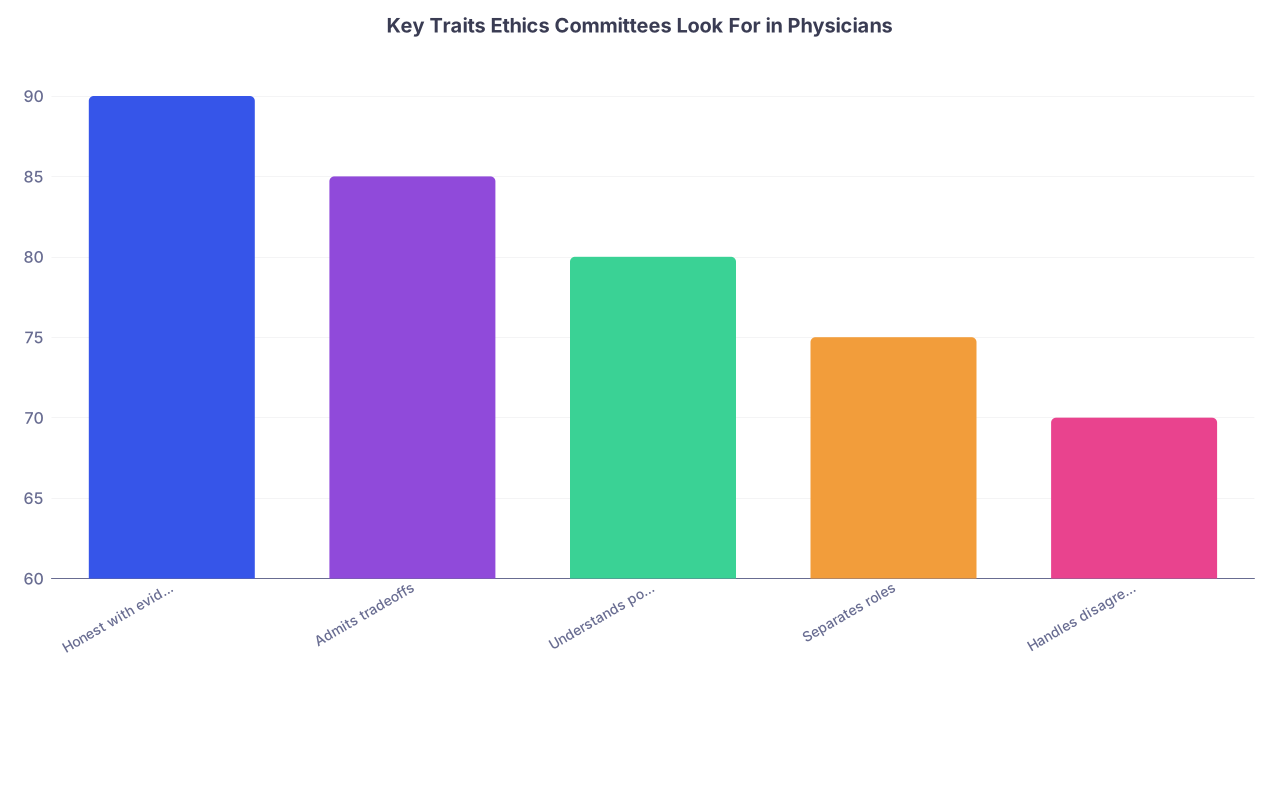
| Category | Value |
|---|---|
| Honest with evidence | 90 |
| Admits tradeoffs | 85 |
| Understands populations | 80 |
| Separates roles | 75 |
| Handles disagreement | 70 |
That’s not literal survey data, but it’s directionally accurate to how people in those rooms rank what makes a physician trustworthy in policy discussions.
The thing they do not reward? Moral grandstanding that dissolves with the first challenging question.
6. They Expect You to Distinguish “Unethical” from “I Dislike This Policy”
This one drives ethicists and committee members absolutely insane.
Every controversial policy brings out the same language from some clinicians:
- “This is unethical.”
- “This violates the oath.”
- “This goes against everything we stand for.”
Most of the time, what they really mean is: “I strongly dislike this policy and it conflicts with my personal values.”
Ethics committees expect you to know the difference. And to argue accordingly.
Here’s the insider rule: In serious policy ethics, “unethical” is not a synonym for “I disagree.” It usually means one of a few things:
- It violates a core professional obligation (e.g., confidentiality without justification, non-consensual experimentation).
- It unjustifiably discriminates against a protected or vulnerable group.
- It sacrifices a foundational ethical norm without adequate reason or procedural safeguards.
So if you walk into a vaccine mandate debate and declare, “Mandates are unethical,” and your reasoning is essentially, “I don’t like coercion,” you’re going to lose credibility.
The ethics committee wants to see something more like:
- “Mandates can be ethically justified if certain conditions are met: proportionate benefit, least restrictive alternative, equity in burden, transparency, and recourse mechanisms. My argument is that in this specific context, those conditions are not adequately met, for these reasons…”
Now you sound like someone who understands public health ethics, not someone who just stapled “ethics” onto their political preference.
7. They Expect You to Respect Process, Not Just Outcomes
Most physicians think in outcomes: Did more people live or die? Did the policy “work”?
Ethics committees care about process almost as much as outcomes. Sometimes more.
In public health policy debates, they’re evaluating you on whether you understand and respect procedural fairness:
- Were stakeholders consulted, especially those most affected?
- Were criteria for decisions established before specific cases arose, or made on the fly?
- Was there transparency in how decisions were made and who had authority?
- Is there an appeals or review mechanism?
I’ve seen clinicians argue, “This visitation policy is fine because our COVID rates were low.” Ethically, that’s not enough. The committee wants to know:
- How were visitation exceptions decided?
- Were some communities disproportionately restricted?
- Was communication consistent, or did it depend on who yelled the loudest attending got their way?
If your entire argument is outcomes-only, you’re missing half the game. They will mentally classify you as a good bedside clinician, but not someone to put on a formal policy-writing committee.
8. They Expect You to Handle Disagreement Like an Adult, Not Like Twitter
Here’s the part that doesn’t show up in official descriptions but makes or breaks reputations.
Behind closed doors, ethics committees talk about how people argue.
They remember:
- The surgeon who rolled their eyes when a community representative spoke.
- The hospitalist who snapped, “Well, if you’d seen what I’ve seen, you’d agree with me.”
- The intensivist who listened carefully, reframed an opponent’s argument fairly, then disagreed without personal attack.
Guess which one gets invited back.

| Step | Description |
|---|---|
| Step 1 | Clinical Concern Raised |
| Step 2 | Evidence Presented |
| Step 3 | Values and Tradeoffs Discussed |
| Step 4 | Policy Options Proposed |
| Step 5 | Stakeholder Feedback |
| Step 6 | Revisions and Safeguards |
| Step 7 | Final Policy Recommendation |
The question committees ask themselves during debates is: “Does this physician help or poison this process?”
They are not impressed by:
- Appeals to “real doctors” vs “theorists”
- Thinly veiled insults about “bureaucrats” or “ivory tower ethicists”
- Rhetorical tricks, mischaracterizing opposing views, cheap shots
They are impressed by:
- “Here’s the strongest version of the position I disagree with…”
- “If we adopt my preferred policy, here’s how it might fail and who might suffer.”
- “I’m worried I’m over-weighting my experience in the ICU; I’d like to hear from primary care and public health colleagues.”
Physicians who argue like that get remembered. And not just as “nice people.” As serious contributors.
9. They Expect You to Understand Your Conflicts of Interest—Including Non-Financial Ones
Everyone thinks of pharma money. That’s the easy part.
Ethics committees are more interested in the less obvious conflicts you probably haven’t fully examined:
- Your specialty: ICU, ED, oncology—each colors which harms you see and which you discount.
- Your institutional role: department chair, hospital administrator, union leader.
- Your social identity and lived experience: which groups you instinctively defend or neglect.
In a resource-allocation debate, when the transplant surgeon argues for protecting transplant beds at all costs, everyone knows there’s a conflict. What they’re watching for is: do you name it, or do you pretend you’re just being “objective”?
The physician who says:
“I want to acknowledge my bias: my entire career is about saving transplant candidates at huge resource cost. That makes me instinctively resistant to any policy that touches transplant access. So take that into account as you weigh my argument.”
That person’s credibility increases when they talk like that. Because committees see self-awareness as a safeguard.
| Type of Conflict | Typical Example |
|---|---|
| Specialty bias | ICU vs outpatient focus |
| Institutional role | Admin vs frontline |
| Research interests | Study population affected |
| Public persona | Social media branding |
| Ideological identity | Liberty-first vs equity-first |
Ethics committees expect you to recognize these. To say them out loud. And to adjust your influence accordingly.
10. They Expect You to Think Beyond the News Cycle
Most public arguments physicians have about ethics track the news cycle: one viral case, one hot-button law, one crisis.
Ethics committees are playing a longer game.
They’re asking:
- If we adopt this principle now, what precedent does it set for the next crisis?
- How will this policy be interpreted, copied, or warped by institutions with fewer safeguards?
- What does this say about what medicine stands for 10 years from now?
So when you weigh in on a controversial law or policy, they’re listening for anything that sounds like long-term thinking.
The physician who insists, “This is an emergency; we can worry about precedent later” might win applause online. In the committee room, that’s a red flag.
A better move:
“I think a temporary departure from our usual norms may be justified, but I want clear sunset clauses and explicit language that this is crisis-specific. Otherwise we risk normalizing restrictions that will be misused in calmer times.”
That’s how you sound like someone who understands ethics at the institutional level, not just at the bedside.
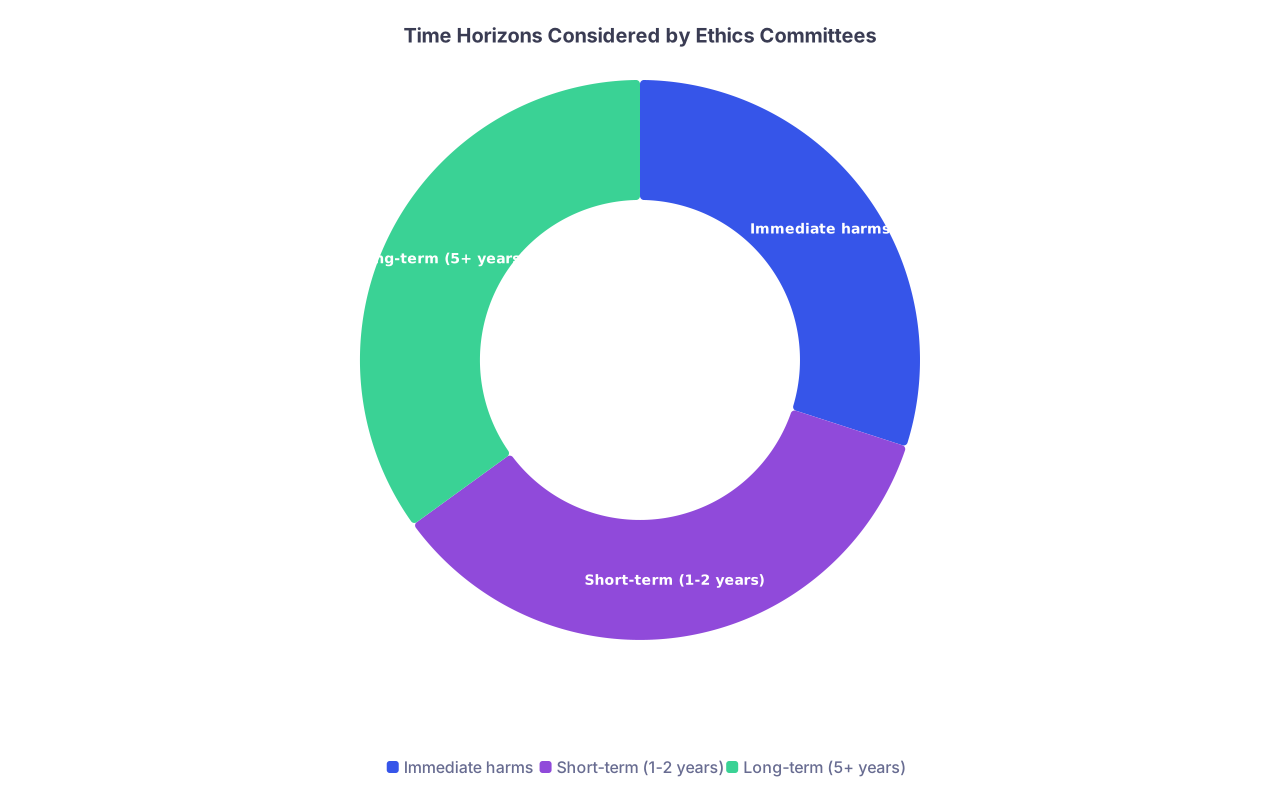
| Category | Value |
|---|---|
| Immediate harms | 30 |
| Short-term (1-2 years) | 35 |
| Long-term (5+ years) | 35 |
They’re splitting attention across all three. They expect you, at minimum, to acknowledge the long-term side.
11. How to Actually Show Up Well in Policy Debates
Let me boil this down into something pragmatic. If you’re a physician stepping into public health policy debates and you care what ethics committees think of you, there are a few concrete behaviors that change everything.
When you speak—on a panel, at a town hall, in an op-ed, in front of your hospital board—do this:
Explicitly separate roles:
“Speaking as a clinician…” vs “Speaking as a citizen…”Name your values:
“I’m prioritizing equity over efficiency here, and that leads me to…”Admit uncertainty:
“Here’s what we know. Here’s what we don’t. My judgment call is…”Show your work on tradeoffs:
“If we choose A, Group X benefits, Group Y is harmed this way…”Declare your conflicts:
“My specialty background makes me especially sensitive to…”Engage the strongest opposition:
“A serious concern with my position is…”Respect the process:
“Whatever we decide, I want transparent criteria and an appeal path.”

Do that consistently, and ethics committees will start saying, in the conversations you don’t hear:
- “We should have them on the working group.”
- “They understand the ethical dimensions, not just the clinical.”
- “They’re a reliable voice in public-facing discussions.”
You’ll stop being just “a doctor with an opinion” and become one of the people they actually trust when the stakes are high.
FAQ: What Ethics Committees Expect from Physicians in Policy Debates
1. Do I need formal ethics training to be taken seriously in policy debates?
No. You need intellectual honesty, some basic ethical vocabulary, and self-awareness. Formal training helps, but committees don’t require you to quote Beauchamp and Childress. They want to see that you can separate facts from values, own your biases, and engage fairly with opposing positions. The worst-performing physicians in these rooms are not the untrained—they’re the overconfident who think “being a good person” replaces structured reasoning.
2. Can I publicly take a strong stance on a controversial policy without hurting my reputation with ethics committees?
Yes—if you do it the right way. You can be very clear and firm (“I support X,” “I oppose Y”) without sounding dogmatic. The key is whether you acknowledge complexity, engage the best counterarguments, and avoid turning every disagreement into a moral indictment. Committees are not allergic to strong views; they’re allergic to simplistic moralizing.
3. How much should I talk about non-medical impacts (economic, social, legal) of a policy?
Enough to show you understand the world does not end at the door of your clinic. You don’t have to become an economist or lawyer, but you should demonstrate awareness that your preferred policy has non-medical consequences, and those matter. Ethics committees expect you to respect those domains and often to defer to those experts while explaining the medical dimensions.

4. Is it a problem if my personal politics are obvious in my policy positions?
Your politics will show; that’s inevitable. The problem is pretending they aren’t there and hiding behind your MD as if your stance is purely scientific. Ethics committees actually respect the physician who says, “My political values lean toward X, which shapes how I see this tradeoff. Here’s how I try to keep that from distorting my interpretation of the evidence.” Transparency beats denial every time.
5. How can I tell if I’m ready to represent my institution in a public ethics or policy debate?
Ask yourself a few blunt questions. Can you clearly explain where the evidence ends and your values begin? Can you summarize the best argument against your own position without caricature? Can you admit uncertainty without collapsing into indecision? If yes, you’re in decent shape. If not, you’re not doomed—you just need to treat ethics and policy reasoning as skills to develop, not as something you’re automatically good at because you survived residency.

You’re a physician stepping into a larger arena now: public health policy, institutional rules, laws that affect thousands or millions, not just the patient in front of you. With these expectations in mind, you’re better prepared to argue like someone ethics committees can actually trust. The next step is using that voice—on hospital committees, in op-eds, in legislative hearings. How you do that strategically and without burning out? That’s another conversation entirely.