What happens if you’re in a program where everyone looks terrified to mention COVID policy, abortion, gun violence, or racism—even though those are literally public health issues?
Because that’s what this really is, right? You’re not asking about “politics” in the abstract. You’re asking: what if my program basically tells me, “Shut up about public health policy. We don’t do that here.”
And then you’re stuck thinking:
- Am I going to get labeled “unprofessional” if I speak up?
- Could this actually hurt my evaluations or letters?
- Am I being cowardly—or smart—if I stay quiet?
- Is this even an ethical place for me to train?
Let’s pull this apart slowly, because the worst part of this situation is feeling like you’re crazy for even noticing it.
First: You’re Not Imagining the Pressure to “Stay Apolitical”
You know that moment in conference when someone almost mentions systemic racism in health outcomes, then stops and calls it “social determinants” and quickly moves on?
You’re not hallucinating that. A lot of programs do this tightrope walk: they say they “care deeply about health equity”… right up until anyone connects that to actual policy, legislation, or power structures. Then suddenly it’s “too political.”
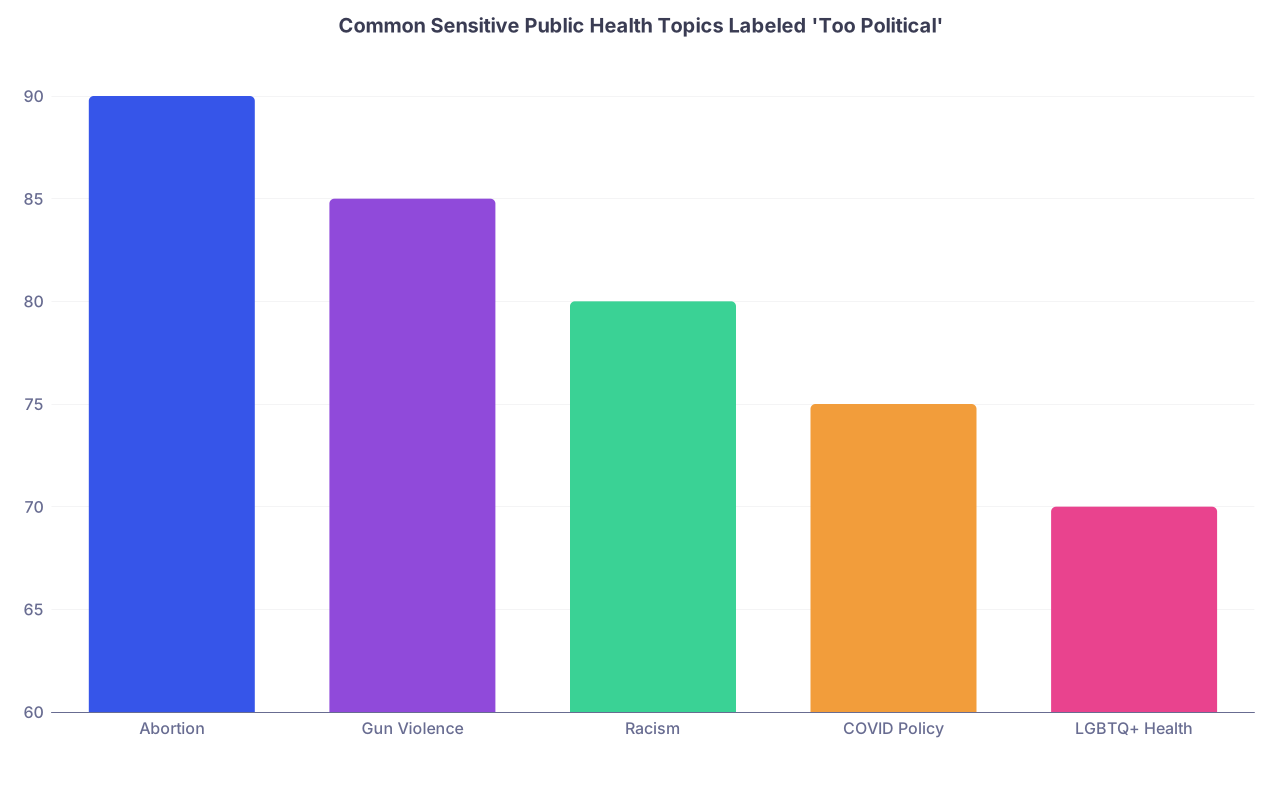
| Category | Value |
|---|---|
| Abortion | 90 |
| Gun Violence | 85 |
| Racism | 80 |
| COVID Policy | 75 |
| LGBTQ+ Health | 70 |
Those numbers aren’t from a specific study—I’m making a point: these are the usual landmines.
Why programs clamp down:
- They’re scared of complaints from patients, staff, or donors.
- Leadership is conflict-avoidant and hides behind “professionalism.”
- The local political climate is hostile (think: restrictive abortion laws, anti-trans legislation).
- They genuinely don’t understand that “public health policy” isn’t optional content; it’s part of the job.
So no, you’re not overreacting. You’re in a system that often wants the appearance of caring about population health, without the discomfort of grappling with the politics that shape it.
And you—relatively powerless, evaluated constantly, dependent on letters—are caught in the middle.
The Ethical Knot: Are You Complicit if You Stay Quiet?
This is the part that keeps you up at 2 a.m., staring at the ceiling.
You see a pregnant patient who wants options in a state where abortion is restricted.
You see a kid with repeated asthma admissions because of terrible housing and air quality.
You see a Black patient treated differently than the white one in the next room.
You know these are policy problems. You know silence is part of why they persist.
And your program’s vibe is: “Stick to the medicine. Leave ‘politics’ out of it.”
Here’s the unpleasant truth, from someone who’s watched many trainees beat themselves up over this:
You cannot single‑handedly fix your program’s political cowardice while you’re still being evaluated by it.
Does that mean you do nothing? No. But you have to separate three different levels:
Ethical duty to individual patients
You’re expected—professionally and ethically—to give patients accurate, evidence-based information, including how laws and policies affect their options. That’s not “politics.” That’s informed consent and patient autonomy.Ethical duty to public health
Things like vaccination campaigns, harm reduction, reproductive health, or gun safety counseling are standard parts of public health practice. If your program treats these as taboo, they’re out of step with modern medicine, not you.Self-preservation as a trainee
You have a right not to be destroyed in the process. You can’t help patients or populations if you’re blackballed from your specialty, or quietly buried by bad evals for being “disruptive.”
You’re not a sellout for choosing your battles. You’re not unethical for noticing the power imbalance and adjusting your strategy. The fantasy that “real advocates always speak truth to power no matter the cost” is how burned-out, bitter former trainees are made.
You’re allowed to play the long game.
What You Can Do Inside a Program That Discourages “Politics”
Let’s be blunt: some places are so rigid that you can’t fix them. But you can often carve out pockets of sanity without getting crushed.
1. Use the language they accept—even if it feels watered down
Horribly annoying, yes. But framing matters if you want to stay under the radar.
Instead of:
“Gun control is a public health necessity.”
Try:
“I’m concerned about firearm injury prevention and how we can better counsel families on safe storage, especially since it’s a leading cause of death in kids.”
Instead of:
“Racism is killing our patients.”
Try:
“We’re seeing consistent disparities in outcomes by race. Could we discuss structural factors—like housing, access, and bias—that might explain that pattern?”
You’re saying the same thing. You’re just not triggering the people who shut down as soon as they hear the word “politics.”
2. Anchor everything to patient care and evidence
If you get pushback, your lifeline is: “This affects patient outcomes, and here’s the data.”
- Talk about state policy changes in the context of what you must tell the patient: “State law now restricts X, so this is what I can and can’t offer.”
- Discuss vaccination campaigns as standard preventive medicine, not a personal opinion.
- Connect structural issues (housing, food insecurity, marginalization) to readmission rates, medication adherence, mortality.
If someone says, “That’s political,” calmly say:
“I’m focusing on how this impacts our patients’ health and the care we can provide safely and ethically.”
3. Build a micro‑community of safe people
You don’t need the entire program to get it. You need 2–5 humans you can trust.
Look for:
- The attending who quietly says, “Yeah, we have to talk about policy, it affects everything.”
- The social worker who has seen decades of system failures and isn’t shocked by anything.
- The resident who asked an actually risky question once and wasn’t destroyed for it.
Have the real conversations in:
- Hallway chats
- Post-call debriefs
- Coffee runs
- Journal clubs you co‑run
This does two things: protects your sanity and gives you cover. When you’re not the only “political” one, you’re just one part of a visible minority who obviously cares about patients, not just controversy.

| Step | Description |
|---|---|
| Step 1 | Notice public health issue |
| Step 2 | Address directly with patient |
| Step 3 | Educational or systems issue |
| Step 4 | Use neutral language and allies |
| Step 5 | Speak more directly |
| Step 6 | Document facts, keep evidence |
| Step 7 | Reflect and adjust for next time |
| Step 8 | Immediate patient impact? |
| Step 9 | Risk to evaluation high? |
When It Crosses the Line from Annoying to Ethically Gross
There’s “we prefer to keep things neutral.”
And then there’s: “Don’t tell patients things the law says you must tell them,” or, “You’re not allowed to mention options that are legal elsewhere.”
That’s different. That’s not discomfort with politics. That’s ethically dangerous.
Big red flags:
- You’re told not to discuss legal, evidence-based care because someone might complain.
- You’re discouraged from documenting concerning social/policy factors in the chart (e.g., unsafe housing, domestic violence, hate-related violence).
- Faculty mock or retaliate against trainees for asking policy-related questions in good faith.
- The program explicitly punishes involvement in professional advocacy that is mainstream in your field (e.g., ACOG, AMA, APHA positions).
At that point, you’re not just in an awkward culture. You’re in a place that conflicts with core medical ethics: autonomy, beneficence, nonmaleficence, justice.
What you can actually do (without blowing yourself up):
- Quietly document what’s happening—for yourself. Dates, what was said, by whom.
- Look up your professional society’s policy statements (AMA, ACP, AAFP, ACOG, APHA, etc.). Often, they explicitly support physician involvement in public health advocacy.
- Talk off-the-record with someone outside your program: another institution’s faculty mentor, a former resident, or someone from your med school who knows the landscape.
- If it’s really bad and you’re not safe internally, consider GME, ombudsperson, or your specialty organization’s resident section—only after you’ve talked strategy with a trusted mentor.
You don’t need to martyr yourself. But you also don’t have to gaslight yourself into believing unethical behavior is “just politics.”
Protecting Your Future: Career, Reputation, and Sanity
You’re probably also thinking: “If I speak up now, will I tank my chances at fellowship? At academics? At public health work later?”
Here’s the paradox: programs that are allergic to politics are not usually the ones that control your future in public health or policy. The people who will later open doors for you tend to be:
- Faculty already involved in health policy, advocacy, or community work
- Mentors at other institutions you meet via conferences or virtual projects
- Public health folks who don’t care what your PD thought of you, as long as you did real work
So your strategy becomes:
Survive your evaluations
Don’t give people easy excuses to label you “difficult.” Show up, do solid clinical work, be prepared, be reliable. That annoys them way more when they can’t say you’re sloppy or lazy.Build your “real self” portfolio quietly
Join a national committee. Write a policy brief. Collaborate on a QI or health equity project that can be framed as “quality” rather than “politics.”Choose where to be loud
You don’t have to fight your entire program to death. You can:- Present at conferences where policy talk is expected
- Publish commentaries or letters in journals
- Engage on state or national advocacy work under professional organizations
That way, when you’re finally out and applying for jobs or fellowships, you’re not just “The Resident Who Complained a Lot.” You’re “The Resident Who Did Actual Work in Public Health Policy While Training in a Tough Environment.”
| Approach | Relative Risk in Rigid Program |
|---|---|
| Patient counseling with evidence | Low |
| Journal club on policy impacts | Low–Medium |
| Internal emails challenging policy | High |
| External op-eds with program name | Very High |
| National advocacy via societies | Low–Medium |

How to Stay Ethically Grounded Without Burning Out
You’re trying to hold two things that don’t sit well together:
- I want to be a good doctor/public health professional.
- I’m in a system that sometimes punishes people for being good in that way.
That cognitive dissonance can wreck you if you don’t handle it intentionally.
Some ways to keep your head above water:
Write down your own lines in the sand
Literally. In a private document or journal, answer:- “I will not lie to patients to make my program comfortable.”
- “I will always inform patients of their options within the law, even if it makes people nervous.”
- “I will not post public rants naming my program while I’m still dependent on it.”
Whatever your lines are, write them. Then you know when you’re compromising on language versus compromising on ethics.
Separate your values from your tactics
Your values can stay rock solid: justice, honesty, patient autonomy, harm reduction.
Your tactics can shift: softer language here, stronger language there, choosing the right time and place.Strategy doesn’t mean your values are weak. It means you want your values to actually survive long enough to matter.
Find mentors who aren’t scared of policy
If you can’t find them in your program, look outside:- APHA local chapter
- State or city health department
- Specialty society advocacy committees
I’ve seen people find their “real tribe” completely outside their home institution and suddenly feel less trapped.
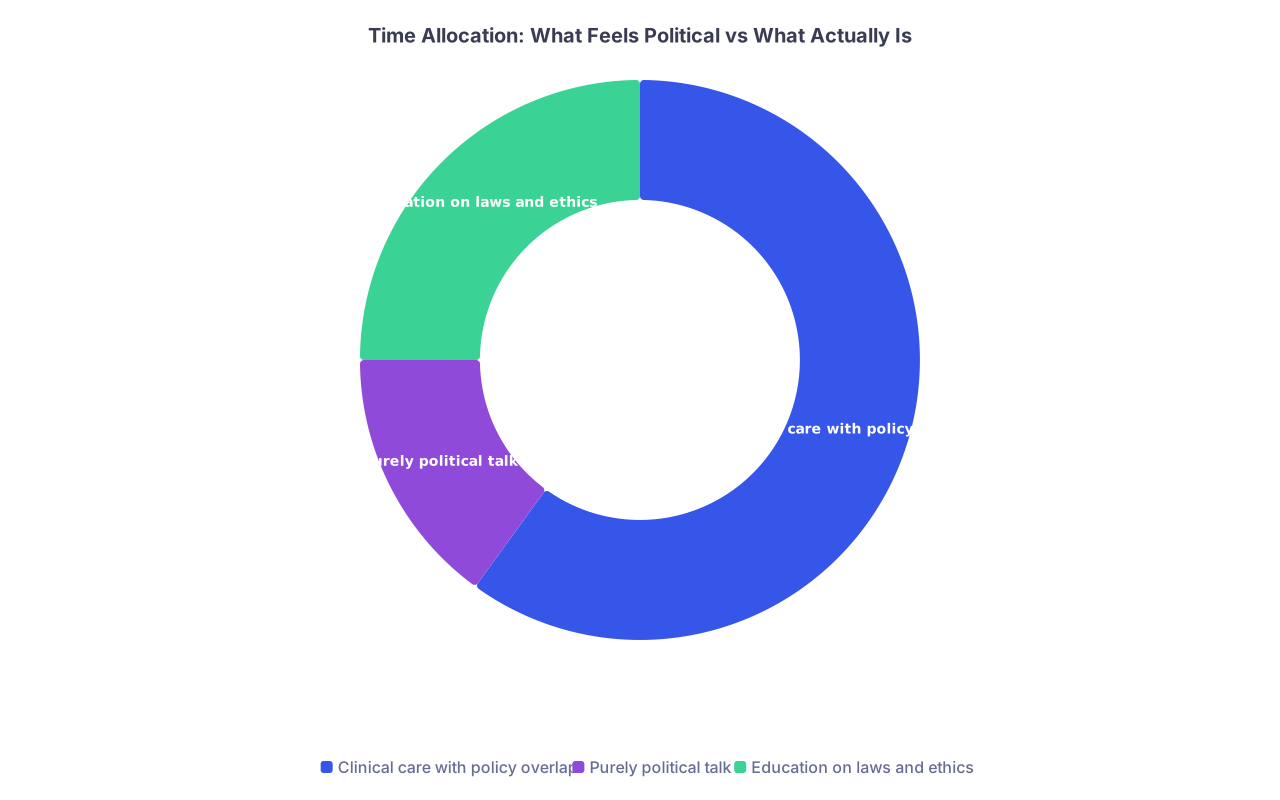
| Category | Value |
|---|---|
| Clinical care with policy overlap | 60 |
| Purely political talk | 15 |
| Education on laws and ethics | 25 |
The reality? Most of what you’re worried about—counseling patients affected by laws, talking about structural determinants, discussing epidemics—is clinical and ethical work that your program is wrongly labeling as “political” because it makes people uncomfortable.
You’re not the problem for wanting to talk about it. You’re just noticing reality.
FAQ (Exactly 5 Questions)
1. Am I unprofessional if I bring up public health policy on rounds?
No. You’re unprofessional if you’re disrespectful, uninformed, or grandstanding. Bringing up, “How is this new state law affecting what we can offer this patient?” or “What do we do when housing policy leads to repeated admissions?” is entirely appropriate. If your program calls that “unprofessional,” that’s a culture problem, not a moral failing on your part.
2. Can speaking up about politics actually hurt my evaluations or letters?
Yes, it can, in some programs. I’ve seen residents tagged as “disruptive” or “agenda-driven” when they pushed too hard in the wrong setting with the wrong attending. That doesn’t mean you must stay silent; it means you should be strategic. Know who’s receptive, choose timing wisely, and back everything with patient-centered reasoning and data.
3. Should I try to change my program’s culture while I’m still a trainee?
You can nudge it. You’re unlikely to overhaul it. Small things—suggesting a journal club article on policy, asking for a lecture on legal aspects of care, framing topics as “quality improvement” or “patient safety”—are realistic. Trying to lead a full-on culture war as a PGY-2 is a fast track to burnout and backlash.
4. What if my program tells me not to mention certain legal options to patients?
That’s a massive red flag. Your ethical obligation is to inform patients of medically appropriate, legal options. If your program is pressuring you to withhold information, you’re in dangerous territory ethically. Talk privately with a trusted mentor (even outside your program), review your specialty society’s ethics guidelines, and consider higher-level resources like GME or an ombudsperson—carefully and with advice.
5. How do I know if I should leave or transfer because of this?
Look at three things:
- Are you being prevented from practicing basic ethical, evidence-based care?
- Are you constantly afraid that any honest question will tank your career?
- Do you have any allies in the program?
If the answer is yes/yes/no, and there’s no path to improvement, then exploring transfer isn’t dramatic—it’s self-preservation. Talk confidentially with mentors outside your program before making moves, but don’t gaslight yourself into thinking you must endure a place that actively undermines your ethics.
Open a blank note right now and write two lists: “What I refuse to compromise on with patients” and “Where I’m willing to be strategic and quiet for now.” That’s your starting map for surviving this program without losing yourself.