
It’s 11:45 p.m. Your clinic notes are half-finished, your inbox still has 30 unread messages, and you just got off a “quick” Zoom with a state medical society committee that ran 90 minutes over. You started this work because you care about patients and policy. But now you’re snapping at your MA, dreading advocacy calls you used to love, and secretly thinking, “If one more person asks me to join a task force, I’m throwing my phone in the river.”
This is where advocacy burnout starts. Not with a dramatic collapse, but with “just this one more thing” layered on top of an already unstable pile.
I’ve watched a lot of clinicians convince themselves they’re “fine” right up until they’re contemplating quitting all advocacy—or medicine altogether. They miss the early warning signs. Or worse, they see them and rationalize them away.
Let’s walk through the mistakes physicians make that push them from committed advocate to burnt-out casualty, and the red flags you cannot afford to ignore.
1. Believing “This Is Just Regular Burnout” (And Missing the Advocacy-Specific Signs)
Advocacy burnout isn’t identical to clinical burnout. If you treat it like generic exhaustion, you’ll miss the chance to course-correct early.
Classic clinical burnout: emotional exhaustion, depersonalization, reduced sense of efficacy.
Advocacy burnout adds its own nasty twist: moral injury plus political fatigue.
Here’s where people screw up: they notice they’re tired and assume “everyone’s tired,” so they keep volunteering, keep joining panels, keep letting their name be used on letters they barely read.
Watch for these advocacy-specific early signals:
- You feel dread before advocacy meetings you used to find energizing. Not mild reluctance—actual stomach-drop dread when the calendar notification pops up.
- You’re increasingly cynical about policy wins. A bill passes and your first thought is, “They’ll water it down anyway,” not, “This is a step.”
- You start ghosting advocacy colleagues. Ignored messages. “Sorry, just seeing this!” when you saw it three days ago and couldn’t bear to reply.
- You’re emotionally flat in the face of injustice you used to fight. Another prior authorization horror story, another patient denied coverage, and you think, “Of course. Whatever.”
That last one is big. When systemic harm feels inevitable instead of infuriating, your advocacy engine is starting to seize.
Do not mislabel this as “growing realistic” or “getting mature.” That’s denial dressed up as sophistication.
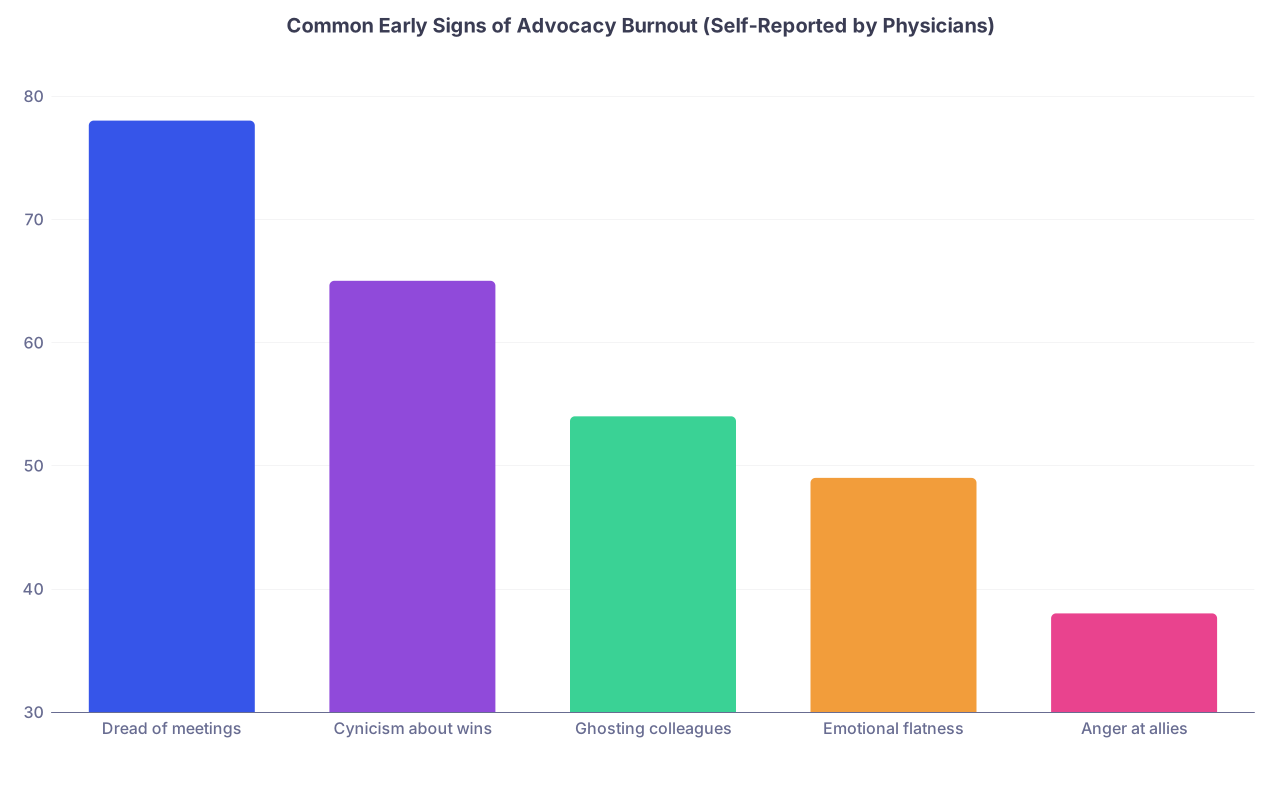
| Category | Value |
|---|---|
| Dread of meetings | 78 |
| Cynicism about wins | 65 |
| Ghosting colleagues | 54 |
| Emotional flatness | 49 |
| Anger at allies | 38 |
2. Confusing Self-Sacrifice With Ethics
Physicians love to martyr themselves and then call it professionalism or ethics.
“I have to stay,” you tell yourself. “If I don’t push this prior auth bill, who will?” Or, “My department needs me on this anti-racism task force. I can’t step back; it’s too important.”
The mistake: treating self-harm as an ethical obligation.
Let me be blunt: burning yourself out doesn’t help your patients, your colleagues, or your cause. It just takes an effective advocate off the field and hands your spot to someone less experienced or, worse, no one at all.
Early warning that you’re crossing from healthy commitment into self-destructive sacrifice:
- You feel guilty taking a single evening off from advocacy work.
- You describe your own participation in moral terms: “I should be there,” “I owe it to them,” “It would be wrong not to go.”
- You tolerate boundary violations: calls during clinic, texts on weekends, “It’ll just be 15 minutes” that always turn into 60.
- You’re proud of being “the go-to person”—even as you’re quietly resentful.
Here’s the ethical test no one teaches you but every sane advocate uses:
If the system depends on you personally overextending to keep progress moving, the system is broken. You’re not ethically obliged to be its patch.
Advocacy needs you sustainable, not sacrificial.
3. Ignoring How Your Time Has Shifted (Until You’re Running on Fumes)
Another trap: losing track of how advocacy has crept into every crack of your schedule. You’re not lazy. You’re just not tracking the shift.
You say yes to one committee. Then a working group. Then testimony prep. Then op-eds. One more panel. A podcast. Suddenly you’re doing a third job but still pretending it only takes “a few hours a week.”
Reality usually looks closer to this:
| Activity Type | What You Tell Yourself | What Actually Happens |
|---|---|---|
| Committee meetings | 2 hours | 4–5 hours |
| Email and coordination | 1 hour | 3 hours |
| Writing/testimony | 1 hour | 2–4 hours |
| Informal advising | 0.5 hours | 2 hours |
| Emotional processing | 0 | 1–2 hours |
That “emotional processing” line? Everyone pretends it doesn’t exist. But doomscrolling after a legislative defeat, replaying a contentious meeting, or venting for 45 minutes after another racist policymaker comment—that’s time and energy you’re spending.
Red flags that your time load has become dangerous:
- You have less than one truly off-work evening per week. Off means no advocacy email, no draft testimony, no committee prep.
- Admin tasks are slipping in your day job. Delayed notes. Piled-up inbox. Missed deadlines.
- You’re more behind on personal life tasks than usual: bills late, clutter everywhere, no groceries, unanswered texts from friends.
That’s not “I need to be more organized.” That’s “I’m overcapacity and stealing from sleep and sanity to make it work.”
You don’t fix this by buying a new planner. You fix it by saying “no” a lot more aggressively.
4. Weaponizing Your Own Anger Against Yourself
Advocacy work exposes you to cruelty, indifference, and injustice. Step therapy that hurts your patients. Legislators who openly dismiss evidence. Hospital leadership more interested in billing than safety.
Your anger is rational.
The mistake is turning that anger into a cudgel and beating yourself with it.
“I’m so privileged; I should be doing more.”
“I can’t complain, my colleagues in X country have it worse.”
“If I really cared, I wouldn’t feel tired. I’d just push through.”
If that sounds familiar, you’re not noble; you’re setting up the perfect psychological trap. Because no matter how much you do, it will never feel like enough. The problems are bigger than you. So guilt becomes your only fuel.
Guilt-powered advocacy burns hot and fast. Then it collapses.
Early warning signs:
- You feel ashamed of needing rest. You hide it. You lie about why you can’t attend something.
- Detachment feels morally wrong. You think, “If I stop reading every tragic story, it means I don’t care.”
- You keep saying, “Once this bill passes, I’ll slow down,” but then you immediately take on the next fight.
Advocacy requires the ability to not feel everything, all the time. Deliberate emotional limits aren’t selfish. They’re survival.
5. Misreading Conflict in Advocacy Spaces
You expect pushback from insurers, hostile lobbyists, or clueless lawmakers. What blindsides many clinicians is conflict inside advocacy spaces—within your own coalition, hospital committee, or specialty society.
I’ve watched this tip people into burnout faster than anything else.
Warning signs:
- You find yourself more drained by infighting with allies than by arguments with opponents.
- Meetings that should be strategic become turf wars over credit, titles, or whose logo is on the press release.
- You’re spending more time smoothing interpersonal drama than moving policy.
If you’ve ever left a “health equity” meeting thinking, “If this is equity work, I’m out,” you know exactly what I mean.
The mistake is assuming this is just “how advocacy is” and that your job is to stick it out indefinitely.
No. You are allowed to decide that a specific advocacy environment is toxic and withdraw—while still being committed to the cause. Leaving a dysfunctional coalition is not abandoning the mission; it’s preserving your ability to fight from somewhere healthier.
Pay attention to these inner reactions:
- Dreading specific people, not just hard topics.
- Feeling you have to script every word to avoid blowups.
- Leaving meetings feeling smaller, not stronger.
Those are early exit signals. Ignore them long enough and you’ll associate the entire field with that dysfunction, not just that one group.
6. Letting Identity-Based Harm Slide “Because The Cause Is Important”
If you’re a physician from a marginalized group, there’s a particular trap you’re at high risk for: tolerating microaggressions, tokenization, or outright discrimination within advocacy spaces because “the cause matters.”
“I don’t want to be the difficult one.”
“At least I have a seat at the table.”
“They mean well, and the policy work is important.”
Do not talk yourself into accepting slow, steady harm as the price of being involved.
Early warning signs you’re doing exactly that:
- You’re consistently asked to represent “your community” but shut down when you challenge the group’s favored narrative.
- You’re invited to panels or task forces only when the topic is DEI, racism, gender, or trauma—not when it’s payment reform, regulations, or leadership.
- You’re praised in public and sidelined in private decision-making.
- You leave advocacy spaces emotionally shredded but convince yourself you’re just “too sensitive.”
I’ve watched brilliant physicians—especially women, Black physicians, LGBTQ+ physicians, and immigrant physicians—convince themselves that enduring this garbage is part of “being at the table.”
It isn’t. It’s a recipe for disillusionment so deep that you walk away from advocacy altogether.
The ethical move is not to swallow it. The ethical move is to set conditions under which you’ll participate, and walk if they’re not met.
7. Failing to Recognize the Physical Symptoms as Burnout, Not “Just Life”
You already know burnout has physical manifestations. You’ve probably counseled patients and trainees about it. Then you ignore your own.
What advocacy burnout looks like in the body—early:
- Sleep is trash. Either you can’t fall asleep after late meetings, or you wake at 3 a.m. replaying one comment from a hearing.
- Headaches ramp up around advocacy work. Pre-meeting migraine? That’s your nervous system talking.
- GI issues flare on days with big policy events. Nausea before speaking, IBS symptoms after hostile sessions.
- Your resting tension skyrockets: jaw grinding, neck/shoulder knots, chest tightness.
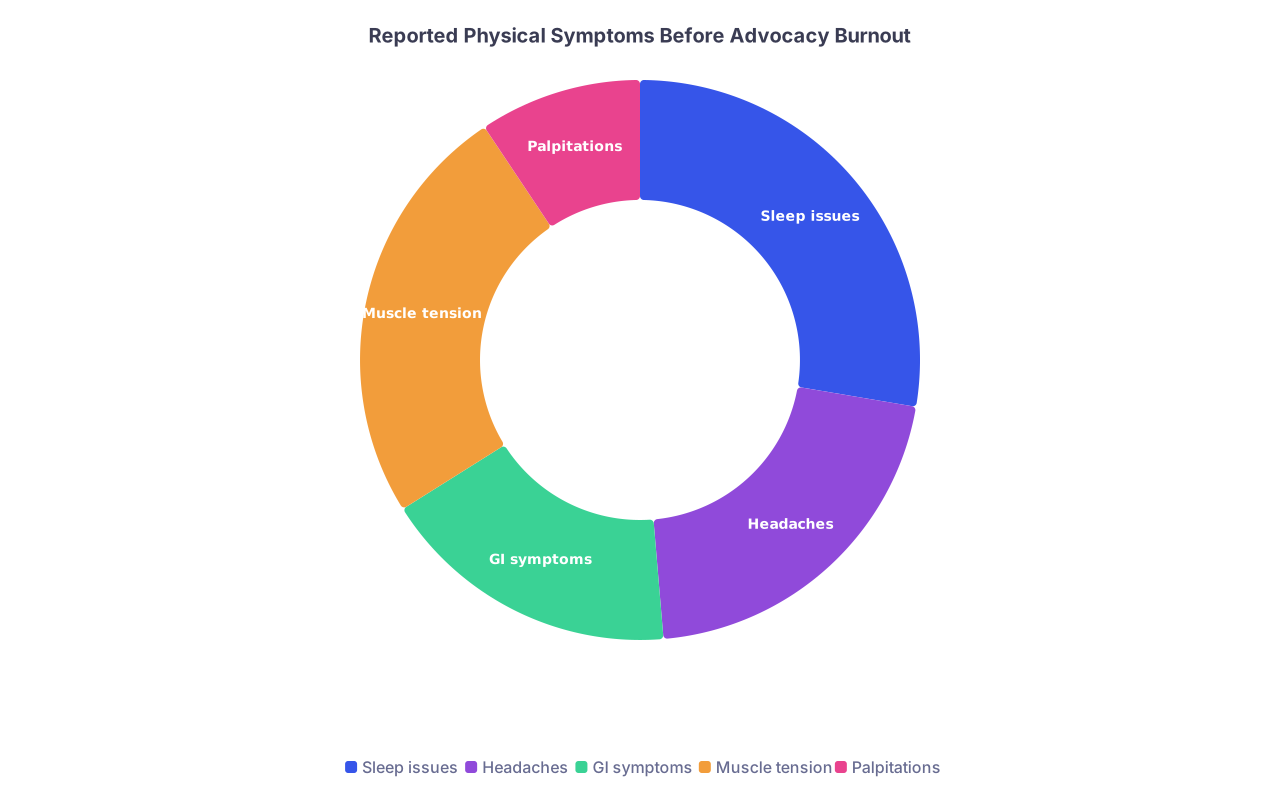
| Category | Value |
|---|---|
| Sleep issues | 62 |
| Headaches | 47 |
| GI symptoms | 39 |
| Muscle tension | 55 |
| Palpitations | 21 |
Here’s the mistake: attributing all of this purely to “clinical load,” “getting older,” or “post-pandemic stress.” Yes, those matter. But if your symptoms are particularly linked to advocacy days, meetings, or tasks, the pattern matters more than your rationalization.
If your body is consistently screaming “No” every time you put on your “policy hat,” that’s an early warning you dare not ignore.
8. Treating Every Ask as Equal and Failing to Triage
Most physicians don’t have a real system for evaluating advocacy asks. Someone says, “Can you be on this panel?” and the internal calculus is basically:
- Is this important?
- Do I care about this issue?
- Can I physically cram it into my schedule?
That’s how you end up saying yes to five medium-impact, high-drain activities and no to the one high-impact, sustainable role that would actually use your skills well.
You need a harsher triage. And you need it before you’re at the point of wanting to abandon everything.
A simple reality-based filter:

| Step | Description |
|---|---|
| Step 1 | New Advocacy Ask |
| Step 2 | Say No |
| Step 3 | Negotiate Scope or Delay |
| Step 4 | Say Yes with Clear Limits |
| Step 5 | Aligned with my core issues |
| Step 6 | High Impact or Unique Fit |
| Step 7 | Time and Energy Available |
Early warning you’ve lost control of triage:
- You feel equally obligated by minor and major asks.
- You can’t clearly articulate your “core issues” anymore; everything feels important.
- You’re taking on roles because “they need a doctor” or “they need a woman” or “they need a Black physician,” not because it matches your actual skills and bandwidth.
By the time you’re angry at every email request, you’ve already blown past the early warning stage. Fix it earlier by deciding in advance what you won’t do.
9. Losing Your Why (And Pretending You Haven’t)
At the beginning, most clinician-advocates can tell you exactly why they’re in the fight: a patient who died, a mentor’s story, a particular injustice that snapped something inside them.
Over time, if you’re not careful, that “why” gets buried under process: agendas, policy memos, endless meetings.
Early signs your “why” is slipping:
- You struggle to answer, “Why are you doing this?” without defaulting to vague language: “Well, it’s important work,” “We need physician voices.”
- You used to tell specific patient stories. Now you only talk in abstractions: “the system,” “stakeholders,” “structures.”
- You’re more animated describing your frustrations with colleagues or leadership than describing the change you’re trying to make.
When you lose your why, advocacy turns into unpaid, high-stress admin work. No wonder you feel burnt. There’s no meaningful emotional return, just obligation and conflict.
I’ve asked mid-career advocates, “Tell me about the first patient who made you want to do this.” Some can answer in a heartbeat. Others stare blankly. Guess which group is closer to walking away?
You cannot brute-force your way through purpose erosion. You have to deliberately reconnect—or consciously pause.
10. Waiting for a Crisis Before You Set Boundaries
The most common—and dangerous—mistake: waiting until you’re on the brink of meltdown to set boundaries, then doing it explosively.
You say yes, yes, yes, yes…then suddenly you quit every committee by mass email or rage-leave a group chat. Or you vanish from advocacy completely and don’t respond to anyone for months.
I’ve seen physicians do career damage this way. Not because they stepped back, but because they left in a way that burned every bridge and confirmed every stereotype about “unreliable clinicians.”
You need boundaries before you’re at the crisis point. That means recognizing these as early danger signs:
- You fantasize about quitting everything at least once a week.
- You catch yourself thinking, “If I got COVID or broke my leg, at least I’d get a break.”
- You’re secretly hoping an external event will “force” you to step back because you can’t bring yourself to choose it.
Those fantasies are your mind begging for boundaries you haven’t set.
FAQ (Exactly 3 Questions)
1. How do I know when I should step back from advocacy versus just cutting back?
If you’re early in burnout—dreading specific meetings, feeling flat, noticing physical symptoms tied to advocacy days—start by cutting back sharply for 3–6 months: decline new roles, drop low-impact tasks, and impose hard limits on time (for example, no advocacy work after 8 p.m. or on weekends). If even after that your baseline mood, health, and sense of purpose don’t improve, or you feel only relief at the idea of never doing advocacy again, that’s your sign a full pause is warranted. Temporary withdrawal is not failure; it’s strategic retreat.
2. What if I’m the only person in my institution doing this work? Won’t everything collapse if I stop?
That belief is one of the most dangerous illusions feeding your burnout. If a cause or committee literally cannot function without you personally, it’s already unsustainable and ethically shaky. Your job is not to be the single point of failure. Your job is to push for shared ownership, institutional support, and succession planning. If leadership refuses to build that and expects your endless unpaid labor instead, that’s not a noble burden—it’s exploitation. Stepping back in those circumstances exposes the structural problem they’re trying to hide behind your good will.
3. How do I bring up advocacy burnout without seeming weak or uncommitted?
You do not center your feelings as the main topic. You frame it as a sustainability and effectiveness issue. For example: “We’re taking on more initiatives than our current capacity can handle without harming clinical work and staff well-being. I’m noticing signs of strain in myself and others. We need to prioritize and set realistic scopes, or we’ll lose people to burnout and our impact will drop.” That language is harder to dismiss and opens the door to talking about boundaries, staffing, and support—while still being honest that you’re nearing your own limit.
Open your calendar and your email right now. Identify one advocacy commitment—meeting, committee, or task—that isn’t high-impact or uniquely suited to you. Reply, today, and either decline it or renegotiate the scope. Don’t wait until you’re fantasizing about disappearing; make a small protective move before you hit that wall.