
Policy committees are where promising junior careers quietly go to die.
Not always. But often enough that you need to treat them like a hazard zone, not an “honor.” Especially in academic medicine and public health.
If you’re early-career faculty and someone just said, “We’d love for you to join our policy committee—great opportunity!” your guard should go up. Not because all committees are bad. Because this is one of the most common ways junior people get exploited, politically exposed, and ethically compromised before they even get their footing.
Let me walk you through the landmines I’ve seen people step on—then show you how to avoid leaving your academic, clinical, or public health career scattered in pieces across some hospital’s Quality & Policy Council minutes.
1. The “Honor” That’s Actually Administrative Exploitation
The first big mistake: assuming a policy committee invitation is primarily a sign of respect. It’s usually a sign of need—the committee (or chair) needs warm bodies, political cover, or free labor.
Common trap: a junior faculty member in a public health department gets asked to sit on the “Health Equity and Community Engagement Policy Task Force.” Sounds perfect, right? It’s in your interest area. It looks virtuous. It’s full of acronyms.
Six months later:
- You’re drafting 80% of the documents.
- Your name appears nowhere on final policies.
- Senior people present the work as theirs.
- Your research and real scholarship are behind schedule.
Here’s the pattern I see over and over:
- Junior faculty join 2–4 committees thinking it’ll help with promotion.
- None of that work translates directly into grants, papers, or clear leadership roles.
- When promotion time comes, the committee work is brushed off as “service,” not leadership or scholarship.
Do not make this mistake:
Never assume “policy committee” = “career advancement.” Sometimes it does. Often it just means you’ll be doing unpaid, uncredited political labor.
Use a simple rule:
If you can’t clearly answer, in one sentence, “How will this committee move me closer to promotion or my next concrete career step?” you decline, or you negotiate the terms of your involvement.
2. The Hidden Currency: Politics, Not Evidence
Policy committees in health systems, schools of public health, and medical centers don’t primarily run on data. They run on politics, then backfill with data to justify decisions.
If you walk in thinking:
“If I bring good evidence and sound arguments, I’ll shape policy.”
You are absolutely setting yourself up to be used or sidelined.
What actually happens:
- The decision is often already informally made by a few senior people.
- The “committee” is there to create the appearance of broad input.
- Your role as junior faculty is quietly: “provide data we can quote, and don’t get in the way.”
I’ve watched junior faculty:
- Present well-designed analyses on screening policies, only to be told, “That’s interesting, but operations has already committed to Vendor X.”
- Push for stronger equity language and get labeled as “politically difficult” or “overly activist,” which then follows them into annual reviews.
- Publicly challenge a crusty senior surgeon on a procedure policy—and suddenly their call schedule and teaching evaluations look mysteriously worse.
You are not being asked to be the truth-telling hero. You’re being asked to sit at a table where power already lives.
If you forget that, you’ll:
- Over-share controversial positions.
- Take strong public stances without senior backing.
- Be remembered not as “smart” but as “problematic.”
Your safer approach:
- Spend the first 3–4 meetings mostly listening.
- Map who really has power: who speaks rarely but whose opinions end the discussion?
- Identify which topics are symbolic battles (billing, staffing, quality metrics) versus safer, technical domains (document wording, implementation timelines).
Bring evidence, yes. But don’t mistake good evidence for actual leverage.
3. Ethical Tripwires: Being the “Diverse” Cover
Public health and academic medicine have become very good at using “diversity” and “ethics” as optics tools.
If you’re junior and:
- From an underrepresented group,
- Working in health equity, ethics, or community engagement,
- Or just visibly “younger and progressive” compared to the room,
you’re at high risk of being used as moral decoration.
I’ve seen this play out like clockwork on hospital DEI policy committees, vaccination policy panels, and reproductive health task forces.
Script:
- Senior leadership crafts a policy that’s politically convenient but ethically weak.
- They invite a few junior, diverse, or ethics-branded faculty to the committee.
- Those faculty raise concerns; some are politely ignored or watered down.
- Final document: “Developed in collaboration with our diverse faculty and ethics experts,” complete with your name in the appendix.
Your reputation: used as cover for a policy you never truly endorsed.
- Endorsing policies that disadvantage marginalized patients but are sold as “neutral.”
- Helping build “community advisory” structures that are purely performative.
- Signing off on “consensus recommendations” that you explicitly objected to in meetings.
Don’t let this happen to you.
Protective steps:
- Ask upfront: “How will dissenting opinions be documented in the final product?”
- If they say “We operate by consensus,” translate that as: “Minority views will quietly disappear.”
- When necessary, put your concerns in writing (short, calm emails) so there’s a trail.
- If a policy crosses your ethical line and they won’t adjust it, you either:
- Request your name not be listed as endorsing, or
- Step back from the final “consensus” process entirely.
Yes, this is uncomfortable. But being memorialized on a policy you believe harms patients or communities is much worse—and that stuff lives forever in institutional archives.
4. Time Sink vs. Real Value: Bad Math Most People Don’t Do
Junior faculty wildly underestimate the time–and opportunity cost–of policy committee work.
Let’s be concrete.
| Activity | Conservative Hours/Year |
|---|---|
| Monthly meetings | 18–24 |
| Prep/reading | 15–30 |
| Email back-and-forth | 10–20 |
| Drafting/revisions | 15–40 |
| Ad hoc “urgent” tasks | 10–30 |
You’re looking at ~70–140 hours per year per serious committee.
Now do the math:
- Could that time produce 1–2 manuscripts?
- A grant resubmission?
- A curriculum innovation you actually lead and own?
The mistake: junior faculty treat this time as “free” because it’s spread out, attached to meetings, and seen as “service.” It’s not free. It’s displacing your actual promotable work.
To make smarter decisions, treat your time like currency. Roughly estimate:
1 hour of policy committee work vs. 1 hour of research / writing / teaching innovation — which moves my metric needle more?
You will almost always find:
- 1 carefully chosen, high-visibility committee = maybe worth it.
- 3–5 generic hospital/department committees = slow professional suffocation.
5. The Documentation Trap: Minutes, Emails, and Permanent Records
You’re not just “sharing thoughts” in a policy committee. You’re helping create official documents that can be:
- Subpoenaed.
- FOIA’d.
- Quoted in the press.
- Used in internal investigations.
Many junior faculty forget this and speak like it’s just a hallway chat.
Big landmines:
- Making off-the-cuff remarks about patient groups that sound discriminatory when written down.
- Admitting in an email chain that a screening policy is more about revenue than outcomes.
- Joking about “workarounds” for regulations.
- Minimizing documented harms (“We don’t have bandwidth to address that population right now”).
Those become:
- “Dr. X acknowledged that the policy would disproportionately affect [group] but proceeded anyway.”
- “Committee members agreed that operational priorities superseded concerns about equity.”
You don’t get to rewrite those minutes later.
Protect yourself:
- Assume anything you say in a meeting might appear in writing.
- If you disagree or feel uneasy about what’s recorded, say calmly:
“I’d like the minutes to reflect that I raised concerns about X and did not support Y as written.” - Follow up with a short email if needed:
“Just to clarify my position from today’s meeting on [policy topic]…”
This is not drama. It’s self-defense.
6. Saying Too Much, Too Soon: The “Heroic Reformer” Fantasy
Another classic mistake: thinking your role is to “fix” a broken institution from inside one committee.
I’ve watched brand-new assistant professors walk into a health system policy group and try to:
- Completely overhaul quality metrics.
- Call out conflicts of interest in vendor selection.
- Aggressively challenge entrenched clinical policies in their first 2–3 meetings.
The intention? Noble.
The outcome? Social isolation, retaliation, and subtle career damage.
What actually happens to “heroic reformers”:
- They get quietly labeled as “not a team player.”
- They’re passed over for roles where discretion and diplomacy matter.
- Senior champions who might have helped them step back to avoid being dragged into visible conflict.
Let me be blunt:
You don’t have the political capital yet to wage big wars in these rooms.
Early on, your best strategy:
- Ask sharp questions instead of making big pronouncements.
- Build alliances with 1–2 senior people who share your values before taking strong stances.
- Focus on small, concrete wins that improve outcomes or ethics without publicly humiliating anyone.
You’re not there to be silent. You’re there to be strategic.
7. Misreading Who Actually Controls the Outcome
Policy committees have a structure on paper and a different structure in reality.
On paper:
- Chair
- Co-chair
- Voting members
- Ex officio members
In reality:
- 1–3 people connected to C-suite, legal, or finance quietly determine:
- What’s “feasible”
- What’s “aligned with institutional priorities”
- What’s “too risky”
If you don’t figure out who those people are, you’ll:
- Argue passionately with the wrong targets.
- Burn trust with mid-level folks who can’t actually change anything.
- Mistake polite agreement for actual support.
Your job in the first few meetings:
- Watch who everyone looks at before speaking.
- Notice who uses phrases like “I’ve already discussed this with leadership.”
- Listen for references to “what legal will accept” or “what finance needs.”
Those are the nodes of actual power.
If your ideas bypass them, they die in a PDF no one reads.
8. The “Service Looks Good” Myth in Promotion
Let’s kill a persistent myth:
Promotion committees almost never reward generic, low-level committee service.
What they reward:
- Clear leadership roles (chair, co-chair).
- Outputs that count as scholarship (guidelines, position statements, policy briefs) with your name on them.
- Policy work that leads to measurable, documentable impact: new practice guidelines, funded initiatives, widely cited institutional changes.
What they do not reward in any meaningful way:
- “Member, XYZ Policy Committee” on a CV.
- Hours and hours of uncredited drafting and logistics.
- Being “such a team player” who did all the admin work.
You can confirm this today: pick three people recently promoted at your institution. Look at their CVs. See how heavily generic committee work is weighted. It’s almost background noise.
So when someone tells you, “This looks great for promotion,” ask them:
- “Can you show me how similar committee work has been valued in recent promotions here?”
- “What concrete outputs will I be able to list—authorship, leadership roles, policy products?”
If they can’t answer, you’re probably being handed busywork dressed up as opportunity.
9. How to Decide: A Simple Filter Before You Say Yes
Here’s the decision filter I wish more junior people used.
Before joining any policy committee, you should be able to answer yes to at least one—and ideally two—of these:
Will this give me visible, documented leadership?
- Role: Chair, co-chair, or clearly defined lead on a major sub-task.
- Output: Your name visibly attached to a guideline, statement, or published policy.
Will this directly support my scholarship or niche?
- Aligns tightly with your research or practice focus.
- Can produce data, collaborations, or papers in your area.
Will this connect me to people who genuinely champion junior faculty?
- People with actual power, a track record of supporting promotions, and a reputation for fairness.
If it’s:
- Off-topic from your niche,
- Led by people you don’t trust or respect,
- Vague on outputs and expectations,
then it’s not a good use of your early-career capital.
10. Safer Ways to Engage in Policy as Junior Faculty
I’m not saying “never do policy work.” I’m saying: don’t do it blindly.
Better options than random institutional committees:
Join a professional society guideline panel
These often:- Produce citable documents,
- Have clearer authorship rules,
- Are viewed positively by promotion committees.
Work on a time-limited policy project with clear deliverables
Example: Develop an opioid-prescribing guideline for your department with built-in evaluation and publication plans.Partner with mentors who do policy scholarship
Help with:- Policy analyses,
- White papers,
- Implementation studies that can be published.
Short version: Choose policy spaces where:
- The rules are clearer.
- The politics are a bit more transparent.
- The academic rewards are explicit.
11. A Quick Visual: How Committee Work Eats Your Capacity
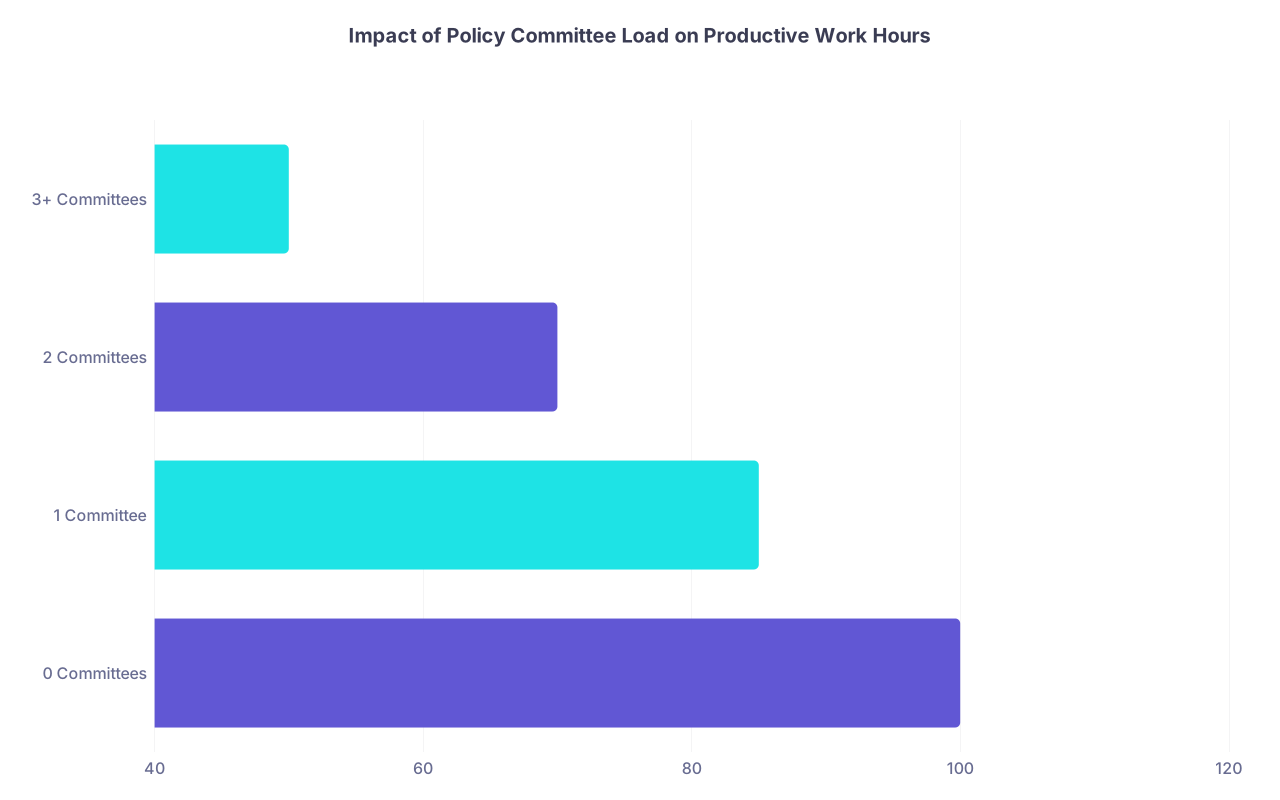
| Category | Value |
|---|---|
| 0 Committees | 100 |
| 1 Committee | 85 |
| 2 Committees | 70 |
| 3+ Committees | 50 |
Interpretation:
- As you stack committees, your available hours for deep work (research, writing, meaningful teaching prep) plummet.
- At 3+ committees, you’re basically a part-time administrator with a research appointment on paper.
Do not let your calendar quietly turn you into something you never planned to be.
12. Practical Scripts: Saying No Without Making Enemies
You’ll need actual words. Here are ones I’ve seen work.
If it’s a hard no:
“I’m honored you thought of me. Right now my priority is building a strong research and teaching portfolio for my early promotion, and I’ve committed not to add new standing committees this year. If that changes in the future, I’d be glad to revisit.”
If you want to negotiate scope:
“I’d be interested if there’s a clearly defined role where I’m leading a discrete piece—something that might yield a publication or formal product. Could we clarify expectations and deliverables before I commit?”
If you’re wary of optics/ethics:
“Given the sensitivity of this area and my junior status, I’d want to make sure there’s room for open disagreement and that minority opinions are documented, not just consensus. Is that how this committee usually works?”
If their answer to that last one is vague or defensive, that’s your signal.
13. A Reality Check Flow: Should You Join?

| Step | Description |
|---|---|
| Step 1 | Invited to policy committee |
| Step 2 | Politely decline |
| Step 3 | Ask to clarify role or decline |
| Step 4 | Avoid or request limited involvement |
| Step 5 | Accept with boundaries and time limits |
| Step 6 | Aligns with niche or promotion plan |
| Step 7 | Clear role and outputs defined |
| Step 8 | Ethical comfort with topic and leadership |
Keep this mental diagram in your head. If you’re skipping steps because you feel flattered or pressured, stop and reassess.
14. Where Ethics Really Comes In
This is under the “Personal Development and Medical Ethics” category for a reason.
The ethical danger isn’t just the policies themselves. It’s what they can turn you into:
- Someone who gets used to signing on to decisions you’re uneasy about.
- Someone who learns to stay quiet because “that’s how things work here.”
- Someone whose name sits under policies that damage trust with patients or communities you claim to serve.
Protecting your ethical spine early in your career matters. It gets harder—much harder—to reclaim it later.
The safest path:
- Engage selectively, where you have some leverage or protection.
- Be very clear with yourself about your ethical non-negotiables.
- Document your positions when you dissent on serious issues.
- Recognize when you’re being used as decoration rather than a real voice.

FAQs
1. Should junior faculty avoid all institutional policy committees?
No. But you should avoid most of them until you’re clearer on your goals and have at least one senior mentor who can tell you which committees actually matter. One or two strategic, aligned committees with clear outputs can be valuable. A bunch of generic “service” roles is almost always a mistake.
2. What if my chair strongly pressures me to join a committee?
You don’t pick a direct fight. You negotiate. For example: “I’m happy to serve on one committee that’s most valuable for the department—could you help me choose the one that will be most impactful for my development?” That subtly forces them to prioritize instead of dumping three on you.
3. How do I handle being on a committee that produces a policy I ethically oppose?
First, state your concerns calmly in the room. Second, ask for your dissent to be reflected in minutes. Third, if the final policy still crosses a line for you, request your name not be listed as an endorser or part of “consensus.” If the institution won’t allow that, you need to seriously consider stepping away from that role and document why.
4. Can policy committee work ever count as real scholarship?
Yes—but only when it leads to tangible, citable products: guidelines, position statements, published policy evaluations, or implementation studies with your name clearly attached. Before you join, ask how authorship, credit, and dissemination will be handled. If they can’t answer, assume it won’t help your CV.
Key points to keep:
- Most policy committees are political, not purely evidence-driven; treat them accordingly.
- As junior faculty, your time and ethical reputation are fragile assets—don’t spend them on low-yield, high-risk committees.
- Say yes only when there’s alignment with your niche, clear outputs, and leadership you trust; otherwise, decline or tightly limit your involvement.