
The public story about hospital quality metrics is a lie of omission.
The data are real. The way they’re created, gamed, and weaponized is not.
If you only see the glossy “Hospital Compare” stars or US News rankings, you’re seeing the brochure, not the building. Inside quality meetings, what actually happens is much closer to politics than science. And if you’re a clinician who still believes “good care = good scores,” you’re about to get eaten alive.
Let me walk you through what really goes on behind those dashboards.
How Quality Metrics Actually Get Made
Every metric you see on a public site went through years of negotiation, compromise, and quiet lobbying. Nobody tells residents that.
Here’s the rough life cycle of a typical hospital quality metric:

| Step | Description |
|---|---|
| Step 1 | Policy priority |
| Step 2 | Expert panel |
| Step 3 | Table idea |
| Step 4 | Define metric |
| Step 5 | Pilot tests |
| Step 6 | Public comment |
| Step 7 | Implementation |
| Step 8 | Hospitals adapt and game |
| Step 9 | Revisions or new metric |
| Step 10 | Feasible to measure |
On paper, it looks rational. In rooms, it’s messy.
I’ve sat in meetings where:
- National specialty societies fight to soften metrics that would expose their weakest members.
- Hospital associations push back on any measure that can’t be “coded for” easily, because they know they’ll lose money.
- Patient advocates are outnumbered and usually outgunned technically, so they get a few wins on language, not on structure.
More uncomfortable truth: metrics are constrained as much by billing systems and IT limitations as by what actually matters for patients. If it can’t be extracted from claims, it usually doesn’t become a national quality metric. So what do you get? A system where what’s easy to count becomes what matters.
You feel it on the floors. We track what’s “documentable,” not what’s actually important.
The Quiet Games Hospitals Play
You already know there’s gaming. You probably don’t know how deep it goes.
There are three big levers hospitals pull, over and over:
- Change the patients.
- Change the documentation.
- Change the denominator.
I’ll give you some concrete examples.
Case mix manipulation (a euphemism for cherry-picking)
No hospital CEO will say “we avoid the sickest patients to protect our numbers,” but I’ve heard versions of it behind closed doors.
Common moves:
- Turning away high-risk transfers for complex surgeries right before public reporting snapshots.
- Steering Medicaid or uninsured patients with complicated social situations toward “outpatient management” or “skilled nursing” instead of admitting them, because readmissions and mortality hit harder in these groups.
- Quietly discouraging ambulance diversion policies that bring in the sickest of the sick when mortality metrics are under scrutiny.
The logic is always the same: “We have to protect the institution so we can help more patients overall.” And sometimes that’s partly true. But when you see a hospital with miraculously low mortality and complication rates, remember: they might actually be fantastic. Or they might be exquisitely selective.
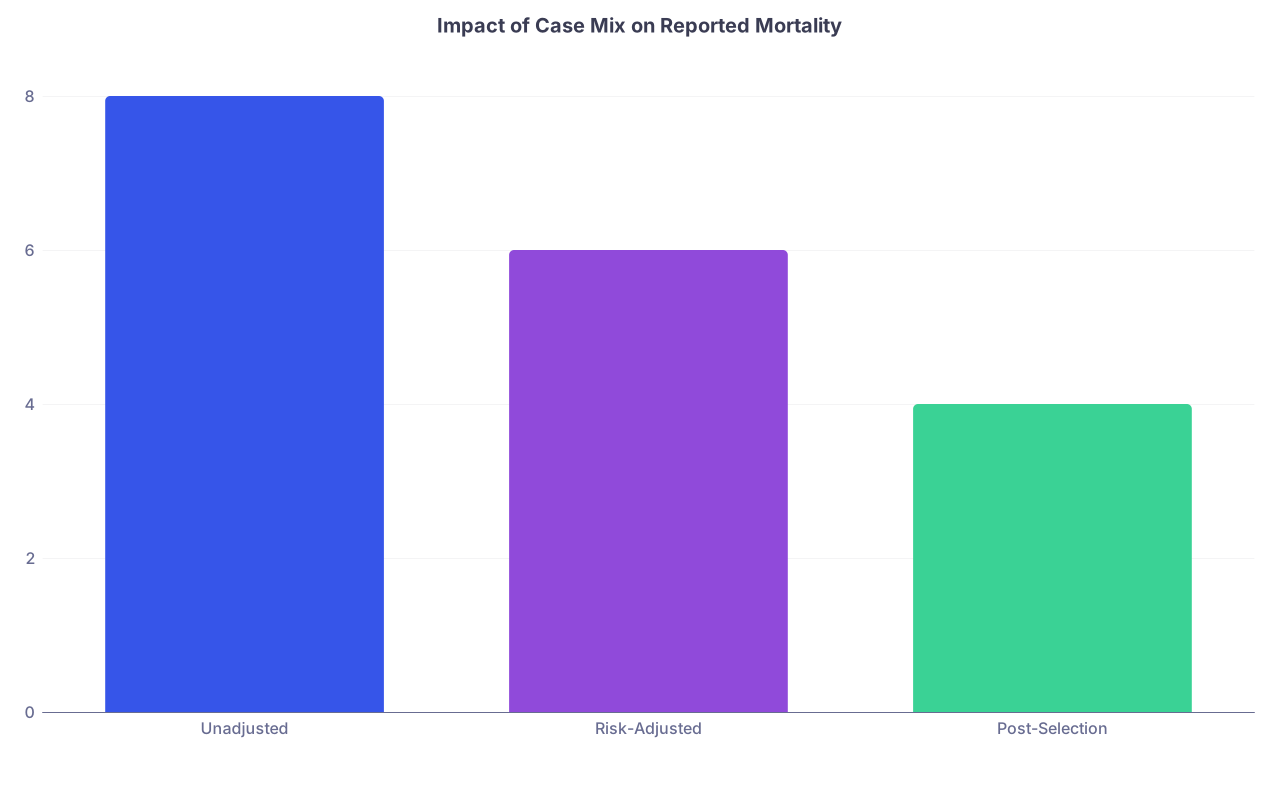
| Category | Value |
|---|---|
| Unadjusted | 8 |
| Risk-Adjusted | 6 |
| Post-Selection | 4 |
Notice how this works: first you apply risk adjustment, then you apply patient selection on top of it. That last step, nobody writes in the public report.
Documentation as a weapon
Residents think documentation is for continuity and billing. Administrators know documentation is how you move numbers.
You’ll see:
- Coding teams “educating” clinicians to document as many comorbidities as possible because higher coded severity lowers “expected mortality” and magically improves your “observed/expected” ratio.
- Sepsis “definitions” being stretched so that marginal cases become full sepsis diagnoses, raising the apparent baseline risk.
- Extubation and re-intubation timings tweaked so complications fall outside the defined measurement window.
You’ll get emails: “Please remember to document all secondary diagnoses and comorbid conditions to ensure appropriate risk adjustment.” Sounds harmless. It’s not. It’s the hospital steering the risk model in their favor.
Denominator games: who “counts” as a failure?
This is where things get very technical and very political.
Examples you won’t see on the billboard:
- Patients who leave AMA sometimes get excluded from certain measures. That’s convenient when the AMA patient is the disaster case.
- HCAHPS patient experience surveys often under-sample non-English speakers or patients in observation status. So populations who are already marginalized have their experience effectively erased.
- Hospice transitions can pull patients out of mortality metrics. So shifting a frail patient to inpatient hospice “just in time” can make your numbers look surprisingly kind.
You’re told it’s “methodologically sound.” And sometimes it is. But it’s also very convenient.
Public Reporting: What Patients See vs What We See
Patients see simple stars, letter grades, or rankings. Inside the hospital, we see dashboards with dozens of metrics, each with caveats, footnotes, and half a dozen ways to “fix” a bad number.

Let’s break down three of the big public reporting tools and what they really mean.
| System | Main Data Source | Primary Focus | How It Gets Misused |
|---|---|---|---|
| CMS Star | Claims + surveys | Safety, outcomes | Marketing & contracting leverage |
| Leapfrog | Self-report + data | Safety & processes | Used to shame or pressure hospitals |
| US News | Survey + outcomes | Reputation & specialty rankings | Prestige, recruiting, donor pitches |
CMS Star Ratings and Hospital Compare
Administrators live and die by these.
Here’s the behind-the-scenes reality:
- The models are complicated enough that very few clinicians actually understand how a 1-star becomes a 3-star after “rebaselining.” This opacity is a feature, not a bug.
- Star shifts are used internally to justify or kill programs. I’ve seen service lines dismantled because “your metrics are dragging down the star rating.”
- Leadership will suddenly “discover” a measure when CMS announces it will affect payment next year. That’s when the emails start. Not when it first emerged as a legitimate quality problem.
For you, this means one thing: what gets attention is not necessarily what matters most clinically. It’s what’s tied to reimbursement and public embarrassment.
Leapfrog and the safety score obsession
Leapfrog letters (A–F) are catnip for local media. Hospitals fear that front page “Hospital X gets a C for safety.”
The game:
- Hospitals that can afford robust quality departments flood Leapfrog with carefully curated data to optimize scores.
- Hospitals serving poorer, sicker populations often don’t have the infrastructure to “play,” so they look worse even when the quality difference is trivial or non-existent.
- Some measures are process-based (did you have a checklist?), not outcome-based (did patients die less?). Hospitals focus on the performative process because that’s what’s scored.
You’ll be asked to complete mandatory “safety trainings” and check electronic boxes to meet these process measures. Not all of them are useless. But do not confuse box-checking with real safety culture.
US News: reputation dressed up as science
US News hospital and specialty rankings still sway patients and trainees, but behind the curtain:
- A large chunk of the score is based on reputation surveys—attendings rating programs based on their own biased impressions, which lag reality by 5–10 years.
- Outcomes data are blended with vague, delayed, and occasionally sticky reputation metrics, so “legacy” institutions hold their position even as mid-tier programs quietly outperform them in real quality.
- Programs use rankings as a cudgel to demand “excellence” without ever investing in the infrastructure that actually produces it.
If you’re making decisions on where to train or refer based solely on US News rank, you’re letting a popularity contest masquerading as measurement think for you.
How Metrics Distort Clinical Behavior at the Bedside
This is where it hits you. Personally. On call. At 2 a.m.
You don’t practice in a vacuum. You practice inside a system wired to certain metrics.
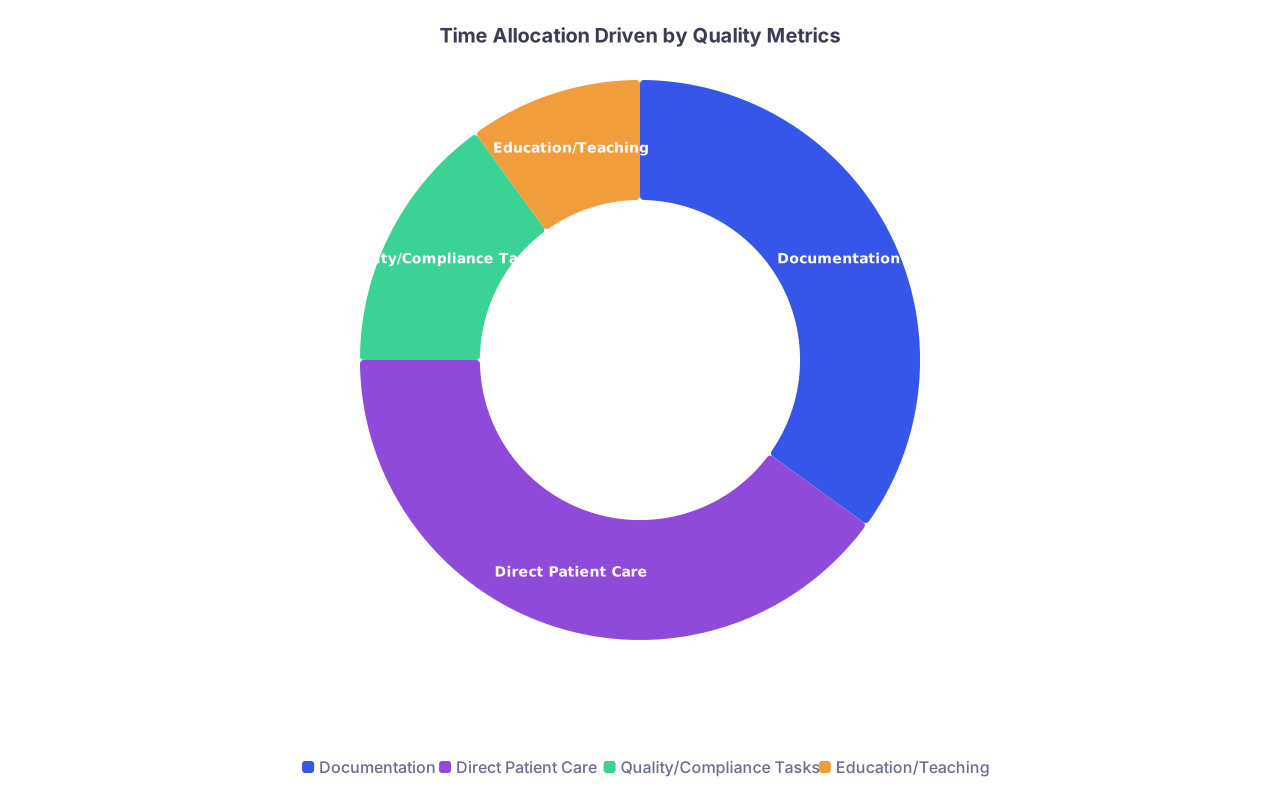
| Category | Value |
|---|---|
| Documentation | 35 |
| Direct Patient Care | 40 |
| Quality/Compliance Tasks | 15 |
| Education/Teaching | 10 |
Look at that distribution. You already feel it.
The readmission paradox
Hospitals obsess over 30-day readmission rates because they’re tied to penalties. So:
- Socially complex patients get extraordinary discharge planning attention. Not always because it’s the right thing, but because a bounce-back is expensive reputationally and financially.
- Some patients are admitted for a “new diagnosis” rather than a readmission if the coding can be justified. You will hear phrases like “Can we make this a new problem?”
- Borderline cases might be held in observation status for days to avoid triggering readmission metrics.
Your ethical tension: the right move for the patient’s health might be admission; the right move for the metric is keeping them out. And you will feel that pressure—verbalized or not.
Sepsis bundles and the timer mentality
The sepsis metrics are a classic example of a good idea taken to absurd extremes.
- You’re forced into rigid timing: lactate, cultures, antibiotics within x hours, even when clinical uncertainty is high.
- You’ll get scolded for “time to antibiotic” outliers even when the case was diagnostically ambiguous and you were appropriately cautious.
- Hospitals blind-push broad-spectrum antibiotics to hit metrics, then turn around and talk about stewardship. The cognitive dissonance is huge.
You’re not crazy if you’ve felt like the metric mattered more than the nuance. Often, it does.
HCAHPS and the customer satisfaction trap
Patient satisfaction scores impact reimbursement and public ratings. So:
- There’s subtle (or not so subtle) pressure to keep patients “happy” even when the rightclinical decision is unpopular—like refusing an unnecessary opioid script.
- “Service recovery” scripts and amenities get more attention than underlying structural problems like chronic understaffing.
- Physicians get dinged for “communication” on surveys filled out by patients who were angry about something completely outside that doctor’s control.
I’ve heard department chairs say, “Your scores are pulling down our HCAHPS. Fix it.” Full stop. No discussion of context.
You’re being held accountable to a number that blends your behavior with patient mood, system failures, and survey bias.
The Ethical Minefield for Trainees and Young Attendings
Here’s where this becomes less policy and more personal ethics.
You’ll face three recurrent dilemmas:
- Do I code/document in the most “advantageous” way for the hospital, or the most straightforward way for the chart?
- Do I accept or decline high-risk patients when I know the institution subtly punishes bad outcomes?
- Do I comply with every metric-driven demand, even when it clearly conflicts with good clinical judgment?

You won’t get clean answers from leadership. You’ll get slogans: “Do what’s right for the patient” in one slide, followed by “We must hit these targets” in the next.
Here’s how I’ve seen ethical clinicians survive this without becoming either complicit or unemployed.
Draw a hard line around truth
There’s a difference between thorough documentation and dishonest documentation.
Adding real comorbidities that you simply hadn’t bothered to list before? Fine.
Re-labeling a clear complication as “present on admission” with no basis? That’s fraud, no matter how gently it’s presented.
If a documentation specialist or administrator is clearly pushing you to fudge reality, the correct answer is: “No. That’s not accurate.” Say it plainly. People back off faster than you think when they realize you’ll put your name on a counter-note if needed.
Stay transparent with trainees and patients
Don’t gaslight your students and residents by pretending these pressures don’t exist. They see the emails. They feel the priorities shift.
You can say out loud: “Yes, the hospital cares a lot about this metric. Here’s how I think about balancing that with what’s best for the patient.” That kind of honesty is rare and remembered.
And with patients, avoid parroting marketing lines. If a family mentions star ratings or rankings, it’s fair to say: “These systems measure certain aspects of care; they miss others. What matters most for your case is X, Y, Z.”
You’re not there to be PR.
Choose your battles, but choose some
You can’t fight every stupid metric. You’ll burn out. But you should push back strategically.
Examples:
- If your team is being pressured to discharge unsafe patients to hit LOS targets, raise it with documentation in an email. Put “patient safety concern” in the subject line. Forces a different level of attention.
- If you’re on a committee, insist that any new metric proposal include: how it can be gamed, who’s likely to be disadvantaged, and how you’ll measure unintended harms.
- When your group discusses incentives, argue that financial bonuses tied 100% to metric performance are corrosive. Push for blended models that include peer evaluation and unmeasured-but-critical work (teaching, complex case management).
Is this politically risky? Yes. Will everyone love you? No. But it’s how culture actually shifts, slowly.
How to Read Hospital Quality Reports Like an Insider
You’re in public health policy and ethics. You should not be fooled by pretty dashboards.

When you look at any public report:
- Ask what’s not measured. Safety-net burden? Complexity of referrals? Social risk? Almost never in the model.
- Compare like to like. A county safety-net hospital will never look as “clean” as a suburban elective surgery center. That doesn’t mean it’s worse at medicine.
- Follow the money. If a measure is tied to payment, it will get attention and manipulation. If it’s not, it’ll live on a slide deck nobody opens.
For your own decisions—where to train, where to work, where to send family—talk to people on the inside. Ask nurses and respiratory therapists, “If your mom got sick, would you bring her here?” That answer is usually more accurate than a five-star rating.
FAQ (4 Questions)
1. Are hospital quality metrics completely useless, then?
No. The cynical take—“all garbage”—is lazy. Some metrics have driven real improvement: central line bundles dropped CLABSI rates, public reporting of cardiac surgery outcomes cleaned up some truly dangerous programs. The problem is that once a metric is tied to money and reputation, it warps behavior. Metrics are tools. Use them, but do not worship them.
2. As a trainee, can I get in trouble for refusing to “optimize” documentation?
If you flat-out fabricate data, yes—you can and should get in trouble. If you refuse to write something untrue, you’re on solid ground ethically and legally. Most institutions know they’re skating on thin ice when they lean too hard on clinicians. If you’re pressured repeatedly, document it and, if needed, go up the chain or to compliance. You won’t be the first.
3. How should I talk about this in interviews or personal statements without sounding bitter?
Be specific and constructive. Something like: “I’ve seen how quality metrics both improve care and distort it. I’m interested in designing measures that align with clinical reality and equity, particularly for safety-net populations.” You’re showing you understand the politics but still want to work on solutions. That’s maturity, not bitterness.
4. Is there any rating system I can actually trust?
Trust is the wrong standard. Use ratings as one data point, not holy writ. Lean more on condition-specific data (e.g., volume and outcomes for the surgery you need) rather than overall stars. And always cross-check against local knowledge—from clinicians, staff, and patients who’ve been inside the building. Public metrics are a map; they are not the terrain.
The Bottom Line
Three things you should not forget:
- Hospital quality metrics are as much political and financial instruments as they are clinical tools.
- The way we measure and publicly report care reshapes behavior—sometimes for the better, often in quietly perverse ways.
- Your job is not to be anti-metric; it’s to be clear-eyed, honest in your own practice, and vocal when the numbers start driving care off the rails.