
The thing hospital leaders notice first is not your ideas. It’s whether you sound like someone who understands how a hospital actually works—or like a student giving a TED Talk.
You want to speak about public health policy in front of people who control budgets, beds, and staffing? Good. We need you. But if you do it the way most trainees and junior faculty do, you’ll get a polite nod, a “thanks for bringing this up,” and your idea will die before the next agenda item.
Let me walk you through what actually goes through a CMO’s or CEO’s head when you open your mouth about policy. This is the stuff they will not tell you. I’ve heard it behind closed doors after town halls, QI meetings, and “strategic retreats”.
1. They’re Scanning You in the First 30 Seconds
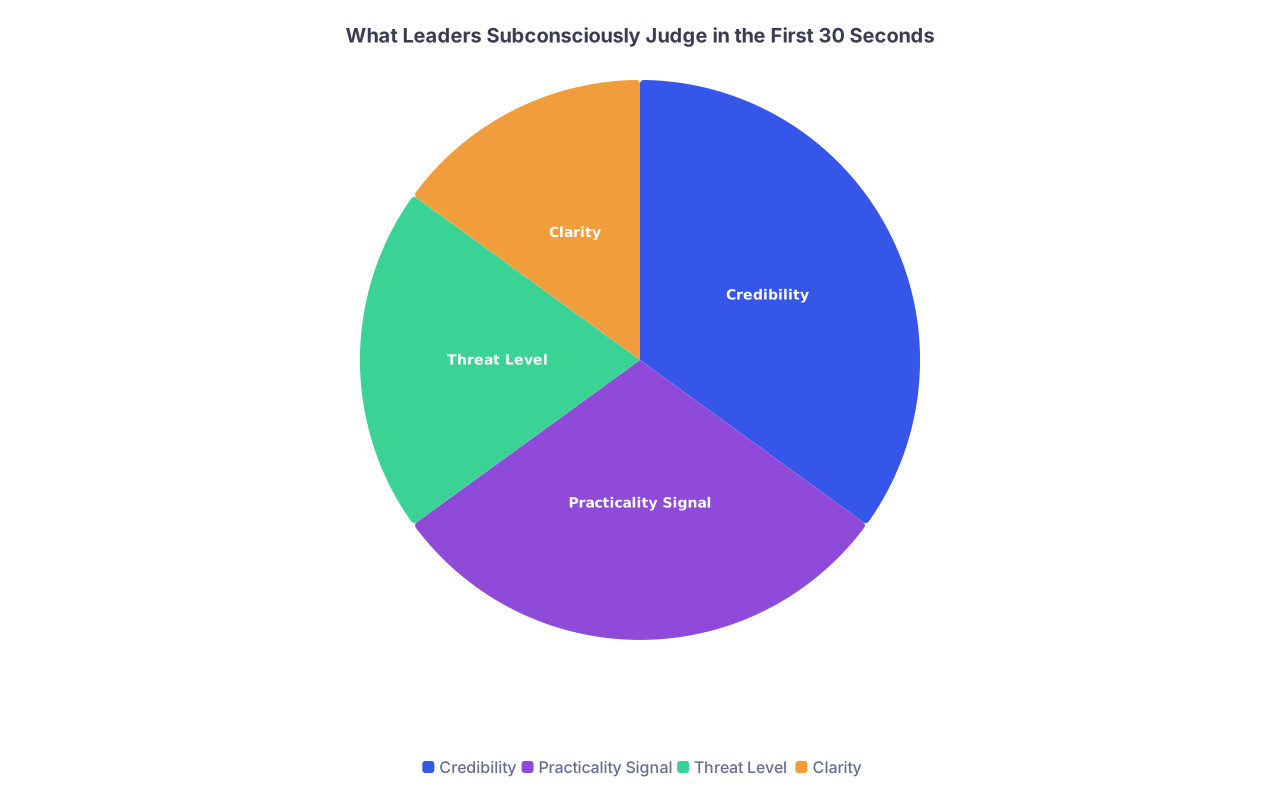
| Category | Value |
|---|---|
| Credibility | 35 |
| Practicality Signal | 30 |
| Threat Level | 20 |
| Clarity | 15 |
The first yes/no question hospital leaders ask internally is: “Is this person grounded in reality or going to waste my time?”
They are not judging your soul. They’re triaging attention.
Here’s what they pick up on immediately when you speak on policy—whether in a committee, grand rounds Q&A, town hall, or a hallway ambush.
1. Do you speak in concrete terms or slogans?
If you say, “We need to address structural inequities in our ED,” they’ve already heard that 50 times. If you say, “Last quarter our uninsured ED readmission rate for asthma was 23%, double the state average, and here’s one change we can realistically make,” now they’re listening.
I’ve watched a CFO physically lean forward only when someone switched from “we should improve access” to “right now we lose X dollars per no-show and here’s how a text-reminder pilot might cut that by 15%.”
2. Do you know the level of the game?
Policy talk that ignores the layer they operate in is dead on arrival. If you’re speaking to unit leadership, talk processes and staffing. Presenting to the CMO or board? Talk risk, reputation, regulatory alignment, and dollars.
You think you’re making a moral argument. They’re silently mapping what you’re saying onto:
- Will this reduce risk of a headline or lawsuit?
- Does this line up with something the Joint Commission / CMS already cares about?
- Is this aligned with what I’m going to be measured on this year?
You don’t have to like it. But if you ignore it, you’ll get politely dismissed.
3. Do you sound angry or constructive?
Here’s the ugly truth: program directors and chiefs will agree with your concerns and still tune you out if you sound like you’re venting instead of building.
I’ve seen brilliant residents nuke their own credibility in a town hall by leading with, “Leadership has failed to protect marginalized patients.” Even if they weren’t wrong, all the execs heard was: “This person will be a PR problem, not a partner.”
If you come in hot, you need twice as much specificity and twice as many solutions to survive.
2. They’re Listening for Three Things: Risk, Cost, and Alignment

Here’s the dirty secret: when you talk about any public health policy issue—gun violence, homelessness, reproductive access, racial bias—leaders mentally translate your words into three buckets.
Not five. Not ten. Three.
Risk. Cost. Alignment.
Risk: “Does this protect us or expose us?”
Example: You stand up at M&M and say, “Our discharge process for patients who are unhoused is unethical and dangerous.” Leaders are translating that into:
- Are we exposing ourselves to preventable readmissions and bad outcomes?
- Is there a foreseeable sentinel event or lawsuit here?
- Is this something regulators or journalists could latch onto?
The savvy move is to pre-translate for them:
“Right now we’re discharging roughly 8–10 unhoused patients a week with no standardized follow-up. That’s a safety risk, but also a regulatory and reputational risk. A basic navigation protocol would put us closer to what other academic centers in the region are already doing and give us a defensible standard.”
Same ethical point. Different effect.
Cost: “What will this actually take?”
This is where most idealistic policy talk dies.
If you say, “We should provide free Lyft rides to all patients from low-income zip codes,” what they hear is: unfunded, open-ended, administratively messy.
If you say, “I spoke with care management—right now about 12 high-utilizer Medicaid patients account for a disproportionate share of our preventable readmissions. A capped ride-share program for just those patients might cost roughly $X per year and reduce Y readmissions, which are currently unreimbursed,” now it sounds like a pilot, not a fantasy.
They don’t need perfect numbers. They just need to see that you understand that every ‘we should’ has a price tag and someone’s job attached.
Alignment: “Can I defend this to my boss and my board?”
This one is underappreciated by trainees.
Leaders sit under their own massive policy stack:
- System strategic plan
- State and federal regulations
- Current grant commitments
- Public relations and community benefit expectations
When you speak, they’re asking, “Can I attach this to something we’re already committed to so I’m not inventing a new priority?”
So if you care about, say, language access and interpreter services, don’t just make it about justice. Tie it to:
- CLAS standards
- Joint Commission requirements
- Disparities in readmission or patient satisfaction scores by language
Then say out loud what they’re thinking: “This seems directly aligned with the health equity language in our publicly posted mission and the community benefit report we already file.”
You’ve just moved your idea from “passion project” to “strategic alignment.”
3. The Subtle Credibility Tests You Don’t Know You’re Taking
| Your Behavior | What They Actually Think |
|---|---|
| Cites only personal anecdotes | “Does not understand scale or data” |
| Knows 1–2 hard numbers | “May be green, but prepared and credible” |
| Blames ‘administration’ in general | “Does not understand how decisions get made” |
| Names a specific constraint (CMS rule, state law) | “Understands the real playing field” |
| Brings 1–2 feasible next steps | “Potential partner, not just a critic” |
This part no one explains to residents or early faculty, and you only learn it by getting burned.
Test #1: Can you name tradeoffs without being prompted?
If you say, “We should never board psych patients in the ED,” everyone agrees in principle. But the real question is, “And then what?”
The resident who says, “We’re boarding 6–10 psych patients daily. I know inpatient psych beds are capped and staffing is short. What we could do is create a fast-track consult-plus-warm-handoff pathway with community mental health for a subset of patients meeting X and Y criteria,” gets taken seriously.
They see you’re not naive about capacity. You already brought the tradeoff into the room.
Test #2: Do you understand who would have to change?
Every policy idea touches at least three groups: clinicians, operations staff, and someone up in finance/compliance.
If your suggestion sounds like, “Everyone else should do better,” it reads as lazy.
If instead you say, “This would mean X change for nursing workflow, Y for ED registration, and Z for care management; I spoke briefly with [charge nurse / social worker / unit clerk] and here’s how they currently see it,” leaders hear: this person did their homework.
I’ve been in meetings where an intern quoted back a registrar’s actual words—“They told me, ‘We’re told to prioritize throughput, so asking us to add a 6-step screen without taking something else away will just make us cut corners’”—and you could see the COO suddenly respect them.
Test #3: Can you distinguish between external and internal policy?
Big rookie mistake: mixing up what’s the hospital’s choice and what’s written in law or payer contracts.
When you say, “We should just ignore this prior auth nonsense,” the CMO hears, “This person has no idea what keeps the lights on here.”
If you say, “I know we’re bound by CMS requirements on X and Y. But within those rules, we still have discretion about how we structure Z, and right now that discretionary part is where patients are getting hurt,” you sound like someone who’s ready to sit at actual policy tables.
Know the difference:
- Law and regulation (state law, CMS CoPs)
- Payer policy (Medicaid MCO contracts, commercial payer rules)
- Institutional policy (what your hospital or system voluntarily decided)
- Culture and habit (what someone wrote 10 years ago that no one revisited)
You’ll gain serious credibility if you can say, “This piece is external—fixed for now. This other piece is ours and is where we’re failing patients.”
4. The Politics You Pretend Don’t Exist but They Live In

| Step | Description |
|---|---|
| Step 1 | You raise issue |
| Step 2 | Unit or committee meeting |
| Step 3 | Dies in minutes |
| Step 4 | Champion adopts |
| Step 5 | Exec meeting or council |
| Step 6 | Deferred indefinitely |
| Step 7 | Pilot or implementation |
| Step 8 | Has data and alignment? |
| Step 9 | Competes with other priorities |
From your side of the table, it looks like this: “I said something true and urgent. Why did nothing happen?”
From their side, it looks like: “We had 50 true and urgent things this quarter. Which ones can we afford to touch without blowing up everything else?”
Let me tell you what leaders actually weigh that you don’t see.
Priority fatigue and political capital
Every senior leader has a finite number of “fights” they can pick per year. If they’ve just burned capital on an EHR overhaul or a contentious union contract negotiation, your perfectly justified policy push might be the thing they emotionally can’t afford to add.
That’s why you’ll sometimes get a maddening answer like, “This is important, but not this year.”
You can increase your odds by:
- Piggybacking on existing priorities (“This dovetails with the readmission-reduction workgroup you already stood up.”)
- Framing it as de-risking something the C-suite already loses sleep over (media stories, sentinel events, legal exposure, external rankings).
Coalitions matter more than sound bites
A single, passionate speaker rarely moves policy. A small, cross-role coalition does.
When a med student stands up and says, “We need to stop calling security on agitated Black patients as our first-line response,” it’s one thing. When that same critique comes backed by, “We spoke with nursing, security leadership, and social work, and we think we can pilot a different pathway on two units,” that’s a different conversation.
I’ve watched a CEO who was clearly exhausted perk up instantly when a junior faculty member said, “We’re not asking you to invent this. We’re asking for support to run a small pilot we’ve already scoped with Operations. If it fails, we’ve defined clear off-ramps.”
Translation: low political cost, high narrative upside.
Optics and messaging
Leaders are constantly worrying about external optics, whether they admit it or not. When you speak, they’re thinking, “How does this look to patients, staff, media, regulators?”
If you’re pushing on a hot policy topic—abortion access, immigrant health, LGBTQ+ care—they are balancing:
- Legal exposure
- Donor reactions
- Staff morale
- Community perception
Help them. Calibrate your language.
Calling something “institutional racism” in an open forum may be accurate, but don’t be surprised if leaders lock up defensively. Sometimes you get more traction saying, “We’re seeing consistent racialized patterns in who gets security called, and that puts us at serious risk of harm, complaints, and lawsuits.”
Same content. Different fight-or-flight response.
5. How to Sound Like Someone They Want in the Room
Let’s be blunt: leaders are constantly scouting for future “bridge people”—clinicians who can speak both ethics and operations, both community and compliance. Those people get invited to closed-door meetings, pilot committees, and, eventually, leadership roles.
Here’s how you make them see you as one of those people when you speak about policy.
Walk in with at least one number and one story
Pure data feels cold. Pure stories feel soft. Policy decisions get made when those two intersect.
You say:
“Last month I discharged a 56-year-old man with uncontrolled diabetes who lives in a car. We both knew he’d be back. Our own data show that unhoused patients have a 30-day readmission rate 1.8 times higher than housed patients here. That’s not just tragic; it’s a bleeding artery in our quality metrics.”
Now you’re doing ethics, quality, and finance in a single breath. You sound like leadership material.
Signal that you understand constraints before you ask for change
Whenever I hear a trainee start with, “I know we’re under staffing pressure and trying to hit throughput metrics,” I already know they’re going to get a better reception. It shows respect for the constraints the people you’re talking to live under.
Then you pivot: “Given that reality, here’s a small, testable change that might move us closer to our stated equity goals without adding net work.”
You’re not brown-nosing. You’re making it easy to say yes.
Always bring a next step that doesn’t require a new department
Leaders hate vague calls to action. “We need to do better” is useless.
Offer something like:
- “Can we get a 20-minute slot at the next Quality Committee to present a focused proposal?”
- “Would you support us pulling data on X so we can quantify the problem?”
- “Can we pilot this on a single unit for 3 months with defined metrics?”
You’re showing that you don’t expect them to magically “fix it.” You’re asking for something bite-sized.
Don’t grandstand. Ask real questions.
The worst “policy” questions are actually speeches with a question mark stapled on.
Leaders are very good at sensing when you’re trying to perform for the crowd. The oxygen in the room changes.
A powerful move: admit what you don’t know and frame it as a genuine request for guidance.
“I’m seeing X and Y at the bedside, and they feel misaligned with our mission. I don’t understand yet how decisions about this get made at the system level. Could you walk us through how that process works, and where frontline clinicians might have real input?”
Now you’re not just complaining. You’re inviting them to reveal the machinery.
Often, afterwards, that’s when a CMO or VP will pull you aside and say, “If you’re serious about this, email me. I’d like you on this workgroup.”
6. The Ethics Question: What They’re Afraid You’ll Say Out Loud
This is the part no one will admit in an open forum.
Hospital leaders are constantly navigating the gap between what’s ethically ideal and what’s politically and financially survivable. They live in that gray zone. Every day. It’s corrosive.
When you speak up on policy, there’s a flicker of fear: “Is this the moment someone forces us to say ‘no’ out loud to something obviously right?”
So they listen for whether you’re going to treat them as villains or as flawed allies under constraint.
If you frame everything as, “You don’t care about patients; you only care about profits,” you’ve shut the door. They’ll nod, take it, and mark you mentally as someone to keep at arm’s length.
If instead you say, “We’re in a system where reimbursement and regulation often push us toward choices that conflict with our stated values. This specific policy—how we triage undocumented patients, how we limit reproductive care, how we discharge unhoused people—seems like a place where we’ve over-corrected toward risk and away from ethics. I think we can rebalance, even within the constraints,” you’ve said the hard thing without putting them in a cartoon villain box.
You’re naming the moral tension. And you’re offering to help carry it, not just throw it back in their face.
That’s the person hospital leaders will actually call back when they need someone to help shape policy that toes the line between law, finance, and what’s left of our ethics.
FAQ (5 Questions)
1. I’m “just” a med student or intern. Do hospital leaders actually care what I say about policy?
Yes, but not automatically. Your title gets you in the room, not into their mental “listen carefully” category. When you show up with real data, respect for constraints, and concrete suggestions, you stand out because you’re early in training. I’ve seen CMOs remember a student’s name years later because they spoke like someone who understood both patients and systems.
2. How much data do I need before speaking up about a policy problem?
You don’t need a full paper. One or two specific numbers are enough to change how you’re perceived. For example: “In the last 3 months, we had 14 readmissions linked to lack of home health coverage,” or “Our interpreter use rate on this unit is 30% lower than the hospital average.” It shows you did homework and you’re not just venting from a single bad night on call.
3. What if my policy concern is politically sensitive, like abortion or undocumented patients?
You should still speak, but be strategic. Focus on safety, standardization, and alignment with existing laws and mission statements. Avoid framing that sounds like you’re asking leaders to pick a partisan side in public. Frame it as your institution living up to its own values within the legal framework you’re stuck in.
4. How do I learn the “real” decision-making structure so I’m not yelling at the wrong people?
Ask. Quietly. Start with your program director, a trusted attending, or a nurse manager: “If someone wanted to change X policy, who actually makes that call here?” Every hospital has a maze of committees and councils. The insiders know where things really get decided. You’ll sound more serious when your policy suggestions name the actual levers and bodies involved.
5. Is it worth speaking up if I don’t have a fully baked solution yet?
Yes, if you’re honest about that and frame your ask correctly. You can say, “I’m seeing a pattern that worries me and I don’t know the best solution yet. Could we at least agree to pull some data or convene a small group to understand it better?” Leaders respect people who flag real problems and invite collaboration, not just people who show up with fully formed prescriptions.
If you remember nothing else: speak in their language (risk, cost, alignment), show that you understand the constraints, and bring at least a small, concrete next step. Do that consistently, and you’ll stop being “that trainee who complains about policy” and start being “the person we should probably have at the table.”