
The myth that you need to be “always advocating” to build a policy career is wrong—and burning people out.
If you want a policy‑oriented career in public health, the question isn’t “Am I doing enough advocacy?” The real question is: “Am I doing the right kind of advocacy, at the right intensity, for the career I actually want?”
Let’s answer that directly.
The Core Rule: Depth Beats Volume
Here’s the blunt truth: you don’t need to be at every rally, sign every petition, or sit on five advocacy committees to be taken seriously in public health policy.
What actually builds a policy‑oriented career is a mix of:
- A clear issue or domain you’re known for
- Demonstrated staying power (you didn’t just show up for one election cycle)
- At least one role where you had real responsibility, not just your name on a list
- Output people can point to: policy briefs, testimony, op‑eds, programs, or data that moved something
If your “advocacy” is 20 small, scattered things no one can remember, that’s noise.
If it’s 3–5 substantial, coherent experiences over a few years, that’s a foundation.
Here’s a simple way to gauge “enough”:
| Level | Description | Is this enough for policy credibility? |
|---|---|---|
| Level 1 | Signed petitions, occasional marches, one‑off events | No, not by itself |
| Level 2 | Active in 1–2 orgs, recurring volunteer work | Good starting point |
| Level 3 | Led a project, authored something, or organized others | Yes, for early career |
| Level 4 | Ongoing leadership + visible policy wins or influence | Strong for policy‑oriented career |
| Level 5 | Recognized expert, media presence, regular advising | Top tier, not necessary for all |
For most early‑career people (students, residents, early professionals), you want to solidly hit Level 3 and be moving into Level 4 over time.
Decide First: What Kind of Policy Career Are You Actually Building?
“Policy‑oriented” is vague. There are at least four very different paths, and each demands a different advocacy load.
| Career Type | Example Roles | How Much Advocacy? |
|---|---|---|
| Policy‑aware clinician | Physician/NP/MPH who engages locally | Moderate, focused, sustainable |
| Academic policy expert | Health policy researcher, bioethicist | Deep, scholarly + some public-facing |
| Insider policymaker | Health department lead, legislator staff | High engagement, strategic advocacy |
| Professional advocate | NGO policy director, lobbyist | Advocacy is your full‑time job |
If you want to be:
- A clinician who influences hospital policy and occasionally testifies – you don’t need daily activism.
- A full‑time advocacy director for a national nonprofit – you absolutely need a heavy, visible advocacy record.
So before you chase “more,” define which of these lanes you’re aiming for in the next 5–10 years. Your advocacy volume should match that lane, not your most intense friend’s Twitter feed.
A Practical Framework: The 20–50–30 Rule
Here’s a structure I’ve seen work for people who want real policy credibility without burning out.
Roughly, over a year:
- 20% of your advocacy time → Broad, symbolic, or solidarity actions
- 50% → Sustained, skill‑building roles with real responsibility
- 30% → Visible outputs that show impact
1. The 20%: Broad Involvement (Optional but Healthy)
This is the stuff people overvalue on CVs:
- Attending marches or rallies
- Signing letters or petitions
- Showing up to “advocacy days” at the capitol
- Being one of many members of a big advocacy org
Do some of this. It keeps you grounded and connected. But understand: on its own, it doesn’t make you a policy person. It shows you care—good, but not sufficient.
Target: 3–6 meaningful broad actions per year. Not 40.
2. The 50%: Sustained Roles (Where Careers Are Built)
This is where you should concentrate your energy:
- Serving on a hospital or clinic quality committee where you help write or revise policy
- Being the advocacy chair for a student/resident group with defined projects
- Interning with a city health department or state Medicaid office
- Joining a working group that actually drafts recommendations
Rule of thumb: if no one would notice you stopped showing up, it’s not sustained enough.
Aim for 1–2 roles at a time where:
- You have a title or defined responsibility
- You stay at least 6–12 months
- You can point to specific changes, documents, or processes you helped shape
3. The 30%: Visible Output (What People Remember)
Outputs are what distinguish “interested in advocacy” from “does policy work.”
Examples:
- Writing a policy brief or white paper for a department, nonprofit, or campus initiative
- Testifying (even once) at a city council or legislative hearing
- Co‑authoring an op‑ed in a local paper on a specific bill or regulation
- Presenting data to a hospital board that leads to a protocol change
- Leading a campaign that changes a school or program policy (grading, leave, equity, etc.)
Target: 2–4 substantive outputs per year. One big, a couple smaller.
Quality > quantity. A thoughtful op‑ed in a reputable outlet beats ten “awareness” Instagram posts.
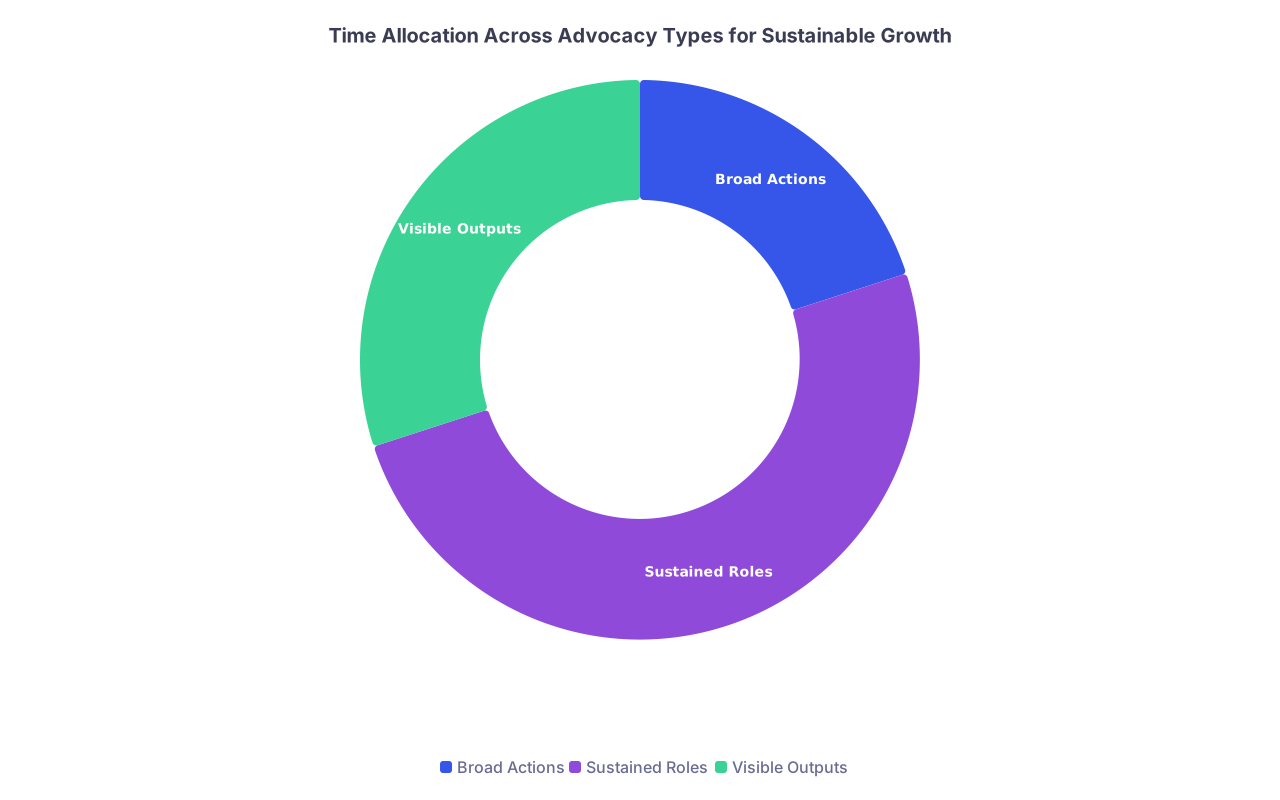
| Category | Value |
|---|---|
| Broad Actions | 20 |
| Sustained Roles | 50 |
| Visible Outputs | 30 |
How to Tell If You’re Doing Too Little vs Too Much
You’re under‑invested if:
- You can’t name a specific policy issue you’re associated with.
- Your “advocacy” is basically sharing articles and being angry in group chats.
- You have no continuous role longer than 6 months.
- In an interview, you’d have trouble describing a concrete change you contributed to.
You’re overextended (and probably ineffective) if:
- You’re on more than 3 “advocacy‑related” committees at once
- You’re missing sleep or clinical/academic responsibilities to attend constant meetings
- You feel guilty all the time for not doing more
- You can’t explain, in one sentence, what matters most to you policy‑wise
A sustainable policy trajectory feels like this:
- You have one main issue domain (e.g., harm reduction, reproductive justice, housing, environmental health).
- You have 1–2 significant roles; you’re a core contributor, not an occasional attendee.
- Each year, you add at least one “I’m proud of this” output that moved something or clarified an issue.
Ethics Check: When “Advocacy” Starts Hurting Your Professional Integrity
You asked under a category that includes medical ethics, so let’s not dodge the hard part.
There are ways to do advocacy that undermine the ethical core of a health professional:
Red flags:
- You’re overstating evidence or certainty to fit a narrative
- You’re attacking people instead of critiquing systems or policies
- You’re sharing patient stories without truly informed consent, or over‑disclosing details
- You’re letting advocacy become performative—more about your brand than the community
A good ethical filter before you sign onto something or jump into a campaign:
- Is this aligned with good evidence or at least a defensible uncertainty?
- Would I be comfortable explaining this position to a thoughtful colleague who disagrees?
- Would patients or affected communities recognize their interests in what I’m saying or doing?
- If this ended up in front of a licensing board or future employer, would I stand by it?
If the answer to any of those is “no,” pause. More advocacy isn’t always better—especially if it’s sloppy or ethically thin.

| Step | Description |
|---|---|
| Step 1 | New advocacy request |
| Step 2 | Politely decline |
| Step 3 | Offer smaller support role |
| Step 4 | Probably decline |
| Step 5 | Accept role |
| Step 6 | Aligned with my main policy focus? |
| Step 7 | Time and energy to commit for 6 to 12 months? |
| Step 8 | Clear impact or skill building? |
Building a Coherent Narrative (What Your Future Self Will Need)
Whether you’re heading toward residency, grad school, a fellowship, or a job in policy, someone is eventually going to ask:
“So tell me about your advocacy work. What have you focused on?”
You want to be able to answer something like:
“I’ve focused on overdose prevention and harm reduction. During medical school, I helped start a street medicine outreach program, then worked with our city health department to develop a naloxone access protocol. That led to testifying at a city council hearing and co‑writing a brief on low‑barrier naloxone distribution.”
Notice what that has:
- A clear through‑line (overdose prevention)
- Roles (program founder, city collaboration)
- Outputs (testimony, brief)
You do not want your answer to sound like:
“Well, I went to the climate march, and I’m on three diversity committees, and I signed a bunch of reproductive justice petitions, and I helped organize a panel on incarceration, and…”
That sounds scattered and shallow, even if you were busy.
So: pick 1–2 anchor issues. Let everything else be secondary.
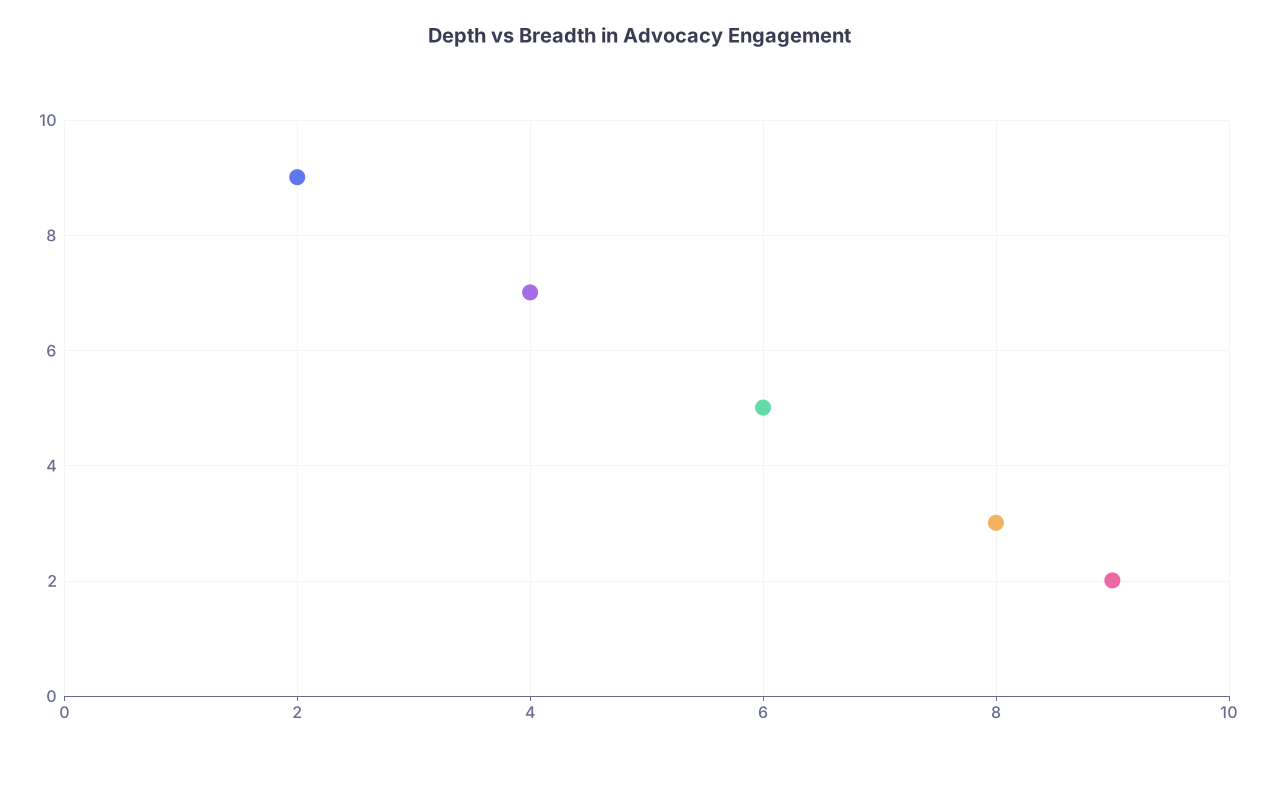
| Category | Value |
|---|---|
| Person A | 2,9 |
| Person B | 4,7 |
| Person C | 6,5 |
| Person D | 8,3 |
| Person E | 9,2 |
(Think of x-axis as depth in one area, y-axis as number of different causes. The sweet spot is mid‑to‑high depth with moderate breadth, not max breadth and minimal depth.)
How Much Is Enough at Different Training Stages?
You don’t have to hit max intensity at every stage. In fact, you shouldn’t.
| Stage | What’s Enough | Stretch Goal |
|---|---|---|
| Undergrad / Early MPH | Join 1 org, 1 sustained project, 1–2 outputs | Lead 1 campaign or project with measurable change |
| Med Student / Professional Student | 1–2 leadership roles, 2–3 outputs over 4 years | State or national testimony, co‑author policy work |
| Residency / Early Career | 1 institutional role, 1 external role, yearly output | Regional or national influence in a niche area |
Your capacity will fluctuate:
- During Step/board prep or thesis crunch → your advocacy load should drop. That’s not failure, that’s adulthood.
- During lighter rotations or gap years → you can take on bigger roles or push a major project.
The key is continuity over years, not perfection every month.

How to Start Today if You Feel Behind
If you’re reading this thinking, “I’ve done almost nothing, and I want a policy‑oriented path,” here’s what to do in the next 3–6 months:
Pick a domain. Not “health equity” (too broad). Something like:
- Medicaid access in your state
- Maternal morbidity in your city
- Air quality and asthma in your region
- Carceral health / jail care in your county
Find one existing effort in that space.
City health department initiative, local nonprofit, campus group, hospital committee—whatever’s actually doing work, not just hosting talks.Volunteer for something unglamorous but concrete.
Data cleaning, policy scan, literature summary, helping with logistics for a hearing or town hall. That’s how you get in the room.Ask your supervisor: “What’s one policy‑relevant thing I could help draft or present in the next 3–6 months?”
That question alone tends to unlock opportunities.
You’re not late. You just need to stop trying to be everywhere and start being useful somewhere.

Common Mistakes That Waste Advocacy Energy
Let me save you some pain. The most common traps:
Confusing social media activity with advocacy
Posting is fine. But tweeting hot takes isn’t the same as shaping policy. If it never leaves the platform, it’s probably not building your career.Staying forever in “student government” mode
Internal school politics can be useful if they translate into real policy changes and skills. If every fight is about exam schedules, you’re not building a broader policy identity.Saying yes to every invitation
Panels, working groups, “advisory councils” that meet four times a year and do nothing—these will drain you. Ask: what would success for this group actually look like in 12 months?Never writing anything down
If weeks of meetings don’t result in a memo, recommendation, or policy draft, you’ve mostly just talked. Being the person who writes is one of the fastest ways into real policy influence.

FAQ: “How Much Advocacy Is Enough?” – 7 Specific Answers
I’m a medical student with limited time. What’s the minimum I should do to credibly say I’m interested in policy?
Take on one sustained role (e.g., advocacy chair, clinic project, health department internship) for at least a year, and produce one or two concrete outputs (brief, protocol, op‑ed, or testimony). That’s enough to be taken seriously for early‑career opportunities.Do I need to do national‑level advocacy to build a real policy career?
No. Local and institutional policy work absolutely counts. In fact, it’s often more substantive. Changing your hospital’s discharge policy for uninsured patients is more impressive than flying to DC once to stand on some steps.Is it a problem if my advocacy interests change over time?
Some evolution is normal. What looks messy is jumping every year to a totally unrelated cause with no through‑line. If you shift, be able to explain it: “I started in housing, which led me to focus more narrowly on health and incarceration.” That’s coherent.How political can I be without hurting my career?
You can take positions on policy. That’s the job. The line you don’t want to cross is into ad‑hominem attacks, misinformation, or unprofessional conduct online. Critique policies and systems, not individuals, and ground your statements in evidence.What counts as a ‘policy output’ for applications or CVs?
Policy briefs, memos, protocols, guidelines, formal recommendations, testimony, invited talks to decision‑makers, op‑eds, and reports all count. The key test: was this document or appearance meant to inform or influence a decision?I feel guilty I’m not doing as much as some of my activist friends. Does that mean I’m not cut out for policy work?
No. Constant visible activism and thoughtful, sustained policy work are not the same thing. If you’re doing focused, long‑term work on a specific issue, you’re building a more solid policy career than someone chasing every headline.How do I know it’s time to scale back advocacy to protect my well‑being?
If your clinical/academic responsibilities are slipping, you’re chronically exhausted, or you’re doing advocacy from a place of guilt and resentment instead of purpose, it’s time to cut commitments. Drop low‑impact roles and protect the 1–2 that matter most.
Open your CV or LinkedIn right now and circle the three advocacy experiences that are most substantial. If you can’t immediately explain how they connect into a coherent policy story, that’s your next piece of work: decide what policy lane you want—and start aligning everything else to match it.