The worst way to choose a policy fellowship is by brand name alone.
If you’re in public health, medicine, or bioethics and staring at a dozen “amazing” policy fellowships, the question isn’t “Which is most prestigious?” It’s “Which one actually moves me toward the career I want?” Those are not the same thing.
Here’s how to evaluate if a policy fellowship really fits your career goals — with concrete filters, not vibes.
1. Get brutally clear on your real career target
You can’t judge fit if your “goal” is a fuzzy sentence like “I want to work in health policy.” That’s not a goal; that’s a genre.
You need a working hypothesis of your future, even if it changes. Something like:
- “I want to be a state health department leader shaping Medicaid policy.”
- “I want to be academic faculty doing empirical health policy research and advising regulators.”
- “I want to work on global health financing with multilateral organizations.”
- “I want to practice clinically but sit on national guideline or ethics committees.”
- “I want to be a hospital system CMO heavily involved in quality and policy.”
Pick one primary “north star” for now. You’re not marrying it. But without that anchor, every fellowship looks “interesting” and you’ll drown in options.
Then translate that north star into 3–5 specific needs:
- Skills you must build (e.g., economic modeling, legislative process, stakeholder negotiation)
- Networks you must enter (e.g., CMS and state Medicaid folks, WHO and country MOHs, academic health policy circles)
- Credibility markers you need (e.g., “DC policy experience,” “peer‑reviewed health policy publications,” “bioethics credentials”)
Write these down. Literally. Because the rest of this article is you checking programs against that list.
2. Understand what different policy fellowships actually produce
Fellowships have very different “default” outputs. Ignore this and you’ll end up in a good program for the wrong trajectory.
Here’s a blunt comparison:
| Fellowship Type | Typical Primary Outcome |
|---|---|
| Legislative (Hill/State) | Political and legislative network |
| Executive branch (HHS/CDC) | Regulatory and implementation experience |
| Think tank / NGO | Policy research and writing portfolio |
| Academic policy fellowship | Publications and academic career signal |
| Bioethics fellowship | Ethics expertise and committee pipelines |
If you want to:
- Work in government → prioritize placements in agencies or legislatures.
- Be a researcher → prioritize academic or think‑tank fellowships with real publishing opportunities.
- Do ethics and clinical policy → ethics centers, guideline bodies, or hospital system fellowships.
Not all “policy” is the same. Writing perspective pieces at a think tank is not the same as grinding on regulatory language at CMS. Both are valuable. But they feed different futures.
3. Use a simple 5-part scoring framework
Here’s the decision framework I’ve seen actually work for public health and clinical folks:
Score each fellowship 1–5 (5 = excellent) on:
- Exposure: Are you in the rooms that matter?
- Skills: Will you leave with new, concrete abilities?
- Network: Are you meeting the right people in your target orbit?
- Trajectory: Where do alumni end up?
- Reality fit: Does it work with your life, values, and timeline?
Let’s break these down.
4. Exposure: What rooms will you actually be in?
This is the part people romanticize.
Don’t be hypnotized by phrases like “national policy exposure” or “high-level meetings.” Ask:
- Where are fellows physically based?
- Who do they sit with day-to-day? Staffers? Analysts? Faculty? Advocates?
- How often do they directly interact with decision-makers versus support staff?
- Are they doing original work or just summarizing other people’s memos?
Good questions to ask current or former fellows:
- “Describe a typical week of your fellowship.”
- “What was the most important meeting you were part of — and what was your role in it?”
- “How often did you interact with people at the level you want to be in 10–15 years?”
If your dream is to eventually be a state Medicaid director, a fellowship that embeds you in a state Medicaid office — even if it’s not glamorous — may beat a fancy DC think tank where you never touch real implementation.
5. Skills: Will you leave objectively more capable?
“Policy interest” isn’t a skill. You need to know what you’ll be able to do after the fellowship that you can’t do now.
Look for:
- Analytic skills: Data analysis, cost‑effectiveness modeling, health impact assessment, regulatory analysis.
- Policy process skills: How to draft a brief, respond to public comments, track a bill, develop guidance.
- Communication skills: Writing for policy audiences, presenting to non‑experts, media skills.
- Leadership / negotiation: Stakeholder engagement, consensus‑building, running meetings.
Scan the fellowship description and ask:
- Are there deliverables that prove skill growth? (Reports, memos, analyses, briefs with your name on them.)
- Is there structured training or is it “learn by watching”?
- Are you allowed (or expected) to lead pieces of work, or just assist?
If all the outputs are “attended meetings” and “provided support,” don’t expect big skill jumps.
You want bullets on your CV that start with verbs and end with impacts, like:
- “Led analysis of state maternal mortality review processes that informed X bill.”
- “Drafted regulatory issue brief used by Y agency when revising guidance.”
- “Co‑authored peer‑reviewed article on Z policy reform.”
If a program can’t clearly point to prior fellow outputs like that, I’d be cautious.
6. Network: Who will answer your email in 3 years?
Early in your career, your network is a better predictor of your trajectory than your title.
For every fellowship, identify:
- Primary ecosystem: Hill staff, federal agencies, state health departments, academic health policy, global orgs, hospital systems, ethics committees, etc.
- Mentorship quality: Is mentorship assigned and enforced, or “available if you seek it out” (translation: nonexistent)?
- Alumni density: Are there enough alumni in your target sector to matter?
This is where you talk to people, not just read websites.
Email 2–3 alumni and ask:
- “Who were the 3–5 most influential people you met through this fellowship?”
- “What introductions did your mentors actually make for you?”
- “Did the fellowship community open doors for you later, or was it mostly a one‑year experience?”
If everyone talks about “our cohort retreat was great” but no one can name a concrete door that opened, the network may be weak where it really counts.
7. Trajectory: Where do people actually end up?
Ignore the shiny brochure line: “Our alumni have gone on to leadership roles at WHO, CDC, and major universities.” That could mean 3 people over 20 years.
You want patterns.
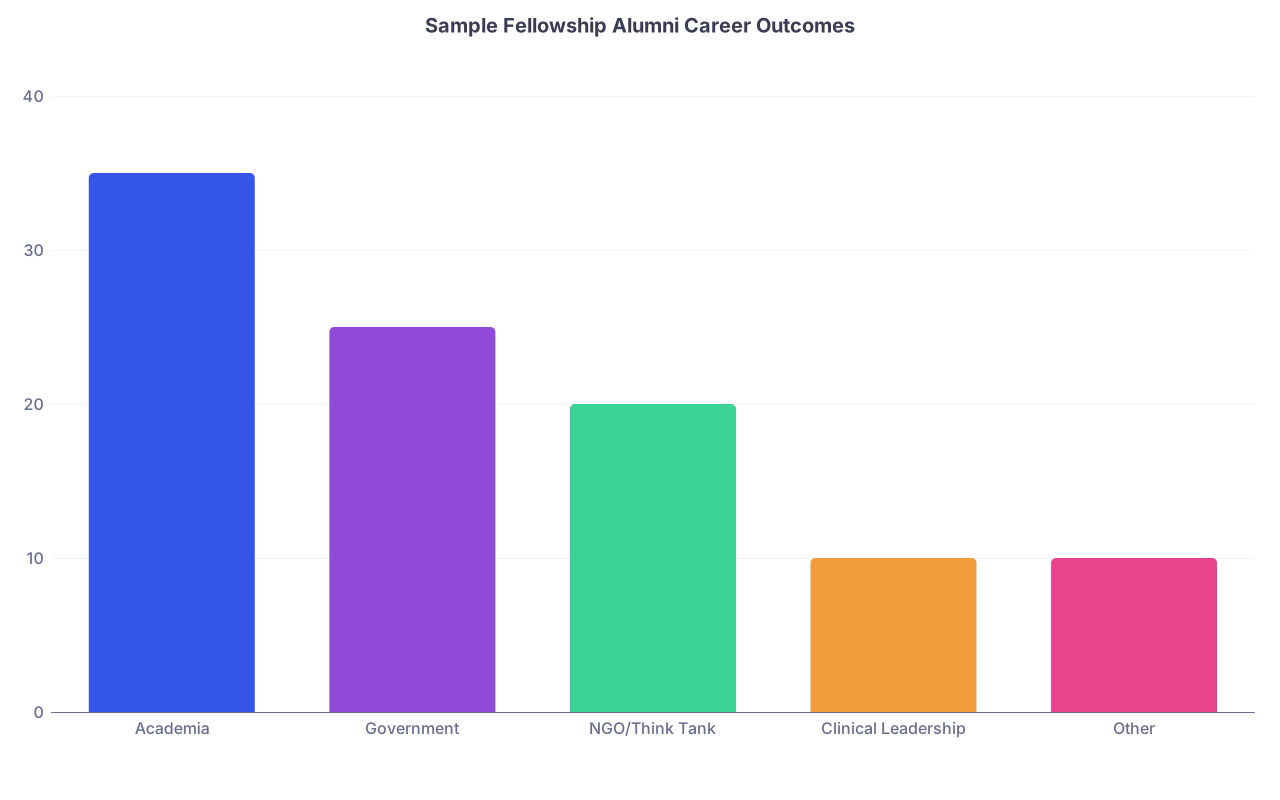
| Category | Value |
|---|---|
| Academia | 35 |
| Government | 25 |
| NGO/Think Tank | 20 |
| Clinical Leadership | 10 |
| Other | 10 |
When evaluating, try to find out:
- What proportion of alumni do something close to what you want?
- How quickly after the fellowship do they get there? (Immediately? 5–10 years later?)
- How many had similar backgrounds to you (MD, RN, MPH, PhD, etc.)?
You can literally sample LinkedIn:
- Search for “[Fellowship Name] fellow”.
- Open 20 alumni profiles.
- Count how many are in roles that excite you today.
- Note whether the fellowship seems central or incidental to their path.
If a program has been around for 10+ years and you can’t find clear role models in your target niche, strong sign it’s misaligned for your goals.
8. Reality fit: Training phase, ethics, and your actual life
You’re not just a generic applicant. You’re at a specific phase: med student, resident, early faculty, practicing clinician, MPH student, etc. The same fellowship can be perfect at one time and awful at another.
Ask these hard questions:
Timing and opportunity cost
- Do you have to take a leave from training? If so, does your program truly support that?
- Will this delay your graduation, promotion, or board eligibility?
- Are there later fellowships that might be a better, higher-impact time to step out?
For example:
I’ve seen residents jump into year-long DC fellowships too early, miss key clinical experiences, then realize there are mid‑career policy programs that would’ve fit them better once they had established expertise.
Financial and personal reality
- Stipend vs your current income — is the cut survivable?
- Cost of living in the city (DC, Geneva, NYC, etc.).
- Family or caregiving responsibilities — is relocation realistic?
If the money situation will keep you constantly stressed or moonlighting, your learning and networking will suffer. Be honest with yourself.
Ethics and values fit
This is under-discussed and matters a lot in public health and bioethics.
Look at:
- Funding sources (industry ties? political donors?).
- The ideological slant and whether you can live with it.
- How the fellowship handles conflicts of interest and advocacy positions.
Ask alumni quietly:
- “Did you ever feel pressure to take positions you didn’t agree with?”
- “How did the program handle disagreement on controversial issues?”
- “Was there space for critical bioethical reflection, or was it more advocacy‑driven?”
If your long‑term goal includes being a trusted, independent voice on medical ethics or health policy, you don’t want early-career affiliations you’ll have to explain away later.
9. Comparing fellowships: a simple head-to-head method
Stop trying to decide in your head. Put fellowships side-by-side.
| Criterion | Fellowship A | Fellowship B | Fellowship C |
|---|---|---|---|
| Exposure (1–5) | 4 | 2 | 5 |
| Skills (1–5) | 3 | 5 | 3 |
| Network (1–5) | 5 | 3 | 4 |
| Trajectory (1–5) | 4 | 3 | 4 |
| Reality fit (1–5) | 3 | 5 | 2 |
Two key moves:
- Circle your non‑negotiables. Maybe network and skills are must‑haves; trajectory is a “nice to have.” Weight your scoring accordingly.
- Notice the tradeoffs. Maybe the best academic trajectory fellowship forces a brutal pay cut and relocation. Maybe the most convenient local program offers weak exposure.
There is no “perfect” fellowship. You’re choosing which flaws you can live with.
10. Red flags that a fellowship doesn’t really fit your goals
I’ve seen these patterns over and over:
- The only people thrilled about your applying are prestige‑obsessed mentors; people actually in your target jobs are lukewarm.
- Current fellows describe the year as “a great break” but struggle to explain concrete skills they gained.
- Alumni outcomes feel random, not clustered around any clear pipeline.
- The fellowship work seems 80% logistics and event planning, 20% policy or ethics substance.
- You’re talking yourself into it mainly because you’re afraid of missing out, not because it clearly advances your path.
If two or more of those are true, step back.
11. How this looks in real life: three quick scenarios
Scenario 1: Public health doc eyeing state leadership
Goal: Become a state health official or Medicaid medical director.
Best-fit fellowship profile:
- Embedded in state government (health department, Medicaid office, governor’s health policy team).
- Direct work on implementation and cross‑agency coordination.
- Alumni heavily represented in state and local health leadership.
Moderately useful but not ideal:
- DC think tank writing national white papers.
- Highly academic policy fellowship heavy on publications but light on implementation.
Scenario 2: Resident interested in bioethics and guidelines
Goal: Clinician with strong involvement in ethics committees and guideline development.
Best-fit fellowship profile:
- Health system or university-based bioethics fellowship with clinical ethics consults.
- Opportunities to sit on IRB, ethics committees, or hospital policy groups.
- Strong mentoring from senior bioethicists, not just general policy people.
Less aligned:
- Advocacy-driven policy fellowship focused on campaigning and messaging.
- Purely legislative fellowship with no ethics infrastructure.
Scenario 3: MPH student wanting global health policy
Goal: Work at WHO, World Bank, Gavi, or similar.
Best-fit fellowship profile:
- Placements in multilateral orgs or major global NGOs.
- Focus on financing, global governance, treaty/mechanism design.
- Alumni clearly present in your target organizations.
Risky:
- Domestic-only fellowships celebrating a single flagship global project once a decade.
- Programs whose “global” work is mainly remote literature reviews for US-based teams.
12. A simple flow to decide: apply, pause, or pass
Here’s the decision logic in plain English:

| Step | Description |
|---|---|
| Step 1 | Define career north star |
| Step 2 | List 3 to 5 concrete needs |
| Step 3 | Score fellowship on exposure, skills, network, trajectory, reality fit |
| Step 4 | Do not apply |
| Step 5 | Pass or defer to later stage |
| Step 6 | Apply and tailor application to goals |
| Step 7 | Meets at least 3 of top priorities? |
| Step 8 | Major deal breakers? money, relocation, ethics |
If you can’t articulate how the fellowship hits at least three of your top priorities, skip it. Your time and energy are finite.
13. How to sanity-check your decision with mentors (without getting steamrolled)
Loop in 2–3 people who actually work in the kind of role you want. Not just whoever is loudest in your department.
Show them:
- Your career north star (one sentence).
- Your 3–5 concrete needs.
- Your quick comparison of 2–3 fellowships.
Then ask one pointed question:
“Which of these fellowships, if any, would you strongly recommend for someone who wants to be where you are in 10–15 years — and why?”
If someone you respect says, “Honestly, I’d skip fellowships for now and do X instead,” take that seriously. Policy fellowships are not the only path to a policy career.
14. Today’s next step
Open a blank page and do two things:
- Write a one-sentence description of your best current guess at your long‑term role in public health policy or medical ethics.
- Under it, list 5 must‑have outcomes you’d want from any policy fellowship.
Then pull up one fellowship you’re considering and ask, line by line: “Does this program clearly give me this?” Be ruthless. If the answer is “I hope so” more than “yes,” you’ve got more digging to do — or a different fellowship to chase.