
How Do I Handle Conflicts of Interest in Industry-Backed Health Policies?
What do you do when the “evidence-based” policy on your desk was written by people who profit if it passes?
Let’s be clear: if you work anywhere near health policy—government, NGOs, hospitals, academia, or pharma/medtech—you will run into industry-backed policies. Food industry “voluntary” nutrition guidelines. Alcohol industry “responsible drinking” campaigns. Pharma-funded opioid prescribing “education.” Medical device–sponsored screening recommendations.
Some of these policies are genuinely helpful. Some are Trojan horses. Your job is to tell the difference and act ethically when interests collide.
Here’s how to handle conflicts of interest (COIs) in industry-backed health policies without being naive, and without burning your career down in the process.
1. First: Get Very Clear on What a Conflict of Interest Actually Is
People confuse “conflict of interest” with “corruption.” They’re not the same.
A conflict of interest is:
A situation where your primary duty (to patients, the public, science, or your employer) may be unduly influenced by a secondary interest (money, prestige, career advancement, relationships, ideology).
You can have a conflict of interest even if you’re acting in good faith and haven’t done anything wrong. The risk of bias is the problem.
Common kinds you’ll see in industry-backed health policy:
- Financial: consulting fees, grants, honoraria, stock, patents, paid speaking.
- Institutional: your organization receives industry funding, “unrestricted educational grants,” or sponsorship.
- Professional/career: sitting on a company advisory board, being known as “the X company expert,” dependence on industry for ongoing studies.
- Personal: close friends, former bosses, or mentors working in the sponsoring company or advocacy front group.
The question you should always be asking yourself:
“Would a reasonable, skeptical outsider think my judgment could be biased here?”
If the answer is “yeah, probably,” you have a conflict you need to manage.
2. Spot the Red Flags in Industry-Backed Policies
Don’t start from “industry = evil.” That’s lazy. But also don’t start from “they’re just partners in health.” That’s how you get played.
Watch for these patterns—I’ve seen every one of them in real policy rooms:
Evidence-lite, opinion-heavy documents
Looks scientific, lots of citations, but:- Few randomized trials or independent systematic reviews
- Heavy reliance on white papers, industry-funded studies, or unpublished “data on file”
- Overconfident conclusions from weak evidence
“Balanced” recommendations that magically align with profit
Example:- Policy says: “We support reducing sugar consumption.”
- But the concrete measures are: “educational campaigns,” “industry self-regulation,” and “front-of-pack labeling designed by industry.”
- Absent: taxes, marketing restrictions, reformulation mandates.
Front groups and friendly branding
You’ll see names like:- “Coalition for Patient Access”
- “Center for Responsible Nutrition”
- “Foundation for Harm Reduction”
Flip the rock: - Who’s on the board?
- Who funds them?
- Who provides their “research”?
Timing that benefits a product cycle
- A new drug is about to launch → suddenly there’s a “consensus statement” recommending earlier treatment.
- A device manufacturer faces expiring patents → you see “updated screening guidelines” that expand use.
Overuse of “patient choice” and “shared decision making” as a shield
I’m all for autonomy. But if every policy objection is met with “We’re just supporting patient choice,” usually someone’s avoiding admitting the evidence is weak or the benefit tiny.
When two or three of these show up together, don’t ignore your gut.
3. Your Personal Decision Framework: Four Questions
When you’re directly involved in an industry-backed policy, run it through this framework:
What’s my primary obligation in this setting?
- Government: public health, transparency, fairness.
- Clinician: patient well-being, evidence-based care.
- Researcher: scientific integrity, honest reporting.
- NGO: mission and the populations you serve.
What secondary interests are in play—for me and for others?
Be honest:- Is your lab funded by the sponsor?
- Do you get paid to lecture for them?
- Do you see career advantages if this policy passes?
Would disclosure plus safeguards be enough, or is recusal necessary?
General rule:- Minor COI → full disclosure + guardrails (you participate, but don’t lead certain decisions).
- Major/financially significant COI → recuse from key decisions or authorship roles.
If this policy becomes public with all backstory exposed, can I defend my role with a straight face?
Imagine:- Your emails are on the front page.
- Your funding is fully listed.
- Your grandma asks what you did.
If you’d feel sick explaining it, that’s your answer.
4. Practical Tactics: How to Handle Yourself in Real Situations
Let’s get concrete. Here’s what you actually say and do.
A. In guideline or policy committees
You’re on a working group. Industry funded the convening or sponsored “unrestricted” support.
Do this early:
Disclose clearly and on record.
“For transparency, I consult for X on Y topic; I have no role in their Z product line. I’m happy to step back from specific votes if the group feels that’s appropriate.”Insist on evidence hierarchy.
Push for:- Independent systematic reviews.
- Pre-specified evidence grading (GRADE or similar).
- Clear marking of where evidence is weak vs strong.
Separate evidence assessment from value judgments.
You want language like:- “Evidence quality: low; Recommendation strength: conditional; Potential commercial implications: high.”
When the sponsor subtly pushes:
- “We’d like to ensure key stakeholders review drafts before release.”
Translation: they want veto power. Your response:
“External review is fine, but editorial control stays with the committee, and all comments + responses should be documented.”
B. In your own career choices and roles
You get invited to:
- Be on an industry advisory board
- Give a sponsored talk
- Join a “multi-stakeholder coalition” funded by a company
Ask yourself:
- Does this align with my long-term credibility, or does it rent my name for their slide deck?
- Would I still say “no” to them if their preferred policy harms public health, without second-guessing because of the money?
If you accept:
- Put strict boundaries in writing:
- You maintain control over your slides/writing.
- They can’t pre-approve your conclusions.
- Your affiliation and funding must be disclosed publicly.
If they push back hard on those? Walk away. You’re not a brand asset.
5. Structuring Policies to Contain Conflicts of Interest
If you have the power to shape process (which, eventually, you might), build in guardrails.
| Safeguard Type | Practical Example |
|---|---|
| Disclosure | Public COI statements for all committee members |
| Participation Rules | Members with major COI can discuss but not vote |
| Evidence Handling | Independent systematic reviews, not sponsor-led |
| Funding Structure | Pooled or firewall funding, no single sponsor veto |
| Transparency | Publish minutes, voting records, and COI details |
You want policies that:
- Treat industry as a stakeholder, not a co-author.
- Accept data from industry, but verify it independently where it matters.
- Make COIs visible enough that bad behavior becomes costly.
6. Managing the Personal and Political Fallout
Here’s the part nobody tells you: pushing on COIs can make people very uncomfortable. Especially your bosses.
You’ll hear:
- “Don’t make trouble; this partnership is important.”
- “You’re being idealistic; everyone has conflicts.”
- “Legal has cleared this; why are you still bringing it up?”
Here’s how to handle that without turning into “the difficult one” no one includes anymore.
Frame it as risk management, not moral purity.
“If we don’t handle the conflicts properly and this policy gets challenged, our credibility and funding are at risk. I’m trying to protect us.”Offer alternatives, not just criticism.
Don’t just say “this is tainted.” Say:
“Let’s include independent reviewers,” or
“We should have a public COI registry for this group.”Pick your battles. Hard.
Not every free sandwich needs a crusade. Focus on:- High-impact policies (drugs, devices, taxes, screening).
- Clear financial entanglements.
- Misrepresentation of evidence.
Document when things look bad.
You don’t have to go full whistleblower, but keep:- Emails where you raised concerns.
- Meeting notes with COI discussions.
That’s self-protection if things blow up later.
7. What “Good” Industry-Involved Policy Actually Looks Like
Not all industry involvement is rotten. There are cases that are genuinely constructive. They just look very different.
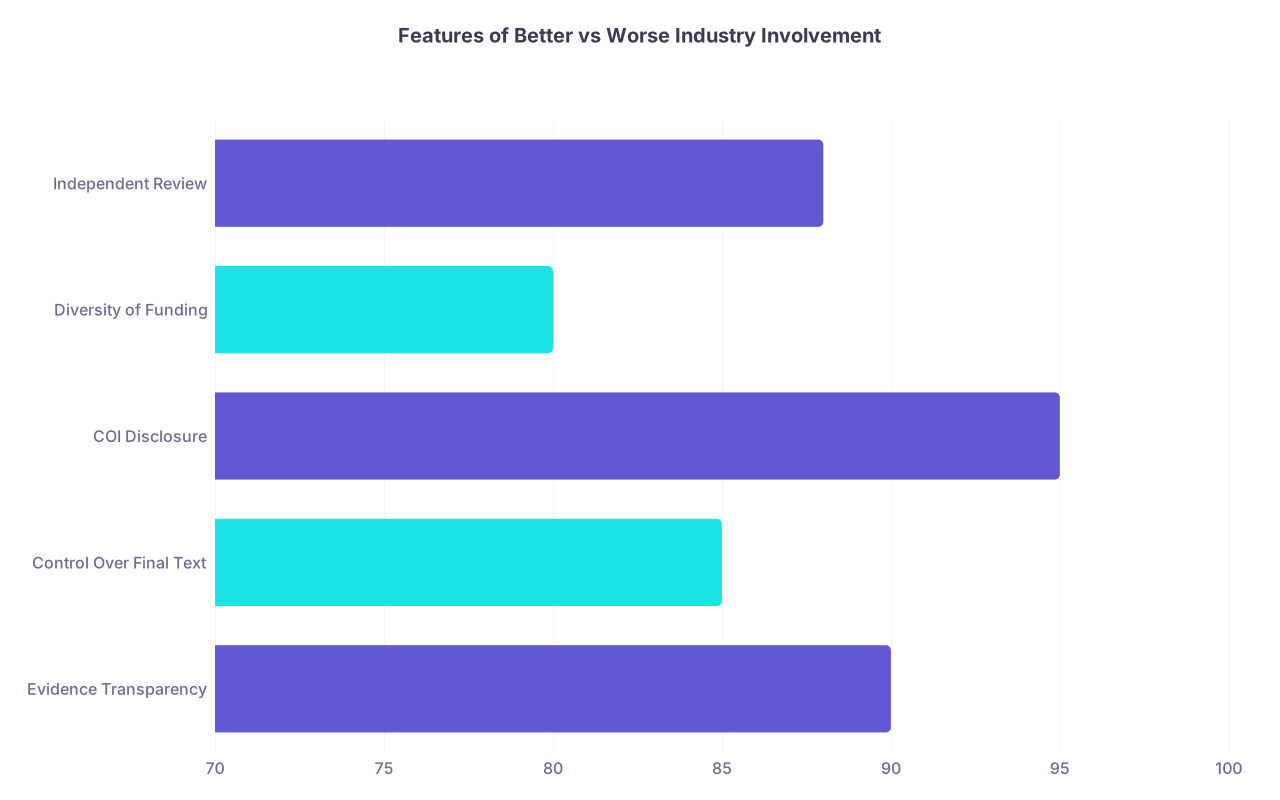
| Category | Value |
|---|---|
| Evidence Transparency | 90 |
| Control Over Final Text | 85 |
| COI Disclosure | 95 |
| Diversity of Funding | 80 |
| Independent Review | 88 |
Good examples usually have:
Clear separation of roles
- Industry supplies data, implementation expertise, and logistical support.
- Independent experts interpret data and write recommendations.
- Government/NGOs own the final policy.
Transparent funding, not hidden sponsorship
- “This guideline was funded by X foundation with contributions from multiple pharmaceutical donors. Full COI statements are available at [link].”
Multiple funders, not single-sponsor capture
One company funding the whole thing is a big risk. Pooled or arm’s-length funding reduces leverage.Independent chairs and majority
The people with the strongest COIs might still be in the room, but they’re not steering the ship.Evidence that cuts both ways is still included
When a policy funded by Company A clearly lays out where their product doesn’t work or where cheaper alternatives are just as good—that’s a good sign.
8. Concrete Scripts You Can Actually Use
Because sometimes the hardest part is the words.
When asked to join an industry-sponsored policy initiative:
“I’m open to contributing, but only if my role and your funding are fully disclosed, and if the group has independent oversight of the final recommendations. Is that how this is set up?”
When you see a draft policy that’s clearly shaped by industry:
“Right now this reads like it’s aligned very closely with the interests of [Company]. We need to explicitly state where evidence is uncertain and where recommendations may benefit specific commercial products.”
When you need to recuse yourself:
“Given my consulting relationship with [Company] on this exact topic, I think it’s better if I don’t vote on this recommendation. I’m happy to provide technical input, but I shouldn’t be part of the formal decision.”
When your boss waves away COI concerns:
“We don’t have to assume anyone is acting in bad faith. But if we can’t defend this process publicly—funding, relationships, everything—then our policy is vulnerable. I’d rather fix that now than explain it later to journalists or a legislative committee.”

| Step | Description |
|---|---|
| Step 1 | Industry backed policy appears |
| Step 2 | Assess as external critic |
| Step 3 | Identify my conflicts |
| Step 4 | Disclose and recuse from key votes |
| Step 5 | Disclose and stay with guardrails |
| Step 6 | Push for strong evidence standards |
| Step 7 | Advocate for transparency and safeguards |
| Step 8 | Reconsider role or oppose policy |
| Step 9 | Support with documented COI handling |
| Step 10 | Am I involved in decision |
| Step 11 | Major conflict |
| Step 12 | Defensible if fully public |
FAQ: Conflicts of Interest in Industry-Backed Health Policies
Is any collaboration with industry automatically unethical?
No. That’s too simplistic. Industry has data, manufacturing capacity, and real-world insight that can be useful. The problem isn’t contact; it’s captured decision-making. The goal is structured, transparent collaboration where public health priorities, not profit, control the final decisions.How much money is “too much” to create a serious conflict of interest?
There’s no universal dollar figure, but patterns matter more than raw amounts. A small honorarium once is less concerning than ongoing consulting that makes up a chunk of your income, equity or stock options tied to a product, or your lab’s survival depending on one company. If losing that funding would hurt you badly, it’s a significant conflict.What if my entire institution takes industry funding—am I automatically compromised?
Not automatically, but you can’t pretend it doesn’t matter. You handle this by: pushing for clear institutional COI policies, disclosing your institution’s relationships when relevant, and avoiding leadership roles in policy decisions where your institution’s major funders stand to gain directly.Is disclosure alone enough to manage conflicts of interest?
Often, no. Disclosure is the bare minimum, not the fix. For substantial conflicts, you need real structural safeguards: recusal from certain decisions, independent review, limits on sponsor involvement, and documentation of how conflicts were managed. “We disclosed it in 8-point font on page 37” is not an ethical shield.What if I’m junior and worried that raising COI concerns will hurt my career?
Then you need to be smart, not silent. Start with questions, not accusations: “Can you walk me through how COIs are being handled in this process?” Support senior people who are already pushing for better practices. Document your concerns professionally. You don’t have to die on every hill—but you also don’t have to put your name on something you know is garbage. Your long-term credibility is one of the few assets you control. Guard it.
Key points to walk away with:
- A conflict of interest is about risk of bias, not proof of corruption—and how you manage that risk is what defines your ethics.
- Industry-backed policies can be useful, but only when there’s transparency, independent control over evidence and recommendations, and real safeguards against capture.
- Your job is not to be “pure.” It’s to be honest, transparent, and willing to walk away or recuse yourself when a policy or role crosses the line you can’t defend in public.