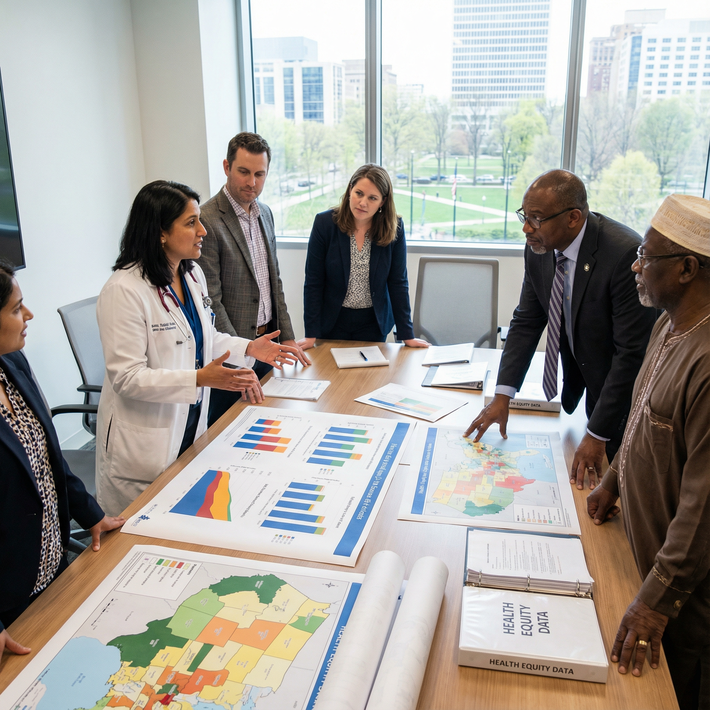
The belief that you need an MPH to be credible in health policy debates is wrong.
The short answer: No, you do not need an MPH — but you do need policy literacy
Let me be clear: an MPH is a tool, not a ticket. It can boost your skills and open doors, but it does not magically make your arguments better, your ethics stronger, or your policy positions more informed.
You can be highly credible in health policy debates if you:
- Understand the evidence and the data
- Speak the language of policy (costs, trade-offs, feasibility)
- Recognize ethical implications and equity issues
- Build a track record of engagement and actual work
An MPH can help with those. It can also be a very expensive way to avoid doing the slower, messier work of learning and participating.
So the real question isn’t “Do I need an MPH?”
It’s “What kind of credibility do I want—and what’s the most efficient way to build it?”
Let’s break that down in a way that actually helps you decide what to do next.
What “credibility” in health policy actually looks like
People throw “credibility” around like it’s a degree. It isn’t. In health policy debates—whether that’s on a hospital committee, in a legislative hearing, or on CNN—credibility usually comes from five things:
Subject-matter expertise
Do you actually understand the issue? Medicaid expansion. Vaccine mandates. Scope of practice. Hospital financing. Maternal mortality. Pick any topic; there’s real technical detail behind it.Evidence fluency
Can you read, interpret, and explain the evidence? RCT vs observational. Confounders. Cost-effectiveness. Absolute vs relative risk. If you hand-wave the methods, policy people stop listening.Policy context awareness
Do you know how the decision gets made? Who has power, what the legal constraints are, what’s been tried and failed before, and why. Policy isn’t a clean lab experiment; it’s constrained chaos.Ethical clarity
Can you clearly articulate what values are at stake? Autonomy vs public good. Equity vs efficiency. Short-term political wins vs long-term health gains.Reputation and track record
Have you done anything? Written a brief, served on a committee, testified, analyzed a bill, written op-eds, worked with a community organization. Talk is cheap. Receipts matter.
An MPH can strengthen each of these, but none of them require an MPH.
What an MPH realistically gives you (and what it doesn’t)
Here’s the real value proposition of an MPH in health policy, stripped of brochure language.
You typically gain:
Structured exposure to:
- Epidemiology and biostatistics
- Health systems and financing
- Policy analysis and evaluation
- Population health and social determinants
A vocabulary and framework
You learn how people in government, public health departments, NGOs, and think tanks talk about problems: externalities, incentives, marginal effects, implementation science, ROI.Networks
Classmates who end up at CMS, WHO, foundations, and health systems. Faculty who get invited to testify. Alumni who forward jobs and fellowships.Signal
For some employers—research-heavy think tanks, certain fellowships, some global health orgs—“MPH” signals you can handle data, evaluation, and policy jargon.
But it does not automatically give you:
- Deep expertise in every policy domain (you’ll scratch the surface of many)
- Instant credibility with frontline clinicians or communities
- Moral authority in ethical debates
- Protection from saying naive or politically tone-deaf things in public
I’ve seen MPH grads who could run a regression but had no clue how a state Medicaid office actually operates. I’ve also seen non-MPH clinicians run circles around “policy people” in legislative testimony because they understood the ground truth and had done the homework.
So you need to decide: Do you want the structure and signal badly enough to justify the cost?
When an MPH is genuinely worth it (and when it’s overkill)
Here’s where people get lost. They confuse “I want to be informed” with “I need another degree.”
| Scenario | Is MPH Helpful? |
|---|---|
| You want a **full-time career** in health policy, public health leadership, or global health | Often yes |
| You aim to work at a **think tank, government agency, or NGO** as your main job | Often yes |
| You are a clinician who wants to be **policy-literate and influential while staying mostly clinical** | Usually no |
| You mainly want to **argue better on Twitter / X or in student groups** | No |
| You already have strong **quantitative and policy training** (e.g., economics, political science) | Maybe, depends on niche |
Strong reasons to pursue an MPH
You should seriously consider an MPH if:
You want to pivot your career into:
- Health policy analysis at places like CBO, RAND, Urban Institute
- Public health departments (city, county, state)
- Global health agencies (WHO, UNICEF, large NGOs)
- Health system population health leadership roles
You know you want to be:
- A hospital system CMO with a population health or value-based care focus
- A public health officer or commissioner someday
- A researcher doing policy-impact or population health studies
You lack:
- Any formal training in statistics or epidemiology
- Any exposure to health systems, financing, or program evaluation
In these cases, the MPH isn’t just vanity. It’s foundational.
Weak reasons to pursue an MPH
I see these all the time. They’re not good enough:
- “I feel behind other people who are ‘into policy’”
- “I want to be taken seriously on panels”
- “Everyone doing health policy in my school seems to be getting dual degrees”
- “It sounds interesting and I don’t know what else to do with this year”
You do not need a $50,000 degree to read bills carefully, understand R0, or write an op-ed that doesn’t embarrass you.
How to be credible in health policy without an MPH
If you decide (correctly) that you don’t need an MPH now, here’s what you do instead.
Step 1: Build a real policy literacy base
Use a focused, self-designed curriculum:
One solid health policy book
Read it cover to cover, not just skim:- “Health Policy Issues” by Paul Feldstein
- “The Health Care Handbook” by Askin & Moore (short, actually readable)
Basic methods competence
You don’t need full biostats, but you do need to:- Understand the difference between correlation and causation
- Recognize basic study designs (RCT, cohort, case-control, natural experiment)
- Interpret simple regression outputs at a conceptual level
Follow 2–3 serious sources regularly
Not just hot takes. Things like:- Health Affairs (especially their blog and policy briefs)
- Kaiser Family Foundation (KFF) issue briefs
- State health department reports on issues you care about
Spend 1–2 hours a week on this for 6 months. You’ll be ahead of most “policy-curious” folks.
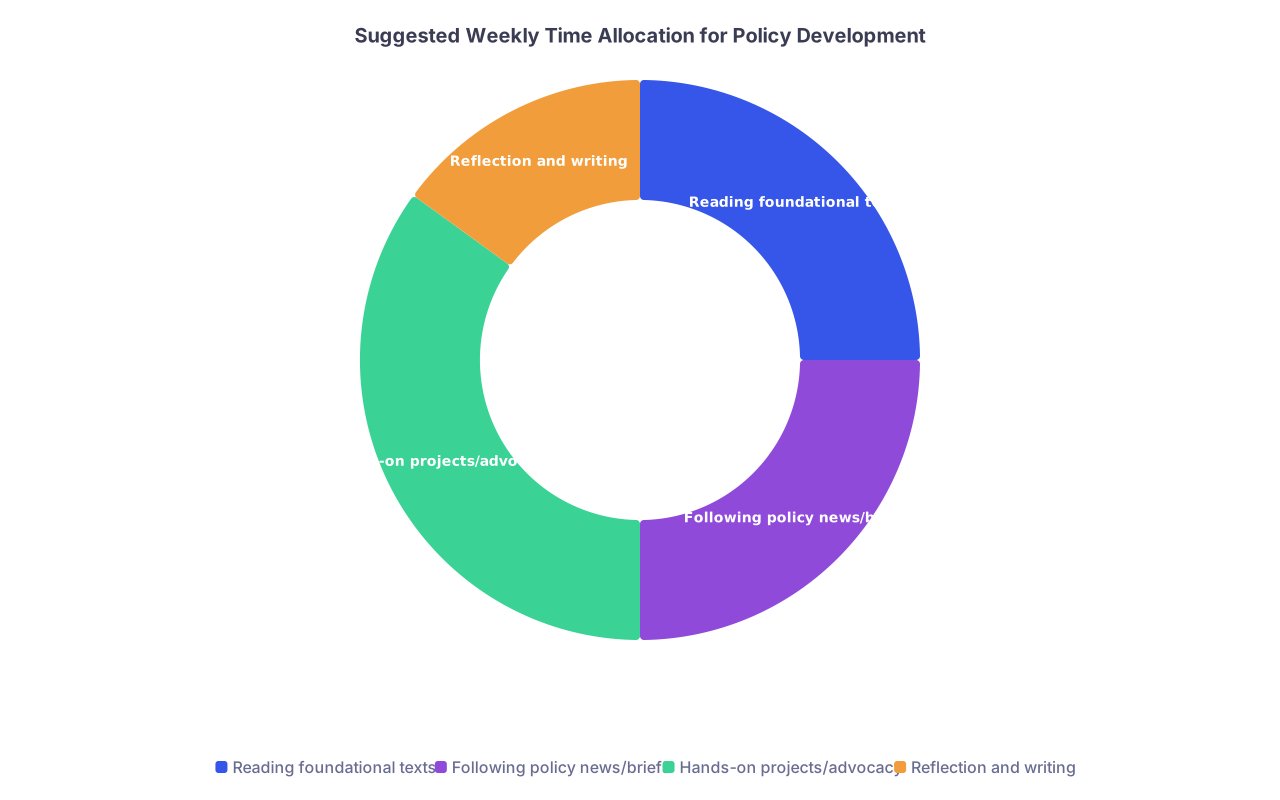
| Category | Value |
|---|---|
| Reading foundational texts | 25 |
| Following policy news/briefs | 25 |
| Hands-on projects/advocacy | 35 |
| Reflection and writing | 15 |
Step 2: Do at least one real-world project
Credibility comes from doing, not just reading.
Pick a concrete problem and attach yourself to a real effort:
Work with your local public health department on:
- Vaccine outreach
- Overdose prevention
- Maternal mortality review
Join a hospital or clinic task force on:
- Readmissions
- Access to care
- Telehealth policies
Partner with a community organization on:
- Environmental justice
- Housing and health
- Food insecurity
Your goal: produce something tangible—a brief, slide deck, small evaluation, or testimony draft—that someone actually uses.

| Step | Description |
|---|---|
| Step 1 | Interest in Health Policy |
| Step 2 | Self Study |
| Step 3 | Local Project |
| Step 4 | Write or Present Output |
| Step 5 | Join Committees or Advocacy |
| Step 6 | Build Reputation |
Step 3: Learn to communicate like a policy person
Most clinicians and students lose credibility not because they’re wrong, but because they talk like they’re still in morning rounds.
Shift your style:
Translate clinical anecdotes into policy-relevant terms:
- Instead of: “I had a patient who…”
- Try: “In our clinic, about 30% of uninsured patients with X end up Y. That’s consistent with [this] study showing…”
Always connect to:
- Cost (direct or indirect)
- Scale (how many people affected)
- Feasibility (who would implement, using what authority)
- Equity (who benefits, who bears the burden)
Once you start talking this way, people stop asking “Do you have an MPH?” and start asking “Can you join this working group?”
The ethical side: credibility, humility, and power
You also asked a stealth question: Is it ethical to speak in health policy debates without formal public health training?
Here’s the honest answer.
It’s unethical to:
- Speak with absolute authority on issues you don’t understand
- Dismiss community voices, lived experience, or frontline workers
- Quote single studies as “proof” without acknowledging uncertainty or limitations
- Push policies that mainly serve your own professional group under the banner of “for patients” when the evidence is mixed
It is not unethical to:
- Enter the debate without an MPH
- Ask naive questions
- Change your mind as you learn
- Say “I do not know enough yet to endorse a specific policy, but here’s what concerns me most ethically…”
The ethical safeguard is intellectual humility, not another three letters after your name.
A simple decision framework: Should you get an MPH?
Here’s a stripped-down framework that I’ve used with residents and med students.
| Question | If YES | If NO |
|---|---|---|
| Do you want policy to be a **core part** of your career (not just a side interest)? | Lean toward MPH | Self-study + projects first |
| Do you lack any quant/methods background? | Short list of MPH | Consider targeted short courses |
| Are you already accepted to a fully or mostly funded MPH? | Strongly consider | Be more cautious |
| Are you mainly anxious about “keeping up” with peers? | Bad reason | Focus on experience, not degrees |
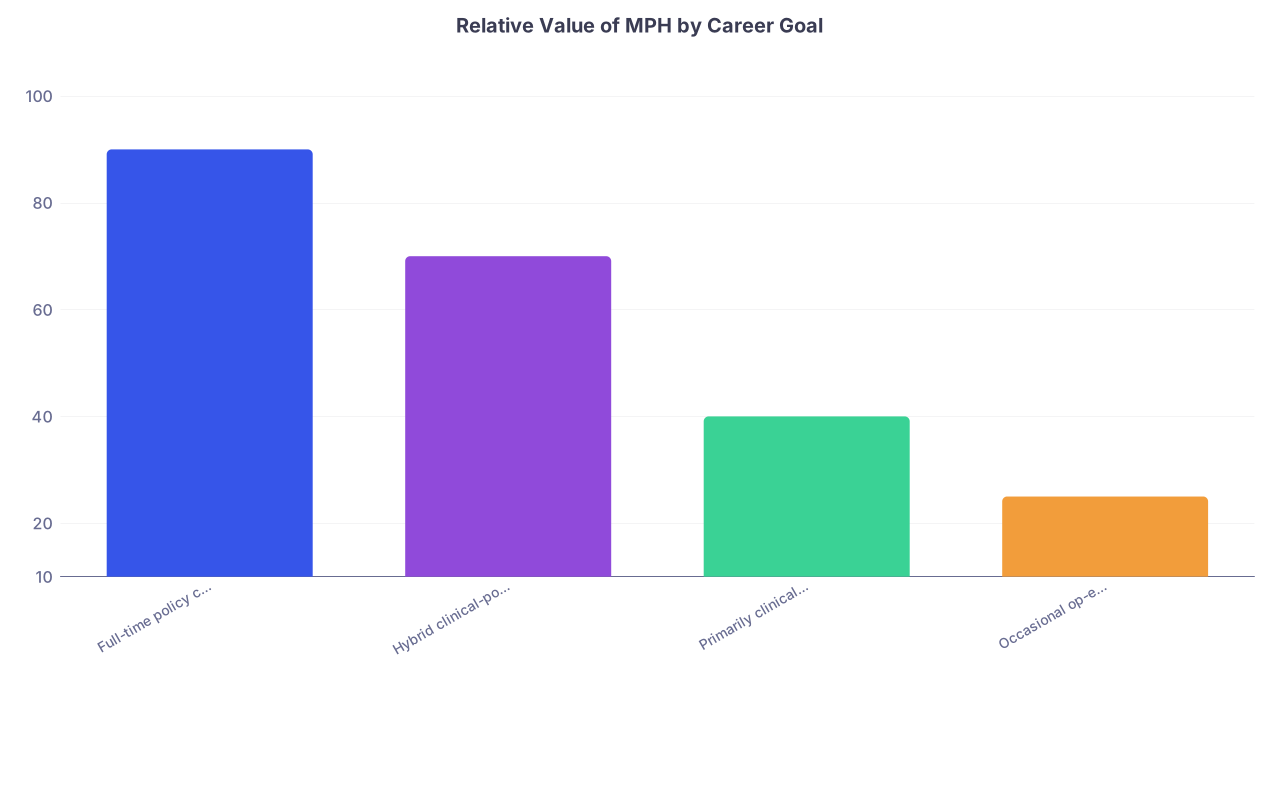
| Category | Value |
|---|---|
| Full-time policy career | 90 |
| Hybrid clinical-policy role | 70 |
| Primarily clinical with advocacy | 40 |
| Occasional op-eds/public commentary | 25 |
If you’re early in training (med student, early resident, grad student) and not sure, your safest move is:
- Do 1–2 years of serious policy engagement (projects, writing, committees).
- Reassess: Are doors closed to you because you lack an MPH, or are you progressing fine?
Most people find the degree is optional if they’ve built a track record.
FAQ: Common questions about MPH and policy credibility
1. Will having an MPH make people take my testimony or op-eds more seriously?
Sometimes, but only at the margins. Lawmakers and the public care more about:
- Whether you’re close to the problem (clinician, patient, community member)
- Whether your argument is clear, specific, and grounded in evidence
“MPH” after your name helps in some DC and academic circles, but it’s not what carries the argument.
2. If I already have an MD, JD, or PhD, is an MPH redundant?
Not automatically, but often you can get 80–90% of the value with:
- Short courses in epidemiology/biostats
- Targeted policy fellowships
- On-the-job learning in policy roles
If your prior training was quantitative (e.g., economics, statistics), a full MPH is frequently overkill unless you’re pivoting squarely into public health leadership.
3. Do public health leaders without MPHs actually exist, or is that just talk?
They exist. You’ll find:
- Clinicians with strong experience in quality improvement and population health
- Lawyers who built careers in health law and regulation
- Researchers from econ/sociology backgrounds who do serious policy impact work
What they all share: years of hands-on policy work, not just opinions.
4. Will not having an MPH hurt my chances at specific policy fellowships?
For some fellowships—especially those branded as “public health” or “population health”—an MPH is preferred or common among recipients. Others (especially clinician-focused fellowships) prioritize clinical experience, leadership, and writing over degrees. You need to check specific programs instead of guessing.
5. I like policy but don’t know my niche yet. Should I wait on the MPH?
Yes. Delay. Do real-world work first:
- Join a local or state advocacy effort
- Work on a research or QI project with policy implications
- Write something for a public audience
After 1–2 years you’ll either be more certain you want policy long-term (and know your focus) or realize it’s an interest, not a career anchor.
6. What can I do this year to boost my policy credibility without enrolling in a degree?
Concrete, one-year plan:
- Pick one issue (e.g., mental health access, abortion access, overdose prevention)
- Read 5–10 serious reports or papers on it
- Join one local working group, task force, or advocacy coalition
- Produce one tangible output (brief, op-ed, testimony draft, poster, or small evaluation)
Do that, and you’ll have more real credibility than someone who did a year of passive coursework.
Open a note right now and write this: “My health policy credibility will come from these three things this year: [topic], [project], [output].” Fill in the blanks. That decision matters more than whether you ever add “MPH” to your signature.