
The word “advocacy” on your CV means a lot less than you think—and sometimes it quietly hurts you.
Let me tell you what actually happens when program directors, faculty, and selection committees see that line.
They do not say, “Wow, what a socially conscious applicant.”
They say, “Okay… is this real, is this fluff, and is this going to be a problem?”
I’ve watched this conversation play out in rank meetings, in hallway debriefs after interviews, and in the snarky side-comments when people think the applicant will never hear about it. You’re about to get the unfiltered version.
How PDs Really Read “Advocacy” On Your CV
When a PD sees “Advocacy” on your CV, they’re running an almost automatic three-step filter in their head:
- Is this performative or substantive?
- Is this aligned with our program’s culture or going to clash with it?
- Does this predict a resident who will show up and do the work—or one who will argue about every policy at 3 a.m.?
Nobody says it out loud in that sequence, but I’ve watched it happen in real time.
Here’s the part you never get told in official workshops: most PDs are not impressed by the word “advocacy” itself anymore. It’s been diluted by years of students listing:
- “Advocacy: social media posting about health equity”
- “Member, advocacy committee (attended 2 meetings)”
- “Helped raise awareness of X via Instagram”
They’ve been burned too many times by people who talk a big game about “justice” and then can’t get their notes done.
So what actually changes how they see you is not that you did advocacy—it’s how you did it and what it says about your behavior under pressure.
Let’s break down how that plays out behind closed doors.
The Quiet Categories PDs Sort You Into
Program directors mentally sort “advocacy” applicants into rough buckets. They don’t write these labels down, but you’d recognize them if you sat in the room long enough.
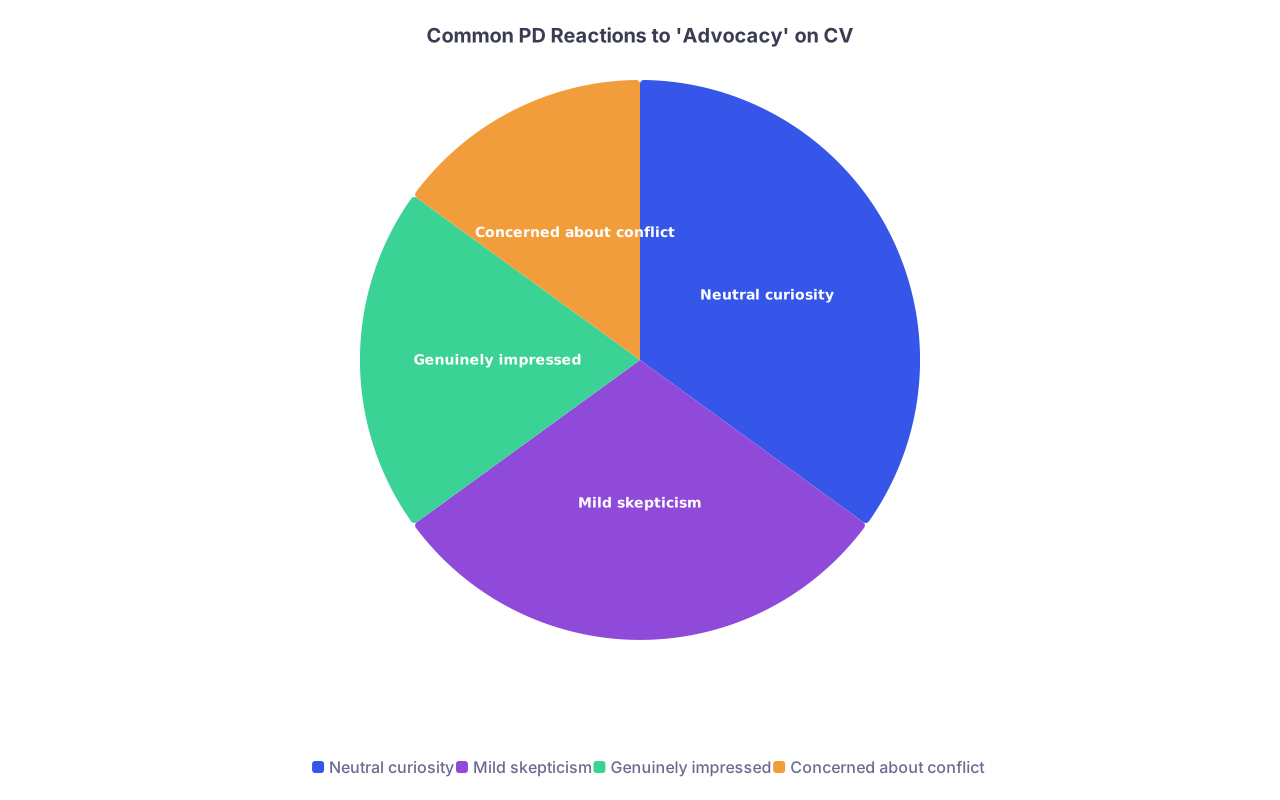
| Category | Value |
|---|---|
| Neutral curiosity | 35 |
| Mild skepticism | 30 |
| Genuinely impressed | 20 |
| Concerned about conflict | 15 |
1. The “Real Work” Advocate
This is the applicant who lists:
- “Led clinic-wide QI project to reduce insulin prior auth delays; decreased average approval time from 5 days to 2.5 days.”
- “Testified at state legislature on Medicaid postpartum coverage, collaborating with department chair and hospital legal.”
- “Founded hospital-based transportation voucher program; secured $15,000 grant, implemented tracking, and presented outcomes.”
This person triggers comments like:
- “They actually got something done.”
- “They understand systems, not just complaints.”
- “If they can move a hospital committee, they can definitely handle floor diplomacy.”
These applicants are rare. They get remembered. Often favorably.
2. The “Hashtags and Slogans” Advocate
The CV looks like:
- “Advocated for racial justice through social media posts and online campaigns.”
- “Spoke out against systemic injustice in healthcare.”
- “Member, Social Justice in Medicine group” with no bullets or outcomes.
The room reaction?
- Raised eyebrow.
- A faculty member quietly scrolling to see if there’s any actual work or just big language.
- Someone asks, “Do we see anything concrete here?”
If that’s all you’ve got, you’re not coming off as passionate. You’re coming off as unserious and potentially high-drama.
3. The “War With The System” Advocate
This is where people start to worry.
CV lines like:
- “Organized student walkout against hospital administration over unsafe staffing ratios.”
- “Led protest campaign against the EM department’s use of law enforcement in the ED.”
- “Publicly criticized residency leadership about inequitable scheduling practices.”
Now, let me be fair: a lot of that may be morally justified. Often the students were right.
But in PD brain, the question is not “Were they right?” It’s, “Is this the person who will blast us on Twitter at 2 a.m. because they did four nights in a row?”
You’ll hear comments like:
- “Are we signing up for trouble?”
- “Passionate, but are they coachable?”
- “Will this turn into an HR problem in PGY-2?”
You might think that’s cowardly. Many PDs would privately agree. But they still have to run a program, protect their residents, and not be in constant conflict with hospital admin.
4. The “Values-Driven But Grounded” Advocate
This is the sweet spot.
Their CV reads:
- “Volunteer physician advocate at legal-medical partnership clinic; helped coordinate medical letters for 25+ housing and benefits cases.”
- “Served as student rep on hospital DEI council; contributed to redesign of interpreter-use policy, presented data to QI committee.”
- “Co-authored op-ed on vaccination access in local newspaper; worked with health department to staff free flu shot clinics.”
This person gets comments like:
- “They care, but they work within systems.”
- “That’s someone I could see leading a QI or DEI project here.”
- “They seem like a bridge-builder, not a bomb-thrower.”
That’s what you want.
What PDs Really Fear (And Won’t Put In Writing)
Let’s be brutally honest.
Program directors worry about three specific things with “advocacy-heavy” applicants:
- Will you get your work done?
- Will you turn every routine conflict into a values war?
- Will you cause public-relations nightmares?
They will never write this in an official communication. But they say it in selection meetings.

Productivity vs. “Cause”
More than once, I’ve heard some version of this:
“He’s on every diversity and advocacy committee, but his notes are always late and nurses can’t find him.”
No PD wants to pick between the resident who champions important causes and the resident who keeps the service running. They want both.
But if they have to choose, they will choose the reliable workhorse almost every time.
Because the pager doesn’t care how powerful your op-ed was.
So when they see advocacy all over your CV and almost no mention of clinical excellence, teamwork, QI, or research, the quiet suspicion is: “Is this person more interested in being a hero than being a team member?”
Values vs. Volatility
Programs aren’t scared of values. They’re scared of volatility.
If your advocacy history looks like a pattern of public blowups—calling out departments by name, flaming institutions online, constant confrontation—PDs read that as:
- “High risk for interpersonal conflict.”
- “Might not take feedback well.”
- “Could tear apart team cohesion under stress.”
I’ve seen excellent candidates dropped down the rank list because an older faculty member said, “I’m getting the sense this person will see us as the enemy the first time something doesn’t go their way.”
Is that always fair? No.
Is it reality? Yes.
Public Image Risk
This one is newer but very real.
Hospitals are terrified of bad press. PDs know one angry resident with a large social media audience can drag an entire institution into the news cycle.
So they look at:
- Do you blast your med school publicly by name online?
- Do you post screenshots of internal emails?
- Do you seem to label every disagreement as “abuse” or “oppression”?
Again, not a moral judgment here. A strategic one. They will ask themselves, “If we’re not perfect—and we won’t be—will this person try to fix things internally, or will they go straight to the internet?”
How To Put Advocacy On Your CV So PDs Respect It
Here’s the part you actually need: how to present your advocacy so it helps you instead of quietly sinking you.
1. Translate activism into outcomes
No one is impressed by “raised awareness.” They’re impressed by changed practice.
Instead of:
- “Advocated for vaccine equity in my community.”
Write:
- “Coordinated mobile vaccine clinic partnership; 3 events, ~450 vaccines delivered to uninsured adults; presented uptake data to county health board.”
See the difference? One sounds like vibes. The other sounds like work.
| Type | Weak Line | Strong Line |
|---|---|---|
| Policy | Spoke out on Medicaid issues | Met with 3 state reps on Medicaid postpartum coverage; contributed data brief used in committee hearing |
| Community | Promoted health equity | Organized 4 blood pressure screening events; 160 participants, 32 referred for primary care |
| Institutional | Fought for DEI | Served on residency DEI taskforce; helped implement new bias-reporting workflow, 30% increase in reports addressed |
2. Show you understand systems, not just slogans
If your experience shows you can:
- Work with administration
- Navigate constraints
- Build coalitions
- Use data to argue for change
PDs mentally shift you from “idealistic complainer” to “future chief resident / future medical director.”
For example:
“In collaboration with clinic leadership and billing, streamlined charity care documentation to reduce visit denials; denial rate dropped from 18% to 7% over 6 months.”
That tells a PD: “This person knows how institutions actually move.”
3. Embed humility and teamwork into your narrative
In interviews, the red-flag version of an advocacy story is:
- “Administration didn’t care, so I had to step up and force change.”
The grounded, safe, still-impressive version:
- “There were real constraints and miscommunication between frontline staff and leadership. I worked with our attending and our nurse manager to gather data and propose a change that leadership could accept.”
Same overall story. Very different signal.

| Step | Description |
|---|---|
| Step 1 | Advocacy story |
| Step 2 | Risk of conflict |
| Step 3 | Leader potential |
| Step 4 | Question maturity |
| Step 5 | Credible advocate |
| Step 6 | Tone |
| Step 7 | Focus |
4. Be ready to connect advocacy to clinical excellence
PDs want to know: does your advocacy make you a better clinician, or is it a separate identity?
Tie it together:
- “Working with housing-insecure patients through the legal-medical partnership changed how I take social histories and safety-plan discharges.”
- “Joining the team revising our sepsis order set taught me to balance ideal care with real-world staffing and resource limits.”
Now advocacy looks like a training multiplier, not a side hobby.
What Different Types of Programs Think (This Matters)
Not every program reads advocacy the same way. Far from it.
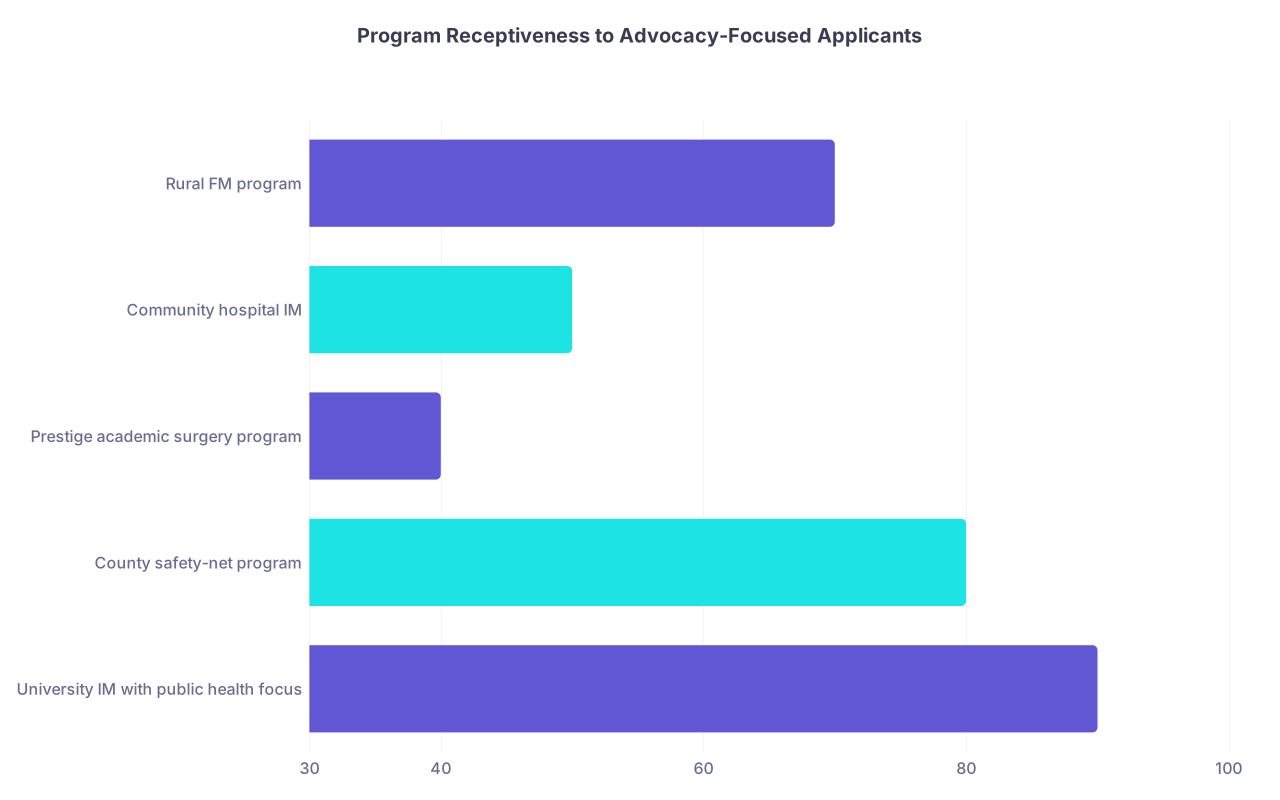
| Category | Value |
|---|---|
| University IM with public health focus | 90 |
| County safety-net program | 80 |
| Prestige academic surgery program | 40 |
| Community hospital IM | 50 |
| Rural FM program | 70 |
Those percentages aren’t precise, but the pattern is real.
Public health–oriented and county programs
They love credible advocacy—especially if it connects to Medicaid, housing, addiction, immigrant health, reproductive health access.
But even there, they want:
- People who can survive the grind
- Residents who won’t alienate nursing or social work
- Colleagues who get that “the system” also includes underpaid, exhausted staff
So they’ll be impressed if your advocacy has teeth and you sound grounded.
High-prestige, research-heavy departments
They tend to respect advocacy packaged as:
- Health policy research
- National committee work
- Publications and invited talks
- Organized leadership roles
They’re less interested in protest photos and more interested in whether you worked with ACP, AMA, national societies, or did health policy fellowships.
Smaller community programs
Here, the PD is thinking:
“Will this person stay in our city, care for our population, and not blow up the hospital’s relationship with the board?”
They respect practical, community-facing advocacy:
- Free clinics
- Local school partnerships
- Vaccine drives
- Homeless outreach
You talking about sweeping federal policy change means less to them than you running a blood pressure night at the YMCA.
Advocacy, Ethics, and Your Own Line in the Sand
Let’s be clear: some programs will never be comfortable with forceful advocates. Some will quietly punish you for having made administrators uncomfortable in med school.
So you have to answer a question for yourself:
Are you trying to hide your advocacy so you match anywhere, or signal it so you match where you belong?
You can absolutely soften edges, be strategic, and emphasize your ability to collaborate. That’s smart.
But if your core identity is being the person who speaks up when patients are harmed by policy, then you actually want the programs that welcome that and want to avoid the ones that will choke you on day one.
I’ve seen residents completely miserable because they sanitized their application and ended up in a program that sees any pushback as “insubordination.”
I’ve also seen residents thrive because they were upfront—calmly, professionally—about their advocacy and landed in places where chiefs and PDs said, “We need that energy here, as long as you’re also doing the work.”
You’re not just trying to impress them. You’re trying to find your people.

How To Talk About Controversial Advocacy In Interviews
You know the hot-button areas: policing in the ED, reproductive rights, trans health, immigration enforcement, unionization.
You can mention all of these and still come out looking thoughtful instead of radioactive, if you frame them correctly.
Use this structure:
- Start with the patient or system problem, not your outrage.
- Describe your role concretely and specifically.
- Acknowledge complexity or opposing pressures.
- End with what you learned about working inside systems.
Bad version:
“I organized a protest against our hospital’s racist security policies, because no one in leadership cared about Black patients.”
Better version:
“Our ED had repeated incidents where Black patients were disproportionately subjected to security calls. I joined a group that gathered data, met with hospital leadership, and helped propose new guidelines and training. It was tense at times—security and nursing had legitimate safety concerns—but I learned how to keep patient safety and equity at the center while working within institutional constraints.”
Same issue. Totally different signal.
Common Mistakes That Make PDs Roll Their Eyes
I’ve watched actual CVs and personal statements get dissected in committee. These patterns come up again and again:
- Using “advocacy” as a label for basic volunteering (“Tutored kids in math—advocacy for education”)
- Calling every involvement “leadership” when you clearly just attended meetings
- Writing more about “calling out injustice” than about building anything
- Subtweeting your own med school in your personal statement about “toxic institutions”
- Putting polarizing hashtags or slogans as headings for activities
If you want to do a quick self-audit, ask:
“Would this still make sense and look solid if I removed all value-charged words and just left the actions and outcomes?”
If the answer is no, the entry is weak.

A Simple Framework To Make Advocacy Work For You
If you strip everything down, PDs are trying to answer one question:
“Will this person be a reliable, ethical, team-oriented physician who makes our program and our patients better—not harder?”
Use that to filter every advocacy experience you present.
For each one, be able to answer:
- What problem was I actually addressing?
- What concrete role did I play?
- What measurable or visible effect did the work have?
- How did I show respect for colleagues even when I disagreed?
- What did I learn about working inside imperfect systems?
If you can answer those cleanly, you’re in the “leader potential” column, not the “walking HR file” column.

| Step | Description |
|---|---|
| Step 1 | Advocacy experience |
| Step 2 | Describe problem |
| Step 3 | Specify role |
| Step 4 | Show outcomes |
| Step 5 | Highlight collaboration |
| Step 6 | Connect to residency skills |
| Step 7 | Positive PD impression |
FAQ: What PDs Actually Think About Advocacy
1. Should I include controversial advocacy (abortion rights, police violence, etc.) on my CV?
Yes, if it’s real work and core to who you are. But frame it in terms of patient care, measurable actions, and collaboration, not ideology. If a program quietly hates that, you probably don’t want to train there long-term.
2. Does heavy advocacy experience make PDs think I’ll neglect clinical duties?
It can, if your CV is lopsided. Balance it with strong clinical comments in letters, concrete examples of reliability, and at least a couple of entries that show you care about QI, education, or team function—not just protest.
3. Is it better to call things “advocacy” or “quality improvement” or “leadership”?
Use the label that most accurately fits what you actually did. If you changed workflows with data and collaboration, that’s QI and leadership. If you worked on policy, law, or structural change, that’s advocacy and health policy. PDs care more about substance than the heading.
4. How much advocacy is “too much” on an application?
There’s no number. The red flag is when advocacy is your only dimension. If 70–80% of your non-required activities are advocacy-themed and you have weak clinical, research, or teaching signals, some PDs will worry you see residency mainly as a platform for politics.
5. What’s one concrete thing I can change on my CV right now to help?
Rewrite every advocacy entry to include a specific problem, your role, and a concrete outcome—numbers if you have them. Cut any entry that’s just “raised awareness” without real action. That alone moves you from vague idealist to credible system-minded physician in training.
Two things to carry with you from all this:
- “Advocacy” by itself doesn’t impress anyone anymore. Real impact, concrete outcomes, and the ability to work inside messy systems do.
- PDs aren’t scared of your values; they’re scared of unreliability and volatility. Show them you can be both a strong advocate and a strong teammate, and you stop being a risk—and start looking like a future leader they’d be lucky to train.