
The myth that “any advocacy is good advocacy” is dangerous. For physicians and trainees, the wrong kind of advocacy can quietly poison your credibility, your relationships, and your future options. Sometimes without you realizing it until doors stop opening.
You are not a free agent pundit. You are a professional whose words get remembered, screenshotted, forwarded, and occasionally weaponized.
Let me walk you through seven advocacy missteps that routinely hurt medical careers—and how to avoid stepping on those landmines.
1. Confusing Advocacy With Activism-At-All-Costs
The first mistake is romanticizing activism and forgetting you also have a license (or will soon) that can be questioned.
Advocacy in public health policy is not the same as being a full-time activist. You have extra constraints:
- Professional codes of ethics
- Institutional policies
- Licensing boards
- Patients watching you online
I have watched a resident post a profanity-laced Twitter thread calling a local health department “criminally negligent” by name. She was not wrong about the policy failure. She was absolutely reckless about how she said it. Months later, a credentialing committee pulled up that thread in a closed-door discussion and described her as “volatile” and “unprofessional.” She never knew. She just did not get the job.
The red flags you are drifting from advocacy into career‑risking activism:
- You feel proudest when you are “calling people out”
- Your posts read like they were written in anger
- You do not distinguish between criticizing policies and vilifying individuals
- You rarely mention evidence, but often mention “what they don’t want you to know”
Advocacy that survives scrutiny looks different:
- You name the problem precisely
- You separate people from systems
- You cite data, not just outrage
- You propose realistic remedies
If your advocacy cannot withstand being read aloud at an academic promotions meeting or medical board hearing, you are doing it wrong.
Avoid this mistake: Before you post, ask: “Would I be comfortable if this were read, with my name attached, at a hospital credentialing meeting five years from now?” If the answer is anything short of a clear yes, rewrite it or do not say it.
2. Blurring Professional Role and Personal Politics
Many physicians sabotage their long‑term influence by blending their medical authority with raw partisan opinion. Voters can do that. Doctors cannot afford it.
Here is the trap: you start by advocating for a public health policy (vaccination, housing, air quality). Then you slide into explicit partisan messaging:
- “No real doctor could vote for X.”
- “If you support Y party, you are anti‑science.”
- “My clinic patients are suffering because of people like you.”
Now you have two problems:
- You have alienated a chunk of patients and colleagues who might otherwise listen to you on the science.
- You have made it harder for institutions to put you forward as a neutral expert witness or advisor.
I have seen hospital leadership quietly take names. The faculty member who cannot resist turning every talk into an anti‑[Party] speech stops getting invited to testify at city council hearings. Not because their evidence is wrong, but because they are seen as politically radioactive.
The distinction you must protect:
- Appropriate: “Evidence shows mask mandates reduce transmission; policy X contradicts CDC guidance.”
- Destructive: “This party is killing people on purpose. No decent human can vote for them.”
Your power comes from being perceived as a trustworthy interpreter of data and ethics, not as a partisan foot soldier.
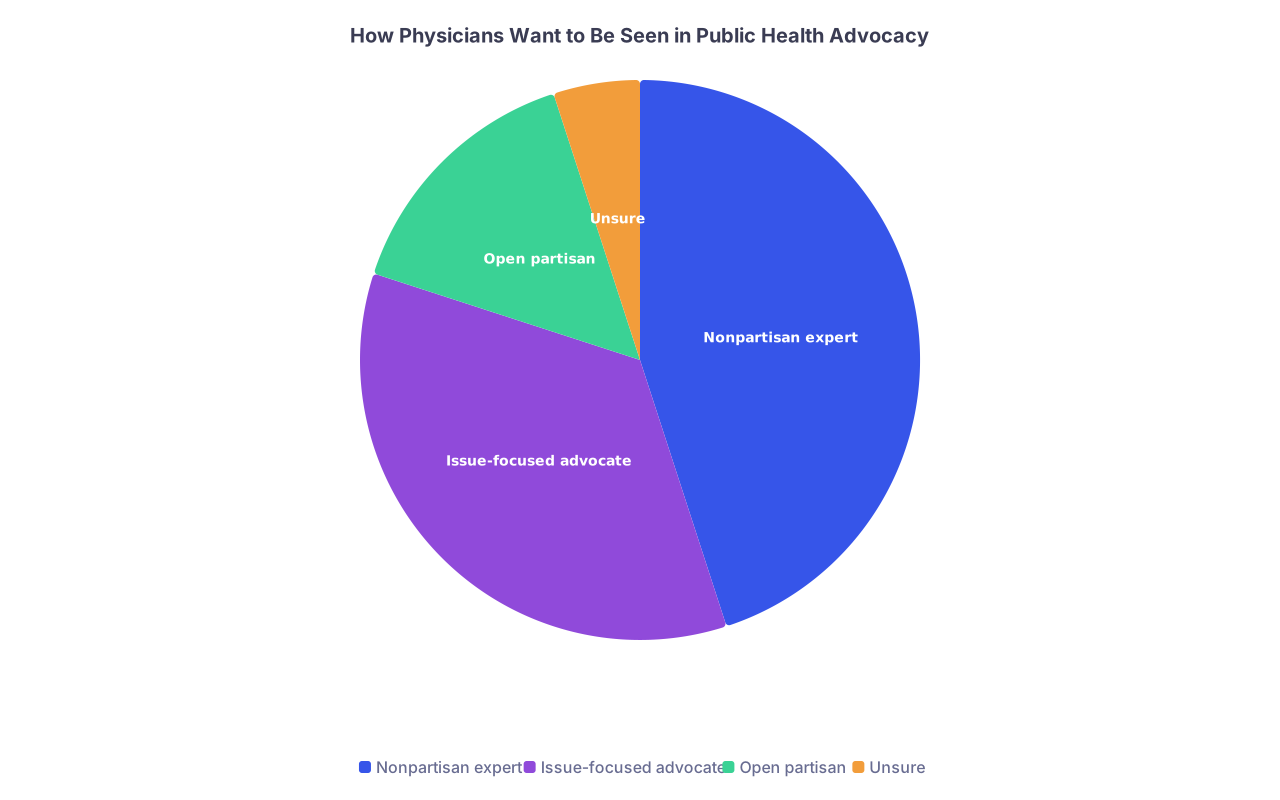
| Category | Value |
|---|---|
| Nonpartisan expert | 45 |
| Issue-focused advocate | 35 |
| Open partisan | 15 |
| Unsure | 5 |
Avoid this mistake: Keep your role clear. When speaking as a physician, anchor your statements in evidence, patient impact, and professional ethics. If you choose to speak as a private citizen about partisan politics, strip the white coat branding and avoid invoking your medical authority as a bludgeon.
3. Underestimating How Permanent Your Digital Footprint Is
You will not out‑argue the internet. But the internet might outlast your judgment.
Too many trainees treat social media like a group chat. It is not. It is a searchable, archivable, screenshot‑able record that hiring committees, residency PDs, journalists, and patients can and do review.
Common digital advocacy missteps:
- Posting hot takes on complex issues within minutes of a breaking news story
- Retweeting or sharing content you have not actually read (“saw it on my side, so it must be right”)
- Piling on individuals by name (especially colleagues, institutions, or public health officials)
- Using sarcasm that looks unhinged when stripped of context
I watched an institutional review of a junior faculty candidate where someone literally projected her Twitter feed on a screen and scrolled. No malice. Just due diligence. Every joke, every late‑night reply, every “spicy” quote tweet was suddenly part of her professional file.
You do not get to separate “DrYou” and “OnlineYou” when the same name and face appear on both.

| Step | Description |
|---|---|
| Step 1 | Post or share content |
| Step 2 | High reputational risk |
| Step 3 | Moderate risk |
| Step 4 | Serious ethical risk |
| Step 5 | Low risk but permanent record |
| Step 6 | Evidence based? |
| Step 7 | Tone professional? |
| Step 8 | Identifiable patient or colleague? |
Basic sanity checks before you publish:
- Does this rely on accurate data I have verified?
- Could this be reasonably misread as harassment, defamation, or unprofessionalism?
- Would I be comfortable if a patient, my program director, and a journalist all saw this tomorrow?
Avoid this mistake: Institute a personal cooling‑off rule. For any emotionally charged advocacy tweet/post, wait at least 30 minutes. Re‑read it imagining it is being read by your harshest professional critic. If it still passes, fine. Most of the worst career‑damaging posts would have died in that 30‑minute window.
4. Violating Confidentiality in the Name of “Storytelling”
This one ends careers. Not always immediately. But disciplinary records have long memories.
Advocacy thrives on stories. Real human narratives move policymakers in ways bar charts do not. But many clinicians cross ethical and legal lines trying to be “impactful.”
The subtle violations:
- Combining enough de‑identified details that a patient or family could still recognize themselves
- Posting “rant threads” about a difficult encounter on a specific date and shift
- Sharing rare disease cases online, convinced that removing the name is enough
- Venting about “that mother who refused vaccines today” on your personal Facebook with location visible
“HIPAA‑compliant rant” is a lie. If the person can recognize themselves—or someone else could reasonably figure it out from context—you have a problem.
I sat through a morbidity and mortality‑style review of a social media complaint once. The physician had never used the patient’s name. But she mentioned:
- The exact ED
- The specific shift time
- The rare condition involved
The family easily identified the post. The result: formal complaint, board report, mandatory remediation, years of anxiety about licensure renewal. All for a post she thought would get some supportive likes from colleagues.

Safer advocacy storytelling practices:
- Use composite cases that blend details from multiple encounters
- Change nonessential features (ages, genders, timing, geography) and explicitly note that you have done so
- Focus on systems and patterns, not individual failures
- Get explicit written consent if you ever intend to use a real, identifiable story publicly
Avoid this mistake: Treat any patient‑related content as if a lawyer and an ethics committee will read it with a magnifying glass. If your advocacy depends on public venting about specific patients, you are not advocating—you are leaking.
5. Speaking Far Outside Your Expertise (But Under the Banner of MD)
“Doctor” is not a universal credential for every controversial topic in public health policy. Acting like it is will quietly erode your credibility with serious people.
The pattern is depressingly common:
- Physician with solid training in, say, dermatology gains a social media following
- Starts commenting authoritatively on macroeconomics of health insurance, geopolitical conflicts, or complex epidemiologic modeling
- Media books them because “physician says X” makes headlines
- Real experts in those fields roll their eyes and quietly note your name as a lightweight
You did not go through all those years of training to become “that doctor who confidently says wrong things on TV.”
When appointments to state task forces, WHO committees, or academic leadership are considered, people remember who stayed in their lane and who acted like an all‑purpose oracle.
| Topic Area | Low Risk to Credibility | Moderate Risk | High Risk |
|---|---|---|---|
| Your clinical specialty | ✔ | ||
| General health policy | ✔ | ||
| National partisan politics | ✔ | ||
| Complex nonmedical policy (tax, foreign affairs) | ✔ | ✔ |
Reasonable extension of expertise:
- A pulmonologist speaking about air pollution policy and respiratory disease
- A pediatrician advocating for school nutrition guidelines
- An emergency physician addressing firearm injury data and access laws
Overreach:
- Any physician pronouncing grand theories about monetary policy, border control strategy, or constitutional law, purely because they are “a doctor and I see suffering”
Avoid this mistake: When venturing beyond your direct expertise, do three things:
- Say what your actual training and experience covers.
- Cite or amplify subject‑matter experts rather than improvising.
- Use language that makes clear you are offering an informed citizen perspective, not a medical decree.
Your long‑term influence is worth more than the temporary ego rush of sounding certain about everything.
6. Neglecting Institutional Realities and Power Dynamics
Another subtle career‑damaging pattern: charging into advocacy as if institutions are cartoon villains, rather than complex systems full of potential allies who have constraints you do not see.
I have seen residents blast their own hospital publicly for “putting profits over patients” based solely on a bed‑capacity decision during a surge, without talking to anyone on the inside. They were not entirely wrong about misaligned incentives. They were completely naive about the context.
What happens next is predictable:
- Leadership labels them “difficult” and “not a team player”
- They are excluded from committees where real decisions get made
- Their advocacy becomes performative instead of impactful
Advocates who actually change policy understand:
- There are legal, financial, contractual, and regulatory constraints hidden from line clinicians
- Public humiliation nearly always hardens institutional resistance
- Strategic internal engagement often beats explosive external condemnation
I am not telling you to be docile. I am telling you to be strategic.
Ask yourself:
- Have I exhausted internal channels (department meetings, ethics committees, staff forums)?
- Have I sought to understand the rationale, even if I end up opposing it?
- Is my goal to fix the problem or to make a public example of someone?
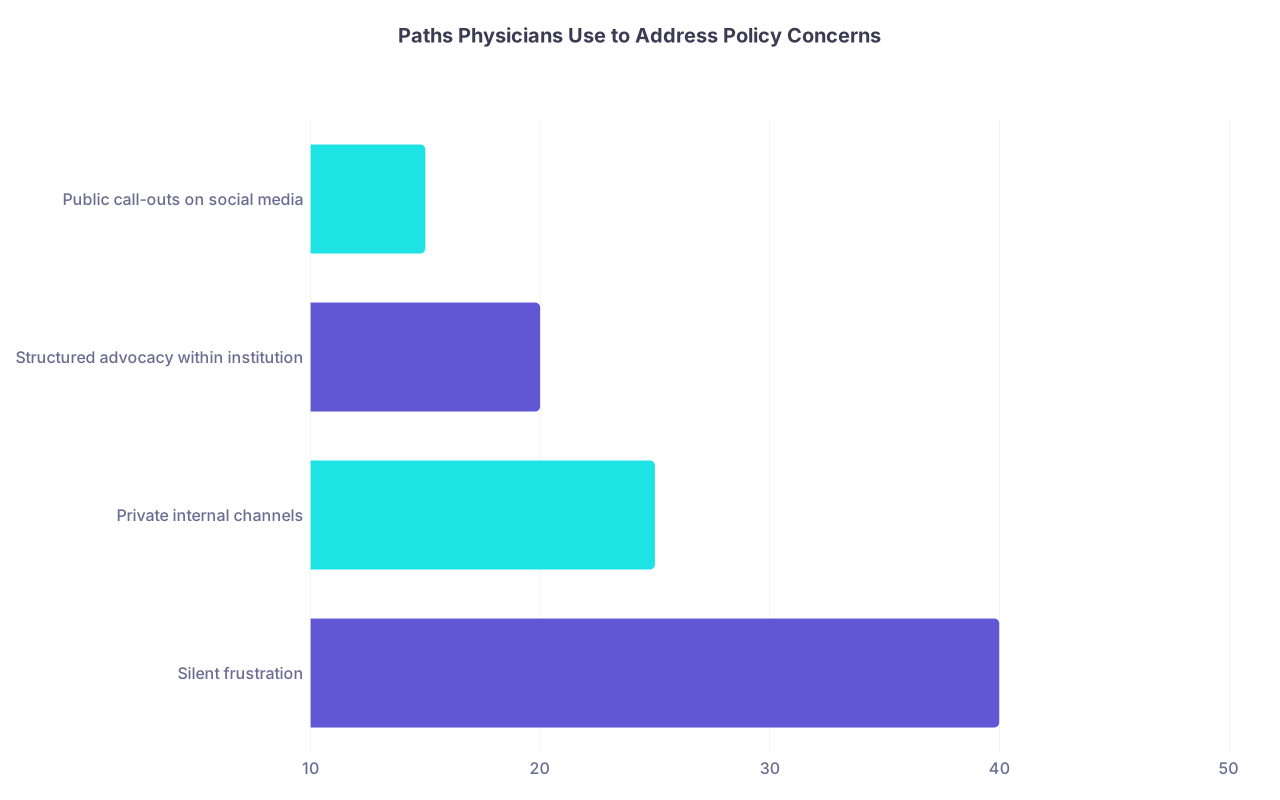
| Category | Value |
|---|---|
| Silent frustration | 40 |
| Private internal channels | 25 |
| Structured advocacy within institution | 20 |
| Public call-outs on social media | 15 |
Public criticism may still be necessary, especially for gross ethical violations or harm that internal channels ignore. But if you ignore institutional power dynamics entirely, you will burn bridges you will later wish you had.
Avoid this mistake: Map the landscape first. Identify internal champions, understand the constraints, use formal processes. If you go public, make it clear you have tried to work through appropriate channels and are focused on systemic change, not personal attacks.
7. Letting Advocacy Consume Your Professional Core
Last one, and it is more insidious: letting advocacy slowly replace the core work of becoming and being an excellent physician.
Public health policy advocacy is part of medical ethics. It is not a substitute for clinical competence, reliability, and professionalism. Yet I have seen trainees and junior faculty drift into this trap:
- Conferences attended: 90% advocacy or policy meetings; 10% clinical updates
- Social media persona: constant commentary, very little about actual practice or learning
- In‑house reputation: late notes, missed deadlines, average clinical performance
Then they are shocked when promotions committees say: “Impressive advocacy. But we cannot promote someone who is merely adequate clinically.”
Your voice in public health policy has more weight when it is backed by real clinical excellence. Otherwise, you are just another loud commentator.
Common warning signs:
- You regularly skip educational conferences but never miss an advocacy panel
- You spend more time optimizing threads than reading primary literature
- You are seen as unreliable on the floor but “everywhere” online
You do not want to be the person whose colleagues roll their eyes and say, “If only they cared as much about their patients as they do about their Twitter.”
Avoid this mistake: Protect your foundation:
- Prioritize competence: solid clinical performance, up‑to‑date knowledge, dependable teamwork
- Build advocacy into your professional role: research, QI projects, committee work, policy writing
- Set explicit time boundaries: advocacy hours that do not cannibalize core responsibilities
The most effective physician advocates I know can walk into a policy meeting and say, “Here is what I saw on rounds yesterday, here are the data from our service, and here is the concrete policy change that would help.” That credibility depends on not letting advocacy hollow out your clinical identity.
Putting It Together: Advocacy Without Self‑Sabotage
You can—and should—engage in public health policy. Silence in the face of injustice or preventable harm is not neutral. But doing it carelessly can quietly corrode the very career that gives you a voice.
Avoid these seven missteps:
- Turning advocacy into uncontrolled activism.
- Merging your medical authority with raw partisan politics.
- Forgetting that the internet is permanent, searchable evidence.
- Leaking patient stories in the name of “impact.”
- Speaking far outside your expertise while wearing the MD badge.
- Ignoring institutional power dynamics and channels.
- Letting advocacy eclipse your obligation to be a competent, reliable physician.
If you dodge these traps, you can build a career where your advocacy is not a side hobby or a self‑destruct button but a respected, integral part of your professional identity.
FAQs
1. Can trainees safely engage in public health advocacy, or should they wait until after training?
Trainees absolutely can and should engage—but with guardrails. Use structured venues: institutional advocacy groups, specialty society committees, op‑eds vetted by mentors, organized lobbying days. Avoid freelance public attacks on your own program or hospital, and be meticulous about confidentiality. In training, your evaluations are fragile; anything that can be framed as “unprofessional” may haunt you. Think “early, guided, and scoped” rather than “wait until I am attending” or “burn it all down now.”
2. How do I know if a social media post about policy crosses a professional line?
Run a three‑part test: content, tone, and identity. Content: is it accurate, evidence‑based, and free of identifiable patient or colleague details? Tone: would a reasonable outsider see it as professional critique, not harassment, defamation, or unhinged venting? Identity: is it clear you understand your role (physician, trainee), and are you avoiding leveraging that status to bully individuals or parties? If any of those three are shaky, do not post it—or rewrite until it would look defensible in a professionalism review.
3. Is it ever appropriate to criticize my own institution publicly?
Sometimes, yes. But public criticism should be the escalation, not the opening move. First use internal mechanisms: conversations with leadership, ethics consults, written concerns, committee channels. Document your attempts. If serious harm continues and internal processes fail, public whistleblowing may be ethically justified—but it will still carry career risk. When you do go public, keep the focus on systems and outcomes, avoid personal attacks, and be laser‑precise with facts. Get legal and ethics advice if the issue is grave.
4. How can I build advocacy into my career without being labeled “difficult”?
Be excellent and reliable in your primary duties, and align your advocacy with institutional goals when possible. Volunteer for policy‑relevant committees, quality improvement projects, or guideline development. Publish on the topics you care about so your advocacy is backed by scholarship. Communicate concerns with solutions attached. Leaders are far more receptive to someone who says, “Here is a problem, here is data, here is a feasible fix,” than to someone who only posts outraged threads at midnight.
5. What is one concrete step I can take this week to reduce my advocacy‑related career risk?
Audit your online presence. Today. Google your name, review your Twitter/X, Instagram, LinkedIn, and any blogs or Substack posts. Ask: Which of these would I be uncomfortable having read aloud during a job or fellowship interview? Save everything questionable, then either delete, edit, or archive it. After the cleanup, write a short personal policy for future advocacy posts—three to five rules you will follow (for example: no posting when angry, no identifiable cases, no partisan endorsements under my MD identity). Then actually use it.