
The biggest mistake medical students make in advocacy is starting loud and late instead of quiet and early.
If you wait until MS3 to “get into policy,” you are already behind the students who quietly built skills and relationships from week one of MS1. Advocacy is not a single project. It is a four‑year build of knowledge, credibility, and networks—if you do it on purpose.
Here is how to do it on purpose.
MS1: Months 1–12 – Lay Foundations And Learn How Power Actually Works
Your job in MS1 is not to “change the system.” It is to understand it and become useful enough that people will take your calls later.
Months 1–3: First Semester – Observation Mode, Not Hero Mode
At this point you should:
- Pick 1–2 advocacy lanes, not six
Examples:- Health equity / Medicaid access
- Reproductive health policy
- Gun violence prevention
- Climate and health
- Medical education & trainee well‑being
If everything is “your passion,” nothing is.
- Map the local ecosystem in your lane:
- State medical society and student section
- AMSA / AMA / APHA / ACP or specialty interest groups with policy arms
- Hospital community benefits office
- Local public health department (county or city)
You are not joining everything. You are identifying the 2–3 places where policy decisions actually get made.
At this point you should do three concrete things:
Attend, do not lead.
Show up to:- One student interest group with a real track record (e.g., AMA-MSS chapter that submits resolutions, not just pizza talks).
- One community or city public health meeting (city council health committee, board of health). Sit in the back. Watch who talks, who everyone defers to, what gets tabled.
Start a micro‑reading habit.
- Pick one weekly policy source:
- KFF Health News
- Health Affairs “Policy Corner” pieces
- Your state medical society newsletter
- 20–30 minutes, once a week. Not everything. Just enough that acronyms (CMS, 1115 waivers, FQHC) stop sounding like static.
- Pick one weekly policy source:
Learn how a bill becomes real pain (or relief) for patients.
- In anatomy lab or clinical skills, pick one patient scenario.
- Ask: “What law or policy upstream is making this problem worse or better?”
That mental reflex is more valuable long‑term than your first student op‑ed.
Months 4–6: Late First Year – Micro‑Projects, No Titles
At this point you should start doing tiny, low‑risk policy work.
Options that fit in 1–4 weeks:
- Help draft talking points for:
- A student group’s lobby day
- A state medical society “day at the capitol”
- Do basic background research for a more senior student:
- “Find 5 key articles and summarize them in 1 page on prior authorization harm”
- Contribute to one small, realistic deliverable:
- One policy brief
- A 1‑page fact sheet for a community partner
- Background section for a resolution someone else is leading
You are building three core skills:
- Quickly reading policy documents
- Distilling to 1–2 key points
- Meeting deadlines
Which, by the way, is exactly what senior advocates look for in students they pull into real work.
Months 7–9: Summer After MS1 – Your First Real Advocacy Sprint
This is where most students fumble. They treat MS1 summer as “research or nothing.” Bad idea if you care about policy.
At this point you should intentionally design one of three summer profiles:
| Profile Type | Main Output | Time Frame |
|---|---|---|
| Policy Research | Brief or white paper | 6–8 weeks |
| Community Advocacy | Campaign or event series | 4–8 weeks |
| Mixed Clinical/Policy | Case + policy reflection | 4–6 weeks |
Option 1 – Policy Research Summer (ideal if you like writing):
- Join a faculty project on:
- Medicaid expansion
- Hospital uncompensated care
- Local overdose trends and harm reduction policies
- Deliverables by end of summer:
- A 3–5 page policy brief
- A slide deck that a faculty member actually uses in a meeting
Option 2 – Community Advocacy Summer:
Work with:
- A local health coalition
- A legal aid org doing medical‑legal partnership work
- A community‑based org (e.g., immigrant health nonprofit)
Concrete goals:
- Help design and run 2–3 community meetings or listening sessions
- Co‑create a short report that summarizes community priorities in clear, quotable language
Option 3 – Mixed Clinical/Policy:
If you are at a site like an FQHC or free clinic:
- Shadow in clinic 2–3 days per week
- Spend 1–2 days per week documenting:
- Barriers you see repeatedly (e.g., insurance lapses, prior auth, language access)
- The specific policies driving them
- Finish with a “clinic policy impact” memo:
- 3 case vignettes
- 3 policy levers
- 2 recommendations the clinic could realistically act on
This is the kind of document that gets you taken seriously by attendings.
Months 10–12: End of MS1 – Decide Your “Anchor”
By now you should pick an anchor identity for advocacy going into MS2:
- Example: “I am the go‑to student on Medicaid redeterminations in our state.”
- Or: “I work with our local gun violence coalition on hospital‑based violence intervention.”
At this point you should:
- Commit to one main issue for 12 months
- Let go of the rest for now
- Tell 3–5 people (faculty mentor, student leaders, community partner):
“Next year I want to go deep on X. How can I plug in more?”
MS2: Months 13–24 – Build Competence And Visible Output
MS2 is where advocacy either becomes real work or stays as “stuff on my CV.”
Months 13–15: Early MS2 – Pair Policy With Boards Without Burning Out
At this point you should:
- Re‑enter your chosen lane with a specific project, not vague enthusiasm.
- Example projects:
- Co‑author a resolution for your state medical society or AMA-MSS
- Lead data collection for a community survey
- Coordinate the student side of a hospital or school advocacy campaign
Keep it tight:
- 1 major project across the whole year
- 1 minor ongoing responsibility (e.g., policy chair for a student org)
Do not accept any role described as “rebuild this dormant committee from scratch” when you are 6–8 months from Step 1/Level 1.
Months 16–18: Pre‑Dedicated – Your First Policy Deliverable With Your Name On It
This is your window for visible, citable output before dedicated board prep.
At this point you should aim for one of:
- A published op‑ed in a local or national outlet
- A formal policy resolution submitted and defended at a meeting
- A named authorship on:
- A policy brief for a state agency
- A white paper for a major org
- A health‑policy blog (Health Affairs Blog, state medical society blog, etc.)
Structure your time like this:
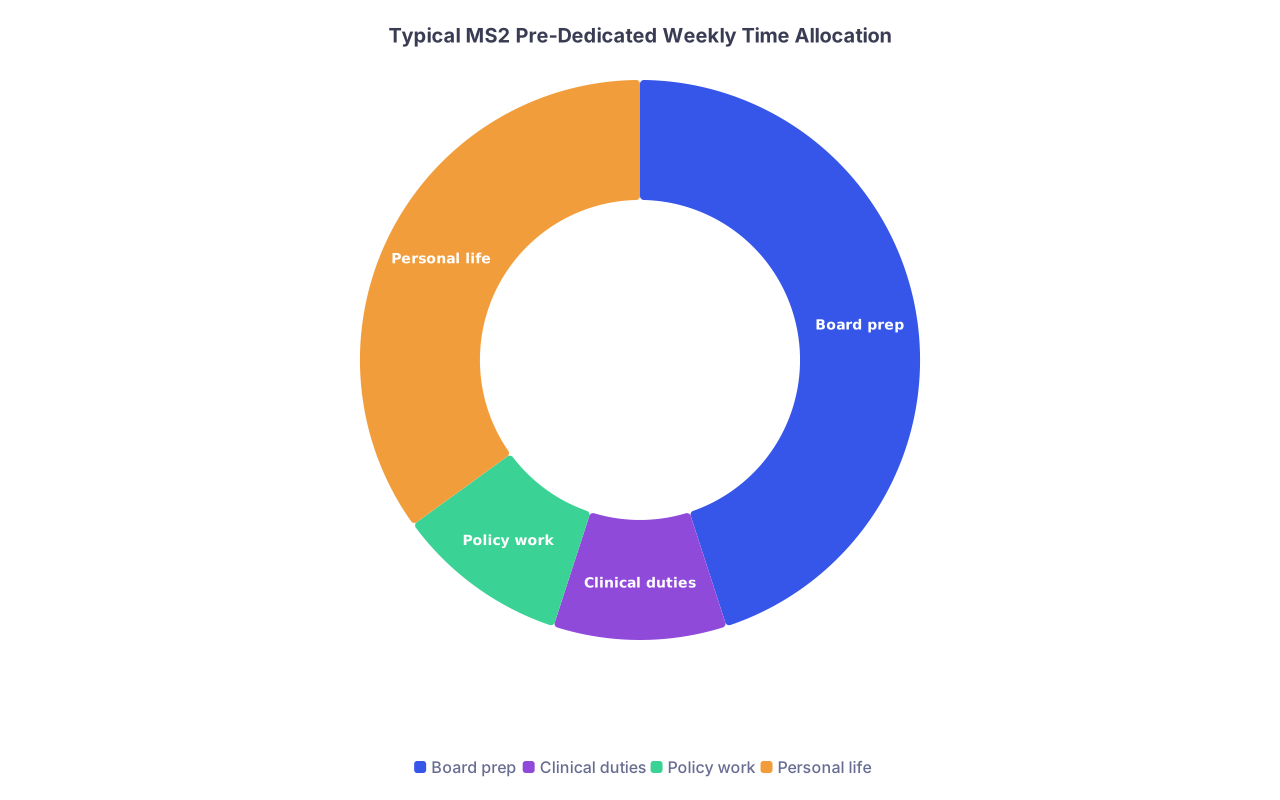
| Category | Value |
|---|---|
| Board prep | 45 |
| Clinical duties | 10 |
| Policy work | 10 |
| Personal life | 35 |
The 10% on policy is enough—if focused— to produce one serious deliverable.
Timeline for a resolution example (about 8–10 weeks):
- Week 1–2: Identify problem, pull 10–15 key references
- Week 3–4: Draft resolution; get feedback from mentor and student section leadership
- Week 5–6: Revise, line‑edit, check formatting requirements
- Week 7: Submit before deadline
- Week 8–10: Prepare talking points; practice testimony with peers
Months 19–20: Dedicated Study – Strategic Pause
At this point you should:
- Deliberately go dark on new advocacy commitments.
- Keep only:
- One short, low‑effort ongoing role (e.g., reviewing a draft by email)
- Any time‑bound commitments you cannot ethically drop (tell people your Step dates clearly)
The advocacy mistake here is ego:
- “I can prep for Step and still run this big campaign.”
Usually ends with both your score and the project suffering.
Months 21–24: Post‑Boards MS2 – Scale to Systems, Not Events
You are now more clinically literate and have breathing room.
At this point you should:
- Take on one structural role that changes how your school or hospital does something:
- Represent students on a curriculum reform committee focused on structural racism or health systems science
- Sit on your hospital’s community benefits or DEI council
- Lead a longitudinal elective in health policy for MS1s
And you should practice power‑adjacent tasks:
- Drafting an agenda for a stakeholder meeting
- Running a 30‑minute workgroup call and ending on clear next steps
- Tracking commitments in a simple 1‑page memo after each meeting
This is the unglamorous work that separates “activist” from “advocate who gets implementation.”
MS3: Months 25–36 – Integrate Advocacy Into Clinical Reality
MS3 is where theory either survives contact with the wards or dies.
Months 25–27: Early Clerkships – Observe The Policy Damage Up Close
At this point you should:
- Carry a tiny “policy notebook” (or a pinned note on your phone).
- For each rotation, document:
- 1–2 recurrent problems clearly rooted in policy:
- Prior auth delays discharges
- Insurance churn interrupts chemo
- Lack of interpreter services at night
- 1–2 recurrent problems clearly rooted in policy:
For each, jot:
- The immediate clinical consequence
- The upstream policy guess (e.g., reimbursement rules, staffing ratios, immigration policy)
End each rotation by writing a 1‑page “policy reflections” memo:
- 3 vignettes, max
- 1–2 cited policies or regulations
- 1 concrete change that would reduce harm
These memos will feed your personal statement, future op‑eds, and residency interviews.
Months 28–30: Mid‑MS3 – Clinic‑Rooted Advocacy, Not Abstract Slogans
At this point you should move from observation to targeted clinical‑policy work.
Examples by rotation:
Internal Medicine:
Work with case management to quantify discharge delays due to insurance issues; help create a short report for hospital leadership.Ob/Gyn:
Help your department prepare testimony or background for legislative hearings on reproductive access or maternal mortality.Psychiatry:
Link with community mental health; contribute to a brief on involuntary holds, jail diversion, or crisis response systems.
Pick one rotation where you actually like the attendings and the culture. That is your best bet for a small but real project.
Expected timeline for a mid‑MS3 project (8–12 weeks, overlapping rotations):
- Weeks 1–2: Identify problem + find faculty ally
- Weeks 3–4: Rough data pull (charts, social work notes, anecdotes)
- Weeks 5–8: Build a basic brief / presentation
- Weeks 9–12: Present to the relevant committee; agree on next steps
Months 31–33: Late MS3 – Specialty Choice And Policy Narrative
Residency program directors will scan your application for a coherent story.
At this point you should:
- Decide your advocacy narrative in 1–2 sentences, linked to a likely specialty.
Examples:
- “I have worked on Medicaid access and community health, and I want to train in Internal Medicine with a focus on safety‑net hospitals.”
- “My work is around reproductive rights and abortion access, which aligns with a career in Ob/Gyn in states with contested access.”
- “I focus on firearm injury prevention and hospital‑based violence intervention, which fits with Emergency Medicine and trauma systems.”
Then:
- Align your final MS3 projects and any presentations with that story
- Identify 1–2 attendings who:
- Understand your advocacy work
- Are willing to write letters that describe you as a clinician and advocate
Months 34–36: Transition To MS4 – Prepare Policy Assets For Applications
At this point you should package what you have done:
A 1‑page advocacy CV (different from your regular CV) organized by:
- Policy research
- Organizational leadership
- Community partnerships
- Publications / briefs / testimonies
2–3 polished artifacts:
- PDF of a brief you wrote or co‑wrote
- Link or PDF of a published op‑ed
- Slide deck (cleaned up) from a policy presentation
These are the pieces you reference in ERAS, personal statements, and interviews.
MS4: Months 37–48 – Choose Your Level And Type Of Policy Work For Residency
The worst MS4 policy move is trying to “squeeze in” one last flashy project while you are on the interview trail. Wrong priority. MS4 is for positioning.
Months 37–39: Early MS4 – Use Rotations Strategically
At this point you should:
- Pick at least one sub‑I or elective in a setting that matches your advocacy focus:
- County hospital
- VA
- FQHC‑affiliated clinic
- State psych hospital
- Reproductive health referral center
During that month:
- Ask explicitly: “Who in this department works at the intersection of clinical care and policy?”
- Schedule 2–3 short meetings:
- 15–30 minutes each
- Goal: understand how they blend advocacy with clinical FTE, and what kind of residents they like to mentor
Months 40–42: Application Season – Signal Policy Without Overshadowing Clinical
At this point you should thread the needle:
In ERAS:
- 1–2 activities clearly labeled as health policy / advocacy
- Quantify impact where possible (number of stakeholders reached, laws or guidelines influenced, etc.)
In your personal statement for policy‑relevant programs:
- One short paragraph connecting:
- A clinical case from MS3
- The policy work you did related to that issue
- How residency in that specialty will expand your capacity
- One short paragraph connecting:
Prepare 2–3 concise stories for interviews:
- A time you worked in a coalition and compromised
- A time a policy project failed and what you changed next time
- A specific patient that cemented your advocacy focus
Do not present yourself as a full‑time activist who happens to be applying for residency. Program directors are allergic to that. You are a future clinician who brings serious policy skills.
Months 43–45: Rank List And Planning – Decide Your Advocacy Intensity For PGY‑1
At this point you should be brutally honest with yourself about bandwidth.
You have three viable models in residency:
| Model | Policy Time / Week | Typical Activities |
|---|---|---|
| Low-Intensity | 1–2 hours | Reading, minor committee work |
| Moderate | 3–5 hours | Projects, writing, local groups |
| High-Intensity | 6–10 hours | Fellowships, major leadership |
Use your MS3 experience to decide which is realistic for your stress tolerance.
Then:
- Prefer programs that:
- Have formal health policy tracks or pathways
- Sit in cities with active coalitions in your lane
- Actually graduate residents who do the kind of work you want (look at alumni)
Months 46–48: Pre‑Residency – Lock In Systems So You Do Not Start From Zero
In the final stretch of MS4, at this point you should:
- Set up 2–3 warm introductions in your residency city:
- From your current mentors to:
- Local advocates
- Health department staff
- Academic health policy folks
- From your current mentors to:
- Build a lightweight “residency advocacy plan”:
- Year 1: Low‑intensity model only (focus on survival and learning the system)
- Year 2–3: Add one structured project or fellowship
And then stop. Do not launch a brand new big campaign three weeks before intern orientation.
Putting It All Together: What Starts When
Here is the rough sequencing you should hold in your head:
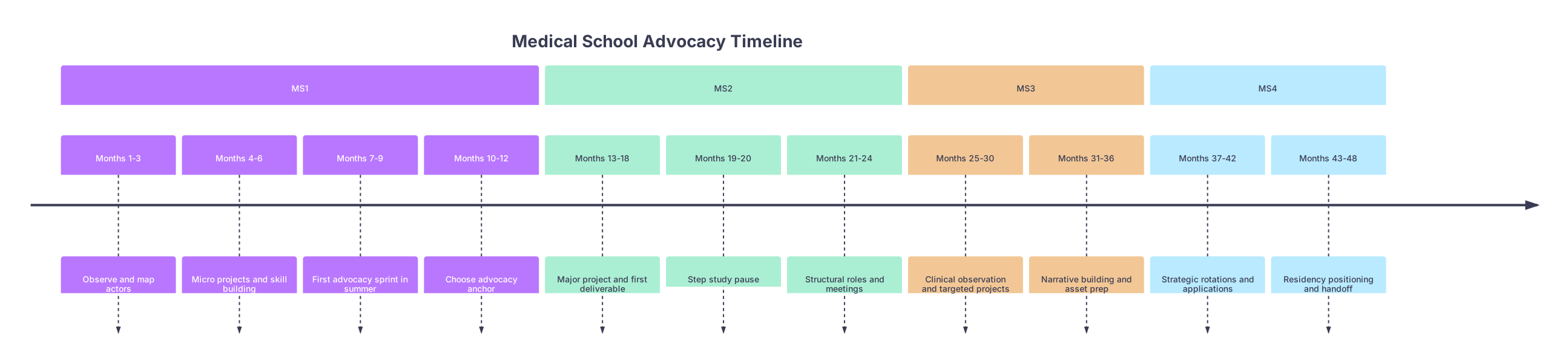
| Period | Event |
|---|---|
| MS1 - Months 1-3 | Observe and map actors |
| MS1 - Months 4-6 | Micro projects and skill building |
| MS1 - Months 7-9 | First advocacy sprint in summer |
| MS1 - Months 10-12 | Choose advocacy anchor |
| MS2 - Months 13-18 | Major project and first deliverable |
| MS2 - Months 19-20 | Step study pause |
| MS2 - Months 21-24 | Structural roles and meetings |
| MS3 - Months 25-30 | Clinical observation and targeted projects |
| MS3 - Months 31-36 | Narrative building and asset prep |
| MS4 - Months 37-42 | Strategic rotations and applications |
| MS4 - Months 43-48 | Residency positioning and handoff |
And if you like to see trends, here is how your advocacy complexity should rise across the years:
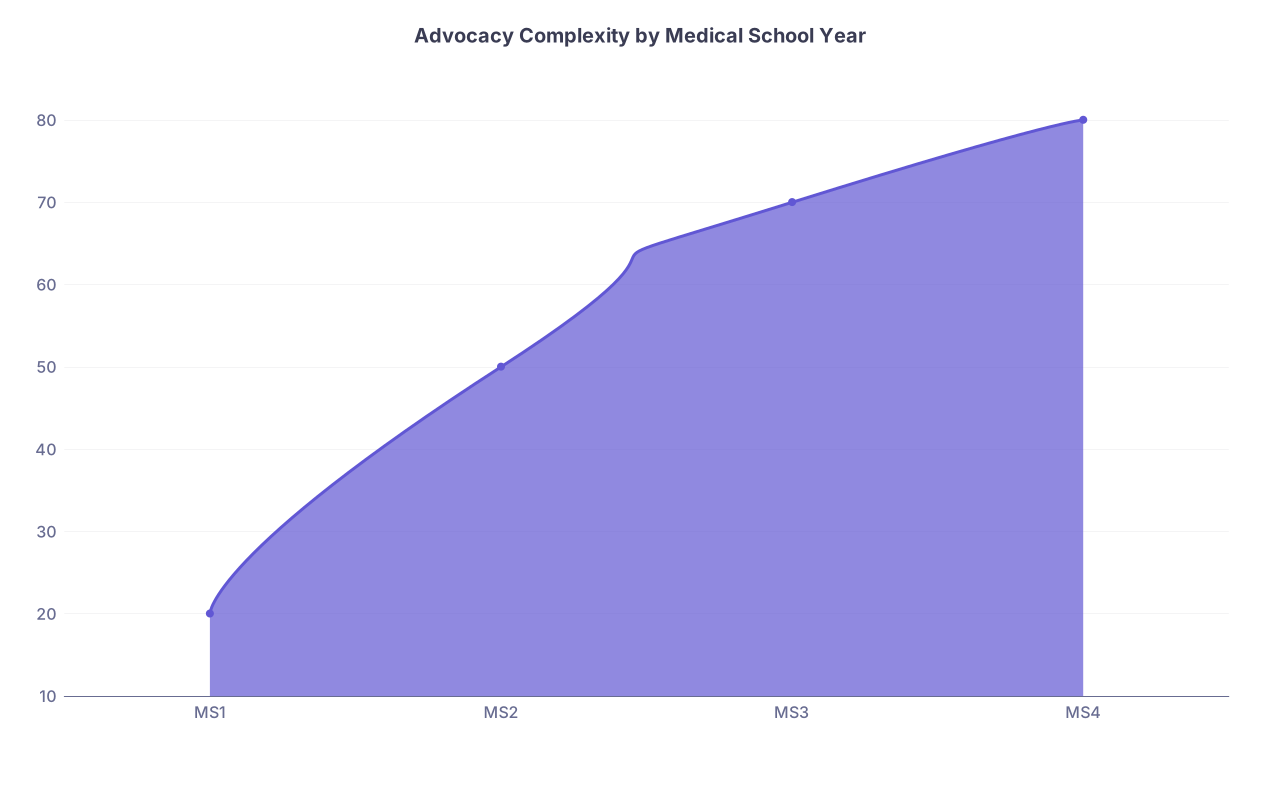
| Category | Value |
|---|---|
| MS1 | 20 |
| MS2 | 50 |
| MS3 | 70 |
| MS4 | 80 |
(Think of the numbers as “relative complexity,” not hours per week.)

Three Things To Remember
- Start small and early. Your MS1 “quiet” work is what makes your MS3–MS4 projects credible.
- Anchor on one main issue for at least a year. Depth beats scattered “interest” every time.
- Match your advocacy intensity to your phase: ramp up in MS2, integrate in MS3, position in MS4, then reset expectations for intern year.
Follow that, and you will not just “do advocacy” in med school. You will become the kind of physician advocates people actually call when something important is on the line.