
The biggest mistake clinicians make about hospital policy is thinking it changes “whenever admin decides.” It doesn’t. It moves on a rigid, academic-year clock—and if you miss that calendar, your brilliant idea dies in committee purgatory.
You’re in public health policy and ethics territory now. If you want to influence hospital policy (or at least not be blindsided by it), you need to think like a scheduler: months, meetings, deadlines. At each point in the academic year, there are specific things you should be watching, doing, and never doing.
Below is the rough architecture: July 1 to June 30. Academic year, not calendar year. That’s the clock committees care about.
The Big Picture: How the Academic Year Really Runs
At this point, you should understand the basic rhythm before we go month-by-month.
Most hospitals and academic medical centers cycle policy decisions through:
- Standing committees (ethics, pharmacy & therapeutics, infection control, quality/safety, credentialing)
- Executive leadership (MEC – Medical Executive Committee, and ultimately the Board)
- Implementation teams (IT, nursing leadership, education, risk management)
And they do it on a repeating pattern:

| Step | Description |
|---|---|
| Step 1 | Identify Issue |
| Step 2 | Draft Proposal |
| Step 3 | Subcommittee Review |
| Step 4 | Full Committee Vote |
| Step 5 | MEC or Board Approval |
| Step 6 | Education and Build |
| Step 7 | Go Live and Monitor |
That loop can take 3–12 months depending on complexity. Now lay that over the academic year and you get something like this:
| Quarter (Academic Year) | Primary Focus |
|---|---|
| Q1: Jul–Sep | Orientation, urgent approvals, cleanup |
| Q2: Oct–Dec | Full policy workload, strategic items |
| Q3: Jan–Mar | Heavy decision-making and approvals |
| Q4: Apr–Jun | Implementation, prep for next July 1 |
At each quarter, your role shifts—observer, influencer, implementer.
July–September: Orientation, Cleanup, and “Fire Drill” Decisions
At this point in the year, you should not be pitching complex, non-urgent new policies. You should be learning who actually runs the place.
July: New Year, New People, Limited Bandwidth
July 1 is the academic reset. New residents, sometimes new fellows and faculty, rotating chiefs. Policy committees are dealing with:
- Orientation content and sign-offs
- Renewal of expiring protocols (order sets, consent forms, call schedules)
- “We forgot to fix this before June 30” emergencies
You’ll see:
- Ethics committees fielding basic consent/refusal questions from interns
- Quality and Safety reviewing last year’s serious safety events and regulatory findings
- Pharmacy & Therapeutics (P&T) rushing formulary renewals so orders don’t break in the EHR
At this point you should:
-
- Who chairs Ethics, P&T, Infection Control, Quality, Bioethics, Transfusion?
- When do they meet (day of week, week of month)?
Learn the real decision path
- Ask a senior resident or nurse manager: “If I want to change X, what committee actually owns it?”
Keep your proposals small and operational
- “Add this lab to the sepsis order set” might fly.
- “Create a new hospital-wide end-of-life care framework” will get deferred.
August: Stabilization and “Fix the Worst Problems Now”
By mid-August, committee calendars settle. The first 1–2 meetings of the academic year usually focus on:
- Reviewing last year’s unfinished items
- Re-approving time-limited policies
- Addressing high-risk, high-liability issues identified by Risk Management or external surveys (Joint Commission, CMS)
Turnaround is still slow because orientation and vacations chew up time.
At this point you should:
Watch the agenda patterns
- Are ethics consults driving new policies on surrogate decision-making or DNR discussions?
- Is Infection Control pushing new device-related protocols?
-
- Track cases where current policy fails patients or staff. Dates, outcomes, who was involved.
- If you ever want to propose a change, this is your raw material.
Avoid “I had a bad call shift, let’s rewrite the policy” moves
- Committees hate anecdote-driven overreaction.
- Start a log instead. Patterns convince people. One night does not.
September: First Real Policy Wave
By September, committees are finally able to think straight. This is when the first serious proposals of the academic year move forward:
- New consent templates
- Updated clinical pathways
- Changes to on-call structures
- EHR safety tweaks recommended by Quality or IT
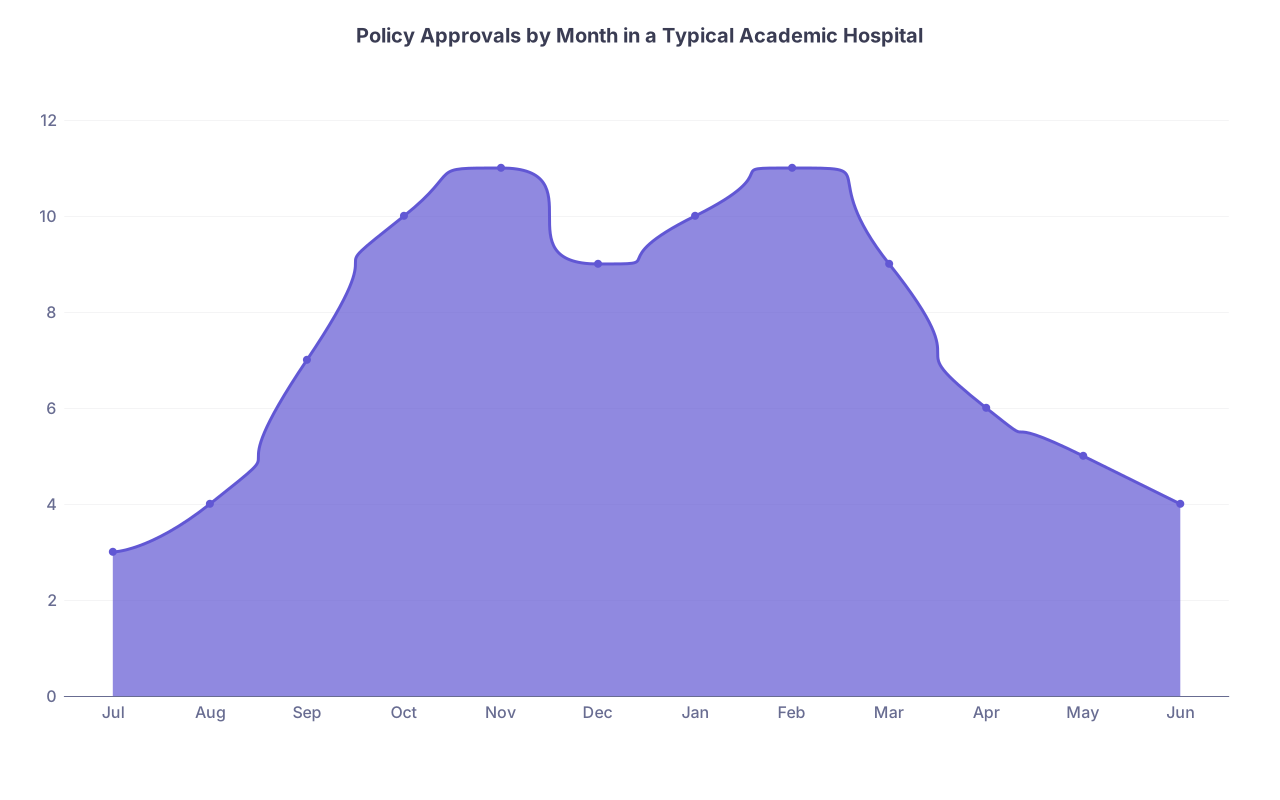
| Category | Value |
|---|---|
| Jul | 3 |
| Aug | 4 |
| Sep | 7 |
| Oct | 10 |
| Nov | 11 |
| Dec | 9 |
| Jan | 10 |
| Feb | 11 |
| Mar | 9 |
| Apr | 6 |
| May | 5 |
| Jun | 4 |
Notice where the slope rises. September is the ramp.
At this point you should:
Start asking, “When is the right time to bring X?”
- Committee admins know the calendar better than most physicians. Talk to them.
If you care about an ethics-related issue (e.g., informed consent quality), quietly collect cases and literature.
- You’re preparing for November–February, when big-ticket ethical policies actually move.
Get yourself on a committee as a learner if you can
- Med students and residents sometimes get non-voting seats. Take one. Watch who speaks and who sways the room.
October–December: The Real Policy Work Begins
This is the heart of the academic policy year. If something major is going to be proposed, vetted, and approved this year, it usually starts now.
October: Full Agendas, Real Debates
By October, committees are dealing with:
- New clinical guidelines that affect workflows (e.g., sepsis, transfusion thresholds)
- Documentation and coding changes that have ethical implications (upcoding concerns, prognosis documentation)
- Safety and quality metrics for the upcoming year
Ethics, Quality, and ICU committees often lock horns over things like:
- Do-not-resuscitate order processes
- “Non-beneficial” treatments
- Time-limited trials of intensive therapy
At this point you should:
Pay attention to the language of policy
- Watch for vague phrases like “when appropriate” or “when clinically indicated.” These are ethical landmines later.
Identify whose signature actually matters
- A policy might be drafted by a resident or junior faculty, but if the ICU director or CMO doesn’t like it, it dies quietly.
Start floating trial balloons
- “Has anyone ever discussed creating a clearer policy on family presence during resuscitation?”
- Listen to the immediate reactions. You’re testing the political weather, not pitching yet.
November: Ethics and Public Health Issues Get Real
November is when ethically loaded topics finally get scheduled:
- Visitor restrictions during outbreaks
- Allocation protocols for scarce resources (ICU beds, ECMO machines)
- Conscientious objection policies
- Advance care planning initiatives
Public health policy meets bedside ethics right here.
At this point you should:
Narrow your focus to one realistic target
- Not “improve palliative care culture.”
- Instead: “Add a mandatory palliative care consult trigger for X criteria in ICU patients.”
-
- Problem: concise, with 2–3 real cases (de-identified).
- Evidence: 3–5 key guidelines or articles.
- Proposal: specific change, owners, and rough timeline.
Ask to be on the agenda, not just to “discuss informally”
- Nothing dies faster than an “informal” idea at the end of a 90-minute meeting.
December: Pre-Holiday Crunch and Deferred Decisions
December is chaos. Shorter months. Vacations. End-of-year reporting.
Committees will:
- Push non-urgent items to January
- Rush through lingering approvals
- Delay controversial or emotionally charged policies (“Let’s take this up fresh in the new year.”)
At this point you should:
Avoid introducing anything contentious that isn’t time-sensitive
- No hospital-wide triage frameworks.
- No massive restructuring of ethics consult processes.
Use the lull to refine
- Tighten your proposal.
- Talk to stakeholders 1:1—nursing, social work, risk management, chaplaincy.
Clarify January meeting dates early
- If your item is deferred, get it explicitly placed on the first or second agenda of the new year.
January–March: Heavy Decision Season
This is when big policies actually get voted through or killed. Budgets are clearer, metrics are set, and leadership is under pressure to show movement.
January: Fresh Year, Aggressive Agendas
In January, committees reset their seriousness:
- Annual goals become real
- Accreditation findings from the prior year demand action plans
- System-level initiatives (sepsis bundles, readmission reduction) push new protocols
Ethics and public health intersect strongly around:
- Discharge safety vs. patient autonomy
- Behavioral health and safety policies
- Equity and access initiatives
At this point you should:
Make your proposal as “implementable” as possible
- Show what changes in the EHR, who gets trained, how you’ll measure impact.
Anchor your ethical argument in risk and quality language
- “This reduces moral distress” is important.
- “This reduces safety events, complaints, and readmission risk” is what gets attention.
-
- One senior nurse leader + one physician leader + one administrator. That triad moves policy.
February: Peak Policy Month
February often has the highest density of substantial policy voting. Budget timelines are visible. Leaders want policies locked in so implementation can happen by July 1.
This is the prime window for:
- End-of-life care policies
- Equity-in-care initiatives
- Community health linkage policies (e.g., referrals to public health programs)
- Pandemic or outbreak preparedness updates
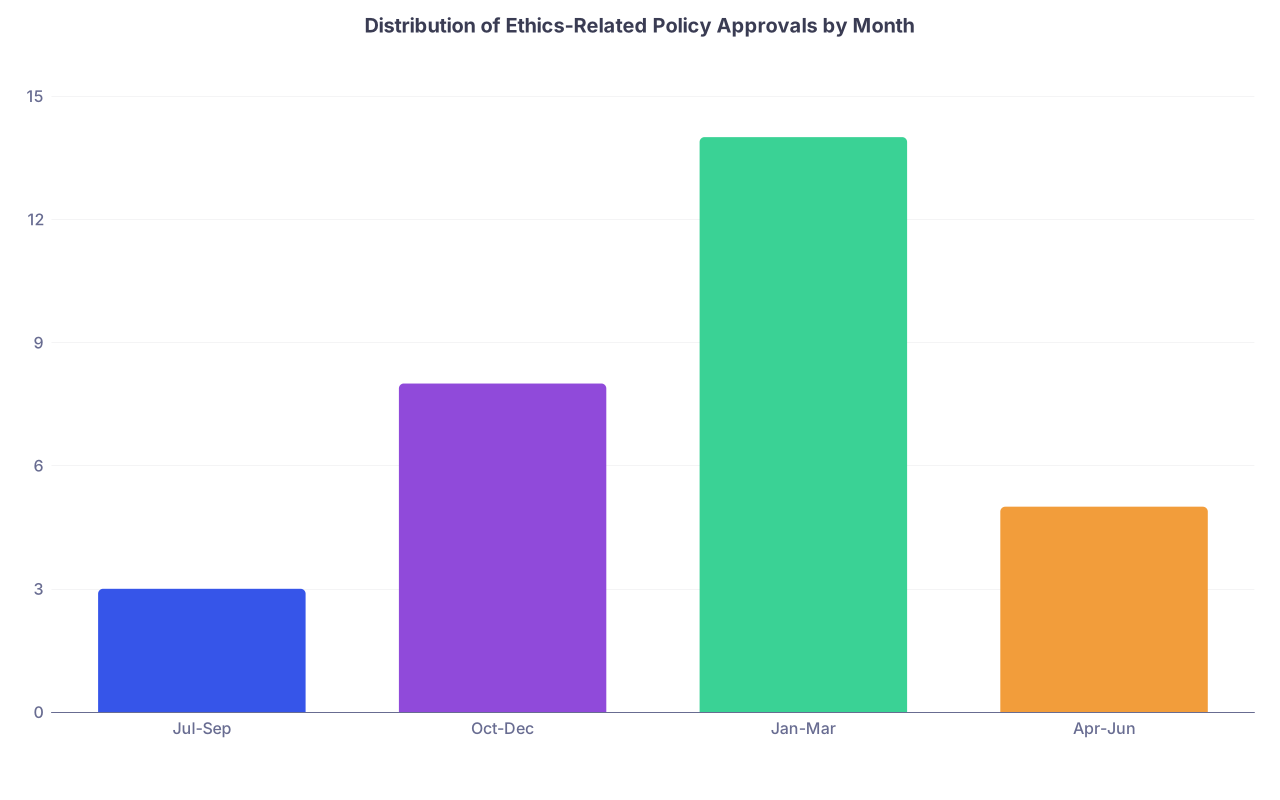
| Category | Value |
|---|---|
| Jul-Sep | 3 |
| Oct-Dec | 8 |
| Jan-Mar | 14 |
| Apr-Jun | 5 |
You’ll see the spike.
At this point you should:
Push for a vote, not endless “more feedback”
- Request: “Can we aim to vote on this in March after any final edits?”
- Open-ended “we’ll keep discussing” = death by delay.
Be ready with data and stories
- A well-chosen 90-second patient story plus 2 crisp data points often shifts a room more than 10 slides.
Watch for scope creep
- People will try to expand your focused ethical policy into a vague “culture change” document. Resist. Keep it concrete.
March: Last Chance for July 1 Implementation
Policies approved in March have a realistic shot at going live July 1, with:
- IT builds completed
- Staff education done
- Monitoring metrics defined
Past March, the odds drop.
At this point you should:
Lock in implementation steps in the minutes
- Who owns education? Who owns IT build? When will progress be reviewed?
Clarify ethical training needs
- If your policy changes consent, disclosure, or triage, someone must build ethics content into orientations and in-services.
Aim small, iterate later
- A narrow, enforceable policy with a six-month review clause is better than a grand manifesto nobody can operationalize.
April–June: Implementation, Clean-Up, and Strategic Setup
By spring, new policies are mostly baked. Committees pivot to:
- Implementation oversight
- Monitoring metrics
- Setting the next academic year’s priorities
This is where you learn if the hospital is serious or just liked the optics.
April: Build and Educate
IT, nursing education, and department heads are:
- Finalizing order sets and clinical decision support
- Rolling out mandatory modules
- Adjusting workflows
Ethics-related policies now compete with everything else for training time.
At this point you should:
Push for realistic education formats
- One 10-minute case-based module integrated into existing training works better than a 45-minute standalone ethics lecture nobody completes.
Ask for early feedback from frontline staff
- “Is this workable on nights/weekends?”
- If nurses say no, you’ve got a compliance problem coming.
Insist on clear accountability
- Who gets called when someone violates the new policy? What’s the escalation path?
May: Monitor and Fix Early Failures
By May, some new policies are in soft launch or pilot phases. Problems show up:
- Confusion over who makes certain decisions
- Conflicting policies (old procedure still in use somewhere)
- Workarounds that completely undermine the ethical intent
At this point you should:
Shadow the policy in real life
- Follow one or two patients through the new process.
- Where does it break? Who ignores it? Why?
Document failures and successes
- Come back with concrete examples: “On 5W, the family meeting workflow works. In the ED, it doesn’t exist.”
Prepare a short “tune-up” memo
- Not a rewrite. Targeted edits to fix the worst gaps.
June: Close the Loop and Set Next Year’s Agenda
June is closing time. Committees:
- Finalize which policies will officially go live July 1
- Review metrics for the year
- Set priority topics for the next academic cycle
Leadership is already thinking 12 months ahead.
At this point you should:
Get your issue on next year’s priority list
- If you didn’t get your major idea through this year, aim for: “Can we place this as a formal agenda item for Q2 next year?”
Ask for formal review dates
- “Can we schedule a 6- and 12-month review of this triage policy focused on equity and patient experience data?”
Decide your next move
- Stay involved? Hand off to a new champion? Shift to another policy area where you’ll have more impact?
Where You Fit in This Calendar (Student, Resident, or Early Faculty)
You don’t need a title to play this game. But you do need timing.
Here’s how your level affects what you should be doing, and when:
| Role | Best Months to Observe | Best Months to Propose |
|---|---|---|
| Student | Jul–Dec | Rare, focus on learning |
| Resident | Aug–Nov | Jan–Mar |
| Early Faculty | Sep–Mar | Oct–Mar |
At this point you should be brutally honest about bandwidth. If you’re on Q3 nights, you’re not drafting a hospital-wide policy. Pick your moment.
Visualizing Your Personal Policy Timeline
Tie it together. Here’s how your personal year might look if you want to influence an ethically important policy in a realistic way.
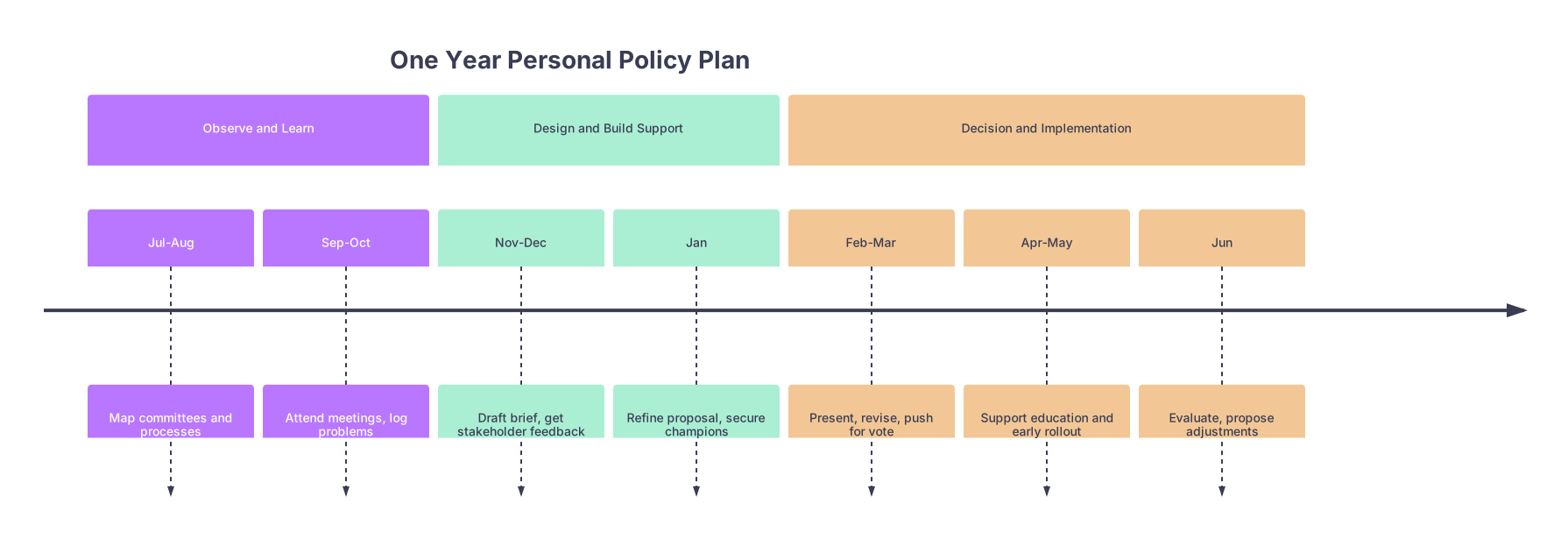
| Period | Event |
|---|---|
| Observe and Learn - Jul-Aug | Map committees and processes |
| Observe and Learn - Sep-Oct | Attend meetings, log problems |
| Design and Build Support - Nov-Dec | Draft brief, get stakeholder feedback |
| Design and Build Support - Jan | Refine proposal, secure champions |
| Decision and Implementation - Feb-Mar | Present, revise, push for vote |
| Decision and Implementation - Apr-May | Support education and early rollout |
| Decision and Implementation - Jun | Evaluate, propose adjustments |

Ethical Discipline: What You Should Do at Each Point
To wrap this into something actionable, here’s how your ethical stance changes month by month—not in theory, but in what you actually do.
July–September
- Listen more than you talk.
- Log ethical friction points.
- Learn whose voices are systematically ignored (often nurses, social workers, interpreters).
October–December
- Turn friction into patterns: “We keep failing this type of patient in this specific way.”
- Check your own biases—are you pushing something that mainly makes your life easier?
- Start building coalitions, especially with people outside medicine (chaplaincy, legal, community reps).
January–March
- Be precise. Vague “do better” statements waste everyone’s time.
- Own your blind spots: ask “Who will be harmed by this policy even if our intentions are good?”
- Fight scope creep and moral grandstanding. Policies should change behavior, not just signal virtue.
April–June
- Watch implementation with humility. Your “perfect” idea will fail in weird ways.
- Help fix it rather than defending the original wording.
- Make sure feedback from the least powerful staff is taken seriously, not dismissed as “resistance.”

Two Things to Remember About Hospital Policy and Timing
Policies don’t live on your schedule; they live on the academic year. If you care about public health and medical ethics, align your actions with that July–June rhythm or you will always be too early or too late.
Influence isn’t about shouting the right moral slogan. It’s about bringing concrete, ethically grounded proposals to the right committee, in the right month, with the right champions—and then sticking around long enough to see what actually happens when the policy hits the floor.