
The worst time to figure out how to talk to the media is when your phone is already ringing.
If you work in public health, emergency medicine, infectious disease, or you sit on any kind of hospital or health department committee, sooner or later a reporter will call you about a crisis. Outbreak. Contamination. Mysterious deaths. A video that went viral for all the wrong reasons.
You have two choices in that moment:
- Wing it and hope you do not create a secondary crisis.
- Follow a clear, repeatable protocol.
Choose the second one.
This is your playbook for exactly what to do—step by step—from the moment the media reaches out to the moment the story airs.
1. First Rule: You Do Not “Just Pick Up and Talk”
When a reporter calls during a public health crisis, your adrenaline spikes and your judgment drops. So you rely on a script.
Your initial response should be almost boringly standard:
Get off the spot. Politely. Use a version of this:
- “Thanks for reaching out. I want to make sure I give you accurate information. Can you email me your questions, your deadline, and who else you are speaking with? I will coordinate with our communications team and get back to you as soon as I can.”
Or if they have already called your cell:
- “I am not in a position to answer that on the phone right now. Please email your questions and I will respond or route you to the right spokesperson.”
Do not say “no comment.”
That phrase reads as “we are hiding something.” Instead:- “We are still confirming details, and I do not want to speculate. I can share what we know right now and what we are doing in response.”
Lock down three facts immediately:
Ask, and write down:- Reporter name and outlet
- Exact deadline
- Topic and angle (“Is this about the water contamination reports?” “Is this for a story on the ER crowding last night?”)
Notify your chain of command. Fast. Within minutes, someone else besides you should know:
- Your immediate supervisor or department chair
- Your institution’s communications / public information officer (PIO)
- If you are in government: your legal/ethics contact if policy-related
If you are solo (small practice, rural health director, local free clinic) and there is no comms team, your process is the same—just with a shorter loop. You still do not answer in real time. You still create a pause to think, coordinate, and prepare.
2. Know Your Role Before You Open Your Mouth
The single biggest mistake clinicians and public health professionals make with the media: confusing their role.
You are usually one of three things:
- Official spokesperson
- Subject-matter expert
- Off-the-record background source
You cannot be all of them at once.

A. If You Are the Official Spokesperson
This is you if:
- Your health department director, hospital leadership, or incident commander has designated you.
- You are the medical officer or health commissioner in a small jurisdiction.
- The PIO says: “You are up.”
Your job is not to “say what you think.” Your job is to:
- Represent the organization’s position.
- Stick to verified facts and approved messaging.
- Avoid freelancing policy opinions in front of cameras.
Protocol:
Get the latest situational briefing. Ask:
- What do we know?
- What is still uncertain?
- What are we actively doing?
- What are we not going to talk about yet?
Coordinate with the PIO:
- Confirm key messages and talking points.
- Clarify what you can and cannot say (privacy, legal, pending investigations).
Decide format:
- One-on-one interview?
- Written statement only?
- Press conference with multiple outlets?
When you are spokesperson, you are the face of the institution. Everything you say sticks to the organization, not just you.
B. If You Are a Subject-Matter Expert
This is you if:
- A journalist is asking you to explain the disease, risk, or science behind a crisis.
- You are not directly responsible for managing that specific event.
Your responsibilities:
- Stick to your lane: your specialty, the evidence, general public health principles.
- Avoid speculating about the specific incident if you are not directly involved.
Your honest line:
- “I am not involved in this specific case, so I cannot speak to the details. I can explain how we generally approach [outbreaks / water contamination / school closures], and what the public can do.”
C. If You Are a Background Source
You are here if:
- You are helping a reporter understand context.
- You are not quoted by name (unless you explicitly agree).
You must still assume everything you say could surface. Because it might.
Be careful:
- Do not share confidential information.
- Do not trash colleagues or institutions.
- Do not say anything you would be ashamed to see paraphrased in print.
3. Use a Structured Message, Not a Brain Dump
Crisis or not, your message needs structure. If you just “answer their questions,” you will drift into speculation, over-sharing, or soundbites that can be cut in ways you do not like.
Use a simple three-part spine for almost every response:
- What we know.
- What we do not know yet.
- What we are doing.
That is your default.
Example: Suspected meningitis outbreak on a university campus.
- “Here is what we know: We have confirmed X cases of meningococcal meningitis among students who live in [dorms / off-campus housing].”
- “Here is what we do not know yet: We are still investigating the exact source and whether cases are directly linked.”
- “Here is what we are doing: We have alerted nearby hospitals, set up a vaccination clinic on campus, and we are contacting close contacts of the affected students. We are working with campus administration to share guidance with students and families.”
Then you add the two elements most people forget:
- Concrete advice for the public.
- Reassurance without lying.
So you finish with something like:
- “If you are a student or parent, the most important thing you can do today is [get vaccinated / watch for these symptoms / call this hotline]. We take this seriously, and we will keep updating the community as we learn more.”
That simple structure stops you from rambling, oversharing early data, or nibbling at rumors.
4. What You Must Never Say (Even If You Believe It)
There are landmines in crisis communication. You step on one and you will spend months cleaning it up.
| Avoid Saying | Say Instead |
|---|---|
| "No comment." | "We are still confirming details. I can tell you what we know now and what we are doing." |
| "Everything is under control." | "We are taking this seriously and have specific steps under way." |
| "There is no risk." | "For most people, the risk is low. Here is who is at higher risk and what they should do." |
| "Off the record..." | "I cannot speak to that." or "That is outside my role." |
| "This is just like [past disaster]." | "Every situation is different. Here is how we are approaching this one." |
A. Do Not Over-Reassure
Saying “There is no risk” or “People do not need to worry” when there clearly is a concern destroys trust.
Better pattern:
- Acknowledge the concern.
- Put the risk in context.
- Give a specific action.
Example:
- “I understand parents are worried. Right now, the cases we are seeing are limited to [setting]. For most people, the risk is low. Here is what parents can do today: [watch for symptoms / call this number / check this website].”
B. Do Not Predict What You Do Not Control
Never say:
- “We will not see more cases.”
- “We do not expect any more deaths.”
You have no idea.
Try instead:
- “We may see additional cases in the coming days. That is why we are [contact tracing / testing / expanding hospital capacity].”
C. Do Not Blame or Speculate About Fault
Reporters love a fight. Do not hand them one.
Avoid:
- “The city dropped the ball.”
- “Hospital X mishandled it.”
- “I heard the first case started at…”
If there will be an investigation, say so:
- “There will be a full review of what happened and how agencies responded. Right now my focus is on [containment / patient care / public guidance].”
5. Build a 10-Minute Prep Routine Before Any Interview
You do not need a day of media training to sound professional and trustworthy. You do need 10 minutes of focused preparation.
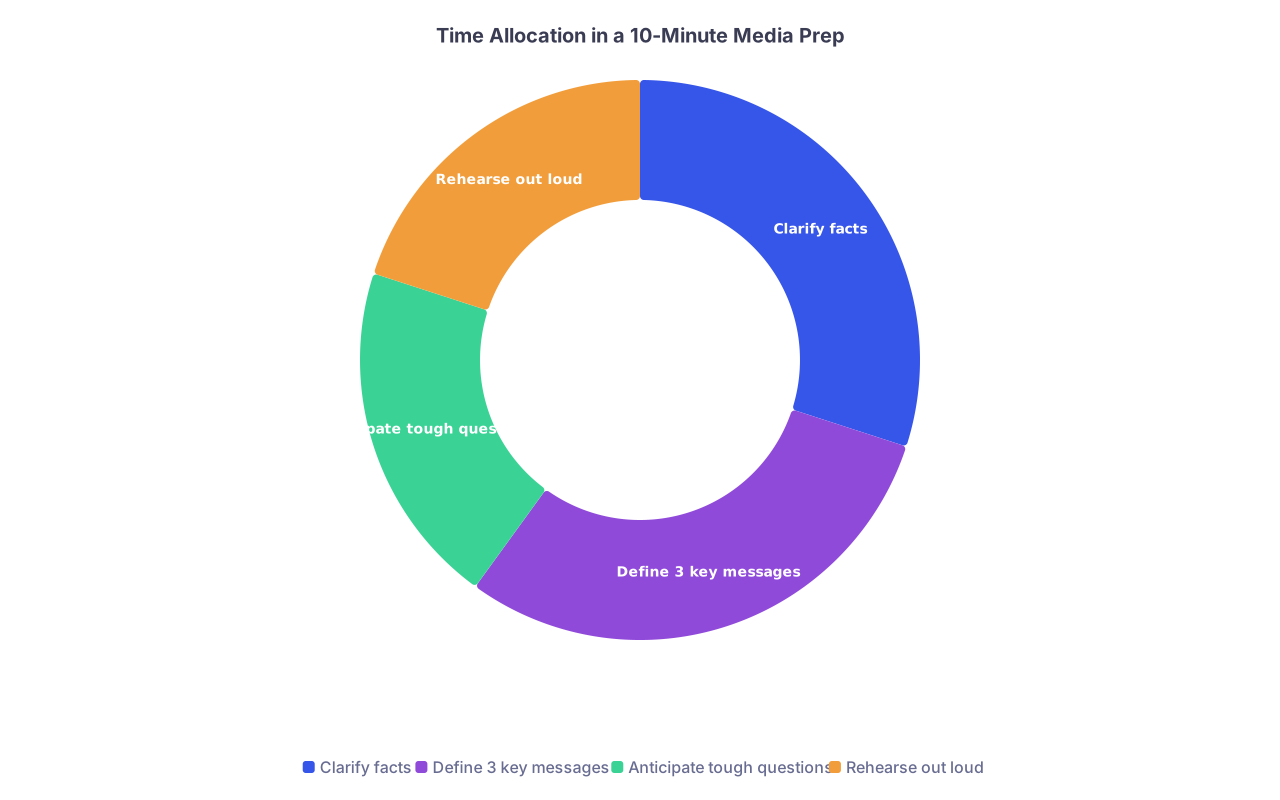
| Category | Value |
|---|---|
| Clarify facts | 3 |
| Define 3 key messages | 3 |
| Anticipate tough questions | 2 |
| Rehearse out loud | 2 |
Here is the routine I have seen work repeatedly for clinicians and health officers.
Step 1: Clarify Facts (3 minutes)
Write down:
- What is confirmed.
- What is suspected but not confirmed.
- What you cannot discuss (HIPAA, minors, individual identities, ongoing criminal investigations).
Use a highlighter or bold text for “CONFIRMED” vs “PENDING” in your notes. Force yourself not to cross that line.
Step 2: Choose Three Key Messages (3 minutes)
Literally three sentences. If the public only remembers these three, you will be satisfied.
Typical crisis messages:
- Status message – “Here is where things stand right now.”
- Action message – “Here is what we are doing about it.”
- Public guidance message – “Here is what you should do.”
Write them in plain language, no jargon. If you cannot explain them at an 8th-grade reading level, you are not ready.
Step 3: List the Two Hardest Questions (2 minutes)
Ask yourself:
- “If I were a skeptical or angry reporter, what would I ask me?”
Write them down. Then write short, honest responses that:
- Stay in your lane.
- Acknowledge emotion without defensiveness.
- Pivot back to your key messages.
Example hard questions:
- “Why did your hospital not catch this earlier?”
- “Did your delay cost lives?”
Your structure:
- Acknowledge:
- “This is a fair question, and people deserve an answer.”
- Brief explanation, no legal self-destruction:
- “We detected [the issue] on [date], and at that point we [steps taken].”
- Pivot to present:
- “Our focus now is on ensuring [this does not happen again / patients are protected], and that is why we are [current steps].”
Step 4: Rehearse Out Loud (2 minutes)
Not in your head. Out loud.
- Say your three key messages.
- Answer your two hardest questions.
You will immediately hear what sounds clumsy, overly technical, or defensive. Fix it before the camera is on.
6. Ethics: Where You Draw the Line
You are not just protecting your reputation. You are protecting your patients, your community, and the integrity of public health messaging.
There are clear ethical boundaries you cannot cross, even if media pressure is high.

A. Patient Privacy Is Non-Negotiable
HIPAA and basic ethics are not suspended during a crisis.
You do not:
- Confirm identities of patients without explicit, documented consent.
- Share identifiable details that allow “jigsaw” identification (the only 27-year-old teacher in a small town).
- Discuss individual clinical details beyond what is officially released.
What you say instead:
- “Out of respect for patient privacy and federal law, I cannot discuss individual cases. We can speak about the situation in general and what we are doing to protect the community.”
B. Do Not Misrepresent Certainty
Public health is full of uncertainty. Lying about that is unethical, even if your intentions are to “prevent panic.”
Say this:
- “We are still learning about this situation. There is uncertainty, and I understand that can be frustrating. Here is what we know now, and here is how we are planning for different scenarios.”
That is honest. Adults can handle that better than fake certainty that later turns out to be wrong.
C. Do Not Let Politics Hijack Your Message
You will sometimes be asked political questions disguised as public health questions.
Examples:
- “Do you think the mayor failed here?”
- “Is this the result of underfunding by [party]?”
- “Should schools close even if the governor says no?”
Your move:
- Drag the conversation back to public health principles, not party narratives.
For example:
- “My role is to provide public health guidance, not political commentary. From a public health standpoint, the key question is [metric / threshold], and based on current data, our recommendation is [action].”
You are allowed to have political opinions. You are not required to air them in the middle of a crisis interview.
7. Handling Different Media Formats Without Getting Burned
Talking to a print journalist over the phone is not the same as live television or social media threads.
A. Print / Online Interviews (Phone or Email)
Advantages:
- You can be more detailed.
- Nuance survives better in print than on TV.
- You can request to answer by email for complex topics.
Protocol:
- If possible, answer detailed technical questions by email. That creates a written record and reduces misquoting.
- Be explicit about off-limits areas:
- “This part is background, not for direct quotation.” Be aware: This is a norm, not a law. Use sparingly and only with reporters you trust.
B. Live TV or Radio
This is the hardest format. No editing, no safety net.
Essential rules:
- Short sentences. One idea at a time.
- Speak 20–30% slower than normal.
- Avoid jargon altogether.
Also:
Do not repeat inflammatory language in your answer.
If they say: “Some people say your department failed and caused deaths. Did you fail and cause deaths?”
Do not respond: “We did not fail and we did not cause deaths.”
Now the clip is you saying “cause deaths.”Instead:
- “Our staff have been working around the clock to [do X]. We are committed to learning from every incident and improving our response.”
C. Social Media and “Citizen Journalists”
A parent with 200,000 followers on TikTok can create more chaos than a local newspaper.
If a social media personality contacts you:
- Treat it as media. Same rules.
- Ask for questions in writing.
- Decide carefully whether you engage directly or respond with a prepared statement that can be shared publicly.
One practical move I recommend:
- Post your own official FAQ or statement on your institution’s website or channel. Then when asked on social media, you can say:
- “We have shared what we know here: [link]. We will update that page as we learn more.”
This keeps you from getting dragged into endless DMs and comment wars.
8. After the Story Runs: Debrief and Tighten Your System
Your job is not over when the article is published or the news segment airs. You either get better each time, or you repeat the same avoidable mistakes.

| Step | Description |
|---|---|
| Step 1 | Media Contact |
| Step 2 | Pause and Notify Comms |
| Step 3 | Prepare Key Messages |
| Step 4 | Give Interview or Statement |
| Step 5 | Monitor Coverage |
| Step 6 | Debrief with Team |
| Step 7 | Update Talking Points and Protocols |
A. Monitor the Coverage
- Read/watch the final piece.
- Note:
- What quotes were used.
- What was taken out of context.
- What questions you were not ready for.
Share with:
- Your comms/PIO.
- Your supervisor or response team.
B. Run a Short Debrief (15–20 Minutes)
Three questions:
- What went well in our media response?
- What did not go well?
- What will we do differently next time?
Turn those answers into:
- Updated talking points.
- Adjusted roles (this person should speak; this person should not).
- Training needs (media skills, plain language practice, legal briefings).
C. Pre-Build Templates for Next Time
After one or two crises, you should never be starting from scratch again.
Have ready:
- Standard opening lines about:
- What we know / do not know / what we are doing.
- Standard privacy language.
- A “risk and action” template:
- “For [group], the risk is [low/moderate/high]. Here is what you should do: [actions].”
These templates save you when you are tired, overrun, and one question away from saying something you regret.
9. Personal Development: Train Before the Phone Rings
If you are reading this in a quiet moment, good. That means you can prepare. Media work in public health is a skill set, not an innate talent.
Here is how you build it without spending thousands on consultants.
A. Do a Mock Interview Quarterly
Grab:
- A colleague who can play an aggressive reporter.
- A smartphone camera.
- A recent real crisis (local or national) as the scenario.
Run:
- 10 minutes of hostile questioning.
- Watch the recording together.
- Identify:
- Jargon you overused.
- Places where you got defensive.
- Questions that rattled you.
Repeat. You will get better surprisingly fast.
B. Build a One-Page “Media Crisis Card”
On a single sheet (laminated if you are old-school), keep:
- The four opening lines you will actually use.
- The three-part structure (“know / do not know / doing”).
- The privacy line.
- Contact info for:
- PIO / comms lead
- Legal/ethics advisor
- Supervisor
Keep it in your white coat, go-bag, or desk drawer. When you are tired and stressed, you will not remember your best instincts. You will remember what is on paper.
C. Learn to Speak Like a Human, Not a PDF
Watch:
- Press conferences from public health leaders who got it right:
- e.g., some state health officers during COVID who were clear, calm, and honest about uncertainty.
- Notice how they:
- Use short, plain sentences.
- Avoid acronyms.
- Show empathy in one sentence, then move to facts.
Steal those moves. You do not need to reinvent the wheel.
Key Takeaways
- Never respond to crisis media calls on impulse. Pause, clarify your role, coordinate with your comms/legal team, and build your three key messages before you speak.
- Use a simple structure every time: what we know, what we do not know, what we are doing, plus clear actions for the public—without over-reassuring or speculating.
- Treat media communication as part of your ethical duty in public health. Protect privacy, be honest about uncertainty, avoid political bait, and commit to a post-coverage debrief so your system gets sharper after every crisis.