
It’s 6:45 pm on a Tuesday. You’ve just finished a brutal wards day, and your program director’s office light is still on. Inside, it’s not just them. The DIO, the CMO, and a finance guy you’ve never seen before are huddled around a screen full of numbers you’ll never be shown.
They’re not talking about “educational mission” or “work–life balance.”
They’re talking about whether your residency class should get smaller next year. Whether they can afford to start that new fellowship. Whether the community clinic rotation you love is “worth it” in RVUs and cost reports.
This is where GME funding decisions actually happen. Behind closed doors. With spreadsheets, not idealism.
Let me walk you through what really drives those decisions, because you won’t hear this at orientation, and the glossy ACGME language will not help you understand why your program grows, shrinks, or quietly disappears.
The Money Engine You Never See: How GME Dollars Actually Flow
First thing: GME is not one big pot of “teaching money.” It’s a set of rules, cost reports, workarounds, and games.
At most teaching hospitals, the core GME money from Medicare comes in two buckets: Direct GME (DGME) and Indirect Medical Education (IME). Everyone pays lip service to DGME. IME is the real beast.
DGME vs IME: What your PD will never fully explain in conference
DGME is the simple-sounding one: Medicare helps pay for resident salaries, benefits, and some overhead. Residents in, money in. Feels straightforward.
But here’s the first secret: DGME is capped. Hard. The cap is essentially how many residents Medicare agreed to help pay for based on what the hospital had in the mid-1990s. If your hospital was small back then and huge now, too bad. That 1990s snapshot still rules your 2026 reality.
IME is the “complexity tax.” Medicare pays more per inpatient admission to teaching hospitals because residents supposedly make care more complex and more costly. The more “resident intensity” you have on a Medicare unit, the higher that add-on. It’s calculated based on intern and resident-to-bed ratios.
This is where the real leverage hides. Leadership does not talk about IME out loud on residency tours. But you’d be shocked how many strategy conversations quietly revolve around “protecting IME.”
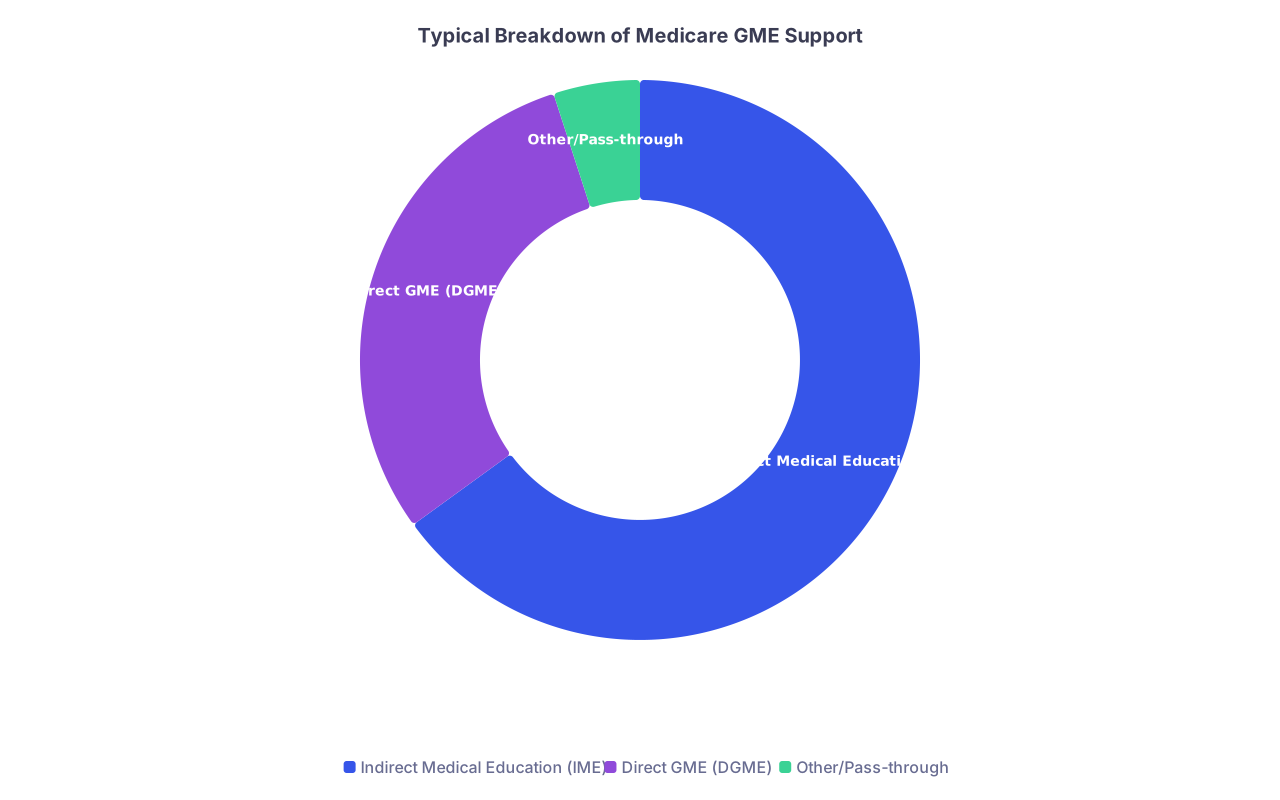
| Category | Value |
|---|---|
| Indirect Medical Education (IME) | 65 |
| Direct GME (DGME) | 30 |
| Other/Pass-through | 5 |
In practice, here’s how the thinking goes in those closed-door meetings:
- “If we cut 5 residents from this service, how does that hit our IME?”
- “If we shift more trainee FTEs to Hospital A instead of Hospital B, can we juice the cost report?”
- “If we add a new fellowship, does it dilute our DGME per resident, and can we live with that?”
Your wellness committee is not in these conversations. The CFO is.
The Hidden Priority List: What Leadership Actually Optimizes
Nobody will ever stand at a podium and say this, but I’ve seen the ranking play out in real time:
- Protect the hospital’s financial position
- Maintain accreditation and avoid public embarrassment
- Keep the most “strategic” service lines fully staffed
- Grow prestige-generating programs (neuro, CT surgery, cards, heme/onc, GI)
- Everything else
Notice where “resident educational experience” shows up. It doesn’t. Not explicitly.
They assume—sometimes honestly, sometimes lazily—that if they meet ACGME minimums and can produce board passable graduates, the education is “good enough.”
What really tip the scales?
- IME leverage: Does a program help justify higher IME by stacking trainees on high-Medicare inpatient services?
- Service coverage: Does the program plug clinical holes the hospital would otherwise have to fill with expensive NPs/PA/locums?
- Strategic growth: Does the program support a lucrative service line (cardiology, cancer, transplant) that leadership cares about?
- Recruitment pipeline: Does it feed their own attending workforce, especially for hard-to-recruit specialties?
Here’s the brutal truth: A program that “loses” money on paper but keeps a cardiology service from falling apart is safer than a program that “breaks even” but is seen as non-strategic.
The Cap Game: Why Some Programs Explode and Others Get Starved
Most trainees vaguely know “there’s a cap.” Very few understand how viciously that cap shapes your life.
Medicare basically froze residency funding caps around 1996. If a hospital had 60 residents then and 400 beds, Medicare funding is pretty much locked to that ratio. Population explodes, needs change, physician shortages grow—cap does not care.
So what happens behind the curtain?
They start playing allocation chess.
| Question Leadership Asks | What It Really Means |
|---|---|
| "Can we afford more residents here?" | "Will DGME/IME cover enough FTE to justify this?" |
| "Should we start this new fellowship?" | "Will it dilute our DGME for core residencies?" |
| "Can we move rotations offsite?" | "Can we salvage more IME at the main hospital?" |
| "Should we expand this program?" | "Does this help a strategic service line or not?" |
Most hospitals are at or over their cap on paper. So when a department wants to start, say, a new cardiology fellowship, someone in GME finance asks:
- “Which existing residents are we going to partially unfund to free up FTE?”
- “Are we okay with those pediatrics residents being funded at 0.35 FTE instead of 0.5 on the cost report?”
Does that change your actual paycheck day-to-day? Usually no.
Does it change how safe your program is long-term, what support you get, whether your expansion requests are entertained? Absolutely.
Programs in specialties that leadership thinks are “replaceable” or “nice-to-have” get slowly starved of cap-protected FTE. Ask around at smaller hospitals what happened to their geriatrics or preventive medicine slots. They’ll tell you.
Service vs Education: The Quiet Subsidy You Are Providing
Let me be blunt: from the hospital’s perspective, you are cheaper labor than an NP, PA, or hospitalist. And often more flexible.
You can schedule residents for nights and weekends, rotate them through the worst services, and call it “education.” NPs can just say no.
Behind the curtain, here’s the ugly algebra they sometimes do, whether they admit it or not:
- Resident salary + benefits + malpractice + a fraction of overhead
vs - APP salary + benefits + full overhead + sometimes agency markup
Now layer in the GME funding:
- Medicare is already kicking in DGME and IME support for your position
- There is no such federal subsidy for an NP or PA
So when leadership is deciding whether to cut a residency slot or an NP position, the “subsidy delta” is absolutely on their minds.
No one stands up in GMEC and says, “Residents are cheaper, let’s lean on them more.” But I’ve seen department chairs argue exactly this in coded language:
- “If we close these resident positions, we’ll have to backfill with nocturnists we can’t find and can’t afford.”
- “The residency is actually saving us money if you factor in IME.”
You can guess how that story ends most of the time.
The Politics: Who Actually Has Power Over GME Decisions
You might think your program director runs your program. On paper, yes. In reality, they’re one voice in a very political room.
Here are the players who truly shape GME funding decisions:
- CFO and finance leadership
- CMO/COO (depending on org structure)
- DIO (Designated Institutional Official)
- Key department chairs (medicine, surgery, anesthesiology especially)
- Occasionally the CEO, if the decision is high-profile or risky
When a program wants to expand, leadership does not ask, “Will this create better doctors for society?”
They ask:
- “Who’s going to pay for the incremental resident salaries beyond DGME?”
- “Does this plug a coverage gap somewhere we’re bleeding locums dollars?”
- “Is this going to make or break our ACGME standing or reputation?”
Program directors who are politically savvy do better for their residents. They frame asks in the language that wins:
- Not “We want a night float for wellness”
- But “If we don’t add night coverage, we will keep hemorrhaging attendings and jeopardize throughput metrics on the hospitalist service.”
The harsh truth: hospitals do not fund “education” for its own sake. They fund institutional risk management and revenue protection and call the byproduct “education.”
Public Health Policy vs Reality: Why Shortages Don’t Match Funding
You’ve heard about the projected primary care shortage. Rural health deserts. The aging population. All of it.
If GME funding decisions were aligned with public health needs, you’d see explosive growth in primary care, geriatrics, psychiatry, rural programs.
Look around. That’s not what’s happening.
Here’s the mismatch:
- Federal and state policy talk about “workforce shortages.”
- Medicare GME caps are largely frozen.
- New dollars for expansion are tiny relative to need and often politically steered.
- Teaching hospitals respond to local market incentives, not national health needs.
So while health policy people write beautiful reports, here’s what a hospital C-suite actually thinks:
- “We make more money on complex procedures than on routine outpatient chronic care.”
- “A cardiology fellow helps build our cath volume; a family medicine resident clinic barely breaks even at best.”
- “If we add rural tracks, are those residents even going to stay in our system long-term?”
There are exceptions. Some institutions truly lean into mission-driven training—safety-net hospitals, VA-heavy systems, some state universities. But they’re swimming upstream against the underlying financial logic.
That’s why you see this completely rational yet ethically uncomfortable pattern:
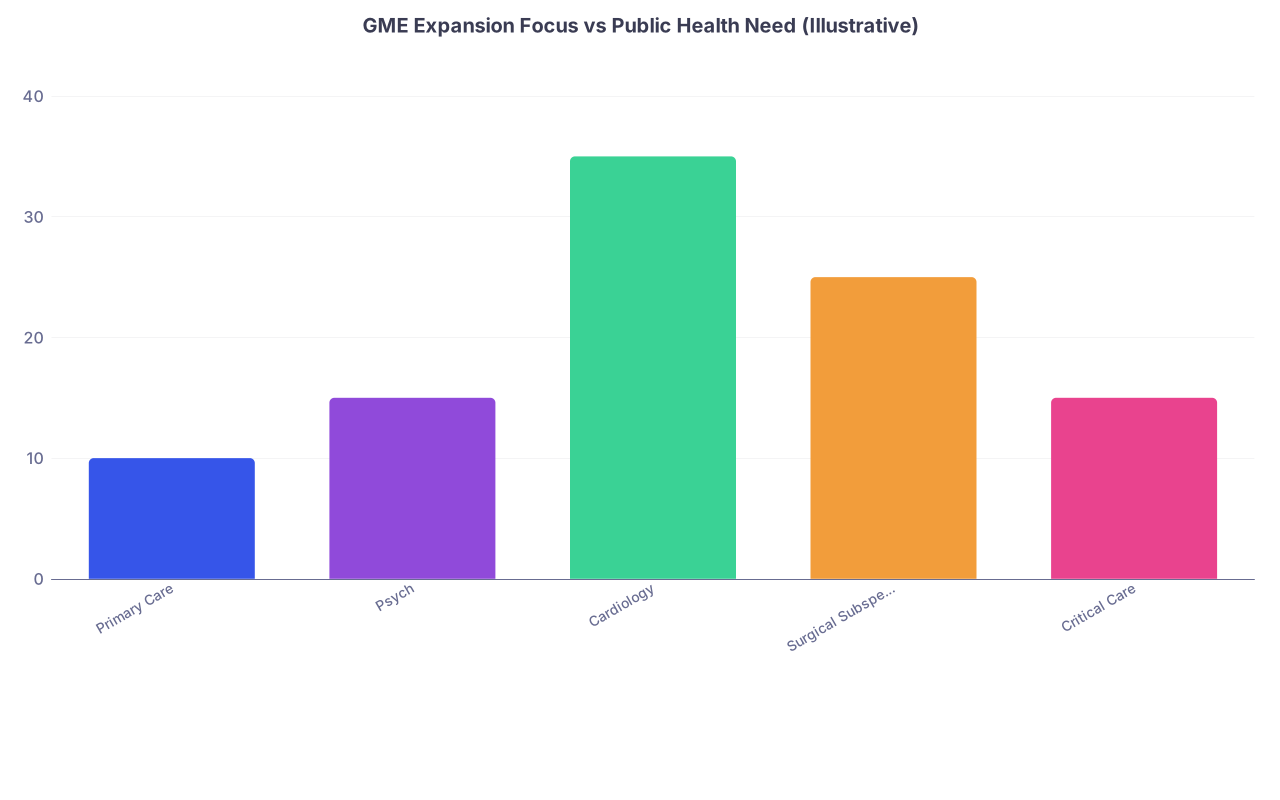
| Category | Value |
|---|---|
| Primary Care | 10 |
| Psych | 15 |
| Cardiology | 35 |
| Surgical Subspecialties | 25 |
| Critical Care | 15 |
Those numbers are not from a specific database; they’re a fair reflection of what I’ve seen on the ground in multiple systems: expansion follows revenue, not pure population health necessity.
How This Warps Training Culture and Ethics on the Ground
All of this background funding drama bleeds into your daily life, even if you never see the spreadsheets.
You’ve seen the symptoms:
- Services that are obviously over-residented—for “education”—but strangely line up perfectly with painful coverage gaps
- Clinics that are clearly revenue-negative getting quietly cut or “restructured” into shorter blocks
- Rotations at under-resourced community or VA sites being expanded not because they’re amazing, but because the main hospital can’t or won’t fund more slots on-site
Ethically, here’s the core problem: residents are supposed to be learners, not primarily workforce.
But when leadership’s mental model is “resident FTEs as adjustable labor with partial federal subsidy,” ethical lines blur. Fast.
You’ll hear justification like:
- “Well, you’re learning by doing.”
- “In the real world you’ll have to handle this volume.”
- “We meet ACGME minimums, so this is fine.”
I’ve sat in meetings where someone quietly raised, “Are we crossing the line where the service obligation is undermining education?” and watched the room go silent. Then someone pivots back to “But our length-of-stay numbers will tank if we cut residents from that service.”
If you feel like the system uses you more as a stopgap than as a trainee, you’re not imagining it. You’re picking up the scent of the underlying financial and operational calculus.
The Small Levers You Actually Have as a Trainee
You’re not going to walk into the CFO’s office and convince them to reweight the IME algorithm in your favor. But you’re not powerless.
Here’s how people in your position have actually moved the needle:
Language shift
When you bring problems to leadership, frame them in institutional risk terms, not just trainee suffering.
Not “This rotation is miserable.”
Instead: “This rotation’s structure is leading to unsafe handoffs, delayed pages, and near-misses. We’re worried about patient safety and burnout-driven attrition.”Data, not vibes
Track how many hours you’re spending on non-educational scut vs bona fide clinical learning. When you show program leadership real numbers, they can use those in their internal battles.Coalitions across programs
I’ve seen psychiatry, pediatrics, and internal medicine residents team up to point out that their clinic time was being quietly cut while procedural services were protected. The optics of that, when presented to the DIO and CMO, were ugly enough that plans got revised.Know the policy hooks
ACGME and CMS have vague but real language around “excessive service obligations” and “educational environment.” Savvy residents and chief residents use that language strategically in GMEC and CCC meetings.Exit threats (used carefully)
When good residents start leaving or threatening to leave, that gets attention. Recruitment costs real money and reputation. If multiple residents point to the same funding-driven structural problems, it can trigger a review.
Will you rewrite federal GME policy as an intern? No. But locally, at your institution, a small, well-prepared group of residents can absolutely force leadership to look at the ethical tradeoffs they’ve normalized.
Where Public Ethics and Personal Survival Meet
You’re stuck in a system that was designed around hospital finances and federal budget politics, not around your development as a physician or the public’s long-term health needs.
You have to live in that reality. And still find a way to practice with integrity.
That means a few things:
- Be clear-eyed. Do not romanticize your institution. Understand when you’re being used as subsidized labor and when you’re genuinely being taught.
- Choose your battles. Not every annoyance is a systemic injustice. But real distortions of training for the sake of coverage? Those deserve pushback.
- Remember the bigger picture. The same forces that push your program toward certain rotations and away from others are also why there are too few psychiatrists in rural areas and too many interventional cardiology fellowships 10 miles apart.
Years from now, you won’t remember the precise DGME formula or which building housed the GME office. You’ll remember whether, in the middle of an opaque and often cynical funding system, you kept your own ethical compass intact—and whether you spoke up when the line between “learner” and “cheap labor” was crossed one time too many.